“A must-read for anyone who wants to understand how salvation works in the Church’s tradition”

Baptism of Desire and Christian Salvation has now been out long enough to begin generating some discussion, and I’m grateful to have seen a number of new reviews and reactions over the past few months.
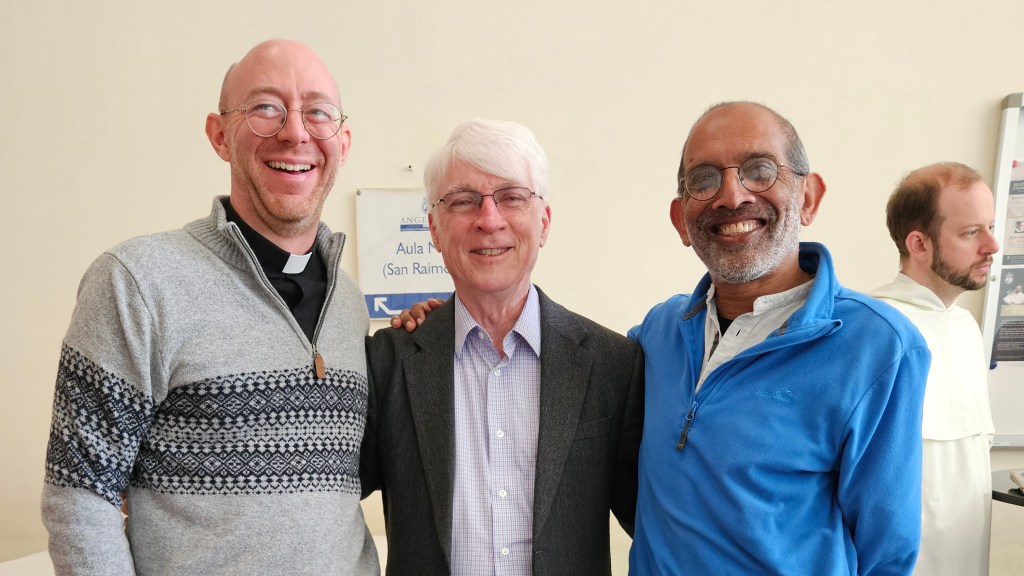
With Dr. Ralph Martin and Dr. Gavin D’Costa

I was delighted to see Dr. Ralph Martin, one of the world’s top authorities on the new evangelization, mention the book in his latest update at Renewal Ministries. Dr. Martin mentions meeting up while he was visiting Rome. I had a charming and stimulating conversation with him and his wonderful wife Anne, as well as a number of equally enjoyable conversations with Dr. Gavin D’Costa, whom he also mentions, an expert on world religions who teaches at the Angelicum. We also discussed Dr. Martin’s book Will Many Be Saved?, which I cite in my work. I’m deeply honored that he considers Baptism of Desire and Christian Salvation “a very solid and brave work of scholarship that faithfully presents the doctrinal and moral implications of the Church’s–and Jesus’–insistence on baptism to be saved.”

I’m equally grateful to have stumbled upon the careful and detailed review and summary of the book by Fr. Richard Conlin at The Prodigal Catholic Blog. I’m especially glad that Fr. Conlin considers the book “a must-read for anyone who wants to understand how salvation works in the Church’s tradition–especially in ‘hard cases’ like the unbaptized, non-Christians, or infants” and that he highly recommends it “especially for priests, catechists, and anyone serious about the faith.” A scholarly book such as Baptism of Desire and Christian Salvation might seem intimidating, but I think this one is important for more than just an academic audience. My intention was always that it would be accessible not just to specialists but to anyone with a theological background. So it’s encouraging to read that Fr. Conlin found it “both theologically rich and remarkably readable–a rare combination.”
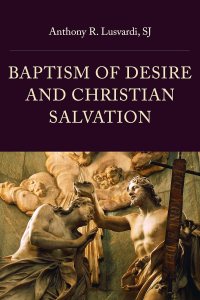
Those who read Italian might check out the insightful review in Ecclesia Orans by Prof. Paolo Trianni, who recognizes the theological approach as “innovative” because it seeks to overcome a “legalistic concept of the sacrament” present at times in scholasticism and neo-scholasticism.

Finally and somewhat unexpectedly, I was recently contacted by Brianne Edwards of Rapid City, who brought to my attention the remarkable story of baby Brian Thomas Gallagher, who died 43 minutes after his birth in 1982 and whose body was found to be apparently incorrupt in 2019. He happens to be interred at Black Hills National Cemetery. I discuss the possibility that infants can receive baptism of desire in the book, and Baby Brian’s case seems almost to have been designed to fit the argument I make. I’ll have more to say on the subject in the future…

In the meantime, remember that Baptism of Desire and Christian Salvation is available on Amazon, directly from Catholic University of America Press (20% discount with the code CT10),  and at other online booksellers.

Screens & Sacraments: a response

Last week I was pleased to take part in a conference organized by at the Gregorian University’s Faculty of History and Culture and the Institute of Liturgy at the University of Santa Croce entitled L’edificio di culto e gli artisti: A 25 anni dal primo Giubileo degli Artisti (2000-2025). The theme was church architecture and art over the past 25 years. The conference brought together an impressive group of international architects, artists, and theologians.

My own rather modest contribution was to extend the reflection I began in November’s issue of First Things on “Screens and Sacraments.” The talk seemed to produce a good deal of agreement that we need to be more discerning in how we allow technology to intrude on our sacred spaces.

Pulpit, Church of the Gesù, Rome

On a related note, I was also happy to read a quite generous response to my article from Kevin Martin of Raleigh, North Carolina in the January 2025 issue of First Things. He reports being “strong-armed against [his] better judgement into Zooming the liturgy during the first year of the pandemic,” but eventually abandoning the practice because it felt wrong for many of the reasons I discussed in my article. He wonders, however, if I do not concede too much by suggesting that it might be OK to continue to broadcast the Liturgy of the Word, while stopping at the Liturgy of the Eucharist.

It’s a thoughtful question. I’d begin by saying that I am by no means arguing that one must broadcast any form of worship, and I have no quarrel with the decision of Rev. Martin’s church to give up streaming altogether. At the same time, I’m not an absolutist when it comes to technology, and some of the goods that people claim from broadcast Masses are real. Sick parishioners in particular can be helped to pray by seeing images of the liturgy online and comforted by the sight of their home church and familiar faces. These might supplement pastoral outreach to the homebound, without replacing it. I’m a little more skeptical about the evangelical or formative value of e-liturgy, since I think its appeal is mainly to those who have already been sufficiently formed by real liturgy.

Continue reading “Screens & Sacraments: a response”

Intentions, motives, and what makes for a valid sacrament

The question of invalid baptisms has been in the news recently. In my commentary on the question in La Civiltà Cattolica, I pointed out that the Vatican’s most recent document on the question, Gestis verbisque, gives renewed attention to the minister’s intention. For a sacrament to be valid, a minister must intend to do what the Church does when celebrating that sacrament. And that means that if he changes what the Church prescribes in her official liturgical texts–by inserting his own words or deleting something required to be there–then he manifests an intention to do something else. It’s just as straightforward as it sounds. The proof is not in the pudding, but in the action.

Baptismal font, St. Peter’s Basilica

Last week, however, another question was sent to the Vatican about what sort of intention might invalidate a sacrament, this time an ordination. The question proposed the distasteful case of a bishop who ordained a man with whom he had engaged in an illicit sexual relationship. Could he possibly have the right intention? Wouldn’t such a sinful situation invalidate the ordination?

The article in which this question was raised described it as “potentially explosive.” Fortunately, this grenade was defused by St. Augustine in the fifth century. The great theologian was responding to controversy about the validity of baptisms, whether the sinfulness of a minster invalidated the sacrament. He responded no. Augustine’s principle has remained a bedrock of sacramental theology ever since. It is really Christ who baptizes, Augustine said, and he can do so even through profoundly imperfect human instruments. The same goes for ordinations. Augustine sagely realized that if perfection were required of ministers in order for sacraments to be valid, then we simply wouldn’t have sacraments.

So how does Augustine’s principle fit with the requirement that one has to have the right intention to celebrate a sacrament validly? Here we have to make what might at first seem like a rather technical distinction but is, once you’ve thought the question through, also rather straightforward. The distinction is between intention and motive.

Continue reading “Intentions, motives, and what makes for a valid sacrament”

Andrea Grillo and Rachel Lu on Baptism of Desire and Christian Salvation

Sant’Anselmo, Rome

Earlier this month, after delivering ten copies of Baptism of Desire and Christian Salvation to Sant’Anselmo at Easter time, I walked up the Aventine Hill to pick up my diploma–the last formality involved in earning my doctorate. The last act, I suppose, of my formal education! It’s a walk I made many times before while a student. I haven’t been back to Sant’Anselmo for a while now, but am grateful for the studies in sacramental theology I did there.

When I received my copies of Baptism of Desire and Christian Salvation, I had one more reason to be grateful — the insightful words of endorsement on the back cover from my dissertation director Prof. Andrea Grillo, who read many draft versions of the tome and managed to remain in good humor throughout! Here’s his review:

Lusvardi offers a historical reconstruction of the ‘baptism of desire’ that traverses the entire arc of the Christian tradition, starting from the origins. A straightforward work, expressed in a language endowed with finesse, irony and acumen. Baptism of Desire and Christian Salvation is singularly effective in pointing out the fact that in the modern reception, a series of priorities is imposed on the issue that empty its meaning.

Andrea Grillo, Pontifical Atheneum of Saint Anselm, Rome

Also last week, I was delighted to see Rachel Lu’s review of the book at Word On Fire. Rachel’s review had a particular significance for me since, as she points out, I was there when she was baptized as an adult 19 years ago.

Granados endorsement

Just a friendly reminder that if you haven’t yet ordered your copy of Baptism of Desire and Christian Salvation, at a mere 20 cents/page, it remains a bargain. And each page is jam-packed with non-stop theological action.

You might think I’m biased, but you don’t have to take my word for it. When the book came out, I was thrilled to see that CUA Press had arranged a review and endorsement from Fr. José Granados. Attentive readers will recall that I mentioned Fr. Granados’s superb Introduction to Sacramental Theology here before. (It’s now available in Italian under the title Teologia dei sacramenti: Segni di Cristo nella carne.)

Here’s his verdict:

Offers a very accurate historical analysis of the doctrine of baptism of desire, starting with St. Ambrose and St. Augustine up to Vatican II. Lusvardi does not only give information about the different Fathers and theologians but delineates a clear leading thread that allows us to follow the development of the idea. The analyses are precise, the bibliography is abundant and well chosen, the documentation is excellent, the theological approach very sound.

José Granados, author of Introduction to Sacramental Theology: Signs of Christ in the Flesh

Some recent publications…

Lisbon, Portugal

I’m honored to have a couple of recent works appear in print in the past few weeks, the first an article in La Civiltà Cattolica, a publication founded by Italian Jesuits in 1850, which has since gone international. The article “Gestis Verbisque: The Words and Actions of the Sacraments” (the Italian is here) analyzes a recent Vatican document dealing with sacramental theology — specifically the question of invalid baptisms. The document Gestis verbisque was available only in Italian at the time I wrote the article, but has since come out in English (and other languages) here. It’s an important document because it reminds priests and deacons of the need to faithfully celebrate the sacraments according to the Church’s tradition and liturgical books. We probably all have had unfortunate experiences of goofy things happening in liturgy because Father thought that he could improve upon a centuries-old ritual with regrettable results. Gestis verbisque reminds us that “The Church is the ‘minister’ of the Sacraments, but she does not own them.” My own article fleshes out some of the background behind the document and points out where I think it adds something theologically (its treatment of the minister’s intention). It was interesting to see some of the strange cases in history that I found while researching Baptism of Desire and Christian Salvation come up again in modern settings. You’d think we’d learn!

The other publication is the first short story I’ve published in a while–too busy with academic work–in a magazine that will be familiar to readers of these pages, Dappled Things. Dappled Things is the only literary magazine I know of dedicated exclusively to Catholic literature. I’ve been honored to have a number of short stories and essays appear in their pages over the years, some of which can be found on their site. My most recent story, “Pious Tchotchkes,” is in their Easter 2024 issue, which is only available in print. Their print issues are always beautifully crafted.

The story is set in Portugal, and here are a couple of places alluded to — baroque exuberance in Coimbra and Cabo da Roca, the westernmost point in continental Europe.

The Virtue of Penance

Last week, I mentioned the seminar I taught this past semester about the sacrament of marriage. I also taught a course about the sacrament of penance. (I learned to be careful when describing my course load to make clear that those were, in fact, two different courses and not a sly commentary on marriage!)

Jonah sarcophagus (ca. AD 300), Vatican Museums

The sacrament of penance has a fascinating history, and the way in which it has been practiced over the centuries has varied more than perhaps any other sacrament. A major theme of the class, however, was that the sacrament itself is not the only way that Christians practice penance. As Thomas Aquinas pointed out (in the Summa Theologiae III q. 85), penance is not only a sacrament but also a virtue. He didn’t come up with that particular insight himself, of course, but was summarizing the theological tradition before him.

Continue reading “The Virtue of Penance”

Ritual and desire

A few weeks ago I mentioned José Granados’s fine new book Introduction to Sacramental Theology: Signs of Christ in the Flesh. It’s full of interesting insights. Since I’m working on putting the final touches on my book about baptism of desire, one line that indirectly touches on the theme of desire stood out.

I often point out that our rituals are meant to form us. They shape us and make us into new beings, especially the sacraments of initiation. In this regard, Granados points out that rituals form our desires as well.

“For in our action there is always more than what we have put into it; and for that reason we desire, when we act, more than what we think we desire.” (309)

The action of the liturgy, in other words, implies desiring certain things and in a certain way. When we participate in the liturgy, therefore, those desires become our own. This insight gets at what makes the sacraments irreducible, why they cannot be replaced with just having the right ideas, and what makes baptism of desire such a difficult and fascinating topic.

Fresh insights in sacramental theology

My summer reading this year included Fr. José Granados’s excellent book Introduction to Sacramental Theology: Signs of Christ in the Flesh, which Catholic University of America Press has recently made available in English. (The Spanish original Tratado General de los Sacramentos came out in 2016.)

Like the Church Fathers, Granados emphasizes the rootedness of the sacraments in the Incarnation of Jesus. This means giving due importance–too often lacking in theology–to the human body, which is the locus for all of our relationships.

The sacraments tell us that the message of Jesus is always rooted in the concrete relations that we form in our flesh.

José Granados, Introduction to Sacramental Theology, xiv

The book’s preface eloquently identifies the fundamental desire to which the sacraments respond, our need for the presence of Jesus:

“We have his parables, we lack the sight of him; we have his commandments, we lack his voice; we have the strength of his commission, we lack the touch of his arms. Without the second, the first loses its foundations: doctrine that is clear but abstract; morality that is superior but utopian; mission that is great but irrelevant.” (xiii-xiv)

The sacraments provide what is missing.

This leads to surprising conclusions about the need for a sacramental basis for today’s evangelization. A fairly common error is to think that responding to the needs of the modern world means conforming to the modern world; really, it means offering what contemporary life lacks.

“In fact, the great evil that afflicts the postmodern subject is his isolation in the cell of subjectivity. What remains is a weak individual who moves to the tune of his most intense feeling, with no relations to sustain him and with no path to bring him to his destination. We will not cure this sickness by proposing that he encounter God in the depths of his soul. For his real problem is the lack of relational environments that would enable him to understand his true identity, which is always discovered and forged in an encounter and a communion.” (383)

Interview on Sacramental Theology

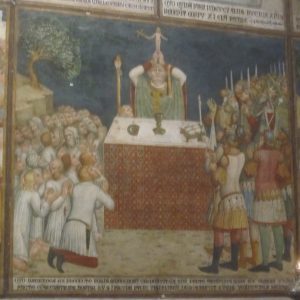
Chapel of the Corporal, Orvieto

Last month I had an interesting discussion with Jesuit scholastic David Inczauskis about the sacraments–what they are, why we have them, how they and the theology surrounding them developed through time, what are the challenges for sacramental theology today. David produces an in-depth podcast on liberation theology, so my general introduction to sacramental theology was the lead-in to some of his reflections on liberation theology and the sacraments, which are also included in the podcast. Here’s the Apple version of the episode:

Episode 22: Liturgy and Sacraments, the Liberation Theology Podcast. I’m told it can be found on other podcast venues as well.