Recently, I was fortunate to be able to take a brief trip to Barcelona for a research project (more on that to come). I spent as much time as I could at Antoni Gaudí’s marvel, La Sagrada Família (more on that, as well).
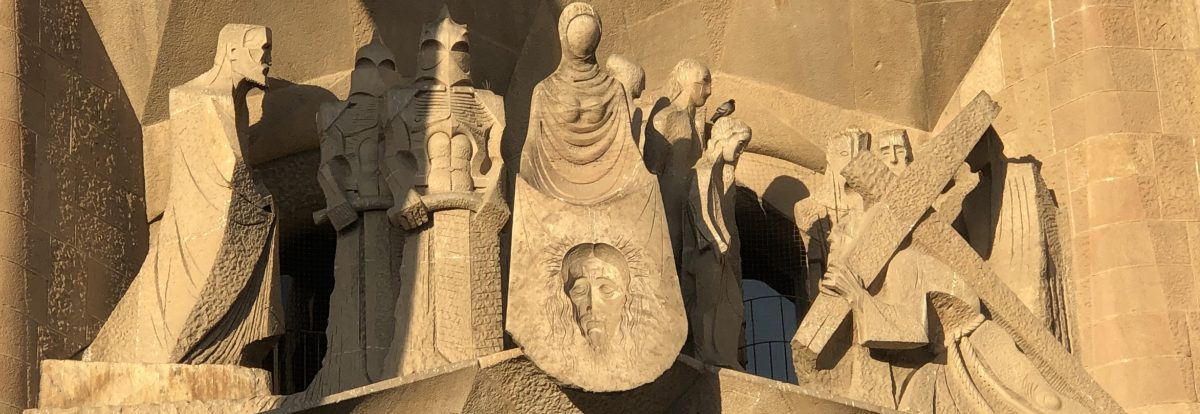
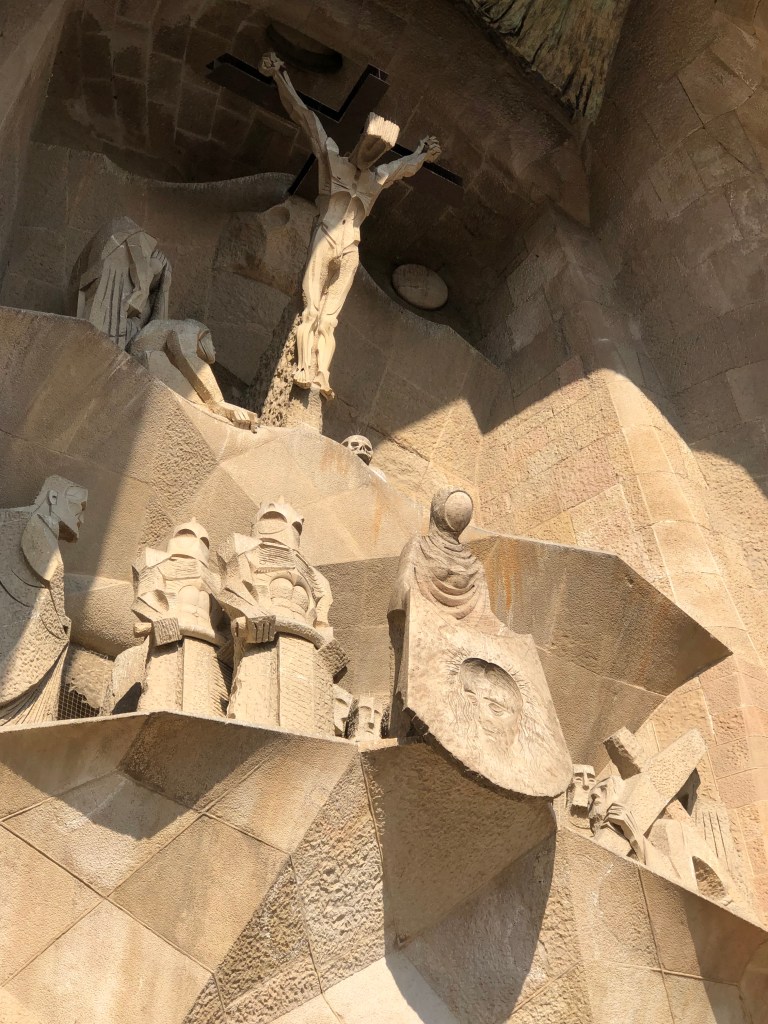
The entire basilica is a marvel, a deeply spiritual and prophetic building. This Holy Week, I thought it would be appropriate to share some photos of the Façana de la Passió, the Passion Facade. The sculptures broadly follow Gaudí’s instructions, though they are the work of Josep Maria Subirachs. If anything, the sculptures are even more harsh and austere than Gaudí’s original sketches. The hardness of the work is actually in keeping with Gaudí’s instructions.
Homily for the Feast of the Dedication of the Lateran Basilica (2023).
From the cloister of St. John Lateran, Rome
The feast we celebrate today is particularly special for us in Rome. We celebrate the dedication of our cathedral. It is a magnificent building, and probably all of us have been there to appreciate the beauty of this splendid and ancient church.
The anniversaries of church dedications are important in the Church calendar because churches are the places where we gather to celebrate the Christian liturgy, the holy mysteries of salvation. Here in Rome, however, we live in an unusual situation because there are many beautiful and ancient churches–but when we enter them, often we find few of the faithful.
We should not be discouraged; instead we should remember the faithful who still speak to us through these monuments of their faith. The churches they built and left us are not mere buildings; they are their testimony. There is a message in these buildings that the saints of past times wanted to convey to us.
But more than a message, there is still a presence. When we celebrate the liturgy, we are not alone; we enter into the presence of the saints. They are with us. On November 1, we entered the season in which we remember the saints. Churches–from St. John Lateran to this little chapel–are more than museums where we learn from the past; they are places where we encounter the saints, where eternity becomes the present.
(Original: Italian)
Readings: Ez 47:1-2, 8-9, 12; 1 Cor 3:9c-11, 16-17; John 2:13-22
Going through some old files, I came across this homily for the Monday of Holy Week, written, in my younger and more vulnerable years, when I was a novice in St. Paul, Minnesota.
St. Mary Magdalene penitent, Guercino 1622
During the Third Week of the Spiritual Exercises, St. Ignatius asks us to contemplate the suffering and death of Our Lord. This week, Holy Week, the Church, liturgically, asks us to do the same. The Third Week is one of the times in the Exercises when we ask for strange graces—shame, sorrow, confusion.
The Church’s liturgy also evokes these troubling graces, and it does so by, among other things, confronting us with today’s passage from John, the Anointing at Bethany. The shock this passage should provoke in us is perhaps diminished by its familiarity, but if we really deeply consider what is happening here, then we should be confused. We should be confused because part of us is tempted to side with Judas.
Three hundred days wages! Put in contemporary terms this must amount to something like $30,000, $40,000, $50,000—enough for college scholarships for one or several years, or private high school scholarships for several students; in some Third World countries that much money could build a school. And instead it is being spent on a jar of ointment. An expensive perfume. An ostentatious toiletry.
“Look to my coming,” Gandolf tells Aragorn in the second installment of the Lord of the Ringstrilogy, The Two Towers. “At dawn on the fifth day, look east.” Those familiar with the story, know that Gandolf’s words come at a particularly dramatic moment in the epic, when the last holdouts of Rohan—one of the two remaining kingdoms of men not to succumb to the forces of evil—have retreated to their mountain stronghold, Helms Deep, and the walls of the fortress have begun to crumble, its gates to give way, and its doors to crack under the onslaught of a massive army sent by the turncoat wizard Saruman, who, seduced by power, has joined the forces of darkness. And as Aragorn, the king in exile, prepares for one final charge with what knights remain, he remembers the words of the faithful wizard Gandolf, who had left five days before to seek aid. “At dawn on the fifth day, look east.”
We read a similar instruction in the Book of Baruch, directed to the holy city, “Up, Jerusalem! Stand upon the heights; look to the east.” These words are echoed in the Advent hymn familiar to many of us, “People, Look East.” There is something primordial in this call, in the instinct to look in hope to the east. When I worked among the Lakota Sioux in South Dakota, I learned that in their traditional religion, east was the direction of prayer. I found some Lakota Christians very insistent on a Christian tradition—which I did not know about—of burying the dead facing east. The Christian tradition of prayer facing east goes back to the first centuries. St. Ambrose talks about catechumens, after their baptism, turning from the west to the east as a sign of the new orientation of their lives.
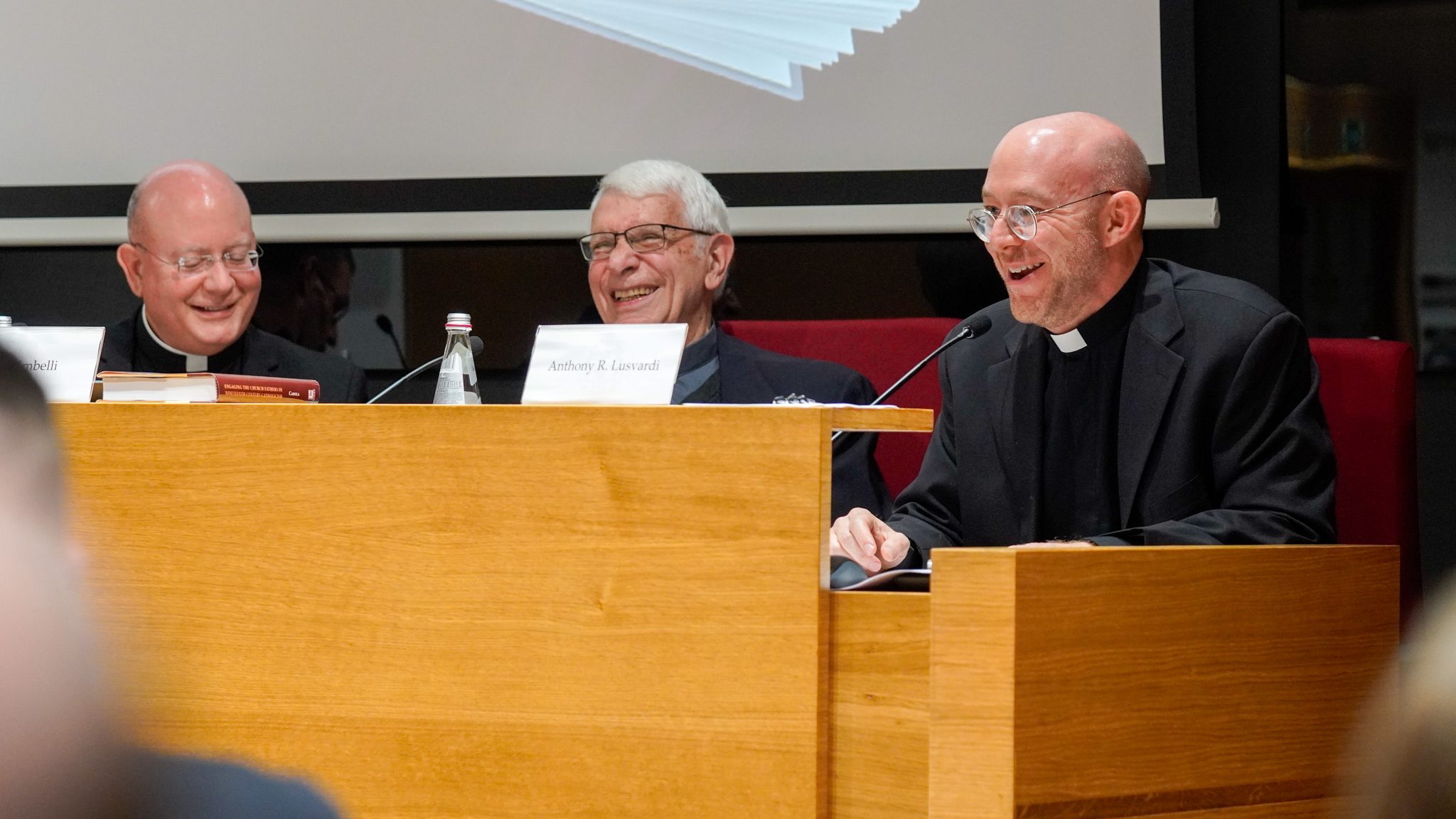
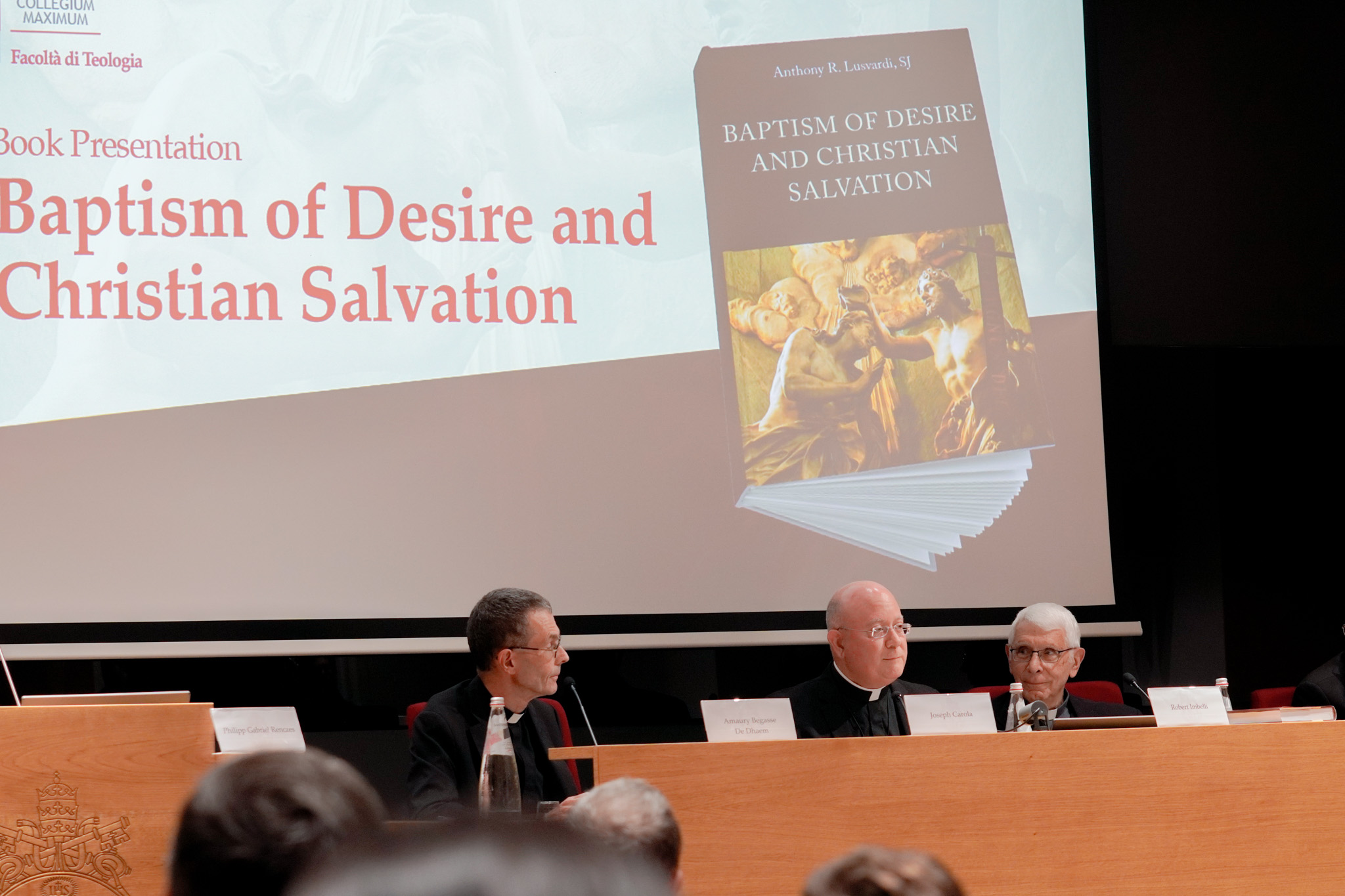
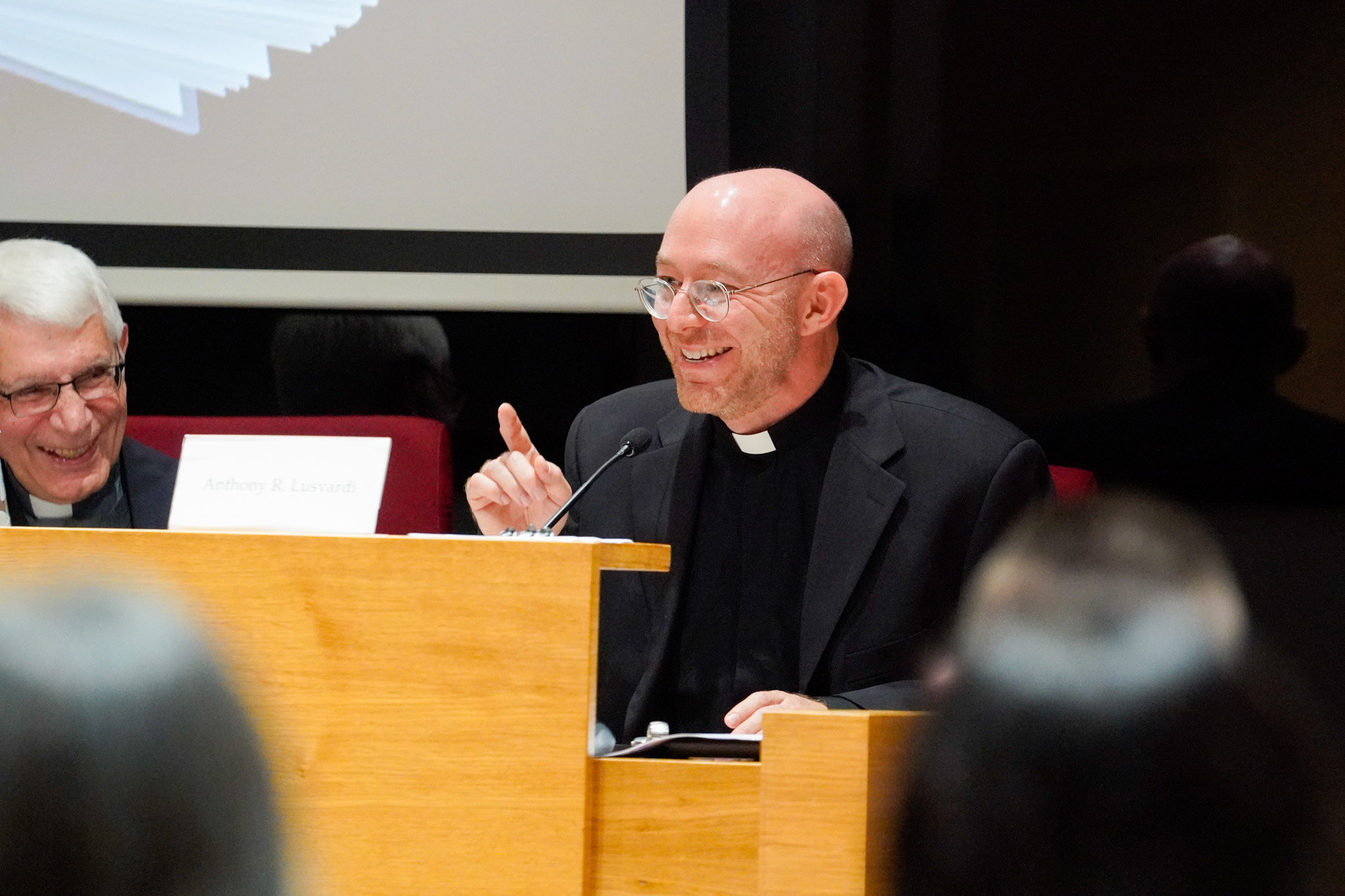
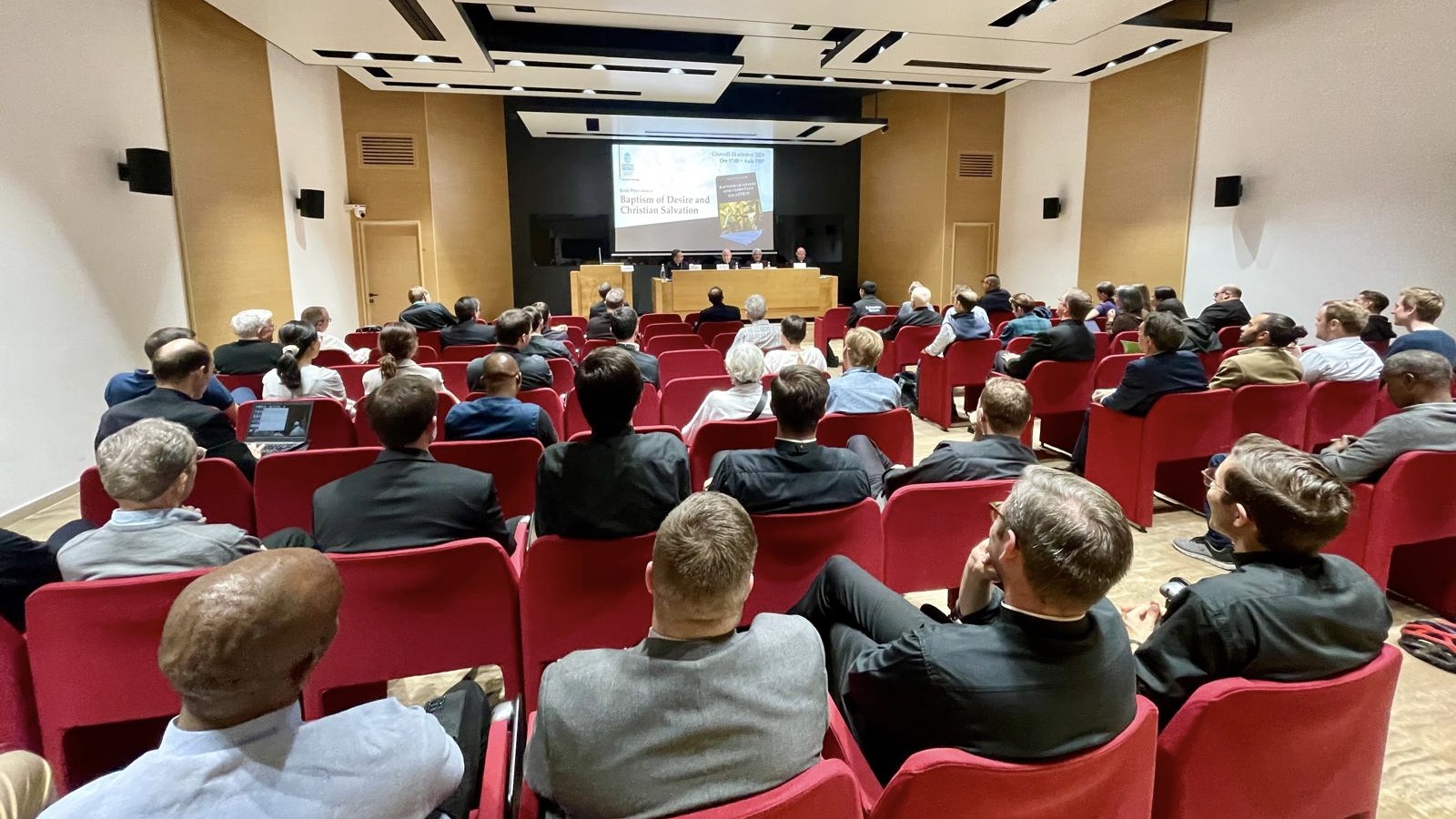
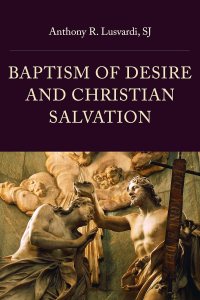
Baptism of Desire and Christian Salvation is now in orbit after an excellent turnout at the official book launch at the Gregorian last Thursday. More good news: the code CT10 still gives you a 20% discount if ordering the book directly from Catholic University of America Press. At the presentation of the book, Fr. Joseph Carola gave an overview of its content and shared some stories from personal experience to illustrate its pastoral relevance. Fr. Bob Imbelli drew on other contemporary thinkers, such as Khaled Anatolios, Charles Taylor, and William Cavanaugh to demonstrate its relevance. I hope to have video of the presentations up on the Baptism of Desire page soon.
Fr. Joseph Carola, S.J., Fr. Robert Imbelli, Fr. Anthony Lusvardi, S.J.
On another note, in this month’s First Things I return to an issue I raised a few years ago in an article in America magazine, the effects of technology on the liturgy. Here’s the new article: “Screens and Sacraments.” The original from 2020 is here.
And, finally, if you’re looking for some pre-election reading that isn’t about either Donald or Kamala, but instead about the way voting functions as a civic ritual, check out my latest at The Catholic Thing: “Rites (and Wrongs) of Democracy.“
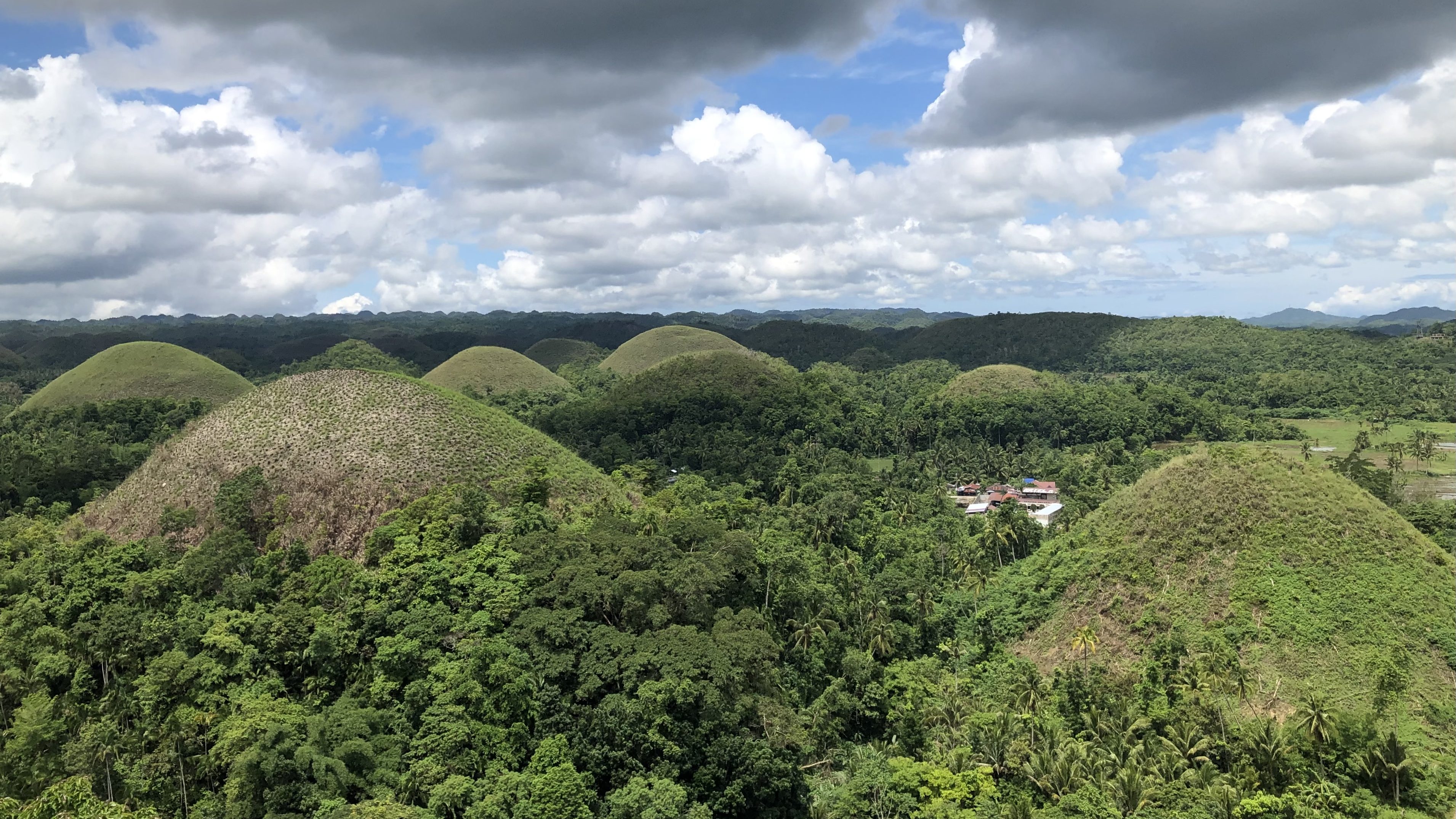
As you could probably tell from last week’s post, I’m back in Rome getting ready for the start of the new academic year next month. It was a full and eventful summer more than a restful one. It started out with my first trip to the Philippines for a meeting of the Jungmann Society, the international association of Jesuit liturgists, where I gave a talk on daily Mass in Jesuit communities. It was encouraging to meet many young Jesuits interested in the liturgy, especially those from Asia. Some new initiatives are coming out of the meeting as well. The initiative I am most excited about is an eight-day retreat for Jesuits I am preparing for next summer: “Praying the Liturgy,” which will be offered June 29 – July 7, 2025 at the Jesuit Retreat Center in Parma, OH. It is open to all Jesuits.
I also spent some quality time at St. Isaac Jogues in Rapid City and back at home in Minnesota, connecting with friends. For the first time, I led a retreat at the gorgeous new retreat center Cloisters on the Platte outside of Omaha, and attended a really excellent conference in Mundelein, IL on the divergent theologies of Karl Rahner and Joseph Ratzinger organized by Prof. Matthew Levering and the Greg’s own Fr. Aaron Pidel, SJ. Some theological all-stars there. A book will be coming out at a later date with papers from the conference, including my own contribution on the two theologians and the liturgy, arguing that Ratzinger continues the project of the Liturgical Movement while Rahner’s attitude toward the liturgy is an extension of pre-Vatican II scholasticism.
Also, if you didn’t get a chance, you might enjoy my article “Getting Back in the Baptizing Business” in The Catholic Thing which explains why I think my book on baptism of desire is important.
And speaking of Baptism of Desire and Christian Salvation, I was pleased to be able to bring my summer to a close by giving several talks on the book in Sweden. I had an enjoyable discussion with the participants of the Hörge seminariet at the Newman Institute in Uppsala and was deeply encouraged by the large and energetic group of young adults at Sankta Eugenia in Stockholm. It is great to see the book both resonating with people and provoking discussion.
More on Baptism of Desire and Christian Salvation will be coming soon, including an official “book launch” here in Rome…
In preparation for I talk I gave last week to a group of seminary rectors from Africa and Asia, I read Romano Guardini’s short but profound book Liturgy and Liturgical Formation.
Guardini was one of the twentieth century’s sharpest and most balanced theological minds, and his writings on the liturgy are particularly valuable. He understands the irreducibility of liturgy and liturgical symbols and has absorbed the way the Fathers experienced liturgy, best exemplified by the line from Pope St. Leo the Great’s Ascension homily: “What was visible in the Lord has passed over into the mysteries.”
Chapel of San Basilio, Maracalagonis, Sardinia
Here are a few gems from Liturgy and Liturgical Formation:
“Liturgy does not deal with knowledge but with reality. There is knowledge of the liturgical action, which precedes it and could be called liturgical knowledge. And there is knowledge within it; the liturgical event allows an insight into itself. To speak of this today is not easy because it has escaped our religious consciousness at large. The liturgy itself is not merely knowledge but a full reality, which embraces much more than knowledge alone: a doing, an order, and the being of itself.” (13)
After a couple of months in Western Australia and half a year Down Under, I am still amazed by the diversity of this island continent’s landscapes. This includes unparalleled bio-diversity–all the birds and marsupials and one-of-a-kind wonders, like the platypus, that look like something out of a Dr. Seuss book–as well as the geological curiosities.
The Twelve Apostles, Victoria, Australia
On this, the driest of Earth’s continents, I’ve been especially fascinated by water. Most of Australia’s population (almost 90%) live within 30 miles of the coast, and some of the country’s greatest wonders–the Great Barrier Reef, for example–lie underwater. My own fascination with water comes in part from its sacramental usage. Water is the one physical element necessary for baptism and, thus, entry into Christianity.






 Tony Lusvardi, S.J.