Melchizedek, Jesus, and perfect sacrifice: Homily for Corpus Christi

This month I’ve been asked to contribute Sunday homilies to the Homiletic and Pastoral Review. You can find the rest of the month’s homilies there as well. Here’s this week’s contribution:


Homily for the Most Holy Body and Blood of Christ (C)

I thought I’d begin today by saying a word about Melchizedek. I’d wager most of you don’t know much of anything about Melchizedek. It’s a safe wager because nobody knows much about Melchizedek. His biographical details are limited to what you just heard in the first reading. But Melchizedek turns out to be an important figure. In the first reading, in Genesis, he seems to come out of nowhere. It turns out, when we get to the Letter to the Hebrews in the New Testament, that this mysterious origin is what makes him interesting. The New Testament speaks of Melchizedek as a forerunner of Jesus, the great high priest who has neither beginning nor end. Melchizedek, the Letter to the Hebrews says, represents an eternal priesthood — the priesthood of Jesus Christ.

In fact, perhaps it’s surprising that Genesis would mention Melchizedek at all. Even more surprising is that it mentions the sacrifice that he offers — bread and wine. At the time, bread and wine were not particularly impressive sacrifices. In the ancient world, if you wanted to impress, you offered meat. Birds were OK, lamb was better, a bull best of all. Bread and wine were not the sort of sacrifice a king would brag about.

Continue reading “Melchizedek, Jesus, and perfect sacrifice: Homily for Corpus Christi”

Christ made visible in his martyrs: Homily for the 7th Sunday of Easter

I’m pleased and honored that the Homiletic and Pastoral Review asked me to provide homilies for the Sundays of June this year. You can find the full text of all the month’s homilies here. (Regular readers might note that the homilies may not be as fleshed out as usual since they are meant to be adapted.) Be sure to visit the HPR site and check out the other articles, reviews, and fine catechetical materials they provide. Below, to give you a taste, is a homily for the Seventh Sunday of Easter (for those places where the Ascension is celebrated on its proper Thursday).


Homily for the Seventh Sunday of Easter (C).

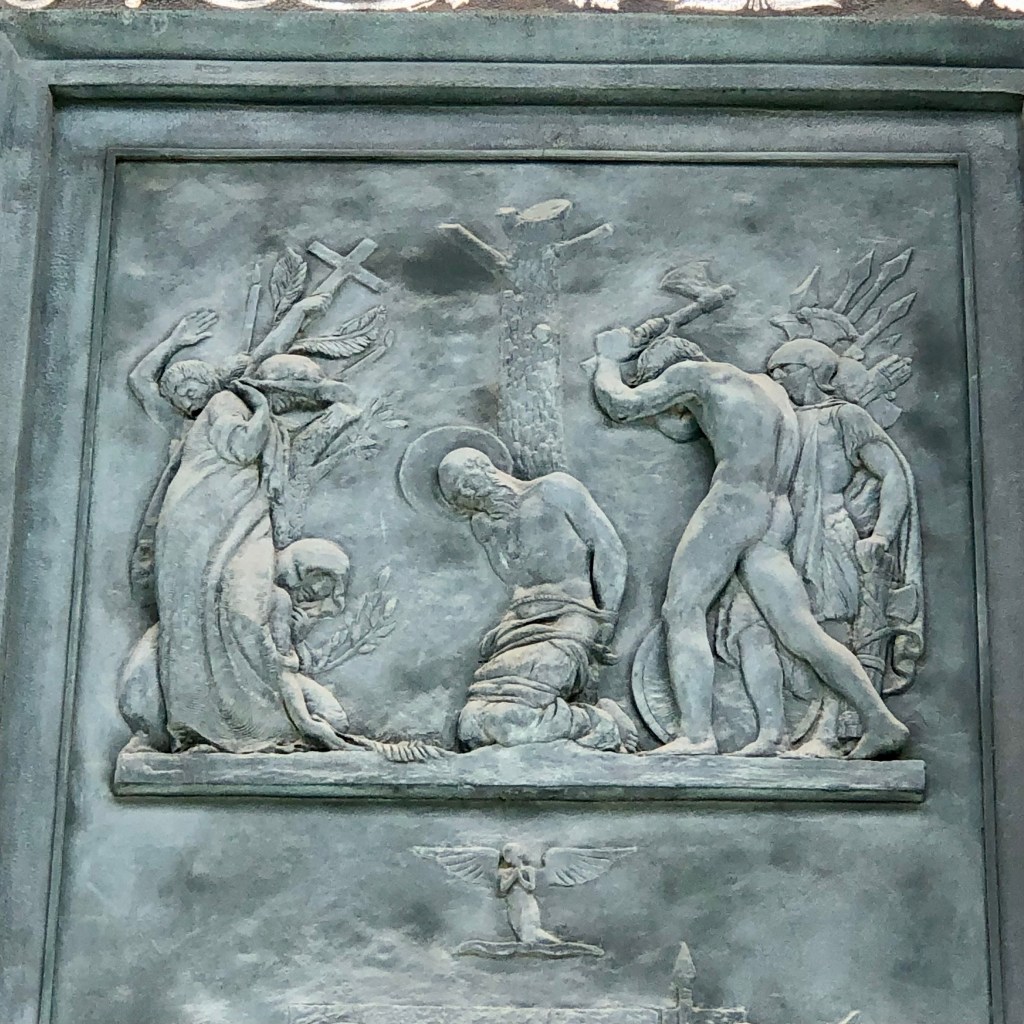
Chapel of St. Stephen, Certosa di San Lorenzo, Padula, Italy

Nowhere is Jesus Christ more visible than in his martyrs.  In the Gospel of John, Jesus, who makes the Father visible to the world, prays that his disciples may be in him and he in them.  In today’s first reading, we see God become dramatically visible in the life of one of those disciples, the deacon Stephen.

First, however, Stephen gazes on God.  He sees Jesus standing at the right hand of his Father in the heavens.  This vision is made possible by the action of the Holy Spirit, already present in Stephen’s life.  In the first part of the chapter from which today’s reading is taken, Stephen delivers a sermon which is both learned and fiery, retelling the story of Israel from a Christian point of view and leveling a hard judgement against the men of Jerusalem who crucified Jesus.

Continue reading “Christ made visible in his martyrs: Homily for the 7th Sunday of Easter”

What to do when you don’t have a pope? Preach Jesus Christ

Homily for Wednesday of the Third Week of Easter.

Brothers and sisters, papam non habemus. We do not have a pope. Not yet.

We live in uncertain and, often, disturbing times. I’m not talking only about the sede vacante in the Church of Rome. The last few years–the last few decades, really–have been a difficult time for the Catholic Church. The Church sometimes seems confused and divided from within, and opposed by powerful forces from without. And today we also live with all the uncertainty of a papal election.

In this uncertain moment, today’s first reading reminds us of a simple but profound lesson: things have been worse. Much worse. Here we see the Church at its very beginning, tiny and persecuted. Stephen, one of the first deacons, has just been killed. The faithful are scattered. Those who persecute the Church are full of zeal, backed by the age’s political powers in all their strength. It seems like a catastrophic moment for the nascent Church, but it becomes a moment of triumph, a moment of growth. The dispersion of the faithful–even if caused by persecution–becomes the condition for the spread of the Word. Soon, we know, even the great persecutor, Saul, will convert and become the greatest missionary in the history of the Church.

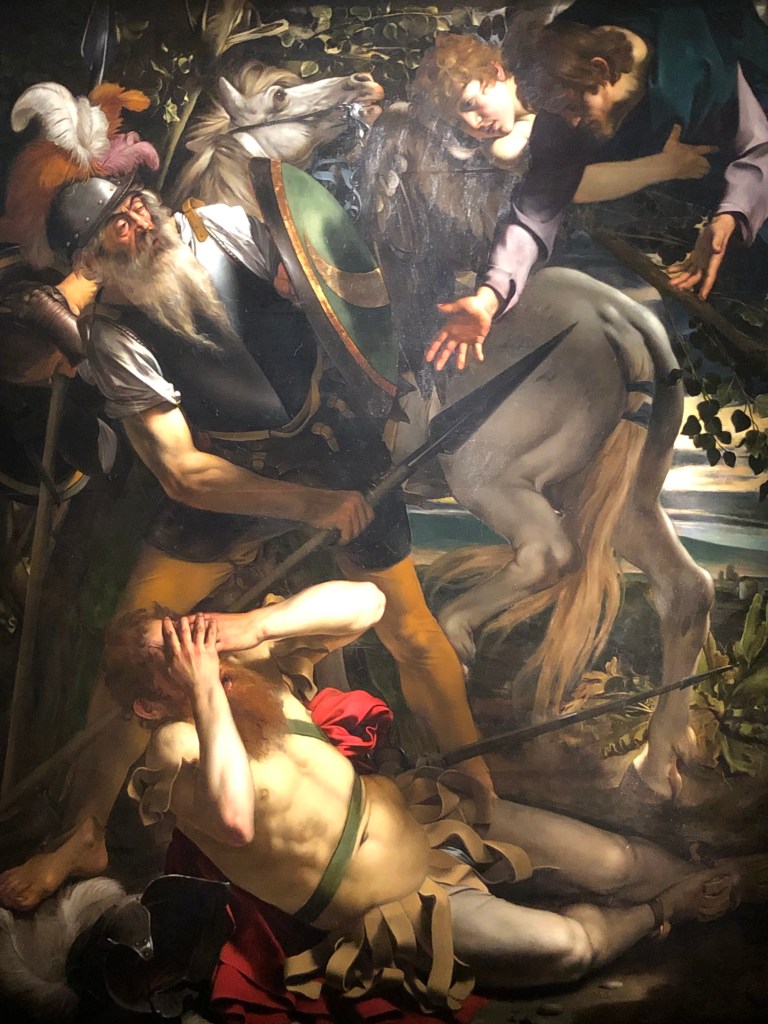
Caravaggio, The Conversion of St. Paul, 1600-1

What I most want to emphasize today is the response of the disciples, who transformed this apparent catastrophe into a moment of growth: They continued to preach Jesus. Without panic, without discouragement. They returned and remained steadfast in the most fundamental mission of the Christian: to bear witness to the life, death and resurrection of Jesus Christ.

Today’s Gospel reading also calls us back to the heart of our Catholic faith: “I am the bread of life,” says Jesus. There is no action more important for the Catholic than to encounter the Lord in the Eucharist, in his true body and in his true blood.

Brothers and sisters, despite our anxieties and our doubts, despite the moments of uncertainty that alternate with moments of glory in the life of the Church, this message remains our rock. If we continue to proclaim it, we cannot go wrong. In a few days we will have a new pope, but our mission will not change. Times change. Popes change. Jesus Christ does not change.

Jesus Christ is the bread of life. Jesus Christ is Lord.

Readings: Acts 8:1b-8; John 6:35-40

(Original: Italian)

May 7, 2025

Gregorian University Chapel, Rome


Those interested can see my interview on the CBS Evening News with Maurice Dubois here.

Entering the tomb: a homily for Easter

This Homily for Easter Sunday comes from 2019 and was given just a few days after the fire at Notre Dame Cathedral in Paris — thus the reference to the rose window at the end. Seems appropriate this year when Notre Dame has been reopened…

Occasionally the most erudite theologians overlook the most obvious things. This morning’s gospel contains a curious detail that has provoked a great deal of discussion among theologians: why do Mary of Magdala and John, the other disciple, not enter the tomb? Mary sees the stone removed from the tomb and returns to the apostles. John, running and perhaps a bit younger than Peter, arrives at the tomb first, but remains outside. Why? Biblical exegetes have explained this event symbolically–maybe John represents prophecy and Peter represents the institutional Church–but in my opinion the reason is simpler.

It’s a tomb. They were afraid.

Sometimes the simplest explanations are also the most profound. We know that Jesus is risen–maybe this announcement has become too familiar and gets taken for granted–but at that moment Mary, John and Peter did not have that advantage. We must imagine their psychological state that morning. Two days ago, they had seen the humiliation and killing of their Lord, teacher and friend at the hands of evil men. We must imagine the darkness of those days, when violence, lies and selfishness defeated the truth.

Continue reading “Entering the tomb: a homily for Easter”

The Anointing at Bethany and Holy Week’s unsettling beginning

Going through some old files, I came across this homily for the Monday of Holy Week, written, in my younger and more vulnerable years, when I was a novice in St. Paul, Minnesota.

St. Mary Magdalene penitent, Guercino 1622

During the Third Week of the Spiritual Exercises, St. Ignatius asks us to contemplate the suffering and death of Our Lord.  This week, Holy Week, the Church, liturgically, asks us to do the same.  The Third Week is one of the times in the Exercises when we ask for strange graces—shame, sorrow, confusion.  

The Church’s liturgy also evokes these troubling graces, and it does so by, among other things, confronting us with today’s passage from John, the Anointing at Bethany.  The shock this passage should provoke in us is perhaps diminished by its familiarity, but if we really deeply consider what is happening here, then we should be confused.  We should be confused because part of us is tempted to side with Judas.  

Three hundred days wages!  Put in contemporary terms this must amount to something like $30,000, $40,000, $50,000—enough for college scholarships for one or several years, or private high school scholarships for several students; in some Third World countries that much money could build a school.  And instead it is being spent on a jar of ointment.  An expensive perfume.  An ostentatious toiletry.  

Continue reading “The Anointing at Bethany and Holy Week’s unsettling beginning”

Seeing truly, judging clearly: homily for the eighth Sunday of Ordinary Time

Homily for the 8th Sunday of Ordinary Time (C)

St. Luke, 13th century, Old St. Peter’s, Rome

I have to admit that the opening of today’s first reading, “When a sieve is shaken, the husks appear; so do one’s faults when one speaks,” is not the most encouraging thing to read when one has to give a homily.  Both the words of Sirach and Jesus’ sayings in the Gospel of Luke deal with what is inside a person and what becomes visible to others, what we see and what we don’t.  The first reading is a warning about putting too much faith in outward appearances.  Someone might have all the right credentials, but little wisdom; someone might repeat all the fashionable phrases, but say nothing of substance.

The test that Sirach proposes to separate the trustworthy from the slick shyster is tribulation.  “As the test of what the potter molds is in the furnace, so in tribulation is the test of the just.”  It is easy to follow Jesus when he tells us what we want to hear, less so when we might lose friends because of what he says.  Fidelity doesn’t mean much when it comes without a cost.  Imagine marriage vows modified to promise faithfulness “in good times but not bad, in health but not sickness, wherever I find my bliss.”  It’s only when the going gets tough that faith, hope, and love show their worth.

Jesus adds another criterion for distinguishing the enduring truth from the well-dressed lie: you shall know the tree by its fruit.  You may have heard people say, “It’s really what’s inside that counts.”  Jesus pours a bit of cold water on such sentimentalism.  If what’s inside produces thorns, then it can’t really be all that good.  Again and again in different ways Jesus calls for the unity of what is inside with what is outside, opposing any division between interior and exterior religion—challenging us to confess his name with both our words and our deeds.

Jesus again and again challenges us to purity of heart, which means purity all the way through—in our thoughts and in our words, in what we do, and what we chose not to do.  In the Beatitudes, Jesus promises that the pure in heart will see God.  Sight, interestingly, is also at the center of today’s Gospel reading.  The blind lead the blind into a pit, and we notice the splinter in our brother’s eye but not the beam in our own.  But that image showing the absurdity of hypocrisy also comes with an instruction and a promise: “Remove the wooden beam… then you will see clearly.”  

Continue reading “Seeing truly, judging clearly: homily for the eighth Sunday of Ordinary Time”

Screens & Sacraments: a response

Last week I was pleased to take part in a conference organized by at the Gregorian University’s Faculty of History and Culture and the Institute of Liturgy at the University of Santa Croce entitled L’edificio di culto e gli artisti: A 25 anni dal primo Giubileo degli Artisti (2000-2025). The theme was church architecture and art over the past 25 years. The conference brought together an impressive group of international architects, artists, and theologians.

My own rather modest contribution was to extend the reflection I began in November’s issue of First Things on “Screens and Sacraments.” The talk seemed to produce a good deal of agreement that we need to be more discerning in how we allow technology to intrude on our sacred spaces.

Pulpit, Church of the Gesù, Rome

On a related note, I was also happy to read a quite generous response to my article from Kevin Martin of Raleigh, North Carolina in the January 2025 issue of First Things. He reports being “strong-armed against [his] better judgement into Zooming the liturgy during the first year of the pandemic,” but eventually abandoning the practice because it felt wrong for many of the reasons I discussed in my article. He wonders, however, if I do not concede too much by suggesting that it might be OK to continue to broadcast the Liturgy of the Word, while stopping at the Liturgy of the Eucharist.

It’s a thoughtful question. I’d begin by saying that I am by no means arguing that one must broadcast any form of worship, and I have no quarrel with the decision of Rev. Martin’s church to give up streaming altogether. At the same time, I’m not an absolutist when it comes to technology, and some of the goods that people claim from broadcast Masses are real. Sick parishioners in particular can be helped to pray by seeing images of the liturgy online and comforted by the sight of their home church and familiar faces. These might supplement pastoral outreach to the homebound, without replacing it. I’m a little more skeptical about the evangelical or formative value of e-liturgy, since I think its appeal is mainly to those who have already been sufficiently formed by real liturgy.

Continue reading “Screens & Sacraments: a response”

The uniqueness of Christian Baptism: homily for the Baptism of the Lord

Homily for the Baptism of the Lord (C)

Baptism of the Lord from “Praznicar,” Romanian, 19th century

Today’s readings use some artful cinematography.  Today we celebrate the Baptism of the Lord.  Our readings give us scenes before baptism and immediately after baptism, but they cut away so that we don’t see the baptisms.  This montage of before and after shots nonetheless serves to highlight the uniqueness of Christian baptism.  Luke cuts from John the Baptist’s preaching to Jesus praying after his baptism.  The Holy Spirit descends like a dove and a voice from heaven speaks to the Lord.  The scene is obviously meant to show approval for Jesus’ baptism at the hands of John.

The scene chosen today from Acts of the Apostles is also meant to put the stamp of divine approval on baptism.  To understand Peter’s words in the house of Cornelius, we need to remember the whole context of the chapter in which they occur, Acts 10.  The scene unfolds in the earliest days of the Church when there was still doubt about who could belong to the Church: was the message of Jesus directed only to Jews or were all people called to Christianity?  In Acts 10, the centurion Cornelius—a Roman, not a Jew—receives a vision that prompts him to call Peter to his house.  At the same time, Peter receives a vision in which he’s told to eat all of the animals that Jewish dietary laws consider forbidden.  The vision was not a marketing ploy for the pork and shellfish industry, but instead it ensured that Peter didn’t hesitate to go to a Gentile’s house when Cornelius’s servants came to find him.  At Cornelius’s house Peter preached the message that we hear today.  The word was sent to the Israelites, he says, but it was intended, as Isaiah prophesied in the first reading, “to bring forth justice to the nations,” in other words, to extend beyond Israel itself. 

What we unfortunately don’t read today is what happens next.  As if anyone missed the first several hints, the Holy Spirit descends on the people in Cornelius’s house, who begin to speak in tongues, and Peter says, “Can anyone forbid water for baptizing these people?” (Acts 10:47).  God’s will is that baptism should be conferred on Gentiles as well as Jews and that all nations should enter the Church, even Roman centurions.

Now if you were a medieval theologian, who spent your days raising difficulties about sacramental theology, the story of Cornelius’s baptism might provoke another question: if the Holy Spirit had already descended on everyone in Cornelius’s household, why did they even need to be baptized?  Isn’t getting the Holy Spirit the whole point of baptism?  And once you’ve got the Holy Spirit, doesn’t the ceremony become redundant?  If you remember from Matthew’s account of the baptism of Jesus, John the Baptist himself poses a similar question about the baptism of Jesus.  “I need to be baptized by you,” he says.  “Why do you come to me?” (Matt 3:4).

Continue reading “The uniqueness of Christian Baptism: homily for the Baptism of the Lord”

The Holy Name of Jesus – and the Society that bears it

In the liturgical calendar of the Society of Jesus, January 3 is the Solemnity of the Holy Name of Jesus, our titular feast. Toward the end of his life, the great American Jesuit theologian Avery Dulles gave a lecture entitled “The Ignatian Charism at the Dawn of the Twenty-First Century,” which I think is as relevant today as it was nearly two decades ago. Dulles’s gift as a theologian was to clarify complex issues and get at the heart of the matter. The talk can be found in the collection of Dulles’s McGinley Lectures given at Fordham, Church and Society. Here are the final three paragraphs in which Dulles reflects on the Jesuit charism today:

“The Society can be abreast of the times if it adheres to its original purpose and ideals. The term Jesuit is often misunderstood. Not to mention enemies for whom Jesuit is a term of opprobrium, friends of the Society sometimes identify the term with independence of thought and corporate pride, both of which Saint Ignatius deplored. Others reduce the Jesuit trademark to a matter of educational techniques, such as the personal care of students, concern for the whole person, rigor in thought, and eloquence of expression. These qualities are estimable and have a basis in the teaching of Saint Ignatius. But they omit any consideration of the fact that the Society of Jesus is an order of vowed religious in the Catholic Church. They are bound by special allegiance to the pope, the bishop of Rome. And above all, it needs to be mentioned that the Society of Jesus is primarily about a person: Jesus, the Redeemer of the world. If the Society were to lose its special devotion to the Lord (which, I firmly trust, will never happen) it would indeed be obsolete. It would be like salt that had lost its savor.

“The greatest need of the Society of Jesus, I believe, is to be able to project a clearer vision of its purpose. Its members are engaged in such diverse activities that its unity is obscured. In this respect the recent popes have rendered great assistance. Paul VI helpfully reminded Jesuits that they are are religious order, not a secular institute; that they are a priestly order, not a lay association; that they are apostolic, not monastic, and that they are bound to obedience to the pope, not wholly self-directed.

“Pope John Paul II, in directing the Jesuits to engage in the new evangelization, identified a focus that perfectly matches the founding idea of the Society. Ignatius was adamant in insisting that it be named for Jesus, its true head. The Spiritual Exercises are centered on the Gospels. Evangelization is exactly what the first Jesuits did as they conducted missions in the towns of Italy. They lived lives of evangelical poverty. Evangelization was the sum and substance of what Saint Francis Xavier accomplished in his arduous missionary journeys. And evangelization is at the heart of all Jesuit apostolates in teaching, in research, in spirituality, and in the social apostolate. Evangelization, moreover, is what the world most sorely needs today. The figure of Jesus Christ in the Gospels has not lost its attraction. Who should be better qualified to present that figure today than members of the Society that bears his name?”

Avery Cardinal Dulles, S.J.

November 29, 2006

Look East! Homily for the Second Sunday of Advent

Homily for the Second Sunday of Advent (C)

Dawn, Mosta, Malta

“Look to my coming,” Gandolf tells Aragorn in the second installment of the Lord of the Ringstrilogy, The Two Towers.  “At dawn on the fifth day, look east.”  Those familiar with the story, know that Gandolf’s words come at a particularly dramatic moment in the epic, when the last holdouts of Rohan—one of the two remaining kingdoms of men not to succumb to the forces of evil—have retreated to their mountain stronghold, Helms Deep, and the walls of the fortress have begun to crumble, its gates to give way, and its doors to crack under the onslaught of a massive army sent by the turncoat wizard Saruman, who, seduced by power, has joined the forces of darkness.  And as Aragorn, the king in exile, prepares for one final charge with what knights remain, he remembers the words of the faithful wizard Gandolf, who had left five days before to seek aid.  “At dawn on the fifth day, look east.”

We read a similar instruction in the Book of Baruch, directed to the holy city, “Up, Jerusalem! Stand upon the heights; look to the east.”  These words are echoed in the Advent hymn familiar to many of us, “People, Look East.”  There is something primordial in this call, in the instinct to look in hope to the east.  When I worked among the Lakota Sioux in South Dakota, I learned that in their traditional religion, east was the direction of prayer.  I found some Lakota Christians very insistent on a Christian tradition—which I did not know about—of burying the dead facing east.  The Christian tradition of prayer facing east goes back to the first centuries.  St. Ambrose talks about catechumens, after their baptism, turning from the west to the east as a sign of the new orientation of their lives.

Continue reading “Look East! Homily for the Second Sunday of Advent”