Recently, I was fortunate to be able to take a brief trip to Barcelona for a research project (more on that to come). I spent as much time as I could at Antoni Gaudí’s marvel, La Sagrada Família (more on that, as well).
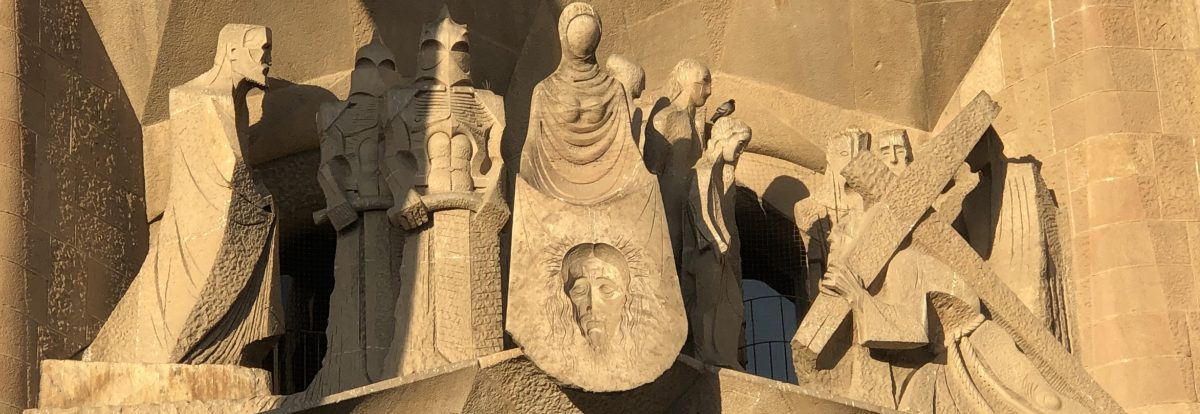
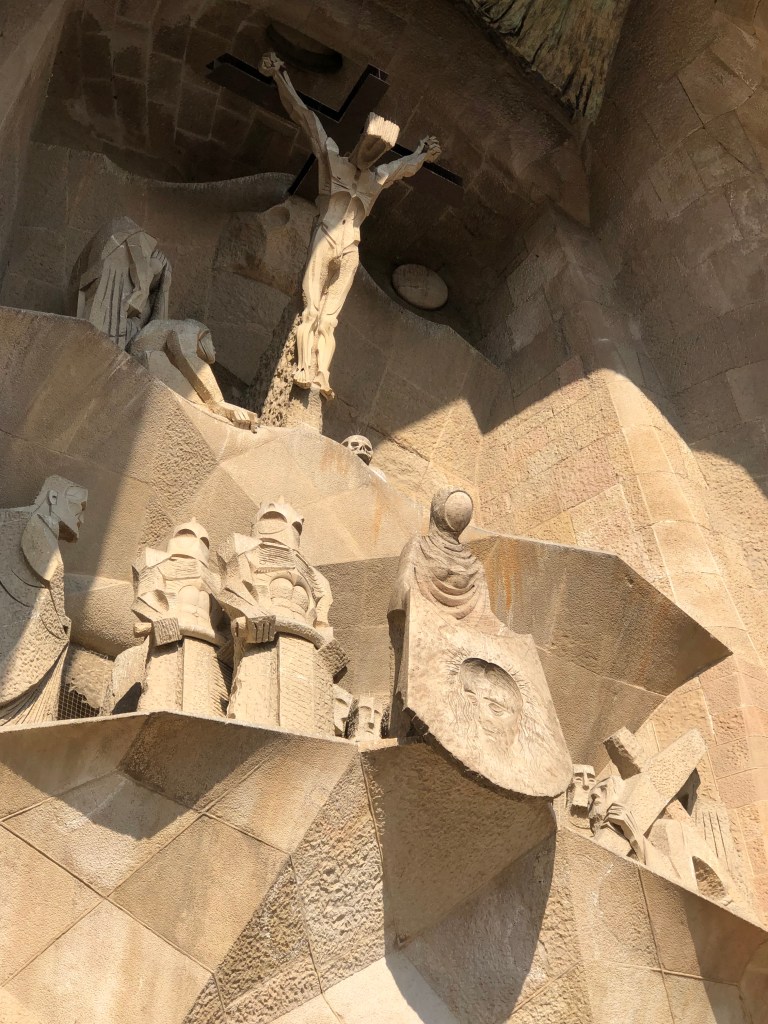
The entire basilica is a marvel, a deeply spiritual and prophetic building. This Holy Week, I thought it would be appropriate to share some photos of the Façana de la Passió, the Passion Facade. The sculptures broadly follow Gaudí’s instructions, though they are the work of Josep Maria Subirachs. If anything, the sculptures are even more harsh and austere than Gaudí’s original sketches. The hardness of the work is actually in keeping with Gaudí’s instructions.
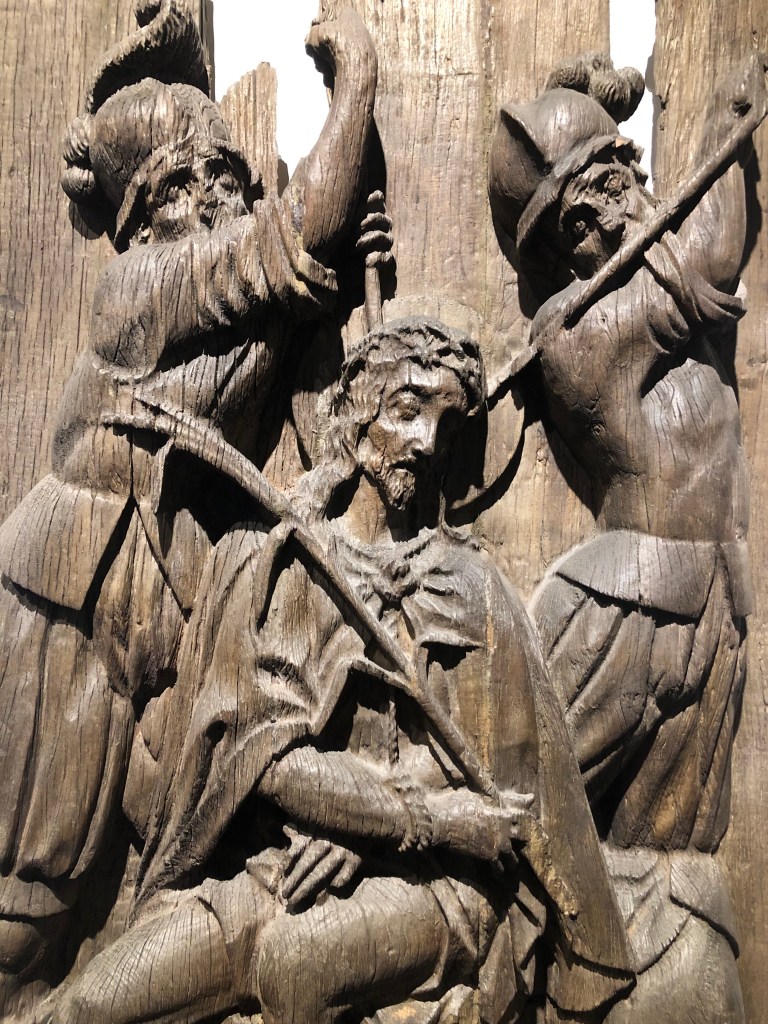
Jesus crowned with thorns, 18th century, Molave wood, San Augustin Museum, Manila
We have reached the final days of Lent. Five weeks ago, this penitential season began with an emphasis on prayer, fasting, and almsgiving. The austere sign of ashes reminded us of our mortality and challenged us to conversion. Prayer, fasting, and almsgiving are the classic means of conversion. Perhaps we have examined our lives, sought to grow in certain virtues, and made personal resolutions. And perhaps now, at the end of these five weeks of Lent, we realize that we have grown—or that we have not been very faithful to our resolutions. Or, more likely, we find that the results have been mixed: some growth, some failure.
In any case, we have reached a new moment. You may have noticed that, in this week’s liturgy, we have stopped using the Lenten prefaces at the beginning of the Eucharistic prayer and have begun to use the Passion preface. And today’s readings strongly orient us toward the Passion. Jeremiah speaks of slander and betrayal, and we naturally think of the sufferings that the Lord will face within a week. In the Gospel, opposition to Jesus grows, becoming increasingly violent, and his identity becomes clearer. It is no longer possible to maintain a moderate position toward him. It is no longer possible to respect him simply as a good teacher, a prophet, or a philosopher with interesting ideas: he is either the Son of God or a blasphemer. Everyone must choose.
This is the moment in Lent when we forget ourselves. Even our desire for conversion takes a back seat, because our attention is focused entirely on Jesus. Perhaps at this very moment, even our unsuccessful resolutions and failures help us understand how much we need a Savior. We are leaving the time of resolutions and moral growth and entering the time of the Savior. This time is his. It is the time of the Son of God, the time of the One who is greater than John and all the prophets, the time of our only Lord and only Savior. Thanks to our efforts—or perhaps despite our efforts—we have arrived here, at this moment. But this is the time of Jesus.
Going through some old files, I came across this homily for the Monday of Holy Week, written, in my younger and more vulnerable years, when I was a novice in St. Paul, Minnesota.
St. Mary Magdalene penitent, Guercino 1622
During the Third Week of the Spiritual Exercises, St. Ignatius asks us to contemplate the suffering and death of Our Lord. This week, Holy Week, the Church, liturgically, asks us to do the same. The Third Week is one of the times in the Exercises when we ask for strange graces—shame, sorrow, confusion.
The Church’s liturgy also evokes these troubling graces, and it does so by, among other things, confronting us with today’s passage from John, the Anointing at Bethany. The shock this passage should provoke in us is perhaps diminished by its familiarity, but if we really deeply consider what is happening here, then we should be confused. We should be confused because part of us is tempted to side with Judas.
Three hundred days wages! Put in contemporary terms this must amount to something like $30,000, $40,000, $50,000—enough for college scholarships for one or several years, or private high school scholarships for several students; in some Third World countries that much money could build a school. And instead it is being spent on a jar of ointment. An expensive perfume. An ostentatious toiletry.
I was fortunate this year to have spent Holy Week and Easter in Maracalagonis, Sardinia, a small town about a 20 minute drive from the center of Cagliari. It was a good break from the classroom and a wonderful taste of parish life.
Chiesa della Santa Vergine degli Angeli, Maracalagonis, Sardinia
The religious atmosphere I experienced was both warm and traditional. Masses were full; I heard confessions all week long; I met deeply committed Catholic families. I was especially impressed by the enthusiasm for traditional popular devotions. Teams of parishioners take responsibility for organizing different devotions throughout the year. Of particular note during Holy Week were the su Scravamentu, in which the nails are removed from the Lord’s hands and feet and he is taken down from the Cross after the Good Friday liturgy, and the many processions through the town streets–Stations of the Cross, Palm Sunday, Holy Thursday, the Sorrows of Mary on Good Friday, and then the S’Incontru on Easter morning.
I recently read something in a book written by an American sociologist that struck me–and disturbed me. This sociologist is a very good scholar and has conducted studies in several different countries and written a number of topics. In one of these studies, as an aside, he mentioned that, in general, people care more about being normal than about being good. For the majority of people it is more important to feel normal than to be good.
Holy Stairs, Rome
This disturbing observation struck me because it seemed hard to deny. And the truth of this observation is evident on no other day more than on this one, Palm Sunday. The celebration begins with Jesus’ triumphal entry into Jerusalem. The people welcome him as a hero, as a king. They throw their cloaks before him and cheer him enthusiastically, “Hosanna!” And in the space of a week, the same crowd will shout with the same enthusiasm, “Crucify him!”
On no other day do we feel so acutely the fickleness of the crowd or the inconstancy of the human heart.
Today is unofficially known as “Spy Wednesday” on the Church calendar because the Gospel reading recounts the story of Judas’s betrayal. I spent this Lent doing the 30-day Spiritual Exercises of St. Ignatius Loyola, and, for me, the most moving part of the retreat was contemplating the Lord’s Passion, in which, through the liturgy, we participate during Holy Week.
There is much to say about the retreat and much to say about Holy Week–but having been away for over a month, I also have a fair bit of catching up to do. So for now, I’ll share just one thought.
Until we reach Easter Sunday, this week is incredibly dark. Judas is present at the Last Supper and his impending betrayal colors everything else. Even before the Lord’s arrest, Jesus suffers because of his disciple’s mendacity. Peter’s courage and good intentions fail. The physical torture–scourging, beating, the nails, exposure and slow suffocation on the cross–is inhuman, enough to turn one’s stomach just thinking about it. And then, the cravenness of Pilate, the calculated cruelty of Jerusalem’s religious leaders, the callous and fickle crowd. What is most sobering of all is the realization that there is some of Judas and Pilate and Peter in each one of us. The Lord suffers for our sins.
When I reached the end of the station pilgrimage the last time around, I was struck by the details.
For the sacramental theologian such as myself, there’s a deep lesson in the details of the journey. The Son of God’s Incarnation meant entering fully into the reality of human life, with all its diverse moments of suffering and disappointment, of hope and joy, of sometimes just getting by. The Passion narrative is the most vividly detailed part of the Gospels, and the Resurrection stories too, though reflecting the discombobulation of that utterly unprecedented event, also retain the sort of vivid details that stick out in one’s mind even when the world has just gone outside-in. Mary thinks Jesus is the gardener. Jesus eats a bit of fish. The sacraments depend on the details of the Lord’s life, too, on what he ate at his last meal.
The Harrowing of Hell, Andrea di Bonaiuto, Santa Maria Novella, Florence
Today’s reading from the Office of Readings put me in mind of the fresco of Christ’s descent into the limbo of the patriarchs in the chapter room of Santa Maria Novella in Florence. Note the demon crushed under the doors of hell at Christ’s feet and the other bewildered devils on the right. (Don’t feel sorry for them.) It’s what the Middle Ages had instead of superhero movies.
I was recently reminded of a post I wrote on the old Whosoever Desires blog eleven years ago. It was prompted by controversy over Mel Gibson and The Passion of the Christ, but the questions it asks are perhaps still worth considering this Spy Wednesday as well…
Nathan’s post on Mel Gibson’s The Passion of the Christ last year generated a lot of discussion and ended with an intriguing question: “Why does Pilate always get so much empathy from us?”
It would be easy, at this point, to start tossing around charges of anti-Semitism, charges which would allow us to feel a certain measure of moral superiority over those less enlightened than ourselves. Then we could pray like the righteous Pharisee, “God, I thank thee that I am not like other men, extortioners, unjust, anti-Semites like Mel Gibson over there” (Lk 18:10).
Throwing around such charges is a way of doing precisely the same thing that blaming the Jews for the crucifixion once did: deflecting guilt from ourselves. I would suggest a far more troubling answer to the question, “Why do we empathize with Pilate?”
Because Pontius Pilate is the character in the Passion who is most like us.
“True reverence for the Lord’s passion means fixing the eyes of our heart on Jesus crucified and recognizing in him our own humanity.
“The earth–our earthly nature–should tremble at the suffering of its Redeemer…. No one, however weak, is denied a share in the victory of the cross. No one is beyond the help of the prayer of Christ. His prayer brought benefit to the multitude that raged against him. How much more does it bring to those who turn to him in repentance… Everything that he did or suffered was for our salvation: he wanted his body to share the goodness of its head.
“First of all, in taking our human nature while remaining God, so that the Word became man, he left no member of the human race, the unbeliever excepted, without a share in his mercy. Who does not share a common nature with Christ if he has welcomed Christ, who took our nature, and is reborn in the Spirit through whom Christ was conceived?
“Again, who cannot recognize in Christ his own infirmities? Who would not recognize that Christ’s eating and sleeping, his sadness and his shedding of tears of love are marks of the nature of a slave? …
“The body that lay lifeless in the tomb is ours. The body that rose again on the third day is ours. The body that ascended above all the heights of heaven to the right hand of the Father’s glory is ours. If then we walk in the way of his commandments, and are not ashamed to acknowledge the price he paid for our salvation in a lowly body, we too are to rise to share his glory.”




 Tony Lusvardi, S.J.