
Staying salty in an indifferent sea: Homily for the 5th Sunday of Ordinary Time

Homily for the Fifth Sunday in Ordinary Time (Year A).
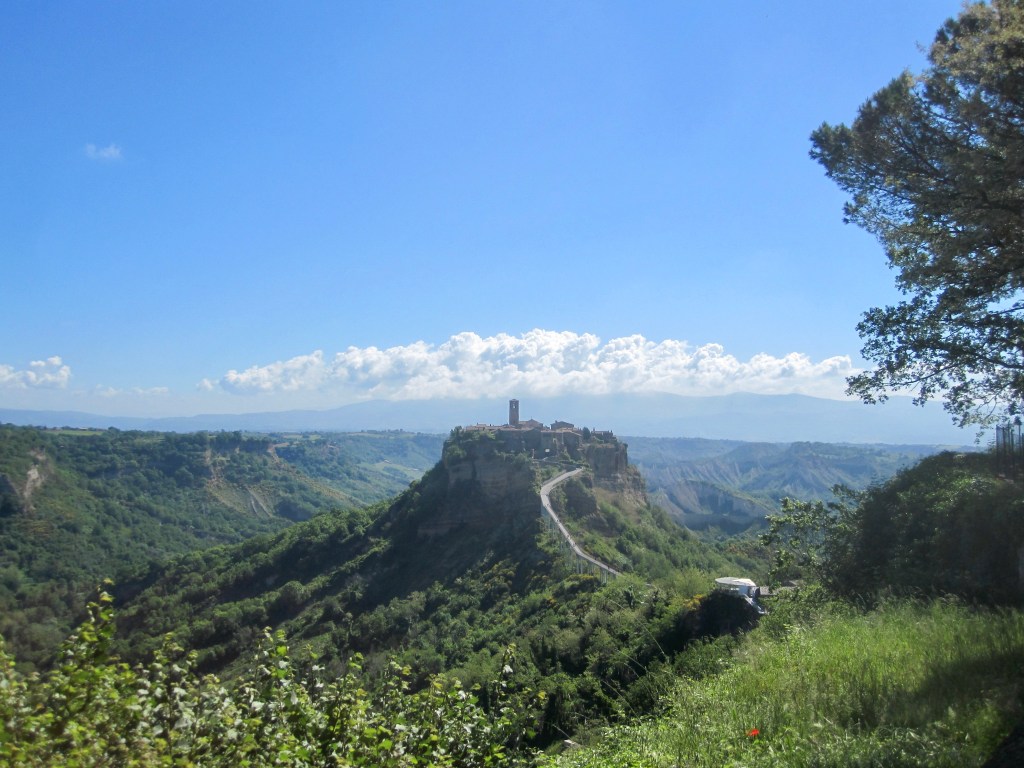
Bagnoregio, Italy

After the Christmas break another Jesuit in our community returned to Rome after having had corrective eye surgery.  The surgery went so well that for a week after he returned, he wore sunglasses at all times of day, even indoors; of course, we gave him a hard time about imagining that he had become a movie star.  What happened was that, with his vision corrected, at first his pupils were letting in too much light—so much light that he couldn’t see.  For our eyes to work, we need light, but we also need contrasts.  Some parts of our field of vision must be lighter or darker than others, otherwise we’ll end up falling down the stairs and running into walls.

If there is no light, of course, we cannot see.  But too much light can blind us too.  In the Biblical world, before electric lighting, the risk of darkness was almost always greater than having too much light.  In the Bible the metaphor of light is usually good, though occasionally the light of God is overwhelming—think of Jesus appearing to St. Paul on the road to Damascus.  Paul is knocked over and blinded by the vision.  If we were to be hit right now with heaven’s light in all its purity, we would probably be paralyzed too.  In order to experience that light, we need to grow, to be re-formed—the same way my confrere’s eyes had to convert after surgery and our own eyes have to adjust when we step outside at midday.  We might, in fact, say that God’s light shines even on those in hell, and that their darkness is the result of eyes grown used to the shadows, forever unwilling to adjust to the daylight.  However, this world in which we live right now contains both light and darkness.  In order to navigate in this world, we need to be able to recognize the contrasts.

Continue reading “Staying salty in an indifferent sea: Homily for the 5th Sunday of Ordinary Time”

Faithfully unfashionable: homily for the twenty-third Sunday in Ordinary Time

Homily for the 23rd Sunday of Ordinary Time (B)

Prophet Isaiah, Raphael (1511-2), Church of Sant’Agostino Rome

A mile or so from where I live in Rome is a street called Via dei Condotti; there you can find the stores of Armani, Tiffany’s, Gucci—the highest high-end designers.  Sometimes I like to amuse myself by looking in the windows at the prices—a thousand dollars for a sweater, twelve hundred dollars for a necktie, twenty thousand dollars for a watch.  Of course, many of the stores don’t list prices because if you have to ask, you can’t afford it.  I’ve never gone inside any of these stores because they are usually guarded by a man with a shaved head, six inches taller than I am, with a black suit and a mouth that never smiles.  In fact, I think they’ve had the facial muscles that allow you to smile surgically removed.  

The owners of these stores would not be happy to read today’s Letter of St. James.  James says: don’t favor a person with gold rings over a person in shabby clothes.  Of course, sometimes shabby clothes are fashionable and expensive; having torn jeans means that you’re one of the cool kids.  What’s in fashion always changes because it’s not based on anything real.  A thousand dollar sweater won’t keep you any warmer than a thirty dollar sweater; a twenty thousand dollar Rollex tells the same time as my twenty dollar Timex.  Fashions based on wealth, prestige, and the most up-to-date style are like the leaves that you see on the trees this September day; next month they’ll be a different color; a month after that, they’ll be gone.

Even though fashion and prestige aren’t based on anything true and lasting, they can be used to hurt people in some very real ways.  I think of how hard it is for someone not to be one of the “cool kids” in middle school or high school.  Adults are sometimes just as bad; I can remember from my time here on the reservation that sometimes people are looked down on for being “too Native”; other times they may be looked down on for “not being Native enough.”  In either case, sometimes people can be treated quite unfairly.  

Continue reading “Faithfully unfashionable: homily for the twenty-third Sunday in Ordinary Time”

Homily for Passion Sunday

I recently read something in a book written by an American sociologist that struck me–and disturbed me. This sociologist is a very good scholar and has conducted studies in several different countries and written a number of topics. In one of these studies, as an aside, he mentioned that, in general, people care more about being normal than about being good. For the majority of people it is more important to feel normal than to be good.

Holy Stairs, Rome

This disturbing observation struck me because it seemed hard to deny. And the truth of this observation is evident on no other day more than on this one, Palm Sunday. The celebration begins with Jesus’ triumphal entry into Jerusalem. The people welcome him as a hero, as a king. They throw their cloaks before him and cheer him enthusiastically, “Hosanna!” And in the space of a week, the same crowd will shout with the same enthusiasm, “Crucify him!”

On no other day do we feel so acutely the fickleness of the crowd or the inconstancy of the human heart.

Continue reading “Homily for Passion Sunday”