Recently, I was fortunate to be able to take a brief trip to Barcelona for a research project (more on that to come). I spent as much time as I could at Antoni Gaudí’s marvel, La Sagrada Família (more on that, as well).
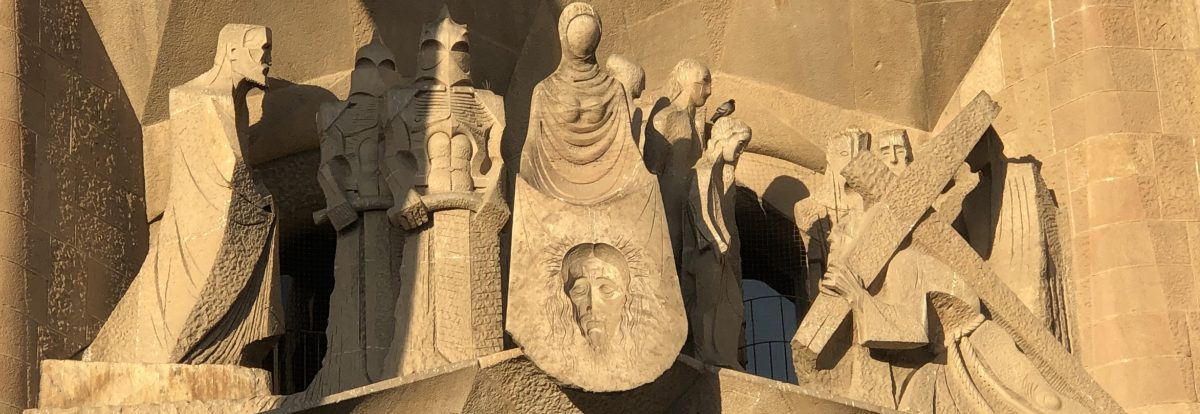
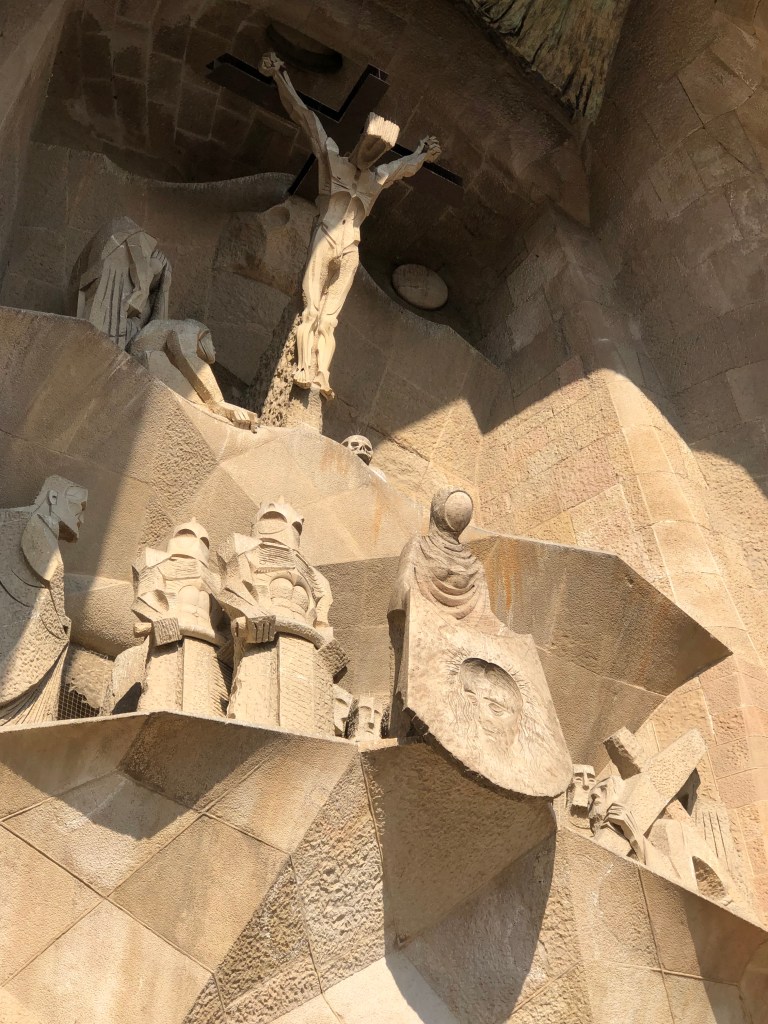
The entire basilica is a marvel, a deeply spiritual and prophetic building. This Holy Week, I thought it would be appropriate to share some photos of the Façana de la Passió, the Passion Facade. The sculptures broadly follow Gaudí’s instructions, though they are the work of Josep Maria Subirachs. If anything, the sculptures are even more harsh and austere than Gaudí’s original sketches. The hardness of the work is actually in keeping with Gaudí’s instructions.
As is traditional for the First Week of Lent, the Pope and the Roman Curia will spend several days making their annual spiritual exercises. This year’s retreat is being preached by Bishop Erik Varden of Trondeim, Norway. Some readers might know Bishop Varden already from his wonderful blog Coram Fratribus. A convert and then a Trappist monk, Bishop Varden has a gift for communication comparable to our own great Robert Barron, though with his own unique style.
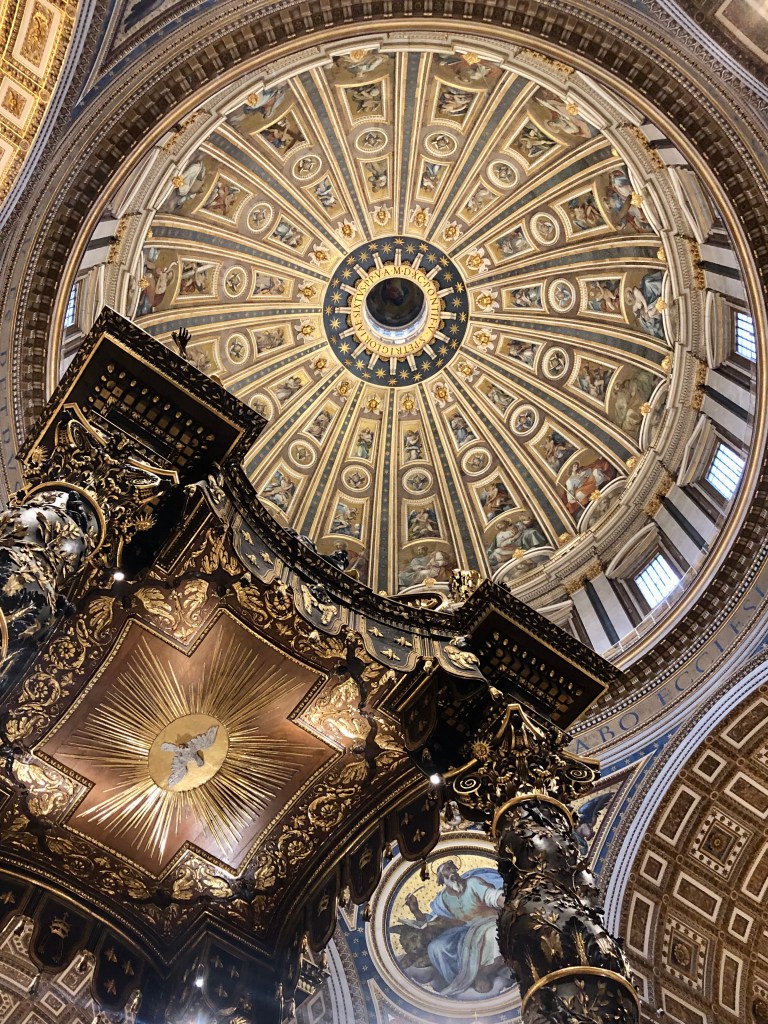
St. Peter’s Basilica, Rome
At a mere 51 years old, Bishop Varden also represents something of a turning of the page in the life of the Church. I’ve written before (here and here) that the zealous and youthful Church I encountered in Scandinavia hints at what fidelity and evangelization must look like in an increasingly secularized world. Bishop Varden–articulate, orthodox, cultured, and creative–seems to understand how to respond to our twenty-first century reality.
Last year I read Bishop Varden’s profound book Chastity: Reconciliation of the Senses, and I thought this week would be a good opportunity to share a few of its many insights…
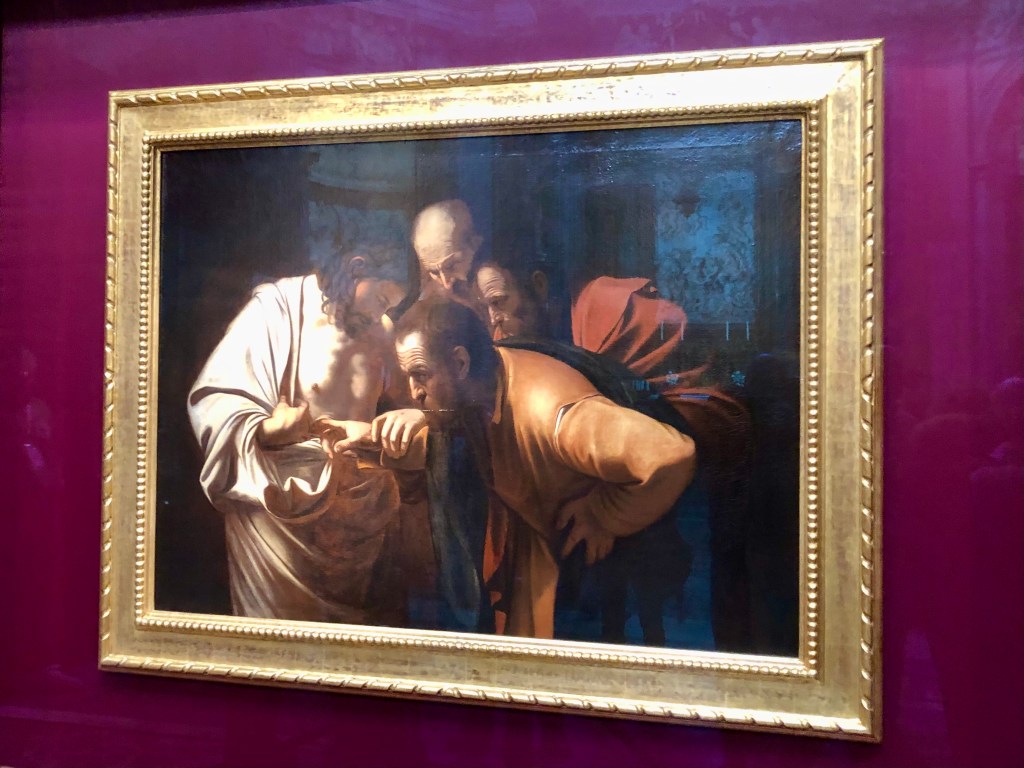
The Incredulity of St. Thomas, Caravaggio (1602-7)
Readers of this blog will know that one of the delights of living in the center of Rome is that a Caravaggio is never more than a stroll away. I’ve written about the great spiritual insight in Caravaggio’s Matthew cycle in the Church of San Luigi dei Francesi. Last year, I reflected in The Catholic Thing on why Caravaggio so resonates with contemporary viewers after visiting an extraordinary exhibit of his work in Palazzo Barberini.
At the tail end of the Jubilee I caught another extraordinary exhibit, albeit of just one Caravaggio, at Sant’Agnese in Agone. The work, The Incredulity of St. Thomas (1602-7), was on loan from a private collection in Florence. It’s a work full of drama and humanity and shows Thomas wide-eyed while inserting his index finger into the Risen Lord’s side. Jesus himself is utterly serene as he guides the doubting apostle’s hand toward his torso. (A nice detail is that the Lord’s face seems a bit sunburned, while his body is not.) Two other apostles look on over Thomas’s shoulder with both concentration and astonishment.
With yesterday’s feast of the Baptism of the Lord reminding us of the beauty and uniqueness of the sacrament of baptism, it seemed an opportune moment for an update on my work on baptism of desire. I’ve continued to do a bit of research on the question of infants that die before baptism and posted some reflections on the issue here and here late last year.
The Baptism of the Lord (above), Guglielmo of Pisa (1160), pulpit, Cagliari cathedral (Sardinia)
The Baptism of the Lord, El Greco
Reviews of Baptism of Desire and Christian Salvation continue to come out, so far all deeply appreciative. Theology today is no longer an exclusively European enterprise, so I’m especially excited to have an international response to the book. The Hekima Review, Africa’s leading theological journal, recommends it for both “Catholic clergy and lay people as it foregrounds the pastoral implications of the doctrine and the need for evangelisation.” Meanwhile, India’s top theological journal, the Vidyajyoti Journal of Theological Reflection published a particularly detailed and insightful review, which noted the specific value of the book in the context of Indian religious pluralism. It expressed the hope that the book would become the standard “theological ‘textbook'” for discussing such issues. The reviewer also picked up on the way the work responds to the deeper philosophical currents of the twentieth century:
This work belongs to what the dogmatic theologian José Granados has identified as a corporeal turn in theology, an emphasis on the body after the heady years of the twentieth century that – whether primarily or exclusively – emphasized cognition. This corporeal turn has meant a returning emphasis on not just the body, but the embodied nature of the Christian faith. It recognizes that the embrace of the faith cannot be restricted to some conceptual nod, but must necessarily embrace ritual, and recognize that the materiality of ritual is important. As Lusvardi writes “The instinct of the early Church to emphasize the ritual was not wrong, for the ritual says and does what nothing else can” (p. 342). In stressing the importance of the corporeal, Lusvardi’s work also becomes part of the corpus of the critique of modernity, which consciously, or unconsciously, seeks to restore a holistic view of the world, sundered through modernity’s adoption of Cartesian binaries, and has powered so much of Indian post-colonial thought.
Closer to home, The New Ressourcement journal said:
Lusvardi’s excellent book … is a must-read for anyone interested in the history of baptism, the nature of sin and salvation, or the hope for non-Christians and infants. It is hard to do justice to the extensive ground this book covers. In a compelling way, it draws the reader to see that the good news of Christian salvation is truly good news for its hearers precisely because the experience of Christ’s saving death and life is available to all in baptism.
Baptism of Desire and Christian Salvation in an Indian stole
The reviewer also offered a defense of the standard scholastic approach to the doctrine, aspects of which I call into question in the book–evidence, I think, that the issues the book raises are worthy of robust theological examination and debate.
So put it on your reading list for the new year!
Baptism of Desire and Christian Salvation is available from Catholic University of America Press (20% discount with the code CT10), Amazon, and other online booksellers. I have collected reviews, interviews, and other news here.
Today we celebrate the story of one particular family—and the story of every family.
On the one hand, the story of the Holy Family of Jesus, Mary, and Joseph is absolutely unique. There is no other historical event comparable to the Incarnation of the Son of God, and the birth of Jesus is surrounded by other miraculous events—the appearance of the archangel Gabriel, the angelic messages that come to Joseph in dreams, the arrival of the Magi, the adoration of the shepherds—which highlight the unique identity of Jesus Christ. Furthermore, Jesus is divine, Mary is immaculate, and Joseph is holy; therefore, this family is threatened by sin, but always from outside. Herod’s envy is one example.
In our families, however, we must admit that often the most damaging wounds are caused by our own sins. Nevertheless, I do not believe that this difference—the holiness of the Holy Family—creates a distance between them and us, because all the actions of the Holy Family are done for us. They are a guide, a support, and a source of hope for us.
Joseph and Mary faced great challenges: an unexpected pregnancy that changed all their plans, the misunderstanding of their neighbors, a period of extreme poverty, danger, a threat to their child’s life, exile; and then all the daily challenges, including—if we think of Jesus’ disappearance in the temple—the difficulties of communication that sometimes occur even between people of good will. At the same time, the Holy Family experienced unexpected joys, tenderness, the celebrations of their religion, and belonging to their people. They experienced the fullness of family life.
Their particular experience offers us inspiration and encouragement to live our Christian mission fully, despite the challenges.
Homily for the Immaculate Conception (2019. Note, that year, the Solemnity fell on a Sunday.)
On the first Sunday of Advent, I cleaned my room. I must admit, it needed it—there were coffee stains on the desk; the trash can was overflowing; I found forgotten lists of things not to forget. But Advent is the beginning of a new liturgical year, the season when we prepare for Christmas, and it seemed right to start with a clean room. In the coming weeks, there will be many other things to prepare: food, gifts, decorations, travel.
Column of the Immaculate Conception, Rome
This is the second Sunday of Advent, and normally the readings highlight the figure of St. John the Baptist, who speaks of another kind of preparation, another kind of cleaning—in fact, a much deeper cleaning than coffee stains. John the Baptist warns of the need for inner cleansing, moral and spiritual conversion. And this too is part of the preparation for Christmas. As a confessor, I have to do a little advertising for my profession, strangely absent from all the Black Friday advertising we received last month. But I must say that our special offer—the forgiveness of sins, eternal life—is truly the best deal in the world.
However, this year is a bit special, because this second Sunday of Advent is December 8, the Solemnity of the Immaculate Conception of Mary, the Mother of Jesus. This coincidence of dates is interesting because the Immaculate Conception is also a feast of preparation. But not the preparation we do during this season. The preparation that God has done for us.
Homily for Monday of the first week of Advent (2019).
The figure we encounter today in the Gospel, the centurion of Capernaum, helps us to prepare. We use his adapted words to prepare for communion: “Lord, I am not worthy that you should enter under my roof, but only say the word and my soul shall be healed.” And today, at the beginning of Advent, the season when we prepare for the coming of the Lord, the centurion appears in the readings.
A season of preparation is a season of faith and hope—and I think the centurion of Capernaum appears today because he is a figure of faith and hope.
Both of these virtues exist in imperfect situations. We need hope because of something we lack in the present; we need faith because there is something doubtful about the situation in which we find ourselves.
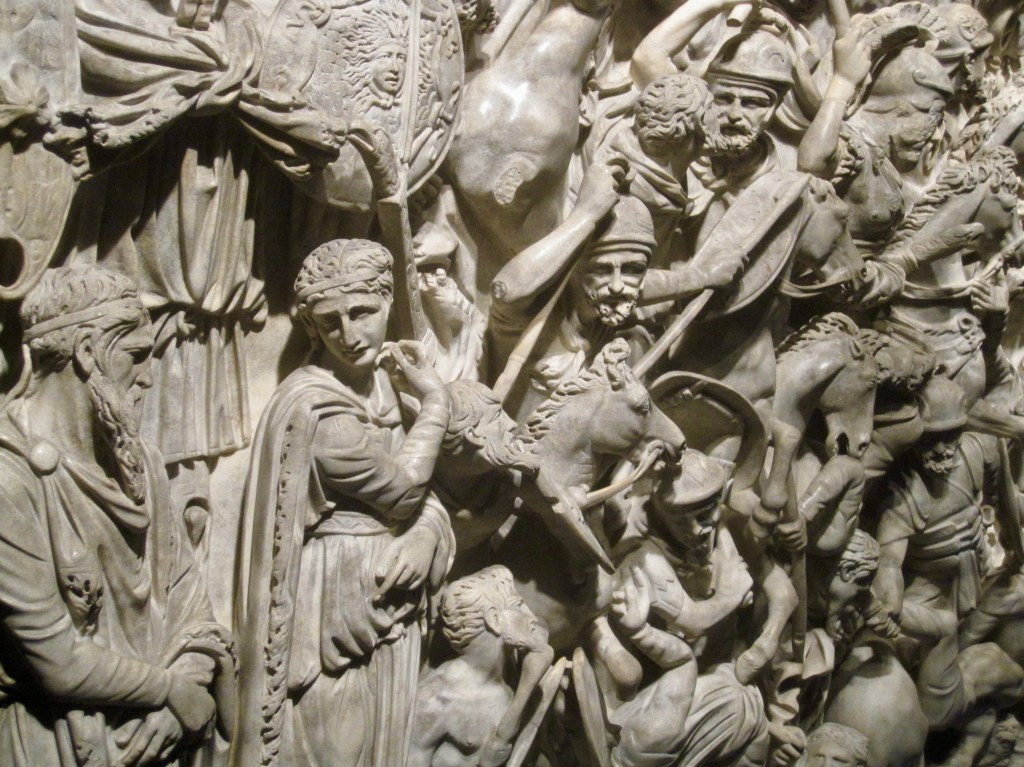
Roman Sarcophagus, Palazzo Massimo, Rome
The centurion comes to Jesus asking for help. And his words—“I am not worthy that you should enter under my roof”—are poignant because in them we hear the unvarnished truth. We can easily imagine that the centurion, an officer in the imperial army, has seen terrible things and perhaps–even if only out of duty–has had to do terrible things as well. His sense of unworthiness, however, does not prevent him from turning to the Lord.
Homily for the twentieth Sunday in Ordinary Time (C).
The word “Jesuit” was first used to mock the early followers of St. Ignatius of Loyola. These first members of my religious order, the Society of Jesus, were derided for talking so much about Jesus and were given the name “Jesuit,” condescendingly, by those who apparently thought they had something better to talk about. Those first Jesuits took the criticism as a compliment, and the name stuck.
The letter to the Hebrews tells us to keep our eyes fixed on Jesus, and the Gospel’s hard words make the same point in dramatic fashion. We’ll return to the Gospel in a minute, but I want to start with the striking passage from Hebrews. The letter tells us to keep our eyes fixed on Jesus so that we can “persevere in running the race that lies before us.” Races, by definition, are challenging events. It is possible to lose a race by giving up, by going off course, by laziness, by getting tripped up on some obstacle. Hebrews tells us to “rid ourselves of every burden and sin that clings to us.” Sins are the sort of thing that will slow us down, trip us up, or send us running in the wrong direction. Running a race usually requires training, and Christianity is no different. We aren’t born Christians. Perhaps a century or two ago when our whole society was Christian, it was possible to imagine that we were, that being a Christian was the same thing as being a good citizen or an agreeable person, just going with the flow. That was always an illusion, and it is even more so today when the forces that shape our culture are often hostile or indifferent to Christianity.
Several weeks ago I spent a wonderful afternoon at a special exhibit of 24 paintings by Caravaggio brought together in Palazzo Barberini and dubbed Caravaggio 2025. The exhibition made me wonder at Caravaggio’s extraordinary popularity. Why is Caravaggio so popular today? And what does this tell us about where we are spiritually? I think the answer is not unrelated to the other recent events in Rome: the election of a missionary as Pope Leo XIV; our new Holy Father’s goal of steering the Church faithfully through the digital revolution, just as Leo XIII provided guidance during the industrial revolution; and this Jubilee year’s theme of hope.
While you’re at it, check out some reflections from a few months back on the artist’s spectacular St. Matthew cycleand a different conversion of St. Paul. And there’s plenty of other great work at The Catholic Thing, including, if you missed it, an explanation of why I think my book on baptism of desire is so important at this time when renewing the Church’s missionary spirit is such a vital challenge: Getting Back into the Baptizing Business. The price on Amazon seems to have dropped a bit recently.
Brothers and sisters, papam non habemus. We do not have a pope. Not yet.
We live in uncertain and, often, disturbing times. I’m not talking only about the sede vacante in the Church of Rome. The last few years–the last few decades, really–have been a difficult time for the Catholic Church. The Church sometimes seems confused and divided from within, and opposed by powerful forces from without. And today we also live with all the uncertainty of a papal election.
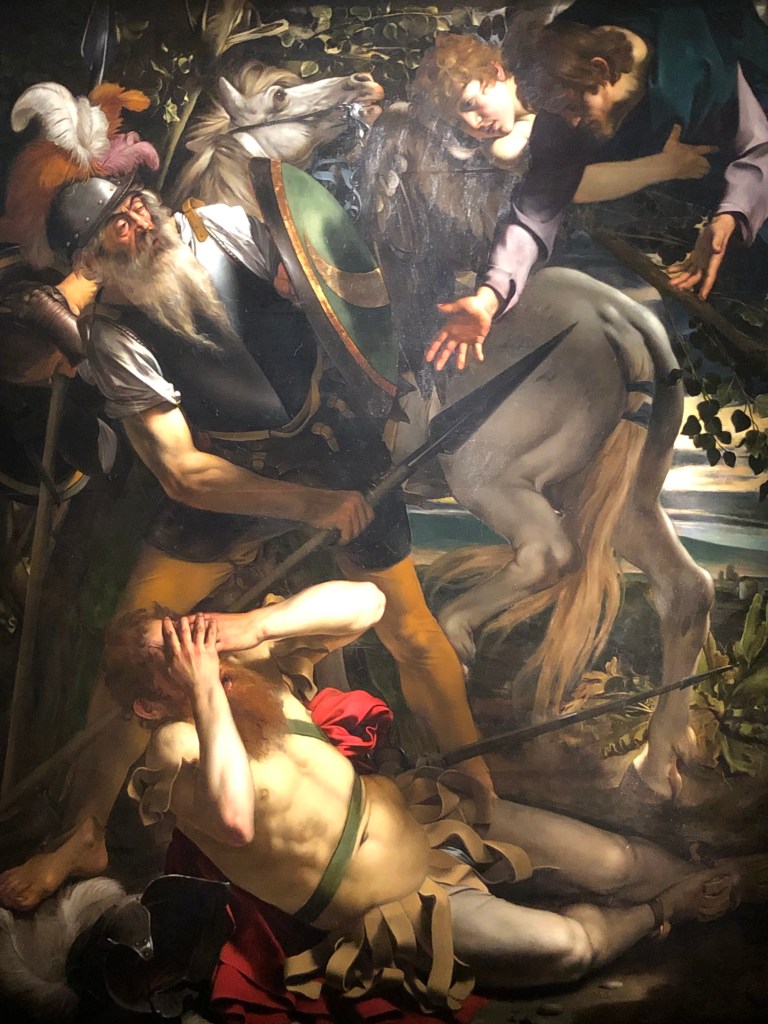
In this uncertain moment, today’s first reading reminds us of a simple but profound lesson: things have been worse. Much worse. Here we see the Church at its very beginning, tiny and persecuted. Stephen, one of the first deacons, has just been killed. The faithful are scattered. Those who persecute the Church are full of zeal, backed by the age’s political powers in all their strength. It seems like a catastrophic moment for the nascent Church, but it becomes a moment of triumph, a moment of growth. The dispersion of the faithful–even if caused by persecution–becomes the condition for the spread of the Word. Soon, we know, even the great persecutor, Saul, will convert and become the greatest missionary in the history of the Church.
Caravaggio, The Conversion of St. Paul, 1600-1
What I most want to emphasize today is the response of the disciples, who transformed this apparent catastrophe into a moment of growth: They continued to preach Jesus. Without panic, without discouragement. They returned and remained steadfast in the most fundamental mission of the Christian: to bear witness to the life, death and resurrection of Jesus Christ.
Today’s Gospel reading also calls us back to the heart of our Catholic faith: “I am the bread of life,” says Jesus. There is no action more important for the Catholic than to encounter the Lord in the Eucharist, in his true body and in his true blood.
Brothers and sisters, despite our anxieties and our doubts, despite the moments of uncertainty that alternate with moments of glory in the life of the Church, this message remains our rock. If we continue to proclaim it, we cannot go wrong. In a few days we will have a new pope, but our mission will not change. Times change. Popes change. Jesus Christ does not change.
Jesus Christ is the bread of life. Jesus Christ is Lord.
Readings: Acts 8:1b-8; John 6:35-40
(Original: Italian)
May 7, 2025
Gregorian University Chapel, Rome
Those interested can see my interview on the CBS Evening News with Maurice Dubois here.





 Tony Lusvardi, S.J.