Last year’s (brief) homily for Ash Wednesday. Original Italian.
In the readings with which we begin Lent today, we see two sides to this season of conversion. There is a public side. In the first reading, Joel calls the people to gather together, to declare a public fast, and to renew their worship. In the second reading, too, we are called to public witness: we are “ambassadors” of Christ, says St. Paul.
It might seem that there is a certain tension between these readings and the Gospel, which exhorts us to perform pious practices in private. However, there is no contradiction, because both of these aspects are part of the mission of a Christian in this world. The Gospel is a warning against hypocrisy, against the temptation to try to gain something—even if only the esteem of others—through our religious observances. All our practices—almsgiving, fasting, prayer—must be directed to the glory of God and not to our own glory.
During this season of Lent, let us seek above all purity of heart, integrity of public conduct, and an interior life consistent with the great call to follow the Lord Jesus as his disciples.
Readings: Joel 2:12-18; 2 Cor 5:20-6:2; Matt 6:1-6, 16-18
Homily for the Fifth Sunday in Ordinary Time (Year A).
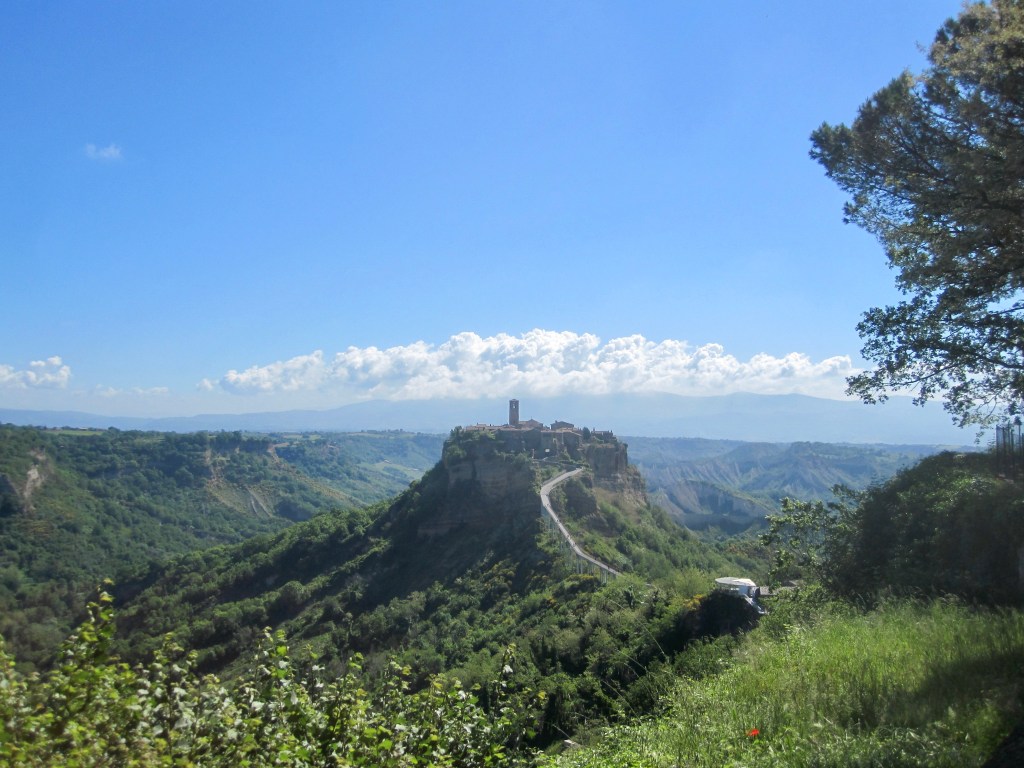
Bagnoregio, Italy
After the Christmas break another Jesuit in our community returned to Rome after having had corrective eye surgery. The surgery went so well that for a week after he returned, he wore sunglasses at all times of day, even indoors; of course, we gave him a hard time about imagining that he had become a movie star. What happened was that, with his vision corrected, at first his pupils were letting in too much light—so much light that he couldn’t see. For our eyes to work, we need light, but we also need contrasts. Some parts of our field of vision must be lighter or darker than others, otherwise we’ll end up falling down the stairs and running into walls.
If there is no light, of course, we cannot see. But too much light can blind us too. In the Biblical world, before electric lighting, the risk of darkness was almost always greater than having too much light. In the Bible the metaphor of light is usually good, though occasionally the light of God is overwhelming—think of Jesus appearing to St. Paul on the road to Damascus. Paul is knocked over and blinded by the vision. If we were to be hit right now with heaven’s light in all its purity, we would probably be paralyzed too. In order to experience that light, we need to grow, to be re-formed—the same way my confrere’s eyes had to convert after surgery and our own eyes have to adjust when we step outside at midday. We might, in fact, say that God’s light shines even on those in hell, and that their darkness is the result of eyes grown used to the shadows, forever unwilling to adjust to the daylight. However, this world in which we live right now contains both light and darkness. In order to navigate in this world, we need to be able to recognize the contrasts.
The October start of the Roman academic year means that I am wrapping up my time in the States before heading home (and back to work!) next week. Nonetheless, I haven’t been idle over the course of the summer. In addition to seminars and retreats, I published a couple of articles which might be of interest.
First Things asked me to weigh in on the questions surrounding transsexuals and the sacrament of baptism: Can Transsexuals Be Baptized?
The relationship between salvation and evangelization, however, is only one of the difficult questions my book addresses. I also suggest a new approach to the question of unbaptized infants and children dying in utero. This summer, I was contacted by some folks involved in ministry to Catholic parents who have lost children either through miscarriage or in early infancy. I found a quite enthusiastic reception for my work among those who are involved in this kind of grief ministry, and, a week ago, a group of the faithful put up a statement online in support of the position that I advance in my book: that baptism of desire can, in some cases, apply to the children of Christian parents. You can find this statement in support of the development of doctrine I outline here and sign if you wish: A Statement of Hope regarding Salvation through Baptism of Desire for Infants.
The statement also mentions the case of baby Brian Gallagher, whose grave I visited at Black Hills National Cemetery. On the outskirts of the cemetery I snapped a photo of a quintessentially American scene: a giant flag waving from a piece of heavy machinery with the Western landscape in the background. What else is there to say but, God bless the USA!
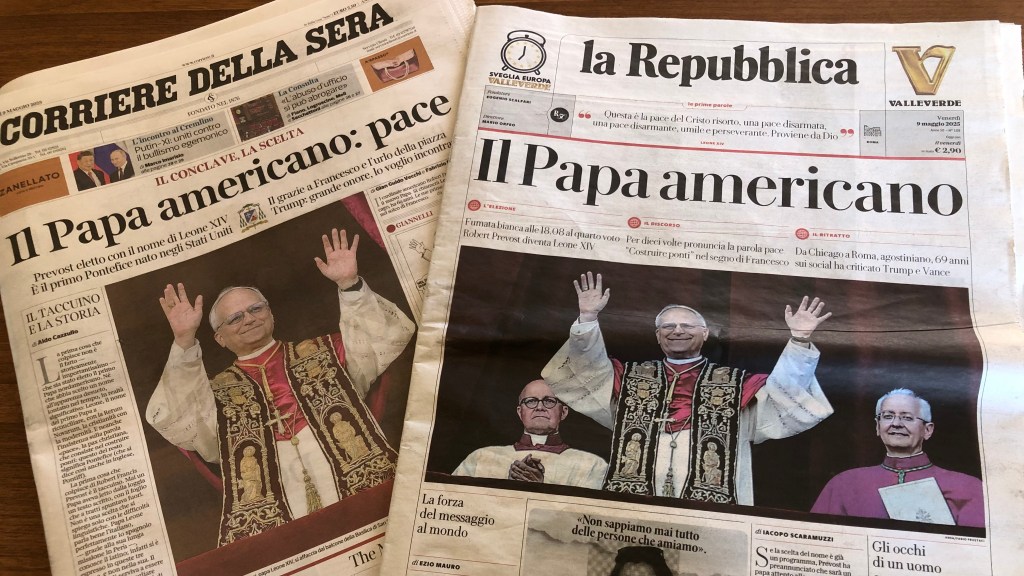
Just over a week ago I stood among the throng in St. Peter’s Square waiting for Pope Leo XIV’s Mass of installation. As the new pope emerged on the back of a white truck and made the rounds through the square, one of the priests who was with me to concelebrate whispered, “It still feels surreal.”
It still does.
The one iron-clad rule of papal elections, after all, used to be that the cardinals would never elect an American pope. And now we have a pope who grew up cheering for the Chicago White Sox. Going into the conclave, the Church seemed tired and divided. Yet Pope Leo has managed to evoke good will on all sides, and he hasn’t had to resort to any particular gimmicks to do so. Rome is elated.
What is perhaps most striking about our new Holy Father is the paradoxical way in which he seems both totally at ease in his new role–as if he’d been pope-ing for years already–and at the same time totally unassuming. One could imagine sitting next to him at a baseball game and him introducing himself as “Bob from Chicago.” At the same time, seeing him on the balcony of St. Peter’s Basilica or meeting world leaders in the robes of his office, one senses the quiet dignity of a successor of the Apostles.
A lot has already been written about Pope Leo on the basis of relatively scant pre-conclave writings and interviews. I was particularly impressed by the first homily he gave to the cardinals after his election. His brief address to the Synod of Bishops on evangelization more than a decade ago equally impressed me because he seemed to grasp one of the central problems facing the Church: the role of the media in communicating–and sometimes miscommunicating–our message. I remember an interview given by the late Cardinal Avery Dulles to Charlie Rose, in which the cardinal observed that the biggest problem faced by the Church was that most Catholics learn what they know about Catholicism not from the Church herself, but from the media. Leo XIV understands that dynamic–and he is alert to the equally challenging frontiers now being opened by artificial intelligence.
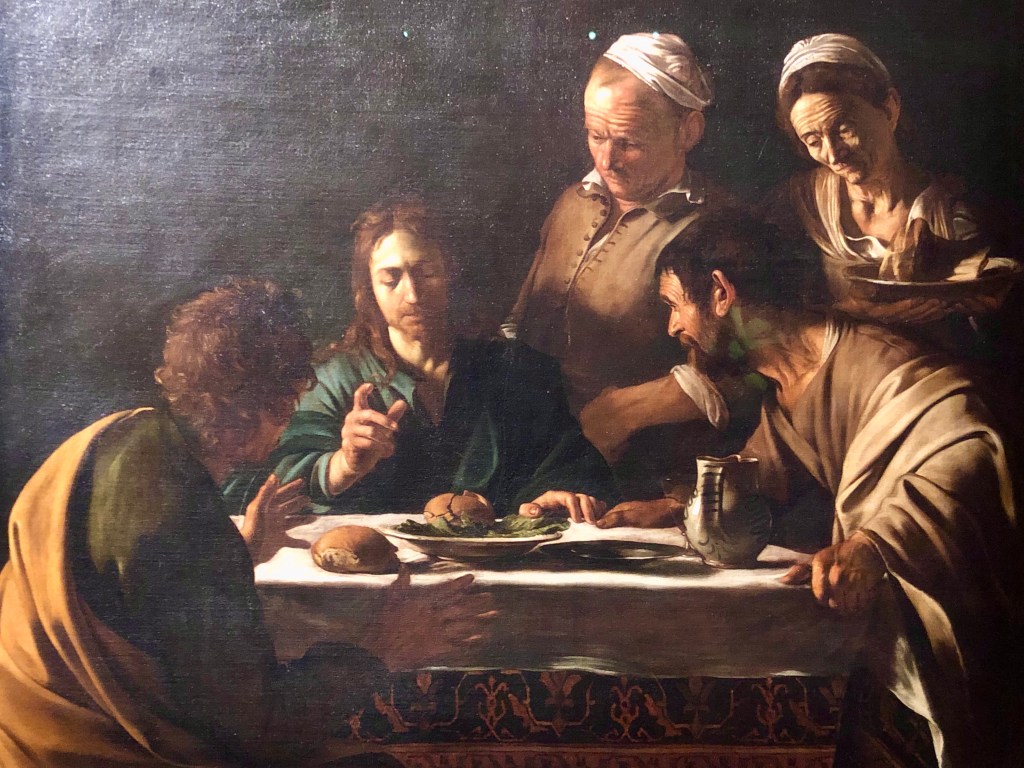
Several weeks ago I spent a wonderful afternoon at a special exhibit of 24 paintings by Caravaggio brought together in Palazzo Barberini and dubbed Caravaggio 2025. The exhibition made me wonder at Caravaggio’s extraordinary popularity. Why is Caravaggio so popular today? And what does this tell us about where we are spiritually? I think the answer is not unrelated to the other recent events in Rome: the election of a missionary as Pope Leo XIV; our new Holy Father’s goal of steering the Church faithfully through the digital revolution, just as Leo XIII provided guidance during the industrial revolution; and this Jubilee year’s theme of hope.
While you’re at it, check out some reflections from a few months back on the artist’s spectacular St. Matthew cycleand a different conversion of St. Paul. And there’s plenty of other great work at The Catholic Thing, including, if you missed it, an explanation of why I think my book on baptism of desire is so important at this time when renewing the Church’s missionary spirit is such a vital challenge: Getting Back into the Baptizing Business. The price on Amazon seems to have dropped a bit recently.
Brothers and sisters, papam non habemus. We do not have a pope. Not yet.
We live in uncertain and, often, disturbing times. I’m not talking only about the sede vacante in the Church of Rome. The last few years–the last few decades, really–have been a difficult time for the Catholic Church. The Church sometimes seems confused and divided from within, and opposed by powerful forces from without. And today we also live with all the uncertainty of a papal election.
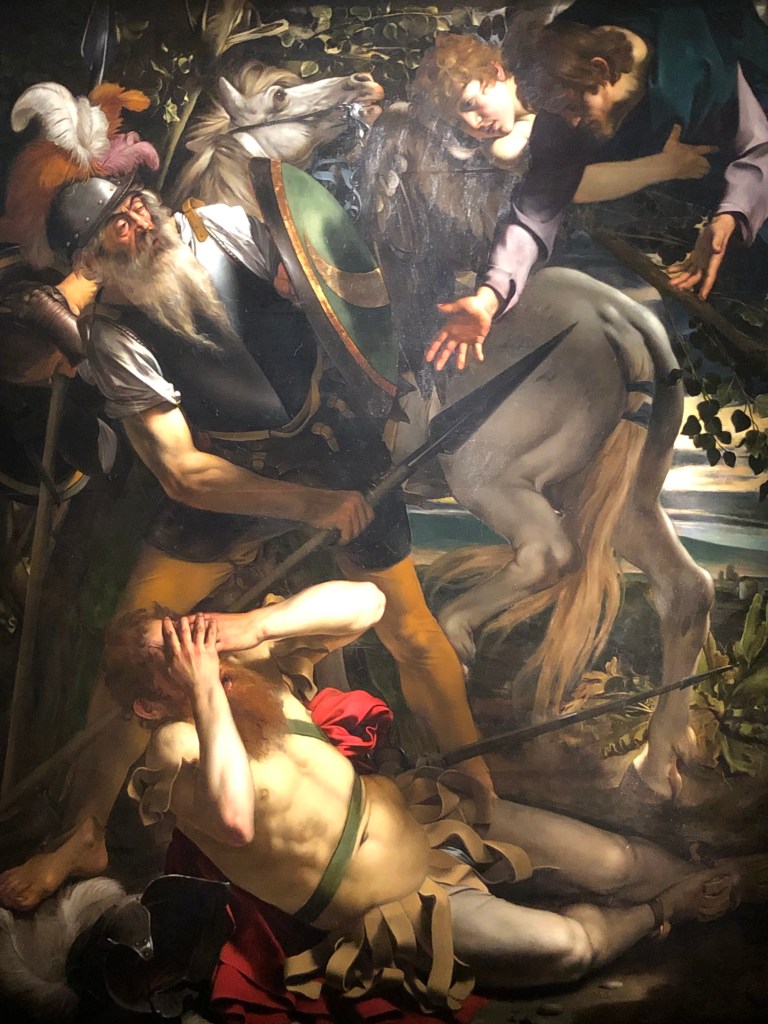
In this uncertain moment, today’s first reading reminds us of a simple but profound lesson: things have been worse. Much worse. Here we see the Church at its very beginning, tiny and persecuted. Stephen, one of the first deacons, has just been killed. The faithful are scattered. Those who persecute the Church are full of zeal, backed by the age’s political powers in all their strength. It seems like a catastrophic moment for the nascent Church, but it becomes a moment of triumph, a moment of growth. The dispersion of the faithful–even if caused by persecution–becomes the condition for the spread of the Word. Soon, we know, even the great persecutor, Saul, will convert and become the greatest missionary in the history of the Church.
Caravaggio, The Conversion of St. Paul, 1600-1
What I most want to emphasize today is the response of the disciples, who transformed this apparent catastrophe into a moment of growth: They continued to preach Jesus. Without panic, without discouragement. They returned and remained steadfast in the most fundamental mission of the Christian: to bear witness to the life, death and resurrection of Jesus Christ.
Today’s Gospel reading also calls us back to the heart of our Catholic faith: “I am the bread of life,” says Jesus. There is no action more important for the Catholic than to encounter the Lord in the Eucharist, in his true body and in his true blood.
Brothers and sisters, despite our anxieties and our doubts, despite the moments of uncertainty that alternate with moments of glory in the life of the Church, this message remains our rock. If we continue to proclaim it, we cannot go wrong. In a few days we will have a new pope, but our mission will not change. Times change. Popes change. Jesus Christ does not change.
Jesus Christ is the bread of life. Jesus Christ is Lord.
Readings: Acts 8:1b-8; John 6:35-40
(Original: Italian)
May 7, 2025
Gregorian University Chapel, Rome
Those interested can see my interview on the CBS Evening News with Maurice Dubois here.
My book Baptism of Desire and Christian Salvation is now available to order, though its shipping date will be a little later. Its official publication date was originally last Friday but now seems to have been bumped to March. I’ve been working on the topic of baptism of desire since my STL studies at Sant’Anselmo–a good six years ago–so it has been a long time coming. I think the result says some important things for Catholic theology and the evangelizing mission of the Church. So let me assure you, it’s worth the wait!
I’ll have more on the topic to say, of course, and I’ll share the reactions of others to the book so you don’t have to take my word for it. For now I’ll just share the official description from Catholic University of America Press. The book is available directly from CUA’s website as well as other online booksellers such as Amazon. This spring CUA is offering a 20% discount on new books with the promo code CT10. Make sure that your library gets a copy, too!
Baptism of Desire and Christian Salvation. Belief in the necessity of baptism for salvation is rooted in the New Testament and was forcefully affirmed by the Church Fathers, yet today this belief is treated with unease if not ignored altogether. Over the course of centuries, Catholic theology has wrestled with a doctrine—baptism of desire—that both preserves this fundamental principle and allows for salvation in hard cases, such as catechumens dying unexpectedly. Baptism of Desire and Christian Salvation traces this doctrine’s varied history, from its genesis in a fourth century funeral oration given by Ambrose of Milan to its uneasy position in the Anonymous Christianity of Karl Rahner.
More than a history, however, this book raises questions about the nature of religious ritual and the sacraments, the mission of the Church, and the essence of salvation. Arguing that theologians of the past two centuries have tended to downplay the role of the sacraments when discussing salvation, Lusvardi suggests that baptism should remain our theological starting point. Engaging with the theological tradition and at times challenging the conventional wisdom, Baptism of Desire and Christian Salvation shows how such a sacramental approach can offer credible—and sometimes surprising—responses to questions related to the salvation of non-Christians, the fate of unbaptized infants, and the relevance of the Church’s mission today.
Not long ago, at dinner in my community in Rome, which houses Jesuits from maybe 30 different countries, one of my brothers from Columbia was talking with one of my brothers from Poland about the different things people eat around the world, and he mentioned hearing that in parts of Asia people eat dog meat. And another of my brothers from the Philippines, who is normally very quiet, looked up from his plate and said, “Oh, yes, very good,” and then he went on with his meal.
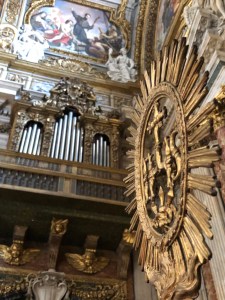
Altar of St. Francis Xavier, Gesù Church, Rome
There is no more diverse an organization in the world than the Catholic Church. Not only do Catholics come from different countries and races and language groups, but the Church includes saints of different historical periods, the great cloud of witnesses mentioned by the letter to the Hebrews last week. The martyrs of first century Rome, of seventeenth century Japan, of 20th century Spain and Mexico, and, in our still-young century, of Turkey, Pakistan, Kenya, Nigeria, France and elsewhere could not have been more different culturally or socially, yet they all shared a belief in Catholicism so strong they were willing to die for it. People have indeed come, as the Lord says, from the east and from the west, from the north and from the south to the table in the kingdom of God, around which we gather this morning.
In today’s second reading, St. Paul warns us of autoimmune disease. An autoimmune disease, as you may know, is when the body attacks itself, one of its own parts. It’s a self-destructive disease. Last week we heard Paul tell the Corinthians, who had been squabbling over who had the better gifts, that all these different gifts come from one Spirit. One Spirit, many gifts.
Today Paul continues the same theme with the analogy of the body. The Church is like a body, with different parts—eyes and ears and limbs and so on—and if jealousy between these parts enters in and the eye stops seeing because it wants to hear, and the legs stop walking because they want to see, and the lungs stop breathing because they want to walk, then pretty soon instead of a body you have a corpse. It is one of the most important metaphors in the Bible, and this morning I’d like to focus on two implications of this metaphor. The first is that bodies share common goods. And the second is that the Body of Christ is meant to be alive.



 Tony Lusvardi, S.J.