Homily for the Feast of St. Ignatius

The feast of St. Ignatius was back in July, of course, but I thought the reflections on discernment in my homily might be helpful in any season. Last year, I was asked for some thoughts on the process of communal discernment used by the Synod on Synodality. These reflections build on those observations.

Inigo the Pilgrim (2017), Church of St. Ignatius, Norwood, South Australia

You might have had the experience of the warning light on your dashboard coming on while you’re driving, signaling that you are low on gas, near the minimum.  Here in South Dakota especially–where outside of the city gas stations can be few and far between–you don’t want to fall below that minimum.  You might end up out in the cold or in this merciless heat—both dangerous circumstances—and in need of a good Samaritan to rescue you.

If you keep your tank filled, however, and don’t fall below the minimum, you can drive wherever you like.  You just plug the destination into the GPS and go.

The warning light and the GPS are both helpful, but they serve different functions—the warning light tells us not to drop below the minimum and the GPS gives us directions.  The readings for today’s feast of St. Ignatius, I think, point to a way of living the Christian faith that goes beyond the minimum.

If we think about the commandments, they are very useful for giving us the minimal rules of the road necessary to avoid an accident or a breakdown by the roadside. Because of this function, most of the commandments are written in a negative form—“Thou shall not…”  Even those that aren’t prohibitions—“Keep holy the Sabbath” and “Honor thy father and mother”—set a minimum of necessary behaviors.  Sunday Mass is the minimum necessary worship if we are to do justice to God, and fulfilling our family duties is the minimum necessary social obligation if we’re to maintain a functional social harmony.

But just doing the minimum isn’t enough to live a fulfilling life or to live a life of discipleship.  If I put on my to-do list for tomorrow, “Don’t kill anyone, don’t commit adultery, don’t steal,” I’ll end up rather bored.  The minimum tells us what to avoid, but not much of what to do.

Continue reading “Homily for the Feast of St. Ignatius”
Gargoyles, east and west

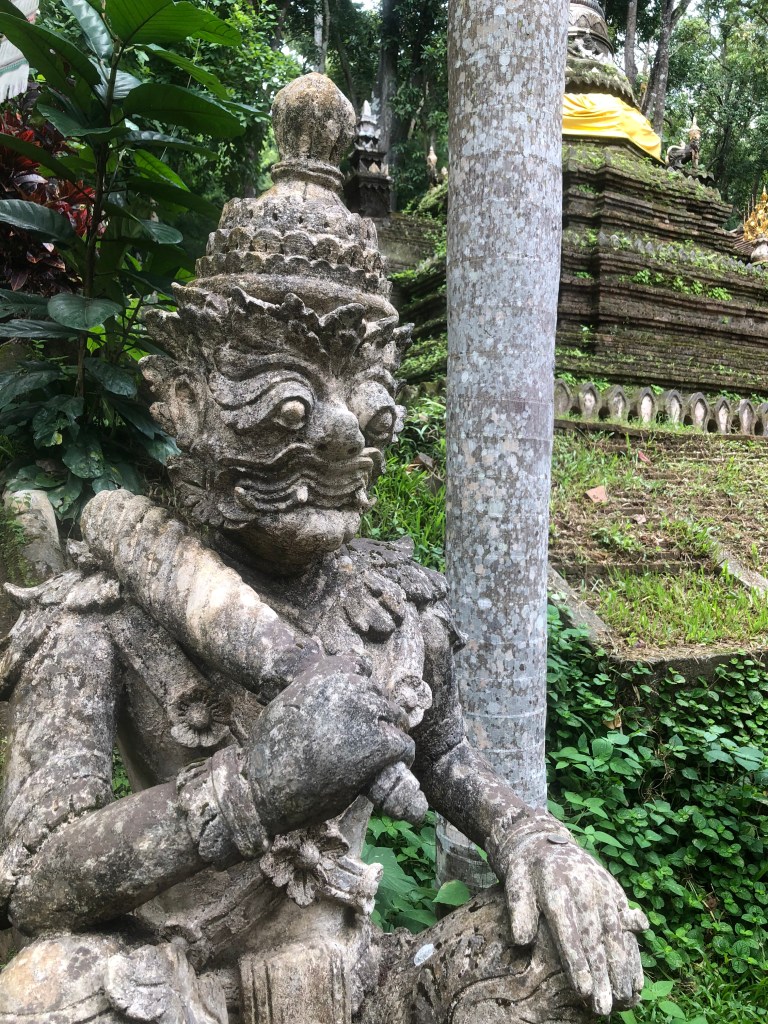
Wat Pha Lat, Chiangmai, Thailand

One of the highlights of my recent travels through Asia was visiting a number of quite impressive Buddhist temples and shrines. This was particularly the case in Thailand, though Chinese temples in Singapore, Taiwan, and Hong Kong were also filled with rich carvings, colorful statues, and piles of offerings including fruit, flowers, and burning incense. The warm red–the color of prosperity–of the Chinese temples reminded me of the red color with which the ancient Romans frescoed the inside of their homes. The desire for a warm hearth is written deeply in the human psyche.

Thian Hock Keng Temple, Singapore

A place of worship that makes an absorbing appeal to the senses is of course nothing new to me. I live in Rome, city of the baroque, where tales of religious ecstasy are told and retold in marble, mosaic, and fresco. The impulse of Christianity to express itself in art goes back to the Incarnation itself, to God revealing himself by entering into the world of the flesh, expressing his divinity in the matter of creation. We Catholics believe that he continues to communicate his grace to us through the sacraments. Artistic expressions using color, smell, and sound to amplify this divine work come naturally enough to a sacramental faith.

But what about Buddhism? Such expressions would seem to me, an outsider, to fit less naturally within Buddhist philosophy, with its distrust of all desire and negation of the world of pleasure and pain. Incarnation and Nirvana are two radically different beliefs. Yet how else to describe the gilded wats of Thailand, the cascades of angels and demons in glittering ceramic, than Buddhist baroque?

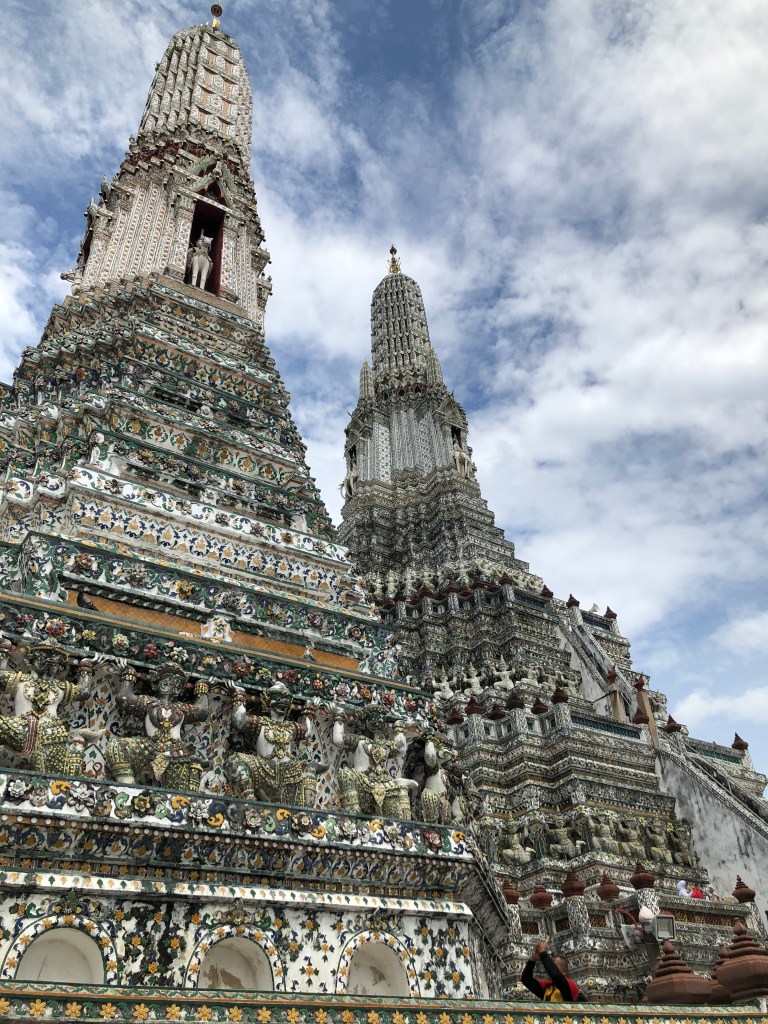
Wat Arun Ratchawaramahawihan, Bangkok

Of course, Thailand’s wats are not the architectural expression of pure Buddhist philosophy but a kind of non-culinary Asian fusion–Buddhism grafted into a still older mix of traditional folk beliefs, legends, and superstitions. How cogent such a mix is, I can’t evaluate. But there’s something human about that folk mix that I find more compelling than Buddhism in its purity, which I’ve always thought a little chilly.

Continue reading “Gargoyles, east and west”

What is wisdom? Homily for the twenty-third Sunday of Ordinary Time

Homily for the 23rd Sunday in Ordinary Time (C).

I’m back to my day job in Rome, so this week I’m posting a homily from 2016, given the day after my ordination to the diaconate.

Ordination to the diaconate 2016, St. Ignatius Church, Boston, MA

Today’s Gospel reading is perhaps the single most unfortunate passage in Scripture to have to preach about to a congregation consisting mostly of family members, so we’re going to work our way up to it by starting with the Old Testament.

The Old Testament reading is from the Book of Wisdom.  You’ll be happy to know that I took an entire course on the Biblical wisdom tradition and have prepared a brief 45-minute summary as an introduction to the homily.  We can skip all that, however, if you will consider for a moment the question of what it means to be wise.  

To understand what wisdom is, it can be helpful, first, to think about what it is not.  Wisdom is not the same thing as being clever; we probably know people who are clever manipulators, for example, but not really wise.  Wisdom is not the same as knowledge, as knowing lots of facts.  Teachers know that there’s a difference between a student who memorizes what he hears and then regurgitates it, and a student who actually thinks about what she’s learning.  Wisdom is not the same thing as being educated.  If you’ve been in school as long as I have, you realize that there are some very foolish people with PhDs.  And we all probably know people who didn’t receive much education who nonetheless we’d consider wise because they had a sense for people, a sense for what was right and wrong, a sense for what really matters in life. 

Continue reading “What is wisdom? Homily for the twenty-third Sunday of Ordinary Time”

Catholic self-help

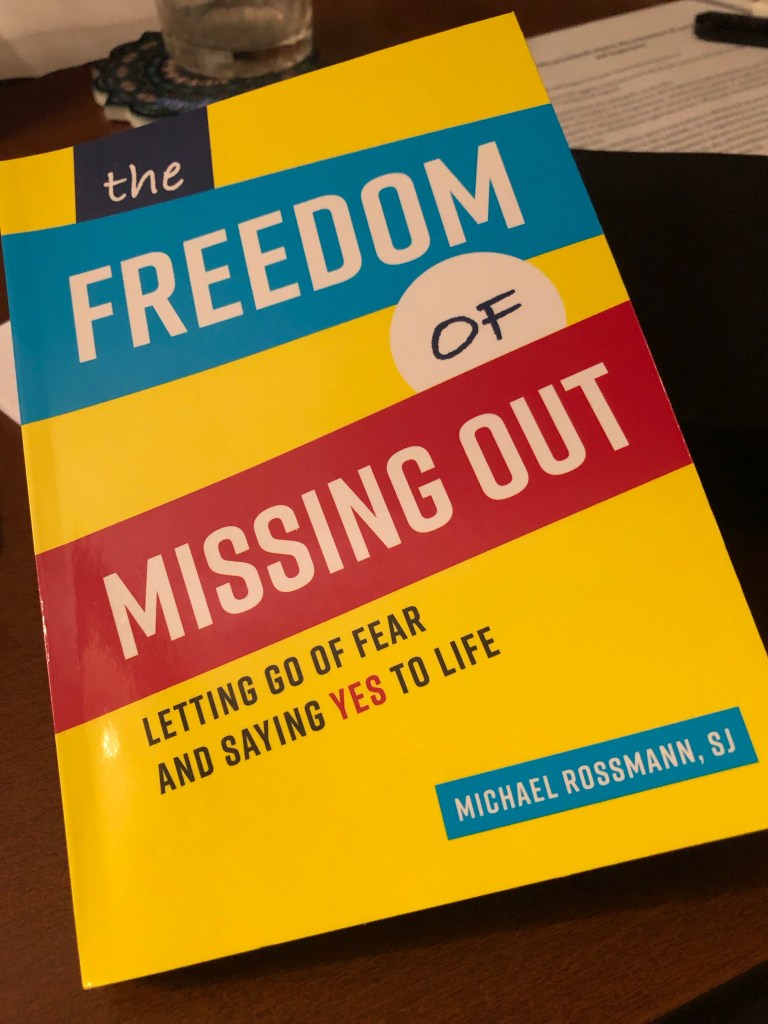
My friend and Jesuit classmate Fr. Michael Rossmann has just published a book, which upon its release held the status of Amazon’s #1 book in “self-help for Catholics”. Actually, I didn’t know there was such a category (and neither did Fr. Rossmann).

Inside the snappy cover, Fr. Rossmann makes a point I think is very important today — really saying yes to something or someone means saying no to other things. Never committing in order to keep one’s options open means refusing to choose the things that matter most.

The book is called The Freedom of Missing Out and continues the long Jesuit tradition of practical help for good decision-making that goes back to St. Ignatius’s rules for discernment. In fact, the influence of Ignatius is not far below the surface, though the book is illustrated with examples from all walks of life and lots of contemporary research. While Rossmann draws on the best of the Catholic tradition, his words about commitment and freedom will ring true to people of any religion.