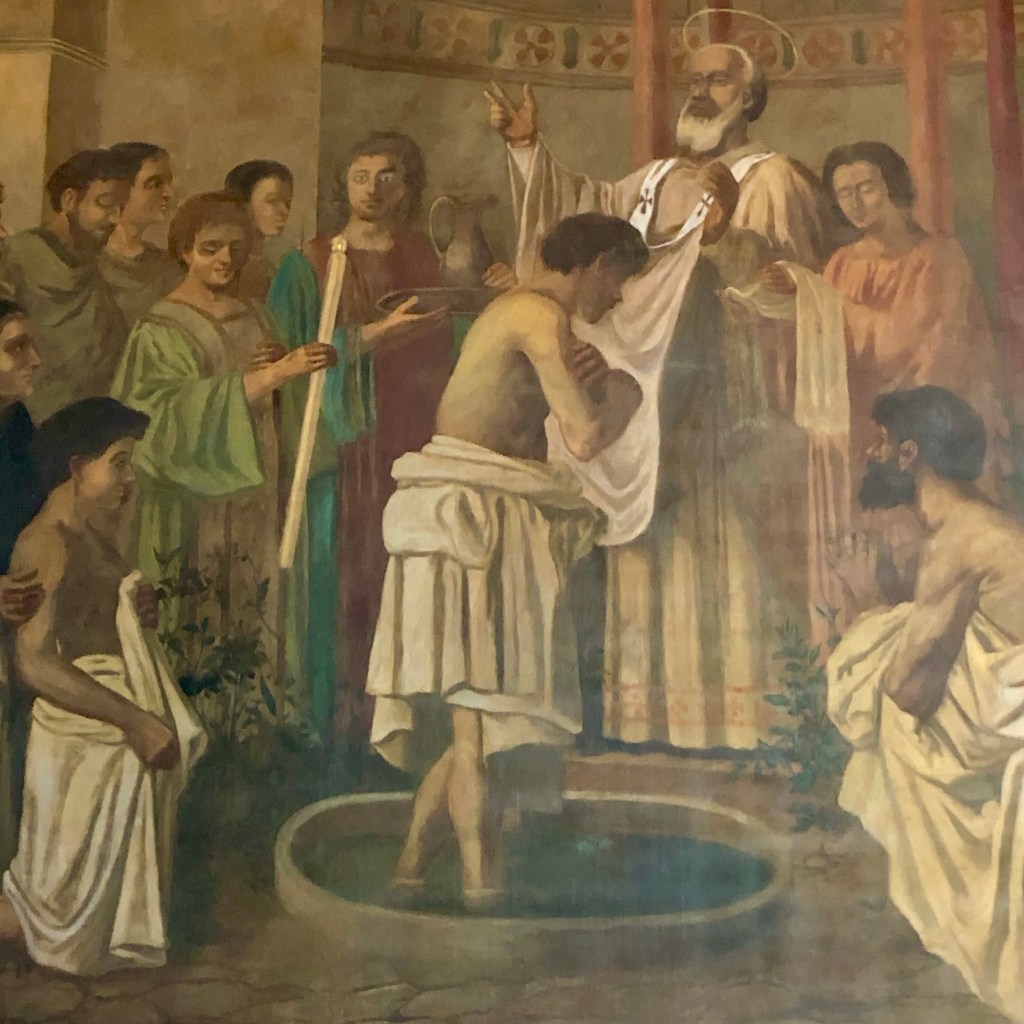
Baptism of St. Augustine (copy), Tito Troya, San Augstin Museum (Manila0
In these two readings, we see the two points of the compass for our Lenten journey. These points are also the two sides of the sacrament of baptism, to which this journey is directed.
The first reading speaks of freedom from evil: freedom from war and oppression; the end of exile in a devastated land; liberation from captivity, darkness, hunger, thirst, and abandonment. The joy that the prophet Isaiah expresses comes from the defeat of these evils that oppress us. The ascetic dimension of Lent is motivated by the desire to be freed from the forces that hold us captive: sin and selfishness.
But the purpose of Lent is not empty freedom. Rather, it is a freedom that allows us to live in a new relationship with the Lord. In the Gospel, Jesus emphasizes his relationship with the Father. And we, at the end of this Lenten journey, hope to renew the gift that was given to us in baptism: the gift of a new relationship with the Father, the gift of being reborn as his adopted children, the gift of the Spirit of Jesus who transforms us. Jesus speaks of intimacy with God.
With yesterday’s feast of the Baptism of the Lord reminding us of the beauty and uniqueness of the sacrament of baptism, it seemed an opportune moment for an update on my work on baptism of desire. I’ve continued to do a bit of research on the question of infants that die before baptism and posted some reflections on the issue here and here late last year.
The Baptism of the Lord (above), Guglielmo of Pisa (1160), pulpit, Cagliari cathedral (Sardinia)
The Baptism of the Lord, El Greco
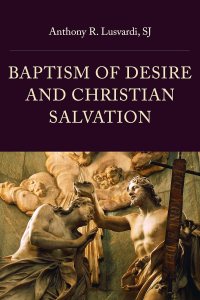
Reviews of Baptism of Desire and Christian Salvation continue to come out, so far all deeply appreciative. Theology today is no longer an exclusively European enterprise, so I’m especially excited to have an international response to the book. The Hekima Review, Africa’s leading theological journal, recommends it for both “Catholic clergy and lay people as it foregrounds the pastoral implications of the doctrine and the need for evangelisation.” Meanwhile, India’s top theological journal, the Vidyajyoti Journal of Theological Reflection published a particularly detailed and insightful review, which noted the specific value of the book in the context of Indian religious pluralism. It expressed the hope that the book would become the standard “theological ‘textbook'” for discussing such issues. The reviewer also picked up on the way the work responds to the deeper philosophical currents of the twentieth century:
This work belongs to what the dogmatic theologian José Granados has identified as a corporeal turn in theology, an emphasis on the body after the heady years of the twentieth century that – whether primarily or exclusively – emphasized cognition. This corporeal turn has meant a returning emphasis on not just the body, but the embodied nature of the Christian faith. It recognizes that the embrace of the faith cannot be restricted to some conceptual nod, but must necessarily embrace ritual, and recognize that the materiality of ritual is important. As Lusvardi writes “The instinct of the early Church to emphasize the ritual was not wrong, for the ritual says and does what nothing else can” (p. 342). In stressing the importance of the corporeal, Lusvardi’s work also becomes part of the corpus of the critique of modernity, which consciously, or unconsciously, seeks to restore a holistic view of the world, sundered through modernity’s adoption of Cartesian binaries, and has powered so much of Indian post-colonial thought.
Closer to home, The New Ressourcement journal said:
Lusvardi’s excellent book … is a must-read for anyone interested in the history of baptism, the nature of sin and salvation, or the hope for non-Christians and infants. It is hard to do justice to the extensive ground this book covers. In a compelling way, it draws the reader to see that the good news of Christian salvation is truly good news for its hearers precisely because the experience of Christ’s saving death and life is available to all in baptism.
Baptism of Desire and Christian Salvation in an Indian stole
The reviewer also offered a defense of the standard scholastic approach to the doctrine, aspects of which I call into question in the book–evidence, I think, that the issues the book raises are worthy of robust theological examination and debate.
So put it on your reading list for the new year!
Baptism of Desire and Christian Salvation is available from Catholic University of America Press (20% discount with the code CT10), Amazon, and other online booksellers. I have collected reviews, interviews, and other news here.
Homily for the Immaculate Conception (2019. Note, that year, the Solemnity fell on a Sunday.)
On the first Sunday of Advent, I cleaned my room. I must admit, it needed it—there were coffee stains on the desk; the trash can was overflowing; I found forgotten lists of things not to forget. But Advent is the beginning of a new liturgical year, the season when we prepare for Christmas, and it seemed right to start with a clean room. In the coming weeks, there will be many other things to prepare: food, gifts, decorations, travel.
Column of the Immaculate Conception, Rome
This is the second Sunday of Advent, and normally the readings highlight the figure of St. John the Baptist, who speaks of another kind of preparation, another kind of cleaning—in fact, a much deeper cleaning than coffee stains. John the Baptist warns of the need for inner cleansing, moral and spiritual conversion. And this too is part of the preparation for Christmas. As a confessor, I have to do a little advertising for my profession, strangely absent from all the Black Friday advertising we received last month. But I must say that our special offer—the forgiveness of sins, eternal life—is truly the best deal in the world.
However, this year is a bit special, because this second Sunday of Advent is December 8, the Solemnity of the Immaculate Conception of Mary, the Mother of Jesus. This coincidence of dates is interesting because the Immaculate Conception is also a feast of preparation. But not the preparation we do during this season. The preparation that God has done for us.
Those of you who have been following this blog know that over the summer I was put in touch with a group of people dedicated to telling the story of baby Brian Gallagher, an infant who died shortly after his birth but whose body was discovered to be apparently incorrupt 37 years after his burial. Because Brian was not baptized before he died, the story raised the question of the eternal destiny of babies who die before baptism and my work on baptism of desire.
That story has started to get attention in several Catholic media outlets, and last week I had the chance to talk about baptism of desire on Real Presence Radio; you can listen to the interview here .
Hats off also to Dr. Kody Cooper for his opinion piece about baptism of desire and infants on the Word on Fire site. The author comes to similar conclusions to my own, arguing that baptism of desire is the best theological doctrine with which to consider this tough case, even citing Cardinal Cajetan who I discuss in my book . Baptism of desire seems to me a superior approach to what the author calls the “post-conciliar view,” which means hoping that the babies will be saved while remaining agnostic about the means. This approach, it seems to me, has two serious flaws. It seems to invite hope in a kind of divine Plan B which turns out to be more effective than those means revealed to us by Jesus. Revelation, then, seems not so revealing. At the same time, precisely because whatever those means happen to be can’t be found in revelation, such hope remains necessarily vague and not particularly well-grounded.
Baptism of desire, on the other hand, identifies our grounds for hope in the Church’s sacramental practice — the practice of a sacrament instituted by Jesus Christ and declared by him to be necessary for salvation (John 3:5). I posted a brief description of my position on the question here a few weeks ago.
As I mentioned earlier, over the summer God’s providence brought me into contact with a group of people dedicated to sharing the story of Baby Brian Gallagher. The circumstances of Baby Brian’s short life raise the question of babies who die before baptism and baptism of desire, and the group asked me to write up a one page summary of the argument I present in my book Baptism of Desire and Christian Salvation. Of course, for the full story–and much else besides–buy the book! What I wrote is not intended as a full pastoral response to those who have lost a child too soon, but a very brief sketch of the theological issues involved.
Theologians have a precise mission within the Church. Our task is not to “create” the truth, but to use the tools of reason and study to understand better what God has revealed to us. When it comes to salvation, theologians don’t “decide” what the Church believes; we merely try to express with greater clarity what we find in Christian revelation.
Good theologians, then, must be humble and cautious in what they claim. Historically, theologians have found the question of what happens to babies who die before baptism particularly difficult. We know that baptism is necessary for salvation (John 3:5) because baptism is the unique way Jesus has revealed for us to participate in his death and resurrection (Romans 6:3-5). At the same time, the doctrine of baptism of desire has found strong support among theologians and in the Church’s official teaching. Baptism of desire does not deny the necessity of baptism or create an alternative to the sacrament. Instead, the doctrine means that those who desire the sacrament but are prevented by circumstances beyond their control from receiving it can still obtain baptism’s effect—rebirth to eternal life.
Historically, most—but not all—theologians have had trouble seeing how baptism of desire could apply in the case of infants who are too young to formulate a desire of their own. After a decade studying baptism of desire, however, I believe that these theologians have tended to leave out a decisive piece of evidence: our practice of the sacrament of baptism. The key theological principle that has been neglected up until now is known as lex orandi—lex credendi, which means “the law of prayer is the law of belief.” In other words, the way we celebrate the sacraments is itself a guide to what is true. In this case, the Church’s firmly-established practice invites us to look more deeply into how to understand the desire for baptism in regard to infants.
The October start of the Roman academic year means that I am wrapping up my time in the States before heading home (and back to work!) next week. Nonetheless, I haven’t been idle over the course of the summer. In addition to seminars and retreats, I published a couple of articles which might be of interest.
First Things asked me to weigh in on the questions surrounding transsexuals and the sacrament of baptism: Can Transsexuals Be Baptized?
The relationship between salvation and evangelization, however, is only one of the difficult questions my book addresses. I also suggest a new approach to the question of unbaptized infants and children dying in utero. This summer, I was contacted by some folks involved in ministry to Catholic parents who have lost children either through miscarriage or in early infancy. I found a quite enthusiastic reception for my work among those who are involved in this kind of grief ministry, and, a week ago, a group of the faithful put up a statement online in support of the position that I advance in my book: that baptism of desire can, in some cases, apply to the children of Christian parents. You can find this statement in support of the development of doctrine I outline here and sign if you wish: A Statement of Hope regarding Salvation through Baptism of Desire for Infants.
The statement also mentions the case of baby Brian Gallagher, whose grave I visited at Black Hills National Cemetery. On the outskirts of the cemetery I snapped a photo of a quintessentially American scene: a giant flag waving from a piece of heavy machinery with the Western landscape in the background. What else is there to say but, God bless the USA!
Homily for the twentieth Sunday in Ordinary Time (C).
The word “Jesuit” was first used to mock the early followers of St. Ignatius of Loyola. These first members of my religious order, the Society of Jesus, were derided for talking so much about Jesus and were given the name “Jesuit,” condescendingly, by those who apparently thought they had something better to talk about. Those first Jesuits took the criticism as a compliment, and the name stuck.
The letter to the Hebrews tells us to keep our eyes fixed on Jesus, and the Gospel’s hard words make the same point in dramatic fashion. We’ll return to the Gospel in a minute, but I want to start with the striking passage from Hebrews. The letter tells us to keep our eyes fixed on Jesus so that we can “persevere in running the race that lies before us.” Races, by definition, are challenging events. It is possible to lose a race by giving up, by going off course, by laziness, by getting tripped up on some obstacle. Hebrews tells us to “rid ourselves of every burden and sin that clings to us.” Sins are the sort of thing that will slow us down, trip us up, or send us running in the wrong direction. Running a race usually requires training, and Christianity is no different. We aren’t born Christians. Perhaps a century or two ago when our whole society was Christian, it was possible to imagine that we were, that being a Christian was the same thing as being a good citizen or an agreeable person, just going with the flow. That was always an illusion, and it is even more so today when the forces that shape our culture are often hostile or indifferent to Christianity.
Baptism of Desire and Christian Salvation has now been out long enough to begin generating some discussion, and I’m grateful to have seen a number of new reviews and reactions over the past few months.
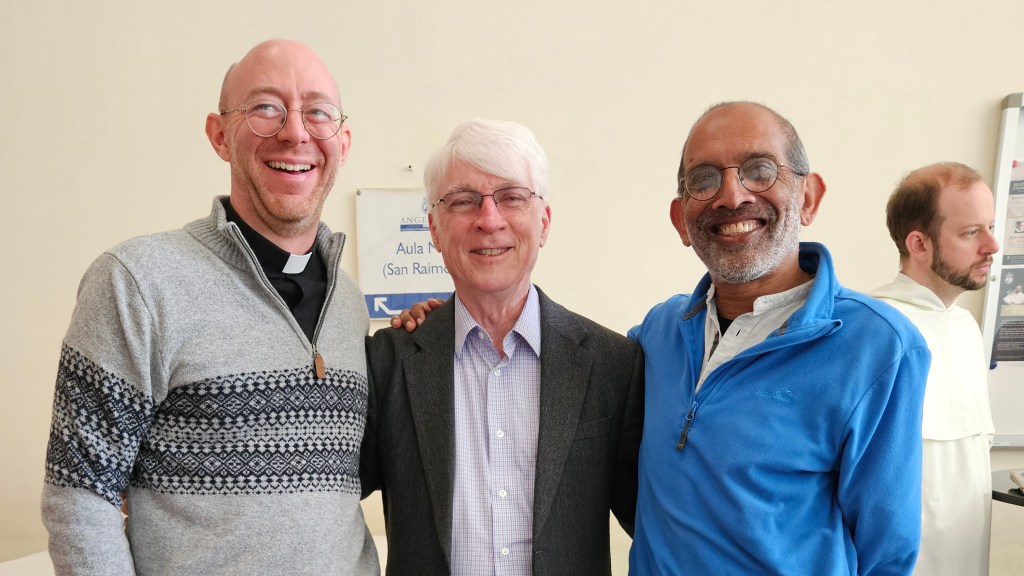
With Dr. Ralph Martin and Dr. Gavin D’Costa
I was delighted to see Dr. Ralph Martin, one of the world’s top authorities on the new evangelization, mention the book in his latest update at Renewal Ministries. Dr. Martin mentions meeting up while he was visiting Rome. I had a charming and stimulating conversation with him and his wonderful wife Anne, as well as a number of equally enjoyable conversations with Dr. Gavin D’Costa, whom he also mentions, an expert on world religions who teaches at the Angelicum. We also discussed Dr. Martin’s book Will Many Be Saved?, which I cite in my work. I’m deeply honored that he considers Baptism of Desire and Christian Salvation “a very solid and brave work of scholarship that faithfully presents the doctrinal and moral implications of the Church’s–and Jesus’–insistence on baptism to be saved.”
I’m equally grateful to have stumbled upon the careful and detailed review and summary of the book by Fr. Richard Conlin at The Prodigal Catholic Blog. I’m especially glad that Fr. Conlin considers the book “a must-read for anyone who wants to understand how salvation works in the Church’s tradition–especially in ‘hard cases’ like the unbaptized, non-Christians, or infants” and that he highly recommends it “especially for priests, catechists, and anyone serious about the faith.” A scholarly book such as Baptism of Desire and Christian Salvation might seem intimidating, but I think this one is important for more than just an academic audience. My intention was always that it would be accessible not just to specialists but to anyone with a theological background. So it’s encouraging to read that Fr. Conlin found it “both theologically rich and remarkably readable–a rare combination.”
Those who read Italian might check out the insightful review in Ecclesia Orans by Prof. Paolo Trianni, who recognizes the theological approach as “innovative” because it seeks to overcome a “legalistic concept of the sacrament” present at times in scholasticism and neo-scholasticism.
Finally and somewhat unexpectedly, I was recently contacted by Brianne Edwards of Rapid City, who brought to my attention the remarkable story of baby Brian Thomas Gallagher, who died 43 minutes after his birth in 1982 and whose body was found to be apparently incorrupt in 2019. He happens to be interred at Black Hills National Cemetery. I discuss the possibility that infants can receive baptism of desire in the book, and Baby Brian’s case seems almost to have been designed to fit the argument I make. I’ll have more to say on the subject in the future…
In the meantime, remember that Baptism of Desire and Christian Salvation is available on Amazon, directly from Catholic University of America Press (20% discount with the code CT10), and at other online booksellers.
Homily for the seventeenth Sunday in Ordinary Time (C)
Guido Reni, Trinity of the Pilgrims (1625-6)
Readings: Gn 18:20-32; Col 2:12-14; Lk 11:1-13
A few weeks ago, some friends were talking about watching a movie. They knew that it took a dark twist at the end, so they hit the stop button early to avoid the tragic finish. That’s exactly what happens in today’s first reading. The wickedness of Sodom and Gomorrah becomes too great for God to ignore, and he decides to destroy the cities. Abraham questions him, as if bargaining him down. If just ten innocent people remain, God will spare the cities. But, as you probably know, if you read on, God does destroy the cities. They did not contain even ten good men. They were corrupt from top to bottom.
Still, it’s not an accident that today’s reading stops where it does. The premature ending focuses our attention on God’s reaction to human corruption. He is not eager for destruction or motived by vindictiveness. To use the terms of later Christian theology, we could say that the destruction of Sodom and Gomorrah is one of the many stories in the Book of Genesis that express the reality of Original Sin. The Biblical message is clear: None of us is innocent. Mankind is corrupt from top to bottom. God’s reaction to Abraham—his desire to spare the innocent—shows that the destruction wrought by Original Sin is not what God wants. Our sinfulness is self-destructive.
If self-destruction were the end of the movie, we could understand turning it off early. But God’s full response to human sinfulness, which unfolds in the New Testament, is not to strike a deal, to plea bargain, or to negotiate. Nor is it to ignore our sinfulness or to excuse it. It is not to declare a new paradigm in which there are no longer any moral absolutes and what was once sinful is now OK, if circumstances are right or you get your pastor’s permission. No, God’s reaction is something else entirely. As St. Paul tells the Colossians, God has removed sinfulness from our midst by “nailing it to the cross.”
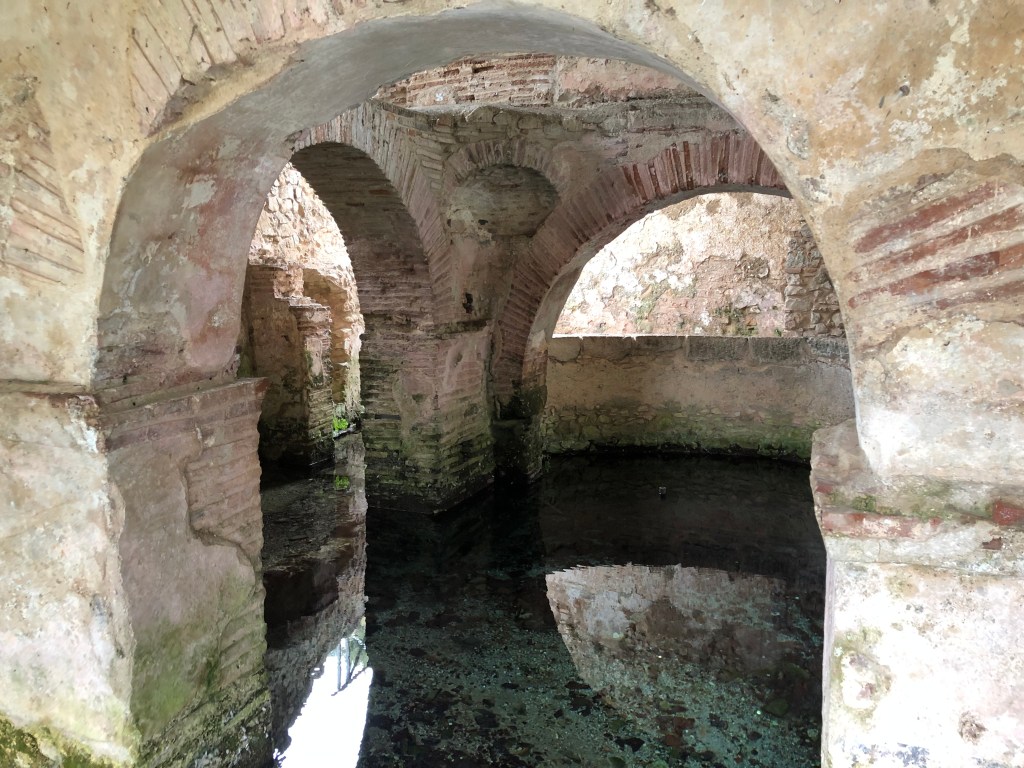
An unexpected discovery on my recent trip to Italy’s Cilento was the Baptistry of San Giovanni in Fonte, just outside of Padula. Also known as the Battistero Marcelliano, after Pope Marcellus, it dates from the fourth century, putting it among the oldest Christian structures in the world. A letter from Cassiodorus in AD 527 mentions a miracle occurring at the baptistry, its water level rising unexpectedly while a priest was pronouncing the prayer over the baptismal waters on the vigil of the feast of St. Cyprian.
Battistero di San Giovanni in Fonte, Paula, Italy
The structure itself sits on the site of a natural spring, so the baptismal font was a pool of “living” water. The baptistry was built on the ruins of an earlier pagan structure and underwent several renovations and expansions throughout history. Hints of a fresco, dating from the 11th century when the structure was converted into a chapel, remain on the wall. The remains of still earlier frescoes from the 6th and 7th centuries were removed and taken to a local museum.
Rising water levels caused the chapel to be abandoned in the 19th century, though the site of the remains and spring, down a winding country road, are quite a pleasant spot today.
This reminder of baptism from Christianity’s earliest days is worth reflecting on during the Easter season. I discuss some of the theological and practical consequences of the shift away from the patristic catechumenate and toward near-universal infant baptism in the Christian cultures of the Middle Ages in Baptism of Desire and Christian Salvation, but the subject is worth more reflection than what I’m able to give it there.
Reflecting on early Christian baptismal practices is important because we are moving into a new phase in Christian history that in some ways will more closely resemble the Church of the Fathers — in which Christianity was a minority — than medieval Christendom. Some of our sacramental practices, I am convinced, will have to shift to respond to this new reality. This may not be entirely a bad thing. When it comes to baptism, for example, too often the sacrament, celebrated in a minimalistic way, has become a mere formality with little connection new life in Christ.






 Tony Lusvardi, S.J.