Choose life, South Dakota: homily for the twentieth Sunday in Ordinary Time

Homily for the 20th Sunday in Ordinary Time (B)

If there is one theme consistently present throughout the whole Bible, from the first chapter of Genesis to today’s Gospel, it is that God desires to give us life.  When he reveals the commandments to Moses on Mount Sinai, he tells the people of Israel, “I have set before you life and death, the blessing and the curse.  Choose life, then, that you and your descendants may live” (Dt 30:19).  Today the Eucharist too is presented as life-giving: “The bread that I will give is my flesh for the life of the world” (Jn 6:51). 

It is fitting that today’s readings would highlight God’s desire to give us life, because, as I mentioned last week, the bishops of South Dakota have asked us to speak these two Sundays about a particularly urgent social issue: a measure, Amendment G, has been placed on the ballot this November, which would add the right to abortion without significant limits to the South Dakota constitution.  As I pointed out last week, Christianity is not a political program, and Catholics can disagree about most political issues while still remaining faithful to the principles of our faith.  Amendment G, however, is impossible to reconcile with the fundamental principle that it is always wrong to deliberately kill an innocent human being.

This principle is something that both conservatives and liberals should be able to embrace.  Conservatives emphasize the government’s duty to protect and not usurp individual rights, and without the right to life no other rights are possible.  Even a libertarian “live and let live” philosophy only works if you let the other live.  Take away the right to life and you have neither conservative government nor a free people, but the oppression of the weak.  

Continue reading “Choose life, South Dakota: homily for the twentieth Sunday in Ordinary Time”

Taking the gold for Team Humanity: homily for the Assumption of the Blessed Virgin Mary

Homily for the Assumption

Raphael, Coronation of the Virgin, Vatican Museums

My brothers and sisters, I’m no angel.  Before you respond with too much glee, “Oh, Father, we know,” let me point out—you’re no angels, either.

Now, when people say, “He’s no angel,” usually what they’re saying doesn’t mean what they think it does.  Usually, if someone says, “He’s no angel,” they mean, “He’s not so nice.”  Maybe there are a few skeletons in his closet.

But not all the angels were good.  Lucifer and the demons are angels, and they have so many skeletons there’s no room for clothes in their closets.  Today’s great feast is dedicated to a woman who never sinned.  But today, the feast of the Assumption, we celebrate the fact that Mary is no angel.  She is a human being.  A woman.  One of us.

You see, because the real reason demons don’t have clothes in their closets is because they don’t have anything to wear them on.  Angels don’t have bodies.  But we do.  That’s the difference between angels and human beings.  Otherwise, we’re quite a bit alike.  We both have intelligence and free will—which is how the fallen angels sinned.  The big difference is the body.

Today we celebrate the fact that at the end of her life on earth, Mary’s body entered immediately into heavenly glory.

And, my friends, this is not some bit of religious trivia, but something very, very important for each one of us.  Because it means that to be saved, to enter into heavenly glory, we don’t have to give up being human.  We don’t have to become angels.  God wants to save us as human beings, which is why his plan for our salvation involved taking the flesh of Mary, a woman, to become a man, so that we, women and men, might be saved in our human bodies.

Continue reading “Taking the gold for Team Humanity: homily for the Assumption of the Blessed Virgin Mary”

The Last Supper, the French Revolution, and Aleksandr Solzhenitsyn

Readers of this blog might be interested in this article America asked me to write on the Last Supper Olympics controversy. A bit of historic context and a bit of tongue-in-cheek… I may have had a warrant issued for my arrest in France.

I think Solzhenitsyn’s critique of the French Revolution is particularly important and something I hope to follow up on in the next book project.

And speaking of books, if you haven’t already ordered your copy of Baptism of Desire and Christian Salvation, do so quick. They’re selling like hotcakes here in Rapid City…

Bread of life or never-ending breadsticks? Homily for the eighteenth Sunday in Ordinary Time

Homily for the 18th Sunday in Ordinary Time (B)

If there were an Olympic event for complaining, the ancient Israelites just might take the gold medal. Today, after being liberated from slavery, they ask to go back, forgetting the oppression they suffered in Egypt and remembering the country as an ancient Olive Garden with fleshpots and never-ending bread sticks.  Hearing their complaint, God sends them manna and quail to eat, but we know that soon enough they’ll start complaining again—“Manna again?  We want leaks and onions, not these leftovers!”  And they’ll attack Moses: “Why’d you have to lead us out here?  Weren’t there enough graves in Egypt?”

The preaching of St. Paul, Rabat, Malta

But, if complaining were an Olympic event, the competition would be fierce.  I suspect there’s something deep in our human nature—some survival mechanism from caveman days that made our ancestors less likely to be eaten by sabretooth tigers or stomped on by wooly mammoths if they were quicker to see the negative than the positive, more inclined to fear than to gratitude.  The problem is if you’re not being stalked by a sabretooth tiger, this instinct for the negative sometimes results in clubbing our friends or retreating into the darkness of our own self-constructed caves.  

Continue reading “Bread of life or never-ending breadsticks? Homily for the eighteenth Sunday in Ordinary Time”

Leftovers transformed: homily for the seventeenth Sunday in Ordinary Time

Homily for the 17th Sunday in Ordinary Time (B)

Miracle of the Loaves from the Triptych of the Miracles of Christ, Master of the Legend of St. Catherine, Flanders 1491-5, National Gallery of Victoria, Melbourne

Today’s readings give a prominent place to leftovers.  In the hands of the prophet Elisha, twenty barley loaves manage to fill a hundred people, with some left over.  When Jesus feeds the five thousand, the leftovers—twelve baskets—exceed the amount of bread there was to begin with—just five loaves.

It’s worth noting that the disciples go to the trouble of collecting the leftovers after the impromptu meal.  Living in an age of abundance, perhaps we are used to throwing leftovers out or letting them molder in the back of the fridge, but letting leftovers go to waste is a luxury most people in history didn’t have.  Certain recipes popular today were originally invented to use stale bread—bread pudding, for example, or the Tuscan bread soup known as ribollita.  The funny thing about ribollita is that what started out as a peasant dish today is served in pricey and fashionable restaurants.  What was once leftovers has become high cuisine.

There’s something deeply Christian in this transformation.  Ours is a faith, after all, in which the stone rejected by the builders becomes the cornerstone, the last become first, the meek inherit the earth, the poor are filled with good things while the rich go away empty, the blood of martyrs becomes the seed of faith, and in dying we are born to eternal life.  We believe not just that leftover bread can be transformed into a savory dish, but that utterly ordinary bread and wine are, in the sacrament of the Eucharist, transformed into the body and blood of Jesus. Moreover, if we approach the sacrament in faith, we too are transformed into the body of Christ; our weak and too often sinful flesh becomes the dwelling place of the Holy Spirit.

I have a friend, a Filipino Jesuit who comes from a family of restauranteurs and is an amazing chef.  He has a particular genius for being able to walk into any kitchen, open the refrigerator, glance over whatever leftovers are inside, spend half an hour spicing and mixing and reheating, and produce a feast that was better than the original meal.  Our Christian faith is something like this.  At its heart is belief in the possibility of transformation.

Continue reading “Leftovers transformed: homily for the seventeenth Sunday in Ordinary Time”

IHSes and resigning popes

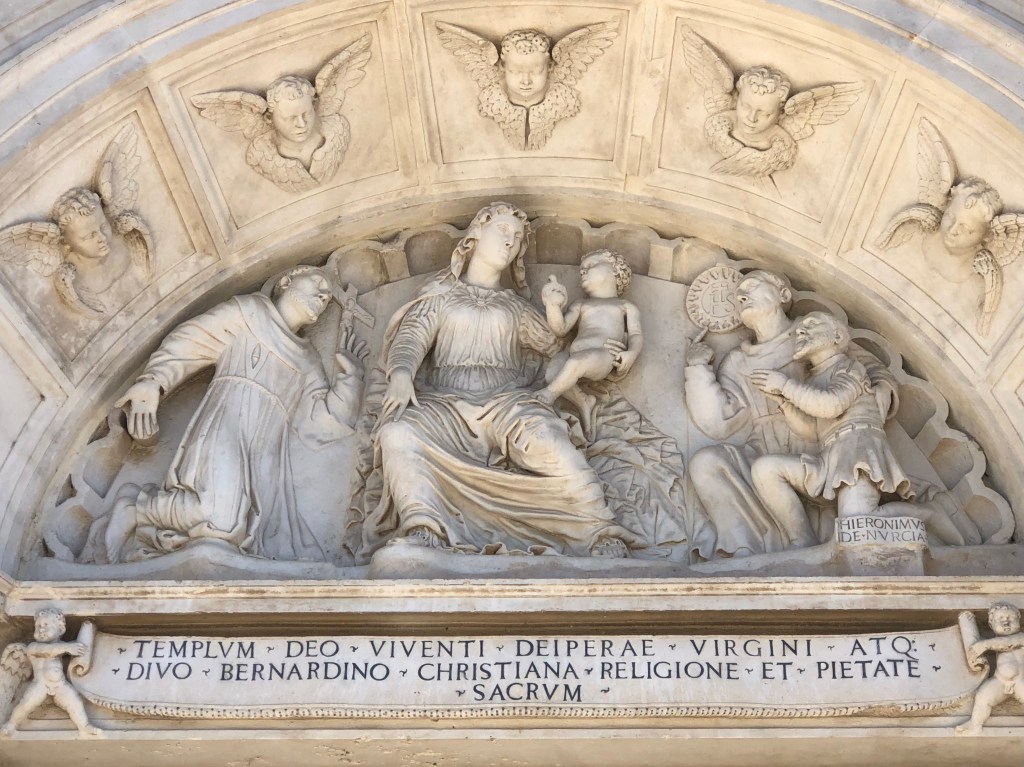
Basilica of San Bernardino, L’Aquila

Last month the Gregorian Jesuits took our spring community outing to L’Aquila, capital of the Abruzzo region. L’Aquila was most recently in the news for a 2009 earthquake that tragically killed over 300 people. Most buildings in the city have been restored, though construction still abounds.

Highlights of the trip were two churches. The first, the Basilica of St. Bernardino of Siena, is dedicated to the Franciscan preacher (1380-1444) with a great devotion to the name of Jesus. In fact, in images of St. Bernardino one frequently sees the IHS Christogram–using the Greek letters for the name of Jesus. The “IHS” was later taken up, of course, by the Society of Jesus. The IHS sunburst with the three nails of Christ’s passion is prominently displayed all over the Basilica of San Bernardino. The saint died in L’Aquila and is buried in the basilica.

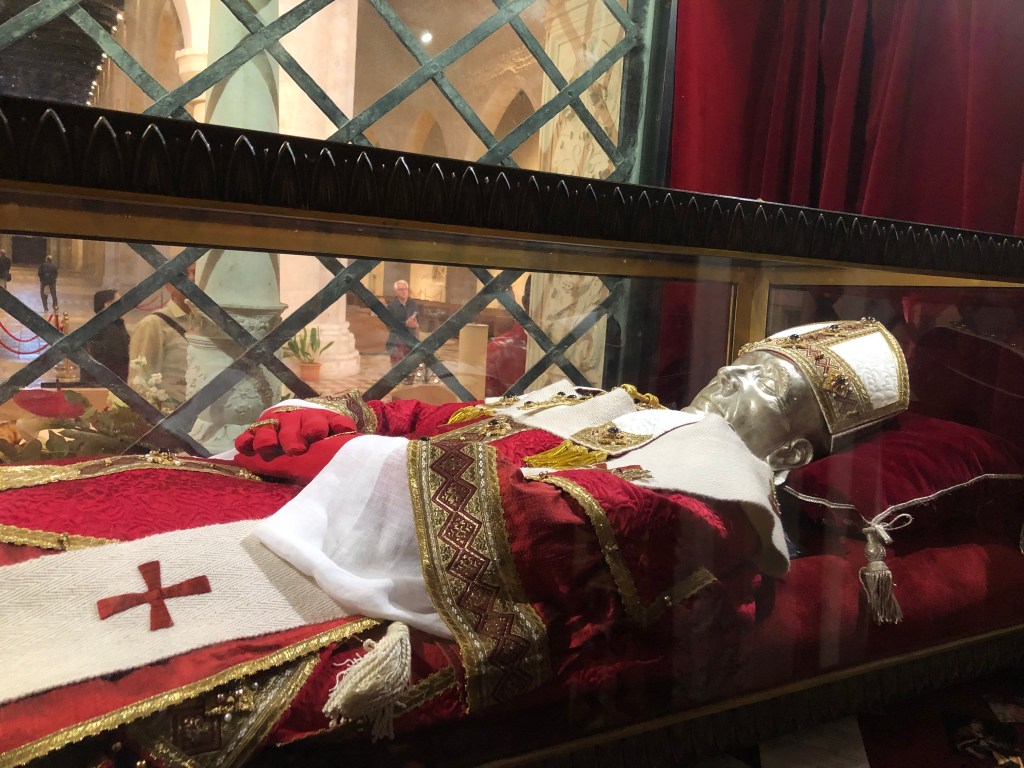
Tomb of Pope St. Celestine V, L’Aquila

L’Aquila’s other iconic church is Santa Maria di Collemaggio, burial place of Pope Celestine V (1215-1296). It is known as the Church of Pardon because of the plenary indulgence Celestine attached to the church–what locals refer to as an annual Jubilee. Celestine’s papacy, however, could hardly be considered a success, and he resigned after only a few months in office. He was a holy hermit, perhaps never really cut out to be pope.

Continue reading “IHSes and resigning popes”

Cagliari cathedral

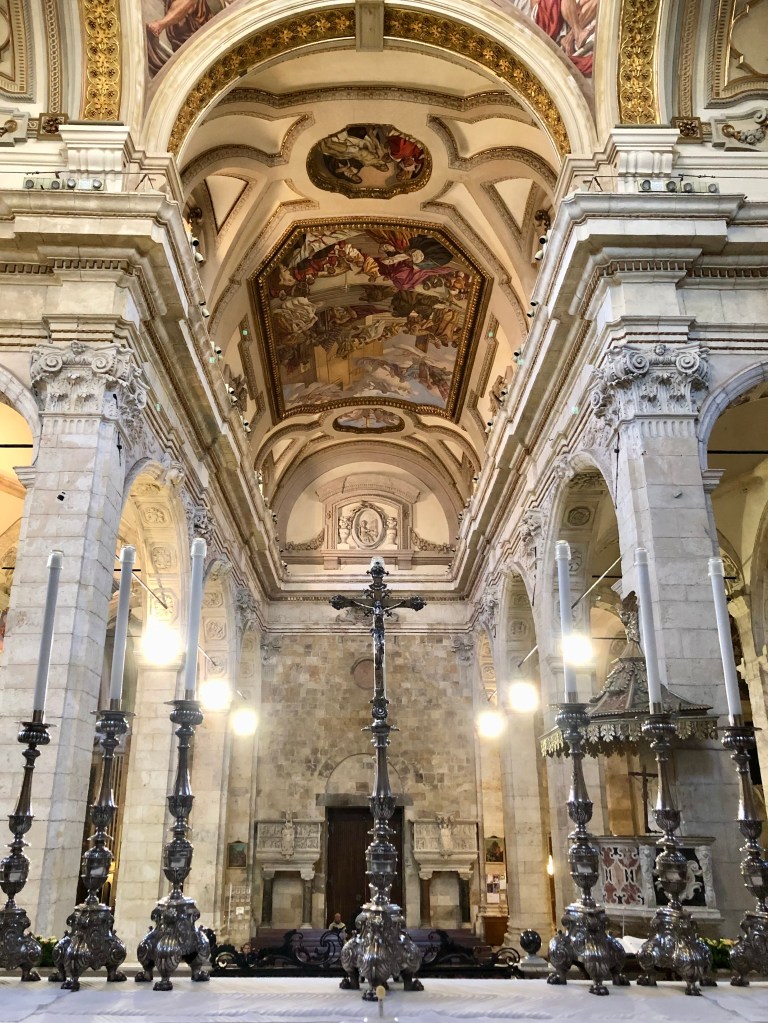
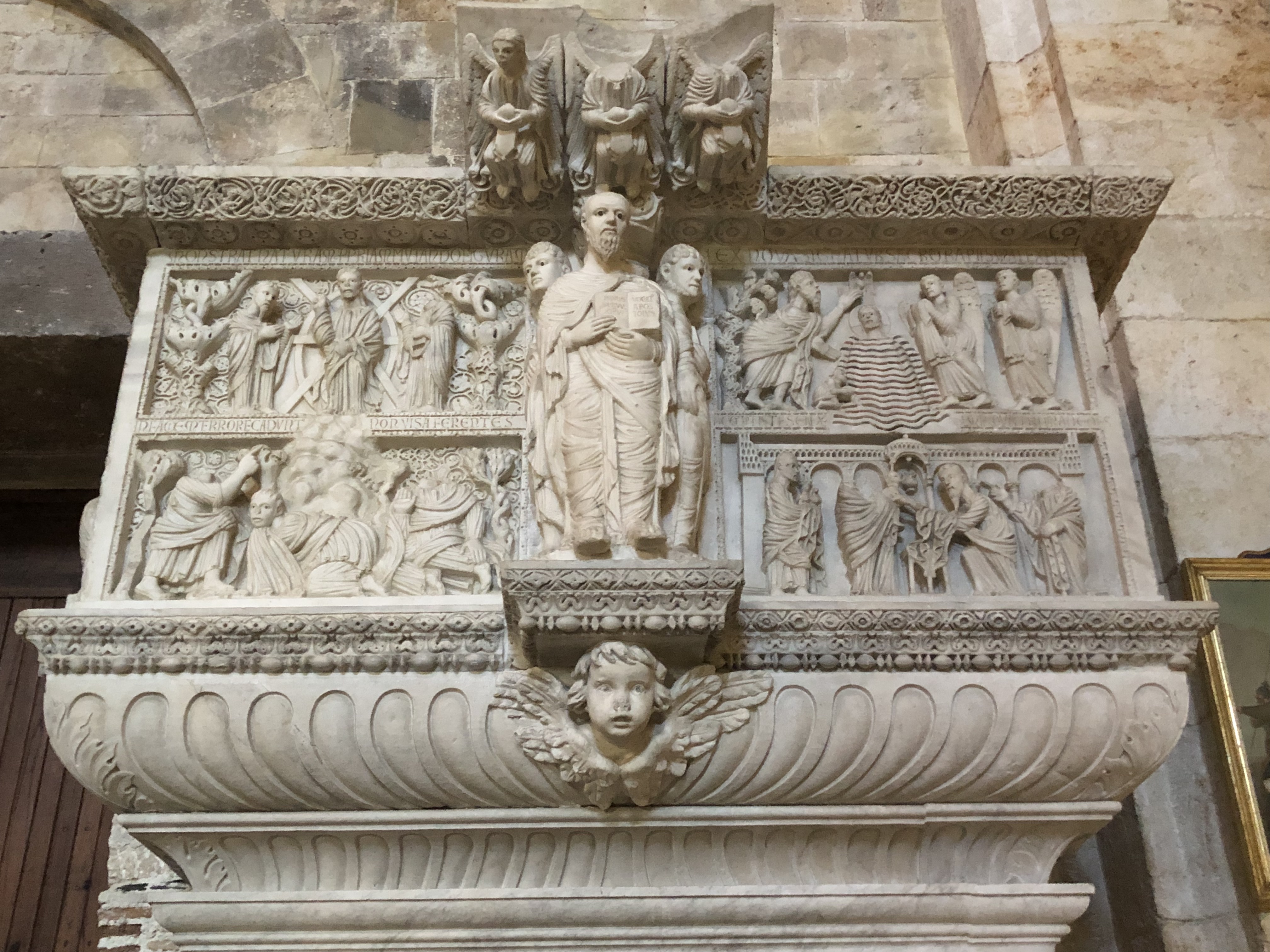
A few weeks ago, I mentioned the time I spent in Maracalagonis, Sardinia during Holy Week this year. I thought I’d follow up with a few pictures of Cagliari’s Cathedral, certainly one of the city’s highlights. The building is well kept up and contains a number of artistic gems. Among these are the two sides of what was once a single pulpit, which now flank the main door. These were sculpted by Guglielmo of Pisa around 1160 and later sent to Cagliari when the city was ruled by that merchant city-state.

Continue reading “Cagliari cathedral”

Intentions, motives, and what makes for a valid sacrament

The question of invalid baptisms has been in the news recently. In my commentary on the question in La Civiltà Cattolica, I pointed out that the Vatican’s most recent document on the question, Gestis verbisque, gives renewed attention to the minister’s intention. For a sacrament to be valid, a minister must intend to do what the Church does when celebrating that sacrament. And that means that if he changes what the Church prescribes in her official liturgical texts–by inserting his own words or deleting something required to be there–then he manifests an intention to do something else. It’s just as straightforward as it sounds. The proof is not in the pudding, but in the action.

Baptismal font, St. Peter’s Basilica

Last week, however, another question was sent to the Vatican about what sort of intention might invalidate a sacrament, this time an ordination. The question proposed the distasteful case of a bishop who ordained a man with whom he had engaged in an illicit sexual relationship. Could he possibly have the right intention? Wouldn’t such a sinful situation invalidate the ordination?

The article in which this question was raised described it as “potentially explosive.” Fortunately, this grenade was defused by St. Augustine in the fifth century. The great theologian was responding to controversy about the validity of baptisms, whether the sinfulness of a minster invalidated the sacrament. He responded no. Augustine’s principle has remained a bedrock of sacramental theology ever since. It is really Christ who baptizes, Augustine said, and he can do so even through profoundly imperfect human instruments. The same goes for ordinations. Augustine sagely realized that if perfection were required of ministers in order for sacraments to be valid, then we simply wouldn’t have sacraments.

So how does Augustine’s principle fit with the requirement that one has to have the right intention to celebrate a sacrament validly? Here we have to make what might at first seem like a rather technical distinction but is, once you’ve thought the question through, also rather straightforward. The distinction is between intention and motive.

Continue reading “Intentions, motives, and what makes for a valid sacrament”

Andrea Grillo and Rachel Lu on Baptism of Desire and Christian Salvation

Sant’Anselmo, Rome

Earlier this month, after delivering ten copies of Baptism of Desire and Christian Salvation to Sant’Anselmo at Easter time, I walked up the Aventine Hill to pick up my diploma–the last formality involved in earning my doctorate. The last act, I suppose, of my formal education! It’s a walk I made many times before while a student. I haven’t been back to Sant’Anselmo for a while now, but am grateful for the studies in sacramental theology I did there.

When I received my copies of Baptism of Desire and Christian Salvation, I had one more reason to be grateful — the insightful words of endorsement on the back cover from my dissertation director Prof. Andrea Grillo, who read many draft versions of the tome and managed to remain in good humor throughout! Here’s his review:

Lusvardi offers a historical reconstruction of the ‘baptism of desire’ that traverses the entire arc of the Christian tradition, starting from the origins. A straightforward work, expressed in a language endowed with finesse, irony and acumen. Baptism of Desire and Christian Salvation is singularly effective in pointing out the fact that in the modern reception, a series of priorities is imposed on the issue that empty its meaning.

Andrea Grillo, Pontifical Atheneum of Saint Anselm, Rome

Also last week, I was delighted to see Rachel Lu’s review of the book at Word On Fire. Rachel’s review had a particular significance for me since, as she points out, I was there when she was baptized as an adult 19 years ago.