Get Married: A review

A couple of years ago I taught a seminar on the sacrament of marriage, using Mark Regnerus’s excellent book The Future of Christian Marriage, which I reviewed for the Homiletic and Pastoral Review. I taught the same seminar again this past semester and reviewed another recent contribution to the subject, Brad Wilcox’s  Get Married: Why Americans Must Defy the Elites, Forge Strong Families, and Save Civilization (Broadside Books, 2024). You can read the review below or visit HRP and read it again!

Marriage is among the most important social justice issues of our day.  Classic Catholic social teaching—think Leo XIII in Rerum Novarum—has long recognized the connection between social well-being and a family life built on marriage. As Brad Wilcox points out in Get Married: Why Americans Must Defy the Elites, Forge Strong Families, and Save Civilization, “questions of marriage and family” are better predictors of positive or negative social outcomes than “race, education, and government spending” (xiv).  Yet even in Catholic circles, questions of marriage and sexual ethics are often treated not as issues of pressing social concern, but as matters of private morality—or dismissed as “cultural issues.”

Such dismissiveness has little theological basis.  And Wilcox—a professor of sociology and the director of the National Marriage Project at the University of Virginia—demonstrates that it is even harder to justify from a sociological point of view.  Marriage is good both for society as a whole—a higher percentage of married parents correlates with lower child poverty (73)—and for individuals, both men and women, who report higher rates of happiness, find more meaning in their lives, and are less lonely than their unmarried—and childless—peers (51-52, 115, 121).

Continue reading “Get Married: A review”

The latest reactions to Baptism of Desire and Christian Salvation

With yesterday’s feast of the Baptism of the Lord reminding us of the beauty and uniqueness of the sacrament of baptism, it seemed an opportune moment for an update on my work on baptism of desire. I’ve continued to do a bit of research on the question of infants that die before baptism and posted some reflections on the issue here and here late last year.

The Baptism of the Lord (above), Guglielmo of Pisa (1160), pulpit, Cagliari cathedral (Sardinia)
The Baptism of the Lord, El Greco

Reviews of Baptism of Desire and Christian Salvation continue to come out, so far all deeply appreciative. Theology today is no longer an exclusively European enterprise, so I’m especially excited to have an international response to the book. The Hekima Review, Africa’s leading theological journal, recommends it for both “Catholic clergy and lay people as it foregrounds the pastoral implications of the doctrine and the need for evangelisation.” Meanwhile, India’s top theological journal, the Vidyajyoti Journal of Theological Reflection published a particularly detailed and insightful review, which noted the specific value of the book in the context of Indian religious pluralism. It expressed the hope that the book would become the standard “theological ‘textbook'” for discussing such issues. The reviewer also picked up on the way the work responds to the deeper philosophical currents of the twentieth century:

This work belongs to what the dogmatic theologian José Granados has identified as a corporeal turn in theology, an emphasis on the body after the heady years of the twentieth century that – whether primarily or exclusively – emphasized cognition. This corporeal turn has meant a returning emphasis on not just the body, but the embodied nature of the Christian faith. It recognizes that the embrace of the faith cannot be restricted to some conceptual nod, but must necessarily embrace ritual, and recognize that the materiality of ritual is important. As Lusvardi writes “The instinct of the early Church to emphasize the ritual was not wrong, for the ritual says and does what nothing else can” (p. 342). In stressing the importance of the corporeal, Lusvardi’s work also becomes part of the corpus of the critique of modernity, which consciously, or unconsciously, seeks to restore a holistic view of the world, sundered through modernity’s adoption of Cartesian binaries, and has powered so much of Indian post-colonial thought.

Closer to home, The New Ressourcement journal said:

Lusvardi’s excellent book … is a must-read for anyone interested in the history of baptism, the nature of sin and salvation, or the hope for non-Christians and infants. It is hard to do justice to the extensive ground this book covers. In a compelling way, it draws the reader to see that the good news of Christian salvation is truly good news for its hearers precisely because the experience of Christ’s saving death and life is available to all in baptism.

Baptism of Desire and Christian Salvation in an Indian stole

The reviewer also offered a defense of the standard scholastic approach to the doctrine, aspects of which I call into question in the book–evidence, I think, that the issues the book raises are worthy of robust theological examination and debate.

So put it on your reading list for the new year!

Baptism of Desire and Christian Salvation is available from Catholic University of America Press (20% discount with the code CT10), Amazon, and other online booksellers. I have collected reviews, interviews, and other news here.

Epiphany homily: recapturing the logic of the gift

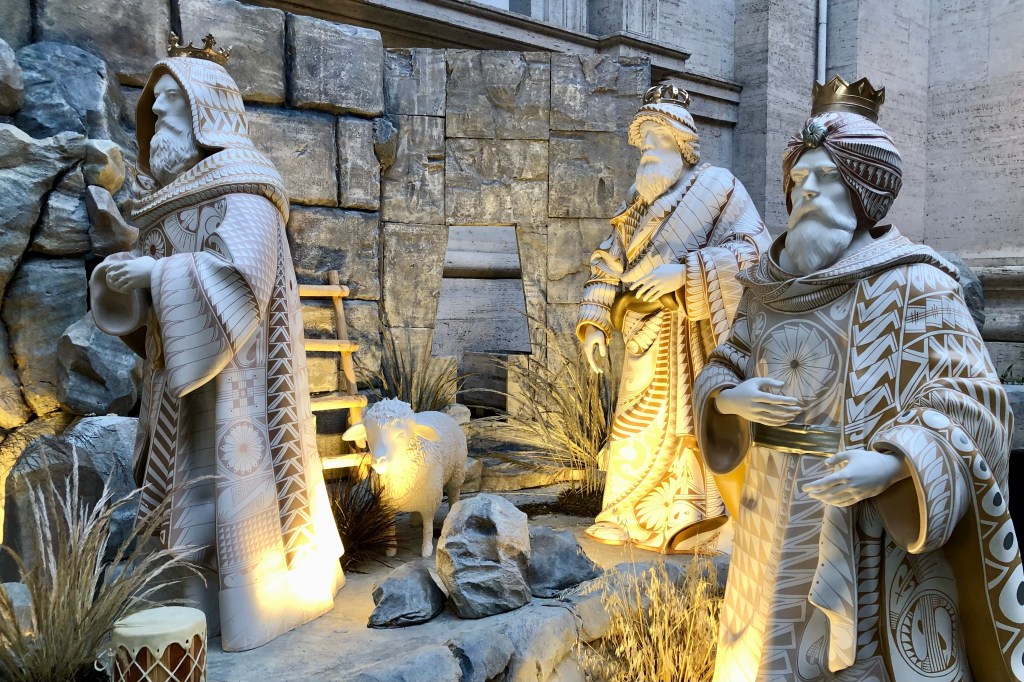
The Three Kings, from a Mexican Nativity displayed inside the Vatican, 2025

Homily for the Solemnity of the Epiphany.

Today’s feast, the Epiphany, traditionally was the day for gift-giving in Italy, though that tradition has been somewhat superseded by the arrival of a more aggressive salesman, Santa Claus.  Santa accepts both Visa and Mastercard—and, in some places, American Express—whereas the Magi bartered or traded in old-fashioned gold.

The Magi are still, however, known for their gifts.  Matthew’s Gospel does not give a precise number of Magi, but since it lists three gifts, the Christian artistic tradition has always depicted three Magi—or kings or wise men, depending on how you translate the word for these learned, wealthy, and adventuresome visitors.  Their gifts—gold, frankincense, and myrrh—struck a chord in the Christian imagination, even if most of us would have trouble explaining what exactly you do with myrrh.

Ancient spiritual writers attributed symbolic meaning to their gifts: gold symbolized Christ’s kingship; frankincense—a type of incense used in worship—symbolized his divinity; and myrrh—myrrh again, gave them a little trouble.  Some associated myrrh with virtue or with prayer.  Myrrh is actually very similar to frankincense; both come from the resin—the sap—of desert trees, which makes them rare and valuable.  Both give off distinct smells when burnt.  Frankincense is sweeter, while myrrh gives off bitter notes sometimes described as earthy or somber.  In the ancient near east, myrrh was used to prepare bodies for burial, so the presence of myrrh at Christ’s birth is sometimes interpreted as foreshadowing his passion and death.  Perhaps that explains why myrrh is no longer popular as a Christmas gift today.

But more than the specific gifts of the Magi, this morning I would like to reflect on what a gift is to begin with.  Today our idea of gift-giving is so shaped by Santa Claus—and by Amazon and Black Friday—that we sometimes lose the sense of what a gift meant in the time of Jesus.  And when we lose our grasp of the logic of gift-giving and gift-receiving, we start to have trouble understanding not only today’s feast of the Epiphany, but other parts of our faith as well, like marriage and the Eucharist.  Even our own existence in this world, which we did not create ourselves and did nothing to earn, becomes difficult to understand.

Continue reading “Epiphany homily: recapturing the logic of the gift”

Homily for the Feast of the Holy Family

Homily for the Feast of the Holy Family (Year A). Original Italian.

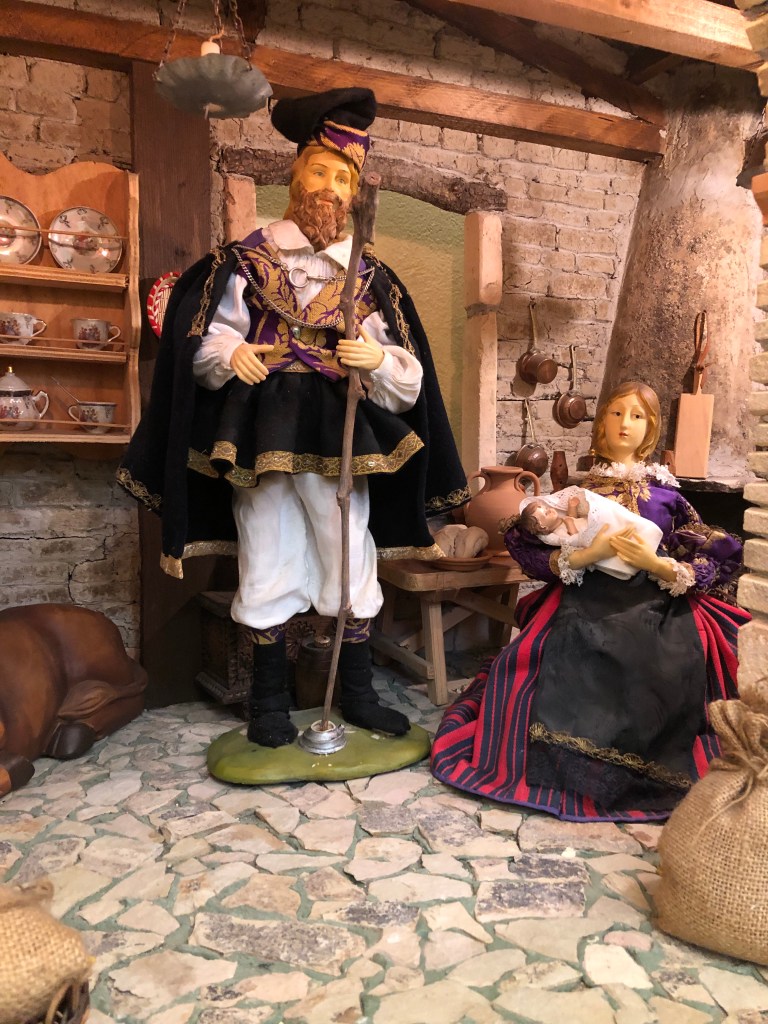
Sardinian Nativity scene, Maracalagonis (Sardinia)

Today we celebrate the story of one particular family—and the story of every family.

On the one hand, the story of the Holy Family of Jesus, Mary, and Joseph is absolutely unique. There is no other historical event comparable to the Incarnation of the Son of God, and the birth of Jesus is surrounded by other miraculous events—the appearance of the archangel Gabriel, the angelic messages that come to Joseph in dreams, the arrival of the Magi, the adoration of the shepherds—which highlight the unique identity of Jesus Christ. Furthermore, Jesus is divine, Mary is immaculate, and Joseph is holy; therefore, this family is threatened by sin, but always from outside. Herod’s envy is one example.

In our families, however, we must admit that often the most damaging wounds are caused by our own sins. Nevertheless, I do not believe that this difference—the holiness of the Holy Family—creates a distance between them and us, because all the actions of the Holy Family are done for us. They are a guide, a support, and a source of hope for us.

Joseph and Mary faced great challenges: an unexpected pregnancy that changed all their plans, the misunderstanding of their neighbors, a period of extreme poverty, danger, a threat to their child’s life, exile; and then all the daily challenges, including—if we think of Jesus’ disappearance in the temple—the difficulties of communication that sometimes occur even between people of good will. At the same time, the Holy Family experienced unexpected joys, tenderness, the celebrations of their religion, and belonging to their people. They experienced the fullness of family life.

Their particular experience offers us inspiration and encouragement to live our Christian mission fully, despite the challenges.

Continue reading “Homily for the Feast of the Holy Family”

The Vatican Nativity Scene, 2025

Vatican Nativity Scene 2025, St. Peter’s Square

While the tradition of a Nativity display dates back to St. Francis of Assisi, today such scenes are most associated with the city of Naples. There such displays came to include not just the figures of Mary, Joseph, and baby Jesus in a manager, but whole surrounding countrysides and cityscapes crowded with figures and replete with detail. These Neapolitan scenes reached their heyday in the 17th and 18th century and today provide a view into what life was like at that time. They feature all strata of society from nobles and servants to shopkeepers and children.

Continue reading “The Vatican Nativity Scene, 2025”

A Thousand Pounds: A review

The Homiletic & Pastoral Review has graciously published my review of Bri Edwards’s moving book,  A Thousand Pounds: Finding the Strength to Live and Love Under the Weight of Unbearable Loss, which I am reproducing below. (It was Bri who first brought the story of Baby Brian to my attention this past summer.) Check out the other great reviews and articles on the HPR site — and pick up a copy of Bri’s book!

A Thousand Pounds: Finding the Strength to Live and Love Under the Weight of Unbearable Loss is a profound and beautiful book, as hope-giving as it is heart-breaking.  In it, Brianne Edwards, a Catholic mother of six from South Dakota’s Black Hills, tells the story of the death of her son Lachlan to sudden infant death syndrome and the long process of learning to live anew after that loss.

The first part of the book is simply an account of Lachlan’s death.  It is a hard read, told with a directness that gives the reader access to what for most of us is an unimaginable experience.  For those involved in pastoral ministry such an opportunity to walk alongside Brianne and her family through the days of grief and confusion is invaluable.  Alongside Brianne’s own grief we see numerous other people—relatives and friends, a few priests, funeral directors, co-workers and near strangers—come in and out of the picture, often unsure how to react, some helpful and others not.  The author writes with sympathy and understanding even of those who do not quite manage to be helpful, but it is immensely valuable to see and reflect upon the different ways of being present to those experiencing such excruciating loss.

Continue reading “A Thousand Pounds: A review”

The Immaculate Conception: God’s own Advent preparation

Homily for the Immaculate Conception (2019. Note, that year, the Solemnity fell on a Sunday.)

On the first Sunday of Advent, I cleaned my room. I must admit, it needed it—there were coffee stains on the desk; the trash can was overflowing; I found forgotten lists of things not to forget. But Advent is the beginning of a new liturgical year, the season when we prepare for Christmas, and it seemed right to start with a clean room. In the coming weeks, there will be many other things to prepare: food, gifts, decorations, travel.

Column of the Immaculate Conception, Rome

This is the second Sunday of Advent, and normally the readings highlight the figure of St. John the Baptist, who speaks of another kind of preparation, another kind of cleaning—in fact, a much deeper cleaning than coffee stains. John the Baptist warns of the need for inner cleansing, moral and spiritual conversion. And this too is part of the preparation for Christmas. As a confessor, I have to do a little advertising for my profession, strangely absent from all the Black Friday advertising we received last month. But I must say that our special offer—the forgiveness of sins, eternal life—is truly the best deal in the world.

However, this year is a bit special, because this second Sunday of Advent is December 8, the Solemnity of the Immaculate Conception of Mary, the Mother of Jesus. This coincidence of dates is interesting because the Immaculate Conception is also a feast of preparation. But not the preparation we do during this season. The preparation that God has done for us.

Continue reading “The Immaculate Conception: God’s own Advent preparation”

Capernaum’s centurion: a man of faith and hope

Homily for Monday of the first week of Advent (2019).

The figure we encounter today in the Gospel, the centurion of Capernaum, helps us to prepare. We use his adapted words to prepare for communion: “Lord, I am not worthy that you should enter under my roof, but only say the word and my soul shall be healed.” And today, at the beginning of Advent, the season when we prepare for the coming of the Lord, the centurion appears in the readings.

A season of preparation is a season of faith and hope—and I think the centurion of Capernaum appears today because he is a figure of faith and hope.

Both of these virtues exist in imperfect situations. We need hope because of something we lack in the present; we need faith because there is something doubtful about the situation in which we find ourselves.

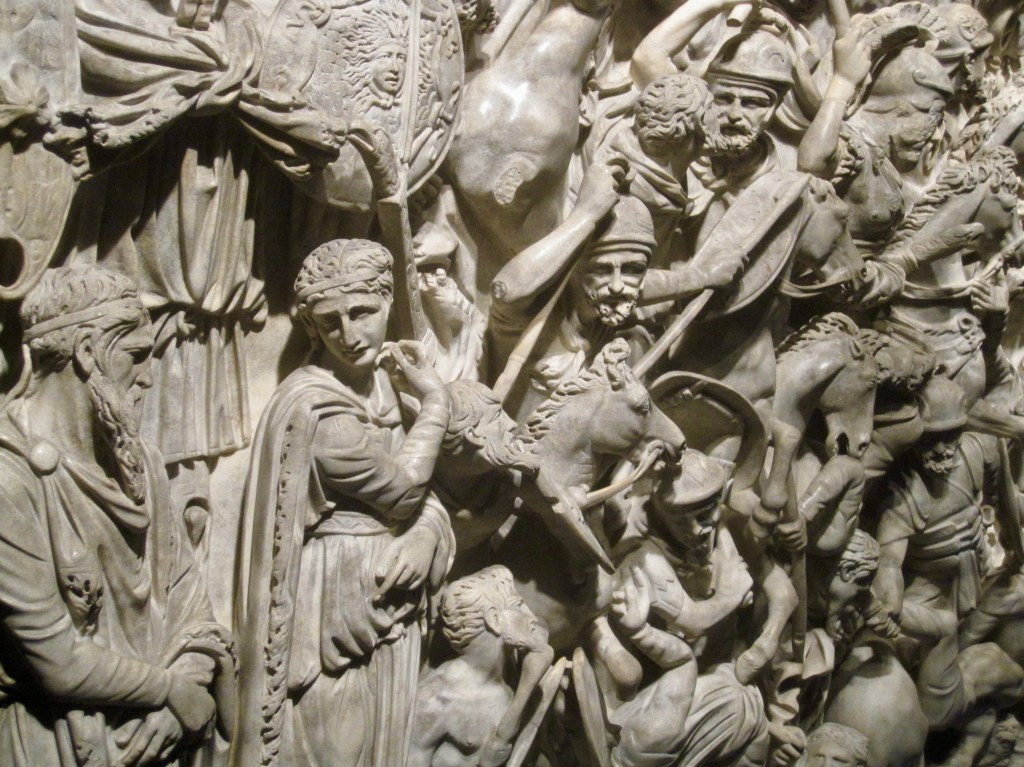
Roman Sarcophagus, Palazzo Massimo, Rome

The centurion comes to Jesus asking for help. And his words—“I am not worthy that you should enter under my roof”—are poignant because in them we hear the unvarnished truth. We can easily imagine that the centurion, an officer in the imperial army, has seen terrible things and perhaps–even if only out of duty–has had to do terrible things as well. His sense of unworthiness, however, does not prevent him from turning to the Lord.

Continue reading “Capernaum’s centurion: a man of faith and hope”

How much does heaven cost?

Homily for Monday of the 34th week of Ordinary Time (Year 1, 2019 – original Italian).

Church of the Holy Spirit, Žehra, Slovakia

How much does it cost to enter the Kingdom of Heaven?

Perhaps a lot. In the Gospels, the rich never seem to have enough. If we arrive at the gates of paradise with suitcases full of banknotes, it seems that won’t be enough. In eternity, they probably won’t accept credit cards, either.

Perhaps it costs very little. The widow offers just two cents. But if we have listened to the readings from the Old Testament in recent days—the sufferings of the Israelites under pagan rulers and in exile—we know that the price of fidelity can be very high. Martyrs pay with their blood.

Perhaps it is free. God does not need money. He created the world. What would he buy? Still, Jesus praises the widow for making an offering.

So, how much does it cost to enter the Kingdom of Heaven? The answer is everything. No more and no less.

Offering everything to the Lord means that no aspect of our lives is outside the Lord’s presence. Not just certain moments of worship–but also our financial, family, social, political, and professional decisions must be made with God at the center. The young Jews in the first reading from the book of Daniel put fidelity to divine law at the center of their lives, even in the service of the king of Babylon. We owe God nothing less than everything.

But nothing more, either. That is, God does not expect from us something we do not have, something we are not. If we are not the richest, God does not care. If we are not the strongest, God does not care. If we are not the most intelligent or the most beautiful or the most famous, God absolutely does not care. God does not want these things from us. He wants what we have–or, rather, he wants what we are. He wants an offering of ourselves.

This is, in fact, the offering that God makes to us in the sacrament we are about to celebrate. Physically, the Eucharist is not very big. But it is certainly not little. It is God’s gift of himself.

And that is everything.

(Original: Italian)

Readings: Daniel 1:1-6, 8-20; Lk 21:1-4

Church of the Gesù, Rome

November 2019


I was happy to be invited back to the pages of First Things last week to discuss celebrities, scandal, and the sacrament of confirmation. Check out the article: Sacraments of Initiation or Affirmation?

Baby Brian’s story and baptism of desire

Those of you who have been following this blog know that over the summer I was put in touch with a group of people dedicated to telling the story of baby Brian Gallagher, an infant who died shortly after his birth but whose body was discovered to be apparently incorrupt 37 years after his burial. Because Brian was not baptized before he died, the story raised the question of the eternal destiny of babies who die before baptism and my work on baptism of desire.

That story has started to get attention in several Catholic media outlets, and last week I had the chance to talk about baptism of desire on Real Presence Radio; you can listen to the interview here .

Hats off also to Dr. Kody Cooper for his opinion piece about baptism of desire and infants on the Word on Fire site. The author comes to similar conclusions to my own, arguing that baptism of desire is the best theological doctrine with which to consider this tough case, even citing Cardinal Cajetan who I discuss in my book . Baptism of desire seems to me a superior approach to what the author calls the “post-conciliar view,” which means hoping that the babies will be saved while remaining agnostic about the means. This approach, it seems to me, has two serious flaws. It seems to invite hope in a kind of divine Plan B which turns out to be more effective than those means revealed to us by Jesus. Revelation, then, seems not so revealing. At the same time, precisely because whatever those means happen to be can’t be found in revelation, such hope remains necessarily vague and not particularly well-grounded.

Baptism of desire, on the other hand, identifies our grounds for hope in the Church’s sacramental practice — the practice of a sacrament instituted by Jesus Christ and declared by him to be necessary for salvation (John 3:5). I posted a brief description of my position on the question here a few weeks ago.

Continue reading “Baby Brian’s story and baptism of desire”