Visiting Augustine’s Tomb

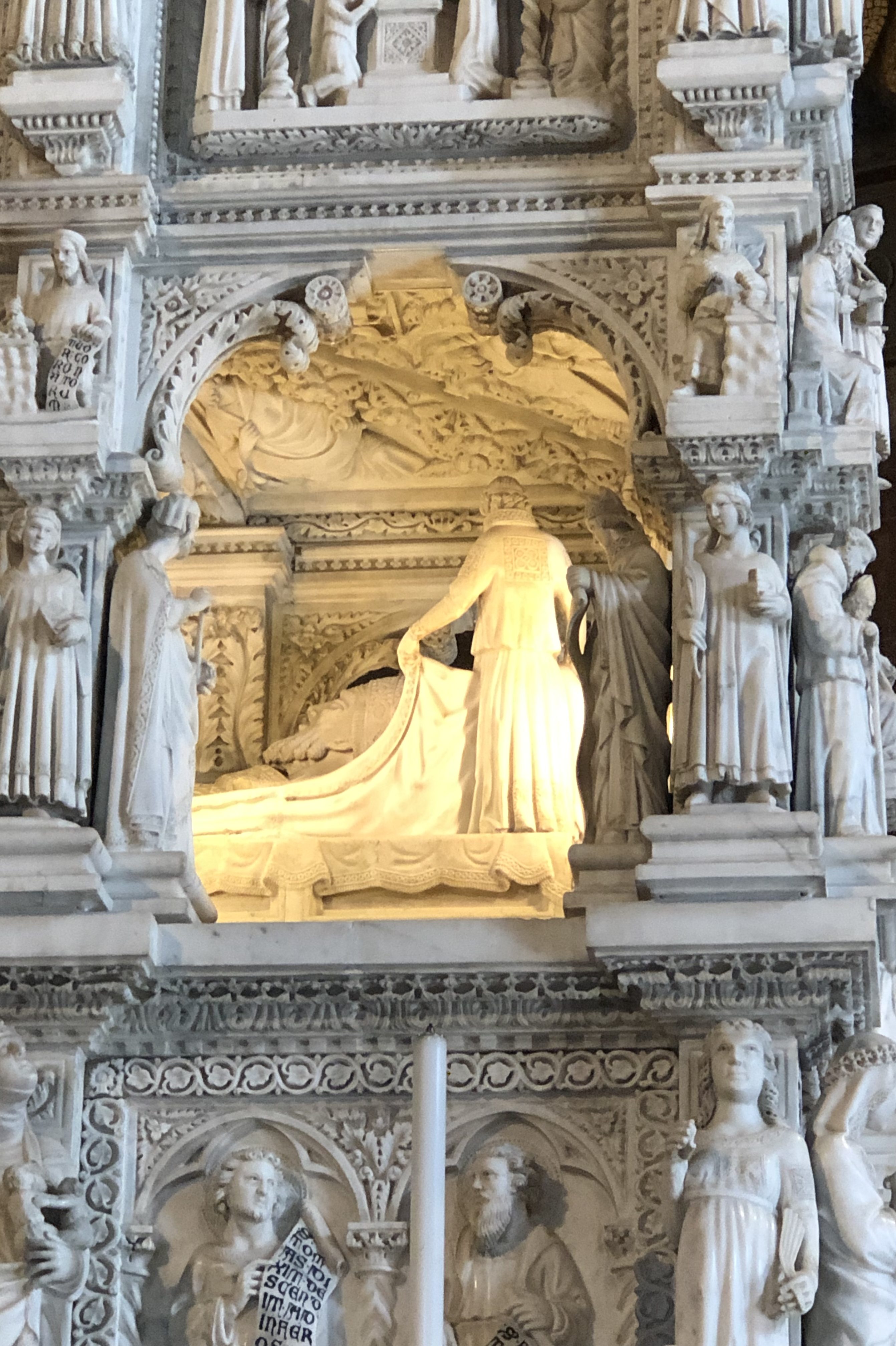
Arca di Sant’Agostino (1362), San Pietro in Ciel d’Oro, Pavia, Italy

Theologian don’t have a G.O.A.T. designation. (That’s “Greatest of All Time” for those who aren’t as hip as yours truly.) But if we did, Augustine of Hippo would probably get my vote. Sure, he’s not as systematic as Thomas Aquinas, but he more than makes up for it with humanity and passion, the way you can feel him throw himself so completely into the quest for God in his sermons and treatises. If you read Augustine’s sermons out loud, you can feel the power of his rhetoric. I’ve had many a conversation with the saint as I worked on my book Baptism of Desire and Christian Salvation. Augustine, alongside Ambrose of Milan, can be considered one of the doctrine’s fathers.

So it was quite a thrill–like visiting Graceland, or Disney World before it went woke–to spend an afternoon at the tomb of St. Augustine in Pavia last week. You might reasonably wonder how the North African theologian’s bones ended up in a smallish city in the north of Italy. Pavia, today sensible and pleasant, was the capital of the Kingdom of the Lombards in the 8th century. After his death, Augustine’s relics had been hustled out of Hippo to save them from the Vandals (today the tribe would be called the Mostly Peaceful Protesters) who lay siege to Hippo as its bishop lay dying. The saint’s body ended up in Sardinia, which, like much of the Mediterranean coastline in the Middle Ages, was subject to vicious Saracen raiding. For safekeeping, Liutprand, King of the Lombards–who is buried in the same church–had the bones brought to Pavia. There they reside in the church of San Pietro in Ciel d’Oro.

Continue reading “Visiting Augustine’s Tomb”
Leo the Great on the Ascension

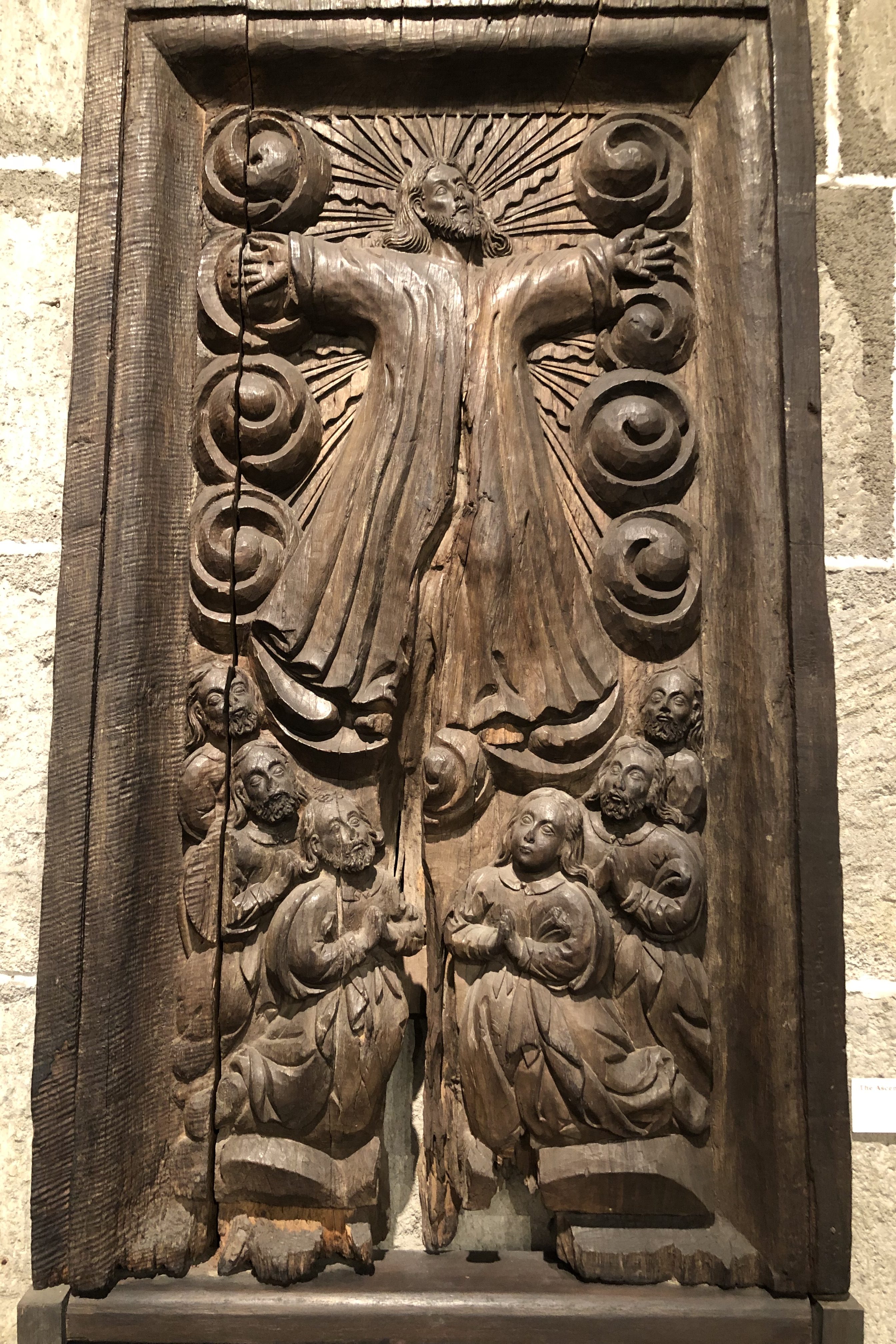
The Ascension, 18th century, Molave wood, San Augustin Museum, Manila, Philippines

The conviction on which sacramental theology rests is nowhere better expressed than by St. Leo the Great in his sermon on the Ascension: after Jesus ascended into heaven, what was visible in his earthly life has passed over into the sacraments.

At Easter, beloved brethren, it was the Lord’s resurrection which was the cause of our joy; our present rejoicing is on account of his ascension into heaven. With all due solemnity we are commemorating that day on which our poor human nature was carried up, in Christ, above all the hosts of heaven, above all the ranks of angels, beyond the highest heavenly powers to the very throne of God the Father…

And so our Redeemer’s visible presence has passed into the sacraments…

The truth is that the Son of Man was revealed as Son of God in a more perfect and transcendent way once he had entered into his Father’s glory; he now began to be indescribably more present in his divinity to those from whom he was further removed in his humanity…

Leo the Great, Sermo 2 de Ascensione, Office of Readings, Friday of the Sixth Week of Easter

Maximus of Turin on the Resurrection

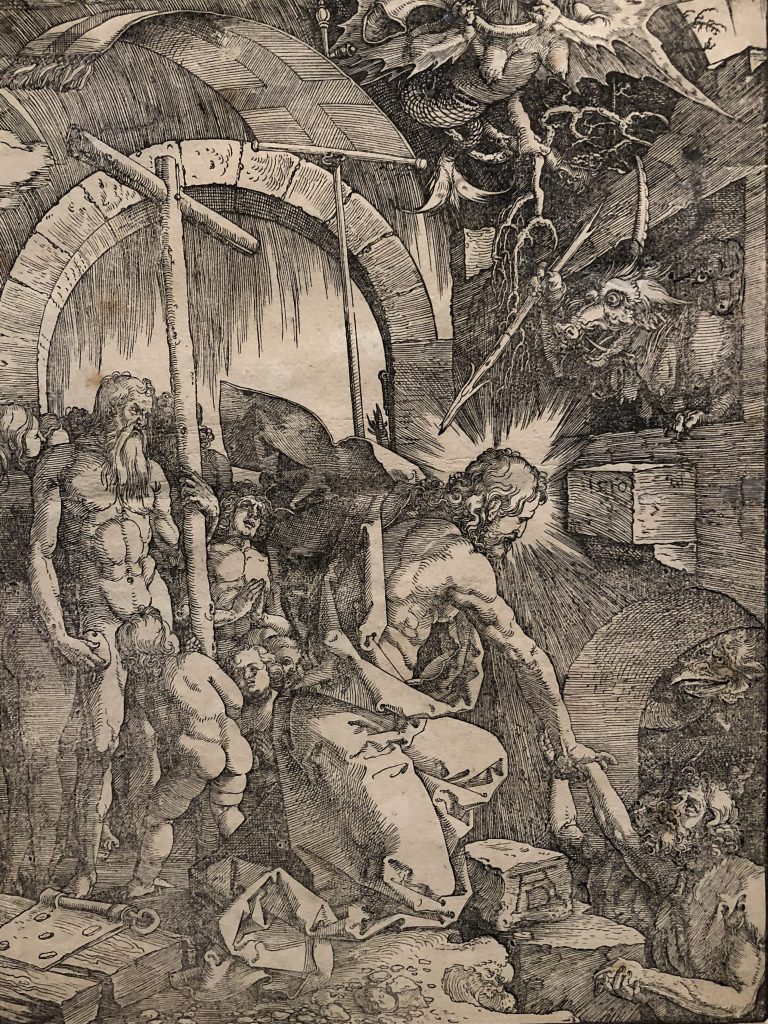
Albrecht Dürer woodcut, cathedral museum, Mdina, Malta

Christ is risen! He has burst open the gates of hell and let the dead go free; he has renewed the earth through the members of his Church now born again in baptism, and has made it blossom afresh with men brought back to life. His Holy Spirit has unlocked the doors of heaven, which stand wide open to receive those who rise from the earth. Because of Christ’s resurrection the thief ascends to paradise, the bodies of the blessed enter the holy city, and the dead are restored to the company of the living. There is an upward movement in the whole of creation, each element raising itself to something higher. We see hell restoring its victims to the upper regions, earth sending its buried dead to heaven, and heaven presenting the new arrivals to the Lord. In one and the same movement, our Savior’s passion raises men from the depths, lifts them up form the earth, and sets them in the heights…

Continue reading “Maximus of Turin on the Resurrection”

A challenging examination of motherhood

Over at America, my friend Rachel Lu has authored the most thought-provoking reaction I’ve seen so far on what appears to be the downfall of Roe vs. Wade, Do we really honor motherhood?. It’s both personal and penetratingly analytical, a thought-provoking lead-up to Mother’s Day.

Roe vs. Wade was a horrific decision in every respect, an act of judicial lawlessness, the fruits of which can be seen in the lawless tactics — from slandering Supreme Court nominees to this week’s leak and violent protests — employed to defend it. Violence begets violence. There seems no line of decency or ethics that Roe’s partisans will not cross to protect it — like a lie that requires a whole string of other lies to keep it going. Listening to the President bluster about having the “right” to abortion-without-limits “because I’m just a child of God, I exist,” one cannot help but wonder, Have you no shame, man?

Rachel’s essay goes deeper than political debates and gets at more complex questions of our social and human identity. There’s plenty in it to challenge everyone’s thinking, including theologians and pro-lifers. It suggests ways in which we’ve ended up with the brutal culture of abortion that has prevailed in Roe’s wake by taking the sacrifices women make to be mothers for granted. I’ll offer just one example, Rachel’s surprising analogy between soldiers and mothers.

At first glance, it might seem strange to compare mothering to soldiering; one involves killing and the other fosters life. In many ways though, the parallels are quite strong. Historically, these are the only two demanding vocations that have been foisted on people in nearly all human societies, with little or no regard for their personal feelings or level of preparation. The demands are daunting, but failure can bring crippling consequences for individuals and society. Motherhood is also like military service in that both require recruits to put their very bodies on the line, running very real risks of disfigurement or death. These remarkable demands are justified in the simplest of terms: They are necessary. Civilization itself is at stake.

Rachel Lu

The rest is worth more than a casual read. Read the full article.

Holy Saturday

The Harrowing of Hell, Andrea di Bonaiuto, Santa Maria Novella, Florence

Today’s reading from the Office of Readings put me in mind of the fresco of Christ’s descent into the limbo of the patriarchs in the chapter room of Santa Maria Novella in Florence. Note the demon crushed under the doors of hell at Christ’s feet and the other bewildered devils on the right. (Don’t feel sorry for them.) It’s what the Middle Ages had instead of superhero movies.

Continue reading “Holy Saturday”

Leo the Great on the Passion

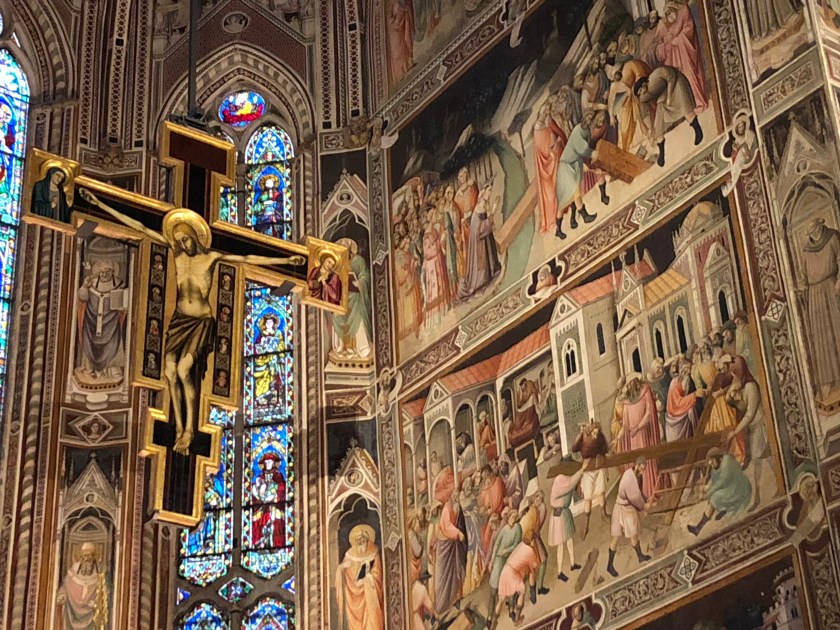
Santa Croce, Florence

“True reverence for the Lord’s passion means fixing the eyes of our heart on Jesus crucified and recognizing in him our own humanity.

“The earth–our earthly nature–should tremble at the suffering of its Redeemer…. No one, however weak, is denied a share in the victory of the cross. No one is beyond the help of the prayer of Christ. His prayer brought benefit to the multitude that raged against him. How much more does it bring to those who turn to him in repentance… Everything that he did or suffered was for our salvation: he wanted his body to share the goodness of its head.

“First of all, in taking our human nature while remaining God, so that the Word became man, he left no member of the human race, the unbeliever excepted, without a share in his mercy. Who does not share a common nature with Christ if he has welcomed Christ, who took our nature, and is reborn in the Spirit through whom Christ was conceived?

“Again, who cannot recognize in Christ his own infirmities? Who would not recognize that Christ’s eating and sleeping, his sadness and his shedding of tears of love are marks of the nature of a slave? …

“The body that lay lifeless in the tomb is ours. The body that rose again on the third day is ours. The body that ascended above all the heights of heaven to the right hand of the Father’s glory is ours. If then we walk in the way of his commandments, and are not ashamed to acknowledge the price he paid for our salvation in a lowly body, we too are to rise to share his glory.”

Leo the Great, Sermo 15

Office of Readings, Thursday, 4th Week of Lent

On the Annunciation

Detail from Botticelli’s Annunciation.

A beautiful piece for today’s feast from Fr. Robert Imbelli, a fine theologian and teacher, “Annunciations are Frequent, Incarnations are Rare.”

Here’s an excerpt:

You may understandably object that I project too much into a scant fifteen-minute encounter passed almost entirely in silence. I concede the complaint. Yet the Spirit radiates where he wills. And the new Eve leads a multitude of daughters (and sons) to compassionate being, which manifests itself in courteous demeanor and directness of gaze. Mary continues both to enchant and to challenge.

Indeed, let me insist: bodily demeanor and gaze. For in an incarnational spirituality the body assumes a dignity and importance that is unique. It is no rarefied “spiritual” assent that we celebrate on Mary’s feast: but a fully embodied “yes” to God’s call.

Read the whole article at The Catholic Thing.

Augustine on desire…

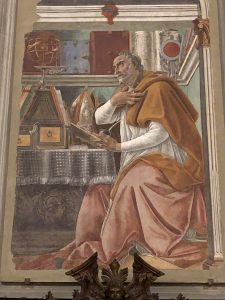
St. Augustine, Sandro Botticelli, Ognissanti, Florence

“The entire life of a good Christian is in fact an exercise in holy desire. You do not yet see what you long for, but the very act of desiring prepares you, so that when he comes you may see and be utterly satisfied.

“Suppose you are going to fill some holder or container, and you know you will be given a large amount. Then you set about stretching your sack or wineskin or whatever it is. Why? Because you know the quantity you will have to put in it and your eyes tell you there is not enough room. By stretching it, therefore, you increase the capacity of the sack, and this is how God deals with us. Simply by making us wait he increases our desire, which in turn enlarges the capacity of our soul, making it able to receive what is to be given to us.

“So, my brethren, let us continue to desire, for we shall be filled…”

St. Augustine, Tractates on the first letter of John 4

from today’s Office of Readings, Friday of the 6th Week in Ordinary Time


For more on the doctrine of baptism of desire see my new book Baptism of Desire and Christian Salvation.