On the road with St. Augustine

It seems like I’ve been on the road–or more precisely in the air–a lot this summer. Some of the journeys have been planned, others unexpected; some have involved meeting old friends, others making new ones. One was to bury my grandfather (that was tough); others involved planting new seeds (both spiritually and literally). My retreat for Jesuits on praying the liturgy got off the ground; I was able to return to St. Isaac Jogues and Rapid City and to Cloisters on the Platte to give a retreat; and for the first time I participated in the marvelous Free Society Seminar in Slovakia. St. Augustine’s words from the Feast of Martha, Mary, and Lazarus a few weeks ago struck me in a particular way this year, a reminder of the journey we all are on…

“Our Lord’s words teach us that though we labor among many distractions of this world, we should have but one goal. For we are but travelers on a journey without as yet a fixed abode; we are on our way, not yet in our native land; we are in a state of longing, not yet of enjoyment. But let us continue on our way, and continue without sloth or respite, so that we may ultimately arrive at our destination.”

St. Augustine, Sermo 103

The Holy Name of Jesus – and the Society that bears it

In the liturgical calendar of the Society of Jesus, January 3 is the Solemnity of the Holy Name of Jesus, our titular feast. Toward the end of his life, the great American Jesuit theologian Avery Dulles gave a lecture entitled “The Ignatian Charism at the Dawn of the Twenty-First Century,” which I think is as relevant today as it was nearly two decades ago. Dulles’s gift as a theologian was to clarify complex issues and get at the heart of the matter. The talk can be found in the collection of Dulles’s McGinley Lectures given at Fordham, Church and Society. Here are the final three paragraphs in which Dulles reflects on the Jesuit charism today:

“The Society can be abreast of the times if it adheres to its original purpose and ideals. The term Jesuit is often misunderstood. Not to mention enemies for whom Jesuit is a term of opprobrium, friends of the Society sometimes identify the term with independence of thought and corporate pride, both of which Saint Ignatius deplored. Others reduce the Jesuit trademark to a matter of educational techniques, such as the personal care of students, concern for the whole person, rigor in thought, and eloquence of expression. These qualities are estimable and have a basis in the teaching of Saint Ignatius. But they omit any consideration of the fact that the Society of Jesus is an order of vowed religious in the Catholic Church. They are bound by special allegiance to the pope, the bishop of Rome. And above all, it needs to be mentioned that the Society of Jesus is primarily about a person: Jesus, the Redeemer of the world. If the Society were to lose its special devotion to the Lord (which, I firmly trust, will never happen) it would indeed be obsolete. It would be like salt that had lost its savor.

“The greatest need of the Society of Jesus, I believe, is to be able to project a clearer vision of its purpose. Its members are engaged in such diverse activities that its unity is obscured. In this respect the recent popes have rendered great assistance. Paul VI helpfully reminded Jesuits that they are are religious order, not a secular institute; that they are a priestly order, not a lay association; that they are apostolic, not monastic, and that they are bound to obedience to the pope, not wholly self-directed.

“Pope John Paul II, in directing the Jesuits to engage in the new evangelization, identified a focus that perfectly matches the founding idea of the Society. Ignatius was adamant in insisting that it be named for Jesus, its true head. The Spiritual Exercises are centered on the Gospels. Evangelization is exactly what the first Jesuits did as they conducted missions in the towns of Italy. They lived lives of evangelical poverty. Evangelization was the sum and substance of what Saint Francis Xavier accomplished in his arduous missionary journeys. And evangelization is at the heart of all Jesuit apostolates in teaching, in research, in spirituality, and in the social apostolate. Evangelization, moreover, is what the world most sorely needs today. The figure of Jesus Christ in the Gospels has not lost its attraction. Who should be better qualified to present that figure today than members of the Society that bears his name?”

Avery Cardinal Dulles, S.J.

November 29, 2006
Ascension

Transfiguration, pulpit (Pisan 1160), Cattedrale, Cagliari

“Today our Lord Jesus Christ ascended into heaven; let our hearts ascend with him. Listen to the words of the Apostle: ‘If you have risen with Christ, set your hearts on the things that are above, where Christ is, seated at the right hand of God; seek the things that are above, not the things that are on earth’ (Col. 3:1-2). For just as he remained with us even after his ascension, so we too are already in heaven with him, even though what is promised us has not yet been fulfilled in our bodies.”

St. Augustine, homily on the Lord’s Ascension, quoted in Robert Imbelli’s
Christ Brings All Newness (Word on Fire Academic, 2023), p. 144.

The bodily resurrection of Jesus

Galleria degli Arazzi (Gallery of Tapestries), Vatican Museum: The Resurrection, Raphael, 1519

As we near the end of the Easter season, I’ve been reading the latest book of Fr. Robert Imbelli, Christ Brings All Newness (Word On Fire Academic, 2023). It is a fine collection of essays on everything from Vatican II to Dante, all held together by the wonder and uniqueness of the Son of God’s entry into the world. The title comes from St. Irenaeus of Lyons: “Christ brought all newness in bringing himself.”

To give a taste of the book–and as we approach the Ascension–I thought I’d share some of Fr. Imbelli’s words on the Resurrection from the essay “Resurrection and Real Presence.” Insisting on the bodily resurrection of Jesus–and not some watered-down academic knock-off–Imbelli again demonstrates a truly sacramental sense of the body’s importance, which I mentioned in another post a few weeks ago.

“Resurrection faith stretches heart and mind to the breaking point, as they stagger under the unbearable lightness of being. Is it any wonder that we frequently retreat before the mystery, reducing it to more manageable perspectives? And so, certain scholars contend, ‘He is risen into the kerygma’–betraying thereby their inordinate appetite for ideas. No resurrection there, only a ghostly apparition. Or, some ecclesiastical functionaries insist, ‘He is risen into the institutional church”–displaying, by the very contention, a rather petrified imagination. That would merely exchange one tomb for another. Or, others of more liberationist bent cry, ‘He is risen as the people’–manifesting their often havoc-wreaking innocence. A provocative resuscitation, perhaps, but no true resurrection. But against all infringement of the mystery, the angel stands adamant: ‘He is risen; he is not here!'” (pp. 158-9)

Sacraments, incarnation, and the body

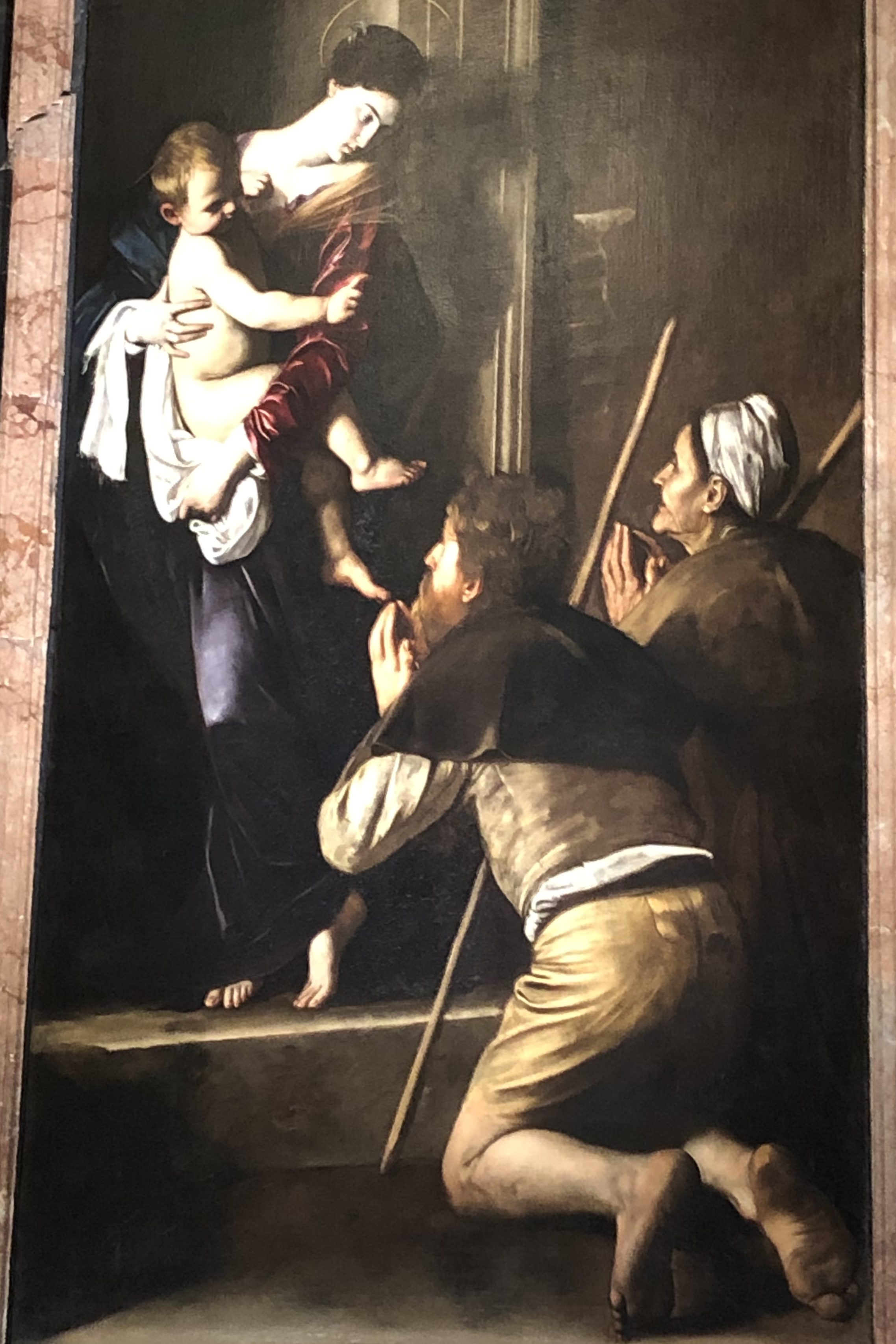
Madonna of the Pilgrims, (1604-6) Caravaggio, Church of Sant’Agostino, Rome

I’ve shared the work of theologian Fr. Robert Imbelli before. Here is another piece from him about a theme near to my heart, the “sacramental sense,” a phrase he takes from St. John Henry Newman.

Imbelli makes a point that has struck me before as well, that our society’s neglect of the transcendent is oddly connected to an unease with the body. We see this unease with our own bodies in everything from the explosion in the popularity of piercings and tattoos to the growth of eating disorders. Sex-changes are perhaps the most dramatic example of turning against one’s own flesh.

One of the sad marks of our secular age is a paradoxical double loss. Not only do we struggle to find access to the other dimension, that is, the spiritual, but we also seem impervious to the true sense of the material. Our sacramental sense has atrophied. Indeed, these two losses may be intricately connected.

Imbelli quotes philosopher Charles Taylor to argue that secular people today live lives of “excarnation,” disconnected from the communities and traditions that bore them. We live increasingly rootless lives. In contrast to this “excarnation,” Imbelli quotes Jesuit poet Gerard Manley Hopkins and points toward our Eucharistic faith. He hints at the way that this sacrament directs us toward a relationship with creation–and our own embodied part in it– that is rooted, first of all, in gratitude.

Read the rest of Imbelli’s piece at the Catholic Thing.

Romano Guardini on the liturgy

In preparation for I talk I gave last week to a group of seminary rectors from Africa and Asia, I read Romano Guardini’s short but profound book Liturgy and Liturgical Formation.

Guardini was one of the twentieth century’s sharpest and most balanced theological minds, and his writings on the liturgy are particularly valuable. He understands the irreducibility of liturgy and liturgical symbols and has absorbed the way the Fathers experienced liturgy, best exemplified by the line from Pope St. Leo the Great’s Ascension homily: “What was visible in the Lord has passed over into the mysteries.”

Chapel of San Basilio, Maracalagonis, Sardinia

Here are a few gems from Liturgy and Liturgical Formation:

“Liturgy does not deal with knowledge but with reality. There is knowledge of the liturgical action, which precedes it and could be called liturgical knowledge. And there is knowledge within it; the liturgical event allows an insight into itself. To speak of this today is not easy because it has escaped our religious consciousness at large. The liturgy itself is not merely knowledge but a full reality, which embraces much more than knowledge alone: a doing, an order, and the being of itself.” (13)

Continue reading “Romano Guardini on the liturgy”

New journal!

It might seem that there’s nothing new under the sun in the world of theology, but that’s not the case. This spring, The New Ressourcement journal launched its first issue. The journal is sponsored by Word on Fire Academic, one of the many great ministries founded by Bishop Robert Barron. In fact, Bishop Barron has an article in the first issue. The editorial staff is an all-star lineup: Matthew Levering of Mundelein Seminary, Jonathan Ciraulo of St. Meinrad Seminary, and my own colleague at the Gregorian University, Aaron Pidel, S.J. The authors represented in the first issue can also all be fairly described as all stars.

Here’s a description of the journal from its website:

The New Ressourcement

 is a quarterly journal of theology and philosophy published by Word on Fire Academic. It serves the Church and the academy by publishing scholarly articles that demonstrate the depth and relevance of the entirety of the Catholic tradition.

This journal aims to sentire cum tota ecclesia, to think with the whole Church as it has ever reflected on the mystery of the Incarnate Christ, as seen in sources that are biblical, patristic, medieval, as well as modern. The journal draws inspiration from, and seeks to continue the work of, previous generations of ressourcement theologians. It shares with them a conviction that the renewal of theology and philosophy occurs by returning to sources that remain inexhaustible. This ressourcement is “new” because we trust that this patrimony is fertile enough to encounter contemporary questions confidently and to illuminate the challenges and opportunities that shape the present age.

https://newressourcement.wordonfire.org

From John Paul II’s “Letter to Artists”

Every genuine artistic intuition goes beyond what the senses perceive and, reaching beneath reality’s surface, strives to interpret its hidden mystery. The intuition itself springs from the depths of the human soul, where the desire to give meaning to one’s own life is joined by the fleeting vision of beauty and of the mysterious unity of things. All artists experience the unbridgeable gap which lies between the work of their hands, however successful it may be, and the dazzling perfection of the beauty glimpsed in the ardour of the creative moment: what they manage to express in their painting, their sculpting, their creating is no more than a glimmer of the splendour which flared for a moment before the eyes of their spirit.

Believers find nothing strange in this: they know that they have had a momentary glimpse of the abyss of light which has its original wellspring in God. Is it in any way surprising that this leaves the spirit overwhelmed as it were, so that it can only stammer in reply? True artists above all are ready to acknowledge their limits and to make their own the words of the Apostle Paul, according to whom “God does not dwell in shrines made by human hands” so that “we ought not to think that the Deity is like gold or silver or stone, a representation by human art and imagination” (Acts 17:24, 29). If the intimate reality of things is always “beyond” the powers of human perception, how much more so is God in the depths of his unfathomable mystery!  […]

Beauty is a key to the mystery and a call to transcendence. It is an invitation to savour life and to dream of the future. That is why the beauty of created things can never fully satisfy. It stirs that hidden nostalgia for God which a lover of beauty like Saint Augustine could express in incomparable terms: “Late have I loved you, beauty so old and so new: late have I loved you!”

From Pope St. John Paul II, Letter to Artists (1999)

Confessing other people’s sins

Old St. Anges Church, Parmelee, South Dakota

In case you missed it, an essay of mine appeared recently in issue 19 of The Lamp, a relatively new Catholic magazine full of interesting and thoughtful writing (if I do say so myself).

“Public apologies for historical wrongs have multiplied in recent years… Yet we do not seem to have become a more reconciled and understanding society.”

This particular essay, “Confessing Other People’s Sins,” is among the most important things I’ve written. The essay draws on a lot — my experiences in South Dakota, as a confessor, and studying theology.

A poem and a prayer for Australia (and Jesuits!)

St. Patrick’s Cathedral, Melbourne, Australia

After a very blessed time of tertianship–the final formal part of Jesuit formation–and travel afterwards, I arrived back in Rome this week to begin preparing for the semester ahead. For me, this new beginning is also a time to look back with gratitude at my time in Australia’s tertianship program. I thought I’d share this poem from Australian poet James McAuley (1917-1976), a prayer for his remarkable country that could just as easily be a prayer for us Jesuits.

The poem is a part of a fountain outside of Melbourne’s cathedral that runs from the doors of the church out toward the city–evoking Ezekiel’s image of the waters of life flowing from the temple. The sculpture includes quotations from both the Old and New Testaments (John 4:14, Ps 23:2-3). It is inspired by the words of Revelation: “Then [the angel] showed me the river of the water of life, bright as crystal, flowing from the throne of God and of the Lamb through the middle of the street of the city; also, on either side of the river, the tree of life […] and the leaves of the tree were for the healing of the nations” (Rv 22:1-2).

St. Patrick’s Cathedral, Melbourne, Australia

Here’s McAuley’s poem:

Incarnate Word,

in whom all nature lives,

cast flame upon the earth:

raise up contemplatives

among us, men who walk within the fire

of ceaseless prayer,

impetuous desire.

Set pools of silence in this thirsty land.

James McAuley (1917-1976), Australian poet
St. Patrick’s Cathedral, Melbourne, Australia