Leftovers transformed: homily for the seventeenth Sunday in Ordinary Time

Homily for the 17th Sunday in Ordinary Time (B)

Miracle of the Loaves from the Triptych of the Miracles of Christ, Master of the Legend of St. Catherine, Flanders 1491-5, National Gallery of Victoria, Melbourne

Today’s readings give a prominent place to leftovers.  In the hands of the prophet Elisha, twenty barley loaves manage to fill a hundred people, with some left over.  When Jesus feeds the five thousand, the leftovers—twelve baskets—exceed the amount of bread there was to begin with—just five loaves.

It’s worth noting that the disciples go to the trouble of collecting the leftovers after the impromptu meal.  Living in an age of abundance, perhaps we are used to throwing leftovers out or letting them molder in the back of the fridge, but letting leftovers go to waste is a luxury most people in history didn’t have.  Certain recipes popular today were originally invented to use stale bread—bread pudding, for example, or the Tuscan bread soup known as ribollita.  The funny thing about ribollita is that what started out as a peasant dish today is served in pricey and fashionable restaurants.  What was once leftovers has become high cuisine.

There’s something deeply Christian in this transformation.  Ours is a faith, after all, in which the stone rejected by the builders becomes the cornerstone, the last become first, the meek inherit the earth, the poor are filled with good things while the rich go away empty, the blood of martyrs becomes the seed of faith, and in dying we are born to eternal life.  We believe not just that leftover bread can be transformed into a savory dish, but that utterly ordinary bread and wine are, in the sacrament of the Eucharist, transformed into the body and blood of Jesus. Moreover, if we approach the sacrament in faith, we too are transformed into the body of Christ; our weak and too often sinful flesh becomes the dwelling place of the Holy Spirit.

I have a friend, a Filipino Jesuit who comes from a family of restauranteurs and is an amazing chef.  He has a particular genius for being able to walk into any kitchen, open the refrigerator, glance over whatever leftovers are inside, spend half an hour spicing and mixing and reheating, and produce a feast that was better than the original meal.  Our Christian faith is something like this.  At its heart is belief in the possibility of transformation.

Continue reading “Leftovers transformed: homily for the seventeenth Sunday in Ordinary Time”

A bloody Sunday: Corpus Christi homily

Homily for the Solemnity of Corpus Christi (B)

Today’s readings are bloody.  Some years the readings for Corpus Christi emphasize the bread that becomes the body of Christ, and they remind us that the Eucharist is our nourishment and also the source of our unity.  A single loaf of bread is formed from many individual grains of wheat.  

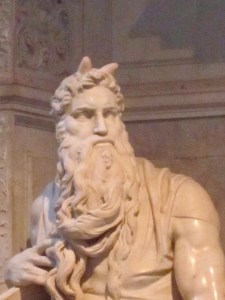
Moses, Michelangelo

But today’s readings are full of blood.  This is not a Sunday for the squeamish.  Blood sprinkled, blood shed, blood poured out, drinking blood.  If we are tempted to imagine that worship is something abstract or comfortable or safe, the blood-spattered images in today’s readings should give us second thoughts.  In the ancient world and in the time of Jesus, worship was a matter of flesh and blood, of life and death.  Entering the Temple of Jerusalem would have been a shock to the senses—crowds of visitors both from Judea and from the Jewish diaspora; animals—birds, sheep, goats, bulls—and all their animal noises and smells; the sounds of these animals being slaughtered; the smell of blood; and the songs of prayer, of the psalms rising to heaven, with the smoke of burning incense and roasting meat.  Worshipping God was not for the squeamish.

I think the fact that today’s readings speak rather vividly of the blood of goats, heifers, and bulls—bowls of blood—is perhaps a way of reminding us that Christianity—following Jesus—requires a certain courage.  In one way or another we all have to overcome our squeamishness, whatever form it might take.  The perfect act of worship, after all, the sacrifice which is the model for all other acts of worship, the death of Jesus on the cross, was not only bloody, but brutal.  There was nothing abstract or comfortable in the scrouging and beating, in the nails, the crown of thorns, or the agonizing hours on the cross.  And yet this was not, in the final analysis, merely an act of violence or a miscarriage of justice but an act of self-giving love.  The blood of the new covenant was shed for those Jesus calls to be his friends and disciples.

But why blood?  What is the meaning, for example, of what probably seems to us the very strange gesture of Moses who, to seal the covenant between God and his people, splashes blood upon the altar and then sprinkles it on the people.  When I read this passage one of my first very modern, very practical thoughts is, “How are the Israelites going to get all that blood out of their clothes?  What a mess!”  But we are told, in the letter to the Hebrews, that it is blood—the blood of Christ—that cleanses.

Continue reading “A bloody Sunday: Corpus Christi homily”

An event unlike any other: homily for Easter Sunday

Homily for Easter Sunday 2024

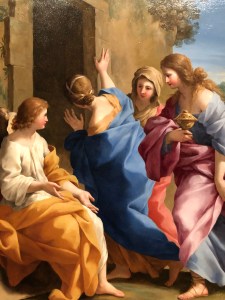
National Gallery of Victoria, Melbourne

What is a miracle? The word is used often and not always in a very precise way. A quick search on the Internet revealed exercises, mineral solutions, and even a perfume, all described as “miraculous.”

At least the word seems to be useful for advertising. Probably we have also heard stories from the Middle Ages or antiquity that tell of extraordinary events. And probably some are really miracles, others are legends. They are the special effects that storytellers from a time before movies used to make a story more fascinating, moving, or funny.

Speaking more precisely, a miracle is something that happens in this world caused by a power beyond this world. Miracles do not mean that the divine is absent from non-miraculous events, from everyday events. When a doctor uses his intelligence to save life, he is using a divine gift–intelligence–to cooperate with the purpose of God who wants to save life and not destroy it. When a woman gives birth it is not a miracle in the literal sense–it does not require a force beyond human biology–but I would say there is something divine about that event because it is a participation in the Creator’s work.

A miracle, however, requires a power that no creature possesses.

We know with certainty that there has been at least one miracle in the history of the universe, namely, the creation of the universe. No existing thing possesses the power to create everything from nothing. This power is the essence of a miracle. I haven’t smelled the miraculous perfume, but I doubt that it qualifies .

Today we celebrate the miracle of miracles–the resurrection of Jesus Christ from the dead. Since creation there has been no other event like this. It is the most important event in human history, an event so different from all other historical events that, even today, after almost two thousand years, it remains difficult to explain.

Continue reading “An event unlike any other: homily for Easter Sunday”

Homily for Passion Sunday

I recently read something in a book written by an American sociologist that struck me–and disturbed me. This sociologist is a very good scholar and has conducted studies in several different countries and written a number of topics. In one of these studies, as an aside, he mentioned that, in general, people care more about being normal than about being good. For the majority of people it is more important to feel normal than to be good.

Holy Stairs, Rome

This disturbing observation struck me because it seemed hard to deny. And the truth of this observation is evident on no other day more than on this one, Palm Sunday. The celebration begins with Jesus’ triumphal entry into Jerusalem. The people welcome him as a hero, as a king. They throw their cloaks before him and cheer him enthusiastically, “Hosanna!” And in the space of a week, the same crowd will shout with the same enthusiasm, “Crucify him!”

On no other day do we feel so acutely the fickleness of the crowd or the inconstancy of the human heart.

Continue reading “Homily for Passion Sunday”

Serpents, Cyrus, and salvation: homily for the fourth Sunday of Lent

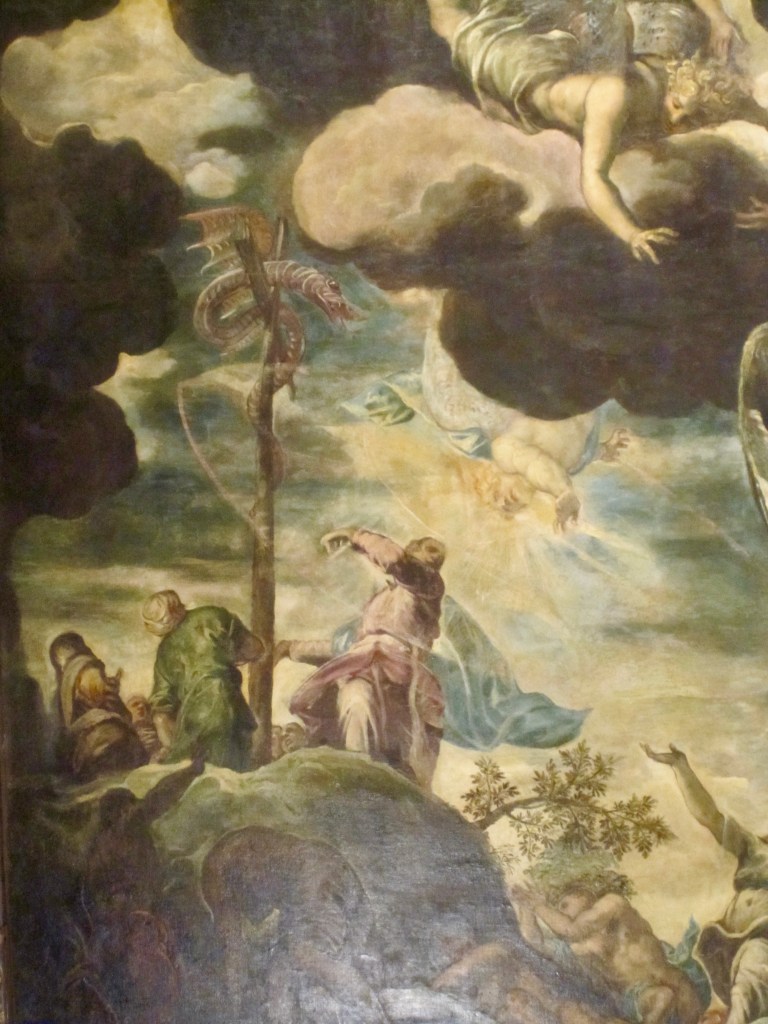
Miracle of the Bronze Serpent, Tintoretto (Scuola Grande di San Rocco, Venice, 1564-1587)

Homily for the 4th Sunday of Lent (B)

Today’s readings are a workout.  The serpent in the desert, God’s love and the refusal of many to accept it, faith and works, the prophets, Israel’s exile in Babylon, and King Cyrus, a Gentile who saves the day.  Getting through today’s readings means not just getting in your spiritual steps for the day—it’s more like earning a medal for the decathlon.

For a bit of mid-Lent spiritual exercise, the first image from today’s Gospel is a good place to start.  At first glance, it might seem a bit obscure.  What was Moses doing lifting up a serpent in the desert?  Jesus is referring to an incident during Israel’s wandering in the desert found in the Book of Numbers.  The Israelites, as seems to be their habit, complain against God and against Moses, saying “There is no food” and “We loathe this worthless food.”  The complaint does raise the question, which is it?  Is there no food or just food the Israelites don’t like?  There seems to be a bit of manipulative use of language in the Israelites’ rebelliousness, perhaps even a bit of self-delusion.  The phenomenon is not unique to the ancient world.  Today our political and social divisions are often made worse because we use exaggerated terms to describe our opponents and their intentions—or to mask uncomfortable facts we do not want to hear—and then we start to believe our own rhetoric.  The result is poisonous.  And, in fact, in the Book of Numbers, God punishes the people of Israel for their rebellion by sending fiery serpents to bite them.

Continue reading “Serpents, Cyrus, and salvation: homily for the fourth Sunday of Lent”

Be made clean: Homily for the Sixth Sunday of Ordinary Time

Homily for the Sixth Sunday of Ordinary Time (B)

Five years ago, if we had read this passage from Leviticus, we might have looked rather harshly at the Old Testament rules for the treatment of lepers.  Making a man shout “Unclean, unclean!” and dwell apart, outside the camp—quarantined—might have seemed unenlightened.  

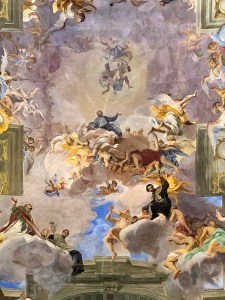
Church of St. Ignatius (ceiling), Rome

Four years ago, about this time of year, all those purity laws in Leviticus started to look a lot more familiar.  We made each other dwell apart outside the camp, in quarantine, not because a scab or pustule or blotch had appeared, but because it might, you never know, you can never be too safe.  Suddenly those purity laws were not so unreasonable after all.

When we read the Gospel, we usually imagine that of course we would take the side of Jesus instead of the Pharisees.  But I wonder.  Look at Jesus in today’s Gospel passage.  No six feet of social distancing, no mask, no respect for the opinion of the experts, touching the infected without hand sanitizer before or after—would we really take the side of Jesus?

Continue reading “Be made clean: Homily for the Sixth Sunday of Ordinary Time”

Mary the Mother of God and the relationships that define us: homily for the Solemnity

Madonna and Child, Umbrian , 14th century, Spoleto

Homily for the Solemnity of Mary, the Mother of God

Today we celebrate the Solemnity of Mary Mother of God.  Fortunately, as you came into church this morning, you did not see armed troops guarding the doors, nor bishops jostling and shouting angrily at each other in Greek.  We should be grateful for such peace and calm this New Year’s Day, 2024.  Sixteen-hundred years ago, you might have seen just that.  At that time, the fiercest controversy in the Catholic Church was over whether the title “Mother of God” could be applied to Mary, a controversy settled by the Council of Ephesus in 431.  Before the Council of Ephesus, Nestorius, the bishop of Constantinople, had claimed that Mary could be called the “Mother of Christ” or the “Mother of Jesus” but not the “Mother of God.”

If you think for a minute about what is at stake in the title, you’ll realize that the controversy was not really about the identity of Mary, but the identity of her son.  Mary can only be called “Mother of God” if Jesus is, in fact, fully man and fully God.  The Council of Ephesus declared Nestorius a heretic for obscuring what we celebrate this Christmas season: that the Son of God has become man, that from the moment of his conception in Mary’s womb Jesus was and is God.

But today is a Marian feast.  What does this title tell us about Mary?  You have probably heard many times that Mary always points to Christ.  Her final words recorded in Scripture are to the servants at Cana, after she has dropped an unsubtle hint to Jesus about the need for more wine at the party: “Do whatever he tells you,” she says (Jn 2:5).  It is hard to think of a more exalted title to bestow on anyone than “Mother of God,” yet there’s a humility in the title too because by exalting Mary we are first exalting her son.

Mary is a woman of both humility and strength, of contemplation and action, of wisdom and patience, of courage and compassion, and yet her greatness—what makes her the greatest woman to have lived, worthy of the title of today’s feast—is the relationship she has with her son.  And there is a lesson here for us, a lesson about the importance of relationships.

Continue reading “Mary the Mother of God and the relationships that define us: homily for the Solemnity”

No surprises on judgment day: homily for the thirty-second Sunday of Ordinary Time

Homily for the 32nd Sunday in Ordinary Time (A)

Many years ago, before I became a Jesuit, my parents celebrated their 25th wedding anniversary with a trip to Italy.  I had just finished two years as a Peace Corps volunteer in Kazakhstan, and I decided to meet them in Italy—but I wanted it to be a surprise.  So I made up an elaborate story about where I was going—a complete fake itinerary—and I pulled it off.  I have never seen my mom’s mouth open so wide as when I showed up and said, “Happy anniversary!”

If you’ve ever pulled off a surprise party—and it’s not easy—you know that both the anticipation and the surprise itself are fun.  There’s something about knowing what is going to happen when others don’t, the cleverness it requires, and then the shock, which in the end turns out to be joyful.

Rocca Albornoziana, Spoleto, Italy

Let me be clear about today’s reading.  Jesus is NOT trying to surprise us.  The arrival of the bridegroom surprises all of the virgins—they all doze off and are awakened by shouting in the night—but for the wise virgins it is a joyful surprise, which brings a wedding feast, and for the foolish virgins, it means darkness.  It means remaining outside in the darkness of the night because they did not care for the light that was their responsibility.  In the Gospel parable, the foolish virgins are surprised, but Jesus is telling us the parable precisely so that we will not be surprised.

Continue reading “No surprises on judgment day: homily for the thirty-second Sunday of Ordinary Time”

Community is worth fighting for: homily for the 26th Sunday of Ordinary Time

Homily for the 26th Sunday of Ordinary Time (A)

The preaching of St. Paul, Boroea, Greece

When I get near the end of my time in Rapid City every summer—or this year, fall—I feel a little nostalgic.  It helps me to imagine how St. Paul would have felt throughout his ministry, founding communities and then having to move on.  He invested himself completely into each one; he made friends; he faced opposition, persecution, and disease; sometimes he owed his survival to the care he received from the Christians in each place.  And because it was much harder for Paul to travel by foot and ship across the Mediterranean than it is for me to book an airline ticket across the Atlantic, I find the yearning and love expressed in his letters particularly poignant.  This is especially the case in his letter to the Philippians.  

Not all of Paul’s letters are as warm as the one to the Philippians.  (The Philippians, just so we’re clear, were residents of the city of Philippi in northern Greece, not to be confused with Filipinos who come from islands in the Pacific.)  In some letters—to the Corinthians, for example—Paul is in battle mode, trying to straighten out bad behavior.  He wrote his letter to the Romans before he arrived in Rome, so it’s sort of an introduction and also a fundraising appeal.  But Paul knows the Philippians well; he describes them as his partners for the Gospel from the first day.  His letter to them was written from prison, probably in Rome.  Contemplating the quarantine that awaits me on my own return to Rome, this is also something I can relate to.  But despite these circumstances, Paul’s letter to the Philippians overflows with joy and peace.  It’s obvious that his affection for the little church in Philippi is a comfort to him even in imprisonment.  He writes, “I am confident… that the one who began a good work in you will continue to complete it until the day of Christ Jesus.”  Paul knows that we can never just tread water in the life of discipleship.  We must always keep striving.  So the letter is an exhortation to continue to grow in Christ, but its tone is more that of encouragement than a call to repent.  

Now you are probably used to being told not to take certain parts of the Bible literally.  Today, however, I’m going to tell you to do the opposite.  Read St. Paul’s words to the Philippians, and take them as if they were addressed to you, as if the letter began, “to all the holy ones of Christ Jesus who are in Rapid City.”  And take these words literally: “If there is any encouragement in Christ, any solace in love, any participation in the Spirit, any compassion and mercy, complete my joy by being of the same mind, with the same love, united in heart, thinking one thing.  Do nothing out of selfishness or out of vainglory; rather, humbly regard others as more important than yourselves, each looking out not for his own interests, but also for those of others.  Have in you the same attitude that is also in Christ Jesus.”

Continue reading “Community is worth fighting for: homily for the 26th Sunday of Ordinary Time”