Humility is our glory: homily for the 22nd Sunday in Ordinary Time

Homily for the twenty-second Sunday in Ordinary Time (C).

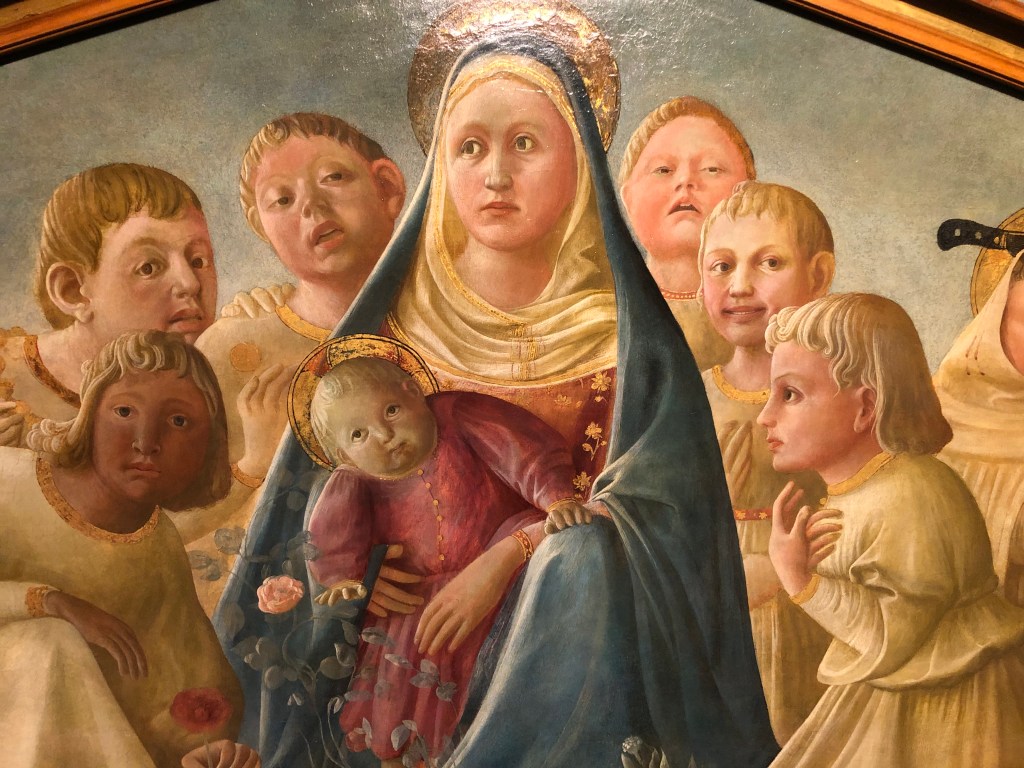
Filippo Lippi, Madonna of Humility, 1420

Humility is the virtue that stands out both in today’s Gospel reading and in Sirach’s advice to “conduct your affairs with humility” and to “humble yourself the more, the greater you are.”  I’ve been thinking about humility a lot this summer because I’ve been thinking about my grandfathers.  One passed away in June, the other fourteen years ago, and “humble” is one of the first words that comes to mind when I think of either of them—perhaps in both cases because my grandfathers were the quiet ones, and my grandmothers were the talkers!  One grandfather was a baker, the other lived his whole life in the same small town in Minnesota.  I think of them both as great men not because they sought attention or prestige, but because they didn’t.  Because they dedicated themselves to others, to their families and to their communities, without making a fuss about it, and left the lives of many better as a result.  In the homely etiquette lesson Jesus offers in the Gospel—take the lower place instead of elbowing your way to the head of the table—he points to one way in which a humble act can leave one better off in the long run.

Continue reading “Humility is our glory: homily for the 22nd Sunday in Ordinary Time”

Heaven without God? Homily for the 21st Sunday of Ordinary Time

Luca Signorelli, The Last Judgment (1499-1504), Orvieto Cathedral

Homily for the twenty-first Sunday in Ordinary Time (C)

Attention: this homily contains spoilers.  A few years ago, Ted Danson and Kristen Bell stared in a comedy on NBC called “The Good Place.”  The premise was that Kristen Bell’s character, Eleanor Shellstrop, had died and in the afterlife ended up in the “Good Place.”  The only problem was that Eleanor was a shallow and selfish person.  There had apparently been a mix-up in the calculations—points were awarded for good actions and subtracted for bad ones—and she had been confused with a much better woman also named Eleanor who happened to die at exactly the same moment.  After not too long, Eleanor realizes that there had been an error and that she needs to hide her true identity to avoid being sent to the Bad Place, where she belongs.  Since she had spent her whole life being petty, mean, and vulgar, she has no idea how to act and keeps slipping up and almost blowing her cover.  

The show presents a picture of a very common understanding of heaven.  It is a pleasant place, a never-ending vacation, tailored to the preferences—dietary, decorating, recreational—of its inhabitants.  It is more or less religiously neutral; it’s a reward for good behavior, that’s it.  In fact, though there are angels in the show—including Michael, played by Ted Danson—God is not mentioned at all.  If you watch the show in light of Christian revelation—the way the Gospel talks about heaven—you figure out pretty quickly that the Good Place is most certainly not heaven.  Understanding where the show goes wrong can help us to understand a bit better what makes the Christian offer of heaven so unique and surprising, and it can also help us to understand Jesus’ admonitory words in the Gospel today.

Continue reading “Heaven without God? Homily for the 21st Sunday of Ordinary Time”

“Eyes fixed on Jesus”: Homily for the 20th Sunday of Ordinary Time

Homily for the twentieth Sunday in Ordinary Time (C).

The word “Jesuit” was first used to mock the early followers of St. Ignatius of Loyola.  These first members of my religious order, the Society of Jesus, were derided for talking so much about Jesus and were given the name “Jesuit,” condescendingly, by those who apparently thought they had something better to talk about.  Those first Jesuits took the criticism as a compliment, and the name stuck.

The letter to the Hebrews tells us to keep our eyes fixed on Jesus, and the Gospel’s hard words make the same point in dramatic fashion.  We’ll return to the Gospel in a minute, but I want to start with the striking passage from Hebrews.  The letter tells us to keep our eyes fixed on Jesus so that we can “persevere in running the race that lies before us.”  Races, by definition, are challenging events.  It is possible to lose a race by giving up, by going off course, by laziness, by getting tripped up on some obstacle.  Hebrews tells us to “rid ourselves of every burden and sin that clings to us.”  Sins are the sort of thing that will slow us down, trip us up, or send us running in the wrong direction.  Running a race usually requires training, and Christianity is no different.  We aren’t born Christians.  Perhaps a century or two ago when our whole society was Christian, it was possible to imagine that we were, that being a Christian was the same thing as being a good citizen or an agreeable person, just going with the flow. That was always an illusion, and it is even more so today when the forces that shape our culture are often hostile or indifferent to Christianity.

Continue reading ““Eyes fixed on Jesus”: Homily for the 20th Sunday of Ordinary Time”

Mary’s Assumption: the ultimate celebration of the human body

Homily for the Assumption of the Blessed Virgin Mary (from 2021.)

Crowning of the Virgin, St. Martin’s Cathedral, Spišská Kapitula, Slovakia

Ounce per ounce, the largest bone in our body, the femur, is stronger than steel.  Laid out end to end, the blood vessels from an adult’s body could circle the globe four times.  Our brains contain 86 billion nerve cells, which are joined by 100 trillion connections.

Right now in your brains several million of those connections are lighting up asking, “What in the world is he talking about?  Nice factoids, padre, but what do they have to do with anything?”  The answer is that today’s feast, among the most solemn on the Church’s calendar, is a celebration of the human body.  

Today we celebrate the Assumption of the Blessed Virgin Mary, the dogma that at the end of her life Mary was taken up soul and body into heavenly glory.  This dogma is more than just an interesting factoid.  It is deeply relevant to each one of us because Christianity professes belief in the resurrection of the body.  St. Paul’s First Letter to the Corinthians talks about Christ’s resurrection as “the firstfruits” of a much larger harvest.  In a sense, Mary’s Assumption is also a guarantee that the fruits of the resurrection will be shared with the whole Church.  Mary, the first Christian believer, the first to receive the news of Jesus’ Incarnation, represents the Church in a way nobody else can.  

We human beings are both body and soul.  We are not souls trapped in a body; our bodies are part of who we are.  Angels are souls without bodies, but we are not angels.  If the resurrection were an entirely spiritual phenomenon, it wouldn’t be us rising from the dead.  This is why Jesus became incarnate, coming in the flesh.  It is why the Gospels insist so forcefully that, when Jesus rose from the dead, he had not become a ghost or a hologram but remained a man who ate food and whose flesh bore the wounds of his passion.  It is why the sacraments require material elements, and not just any material elements but specific elements connected to Jesus’ physical existence on earth.

Continue reading “Mary’s Assumption: the ultimate celebration of the human body”

“A must-read for anyone who wants to understand how salvation works in the Church’s tradition”

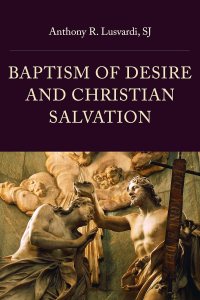
Baptism of Desire and Christian Salvation has now been out long enough to begin generating some discussion, and I’m grateful to have seen a number of new reviews and reactions over the past few months.

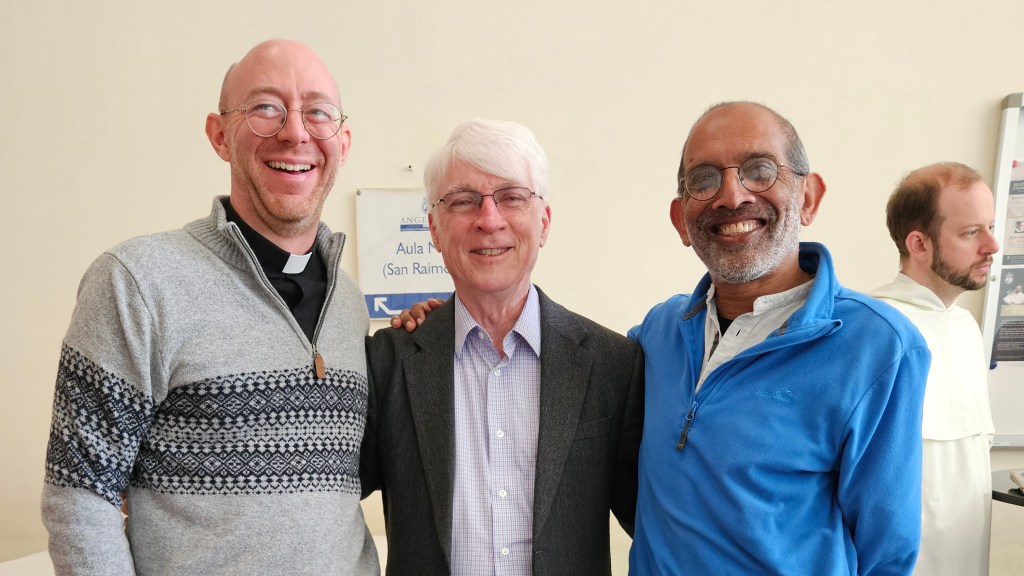
With Dr. Ralph Martin and Dr. Gavin D’Costa

I was delighted to see Dr. Ralph Martin, one of the world’s top authorities on the new evangelization, mention the book in his latest update at Renewal Ministries. Dr. Martin mentions meeting up while he was visiting Rome. I had a charming and stimulating conversation with him and his wonderful wife Anne, as well as a number of equally enjoyable conversations with Dr. Gavin D’Costa, whom he also mentions, an expert on world religions who teaches at the Angelicum. We also discussed Dr. Martin’s book Will Many Be Saved?, which I cite in my work. I’m deeply honored that he considers Baptism of Desire and Christian Salvation “a very solid and brave work of scholarship that faithfully presents the doctrinal and moral implications of the Church’s–and Jesus’–insistence on baptism to be saved.”

I’m equally grateful to have stumbled upon the careful and detailed review and summary of the book by Fr. Richard Conlin at The Prodigal Catholic Blog. I’m especially glad that Fr. Conlin considers the book “a must-read for anyone who wants to understand how salvation works in the Church’s tradition–especially in ‘hard cases’ like the unbaptized, non-Christians, or infants” and that he highly recommends it “especially for priests, catechists, and anyone serious about the faith.” A scholarly book such as Baptism of Desire and Christian Salvation might seem intimidating, but I think this one is important for more than just an academic audience. My intention was always that it would be accessible not just to specialists but to anyone with a theological background. So it’s encouraging to read that Fr. Conlin found it “both theologically rich and remarkably readable–a rare combination.”

Those who read Italian might check out the insightful review in Ecclesia Orans by Prof. Paolo Trianni, who recognizes the theological approach as “innovative” because it seeks to overcome a “legalistic concept of the sacrament” present at times in scholasticism and neo-scholasticism.

Finally and somewhat unexpectedly, I was recently contacted by Brianne Edwards of Rapid City, who brought to my attention the remarkable story of baby Brian Thomas Gallagher, who died 43 minutes after his birth in 1982 and whose body was found to be apparently incorrupt in 2019. He happens to be interred at Black Hills National Cemetery. I discuss the possibility that infants can receive baptism of desire in the book, and Baby Brian’s case seems almost to have been designed to fit the argument I make. I’ll have more to say on the subject in the future…

In the meantime, remember that Baptism of Desire and Christian Salvation is available on Amazon, directly from Catholic University of America Press (20% discount with the code CT10),  and at other online booksellers.

Bargaining with God? Homily for the 17th Sunday of Ordinary Time

Homily for the seventeenth Sunday in Ordinary Time (C)

Guido Reni, Trinity of the Pilgrims (1625-6)

Readings: Gn 18:20-32; Col 2:12-14; Lk 11:1-13

A few weeks ago, some friends were talking about watching a movie.  They knew that it took a dark twist at the end, so they hit the stop button early to avoid the tragic finish.  That’s exactly what happens in today’s first reading.  The wickedness of Sodom and Gomorrah becomes too great for God to ignore, and he decides to destroy the cities.  Abraham questions him, as if bargaining him down.  If just ten innocent people remain, God will spare the cities.  But, as you probably know, if you read on, God does destroy the cities.  They did not contain even ten good men.  They were corrupt from top to bottom. 

Still, it’s not an accident that today’s reading stops where it does.  The premature ending focuses our attention on God’s reaction to human corruption.  He is not eager for destruction or motived by vindictiveness.  To use the terms of later Christian theology, we could say that the destruction of Sodom and Gomorrah is one of the many stories in the Book of Genesis that express the reality of Original Sin.  The Biblical message is clear: None of us is innocent.  Mankind is corrupt from top to bottom.  God’s reaction to Abraham—his desire to spare the innocent—shows that the destruction wrought by Original Sin is not what God wants.  Our sinfulness is self-destructive. 

If self-destruction were the end of the movie, we could understand turning it off early.  But God’s full response to human sinfulness, which unfolds in the New Testament, is not to strike a deal, to plea bargain, or to negotiate.  Nor is it to ignore our sinfulness or to excuse it.  It is not to declare a new paradigm in which there are no longer any moral absolutes and what was once sinful is now OK, if circumstances are right or you get your pastor’s permission.  No, God’s reaction is something else entirely.  As St. Paul tells the Colossians, God has removed sinfulness from our midst by “nailing it to the cross.”

Continue reading “Bargaining with God? Homily for the 17th Sunday of Ordinary Time”

Is the Great Gatsby the Great American Novel?

The dome of the Cathedral of St. Paul from Summit Avenue, not far from where F. Scott Fitzgerald grew up.

As an undergraduate, I was an English major, so it was a real treat for me to have the chance to reread one the classics of American literature, F. Scott Fitzgerald’s The Great Gatsby this spring. This year marks the 100th anniversary of the novel’s publishing. My essay to mark the occasion recently appeared in Law & Liberty, and you can check it out here. The occasion prompted me to dig up another essay I wrote several years ago about “Benediction,” one of Fitzgerald’s few stories with an explicitly Catholic theme (check it out here).

As much as any other book, I think, Gatsby can stake a claim to be the Great American Novel, in part because the novel itself grapples with the question of what it really means to be “great.” Equally important, it wrestles with the nature of the American character. It is an elegantly slim novel but, as I realized while writing and rewriting my reflection on it and still feeling like I couldn’t quite do it justice, it is taut with beauty, irony, and subtle meaning.

Celebrating St. Kateri in South Dakota

July 14 is an important day for Native American Catholics: the feast day of St. Kateri Tekakwitha (1656-1680). St. Kateri’s life was characterized by courage and fidelity in the face of great suffering. She lost her parents to a smallpox epidemic as a girl, and the disease left her scarred for life and with damaged eyesight. At twenty, she converted to Catholicism and, as happens to many converts, suffered hostility for doing so. But she lived an exemplary life as a Christian, dedicating herself to caring for the sick and elderly, prayer, and devotion to the Eucharist.

In 2012, Kateri Tekakwitha, the “Lily of the Mohawks,” became the first canonized saint to hail from one of the Native tribes of North America. Her canonization by Pope Benedict XVI coincided with my time working on the Rosebud Indian Reservation in South Dakota, a deeply formative experience in my own life as a Jesuit. I knew many Lakota Catholics who had spent years praying for Kateri’s canonization, and it was a joy to be with them when the day finally came. I remember very well the beautiful Mass we celebrated in St. Charles Borromeo Church on St. Francis Mission — and the feast that followed.

St. Charles Church was recently the subject of a news segment produced by South Dakota Public Broadcasting. It is a remarkably beautiful church–recognizable on the plains for its distinctive purple color. First-time visitors stepping inside often remark on how they never expected to find such a treasure on the prairie. Its combination of Lakota art with traditional church architecture is, in my opinion, a terrific example of successful inculturation.

I was delighted when I watched the SDPB segment to see it narrated by Deacon Ben Black Bear, an expert in Lakota language and culture and a man of deep faith and spiritual insight with whom I had the honor of working on Rosebud.

If you’re looking for a way to celebrate the memorial of this great and humble saint, spend a couple of minutes watching Deacon Ben describe St. Charles Borromeo Church here:

And if you’re anywhere between Murdo, South Dakota and Valentine, Nebraska, take a detour to check out this gem of a church in person!


If you haven’t already done so, consider subscribing to this blog:

F. Scott Fitzgerald’s Jesuit story

2025 represents the 100 year anniversary of a book that, as much as any other, has a claim to be called the Great American Novel — F. Scott Fitzgerald’s The Great Gatsby. Revisiting the book this year, I came upon something I wrote on the blog Whosoever Desires back in 2011 about one of Fitzgerald’s few explicitly Catholic stories “Benediction.” I thought I’d share it here. This weekend, I’ll have something at Law & Liberty about Gatsby.

I have long thought F. Scott Fitzgerald to be a very Catholic writer, though explicitly Catholic themes show up only rarely in his work.  There’s the urbane Monsignor Darcy in This Side of Paradise, for example, and a few scattered references in Tender is the Night, but mostly Fitzgerald’s Catholic sensibilities come through in his moral vision, in the interplay of truth and illusion we see, for example, in The Great Gatsby.

In a Fitzgerald biography, however, I’d once come upon a reference to an early (1920) short story called “Benediction,” and I took advantage of a Chicago snow day last week to track the story down.  I was not disappointed.

The story is a gem, written in the witty, dancing prose of the youthful Fitzgerald, and touching on many of his typical themes—the giddiness of coming of age, the wistful sadness of romance, even a hint at class sensitivities.  The story centers around Lois, a romantic and beautiful nineteen-year-old travelling to Baltimore to meet her lover, Howard; on her way to their rendezvous she stops to visit her only brother Keith, a seminarian she has not seen in seventeen years.

Fitzgerald’s description of the seminarians spilling out onto the lawn after class like “a swarm of black human leaves” carrying thick volumes of Kant and Aquinas is typical of his lapidary prose—and hints at the identity of the crowd that Keith has gotten himself involved with:

There were many Americans and some Irish and some tough Irish and a few French, and several Italians and Poles, and they walked informally arm in arm with each other in twos and threes or in long rows, almost universally distinguished by the straight mouth and the considerable chin—for this was the Society of Jesus, founded in Spain five hundred years before by a tough-minded soldier who trained men to hold a breach or a salon, preach a sermon or write a treaty, and do it and not argue…

Keith, whom Lois remembers chiefly from the picture of a skinny teenager their mother keeps on her bureau, turns out to be a true brother—understanding, kind, insightful, sympathetic, confident.  Lois describes him as “sweet.”  He recounts his vocation story with slight dissatisfaction, feeling, as one often does when telling one’s vocation story, that something inexpressible—the most important thing—has been left out.

In Keith and his fellow Jesuits, Lois encounters something she recognizes as beautiful and weighty—and different.  What is more, Lois, a Catholic herself, though by her own description a “lukewarm” one, seems to realize that this different something around which her brother’s life revolves makes a claim on her too.

Continue reading “F. Scott Fitzgerald’s Jesuit story”
Homily for the Solemnity of Saints Peter and Paul

Throughout this month, I’ve been reposting the homilies I wrote for the Homiletic and Pastoral Review. You can check them all out on their site, as well as Friday’s Homily for the Sacred Heart. This feast seems especially joyful this year, coming so soon after the election of Pope Leo XIV.


Homily for the Solemnity of Saints Peter and Paul

Martyrdom of St. Peter (Doors of the Basilica of St. Paul Outside the Walls, Rome)
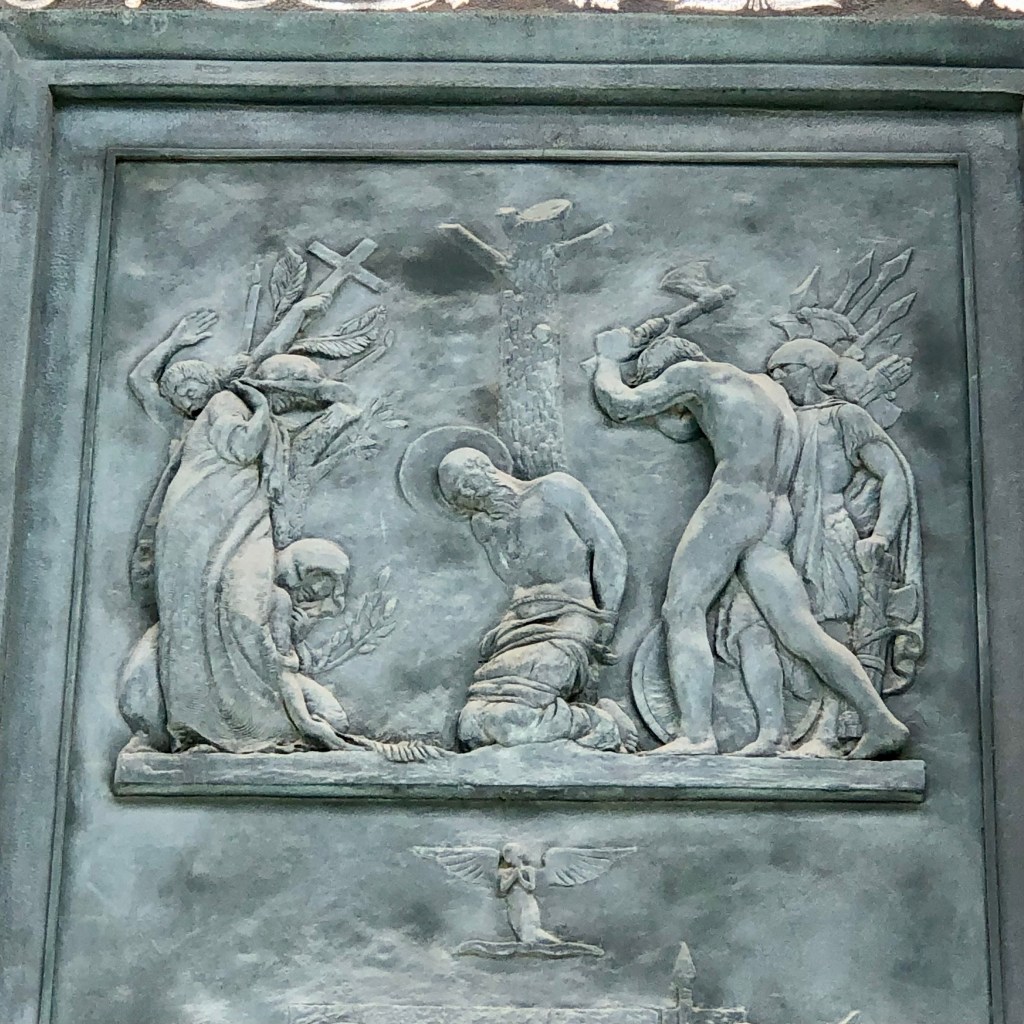
Martyrdom of St. Paul (Doors of the Basilica of St. Paul Outside the Walls, Rome)

Peter and Paul were great men.  It is common in preaching to hear about Peter’s failures—his weaknesses and false steps, which the Gospels make no attempt to hide.  And we first meet Paul, of course, when he is persecuting the Church.  Peter and Paul were both flawed men, but nonetheless they are great men.

In fact, one of the things that makes them both great is that they acknowledge their flaws. Practically the first words out of Simon Peter’s mouth in the Gospel of Luke are, “Depart from me, Lord, for I am a sinful man” (Lk 5:8).  In one of his letters, Paul claims to boast in his weakness (2 Cor 12:9).

Yet, in the Acts of the Apostles, Peter raises the dead to life.  Paul becomes the most remarkable missionary in history.  The faithful of Jerusalem bring their sick into the streets just so that Peter’s shadow will fall upon them.  And in today’s Gospel we hear those remarkable words from the mouth of the Lord himself, “You are Peter, and upon this rock I will build my Church, and gates of the netherworld shall not prevail against it.”  The greatness of both Peter and Paul comes from Jesus.

Continue reading “Homily for the Solemnity of Saints Peter and Paul”