Anthony R. Lusvardi, S.J., teaches sacramental theology at the Pontifical Gregorian University in Rome. He writes on a variety of theological, cultural, and literary topics.
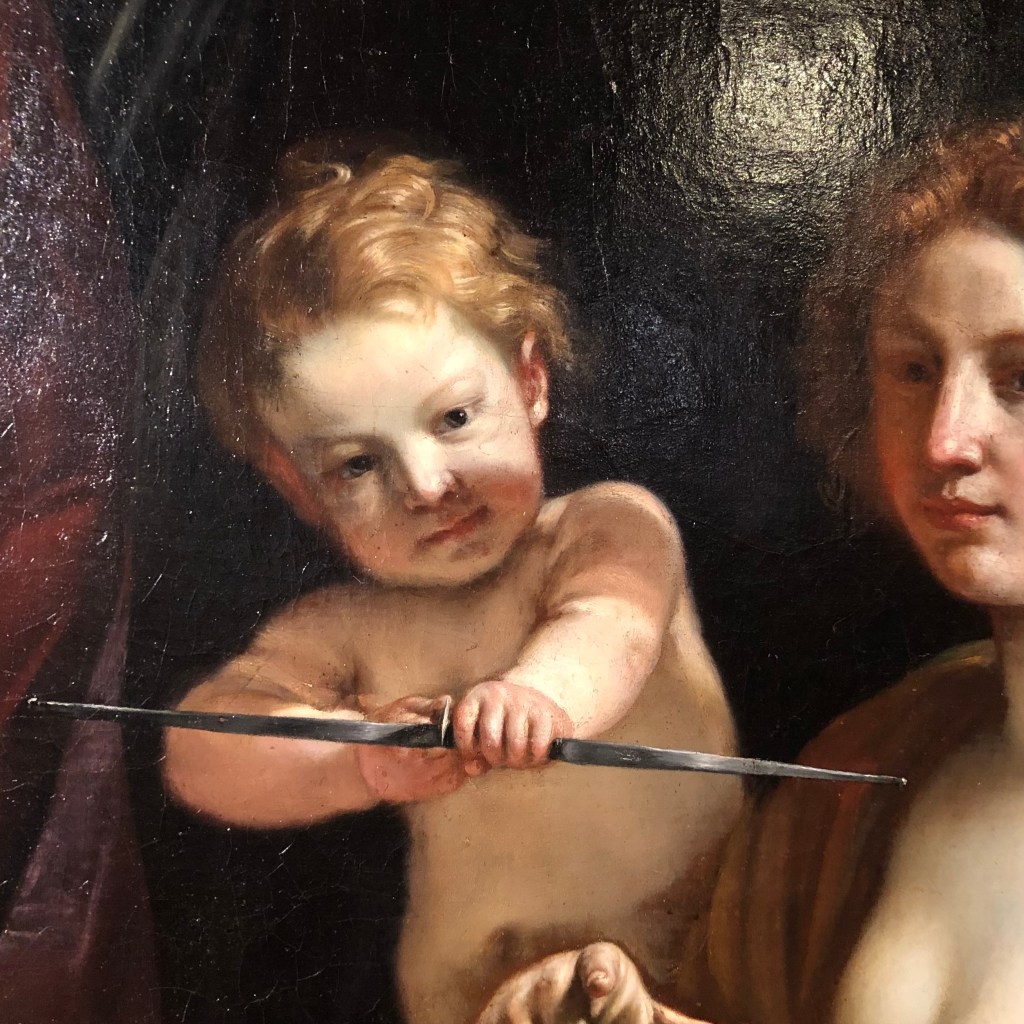
Cupid aims his arrow! From “Venus, Mars, and Cupid,” Guercino, 1633
Late last year, the Vatican’s Dicastery for the Doctrine of the Faith issued Una Caro a document praising monogamy. Monogamy is indeed a praiseworthy institution and not one to be taken for granted these days when everything seems up for grabs. In my seminar on marriage last semester, a student brought to my attention the story of a Protestant pastor in Berlin blessing a “marriage” of four men. And I know from the discussions about marriage in my introduction to the sacraments class at the Gregorian University that polygamy remains a real pastoral challenge in many parts of the globe.
I was happy to be able to review Una caro in the latest issue of La Civiltà Cattolica, adding some insights from recent sociological studies on marriage by Brad Wilcox, Mark Regnerus, and the Belgian sexologist Thérèse Hargot. These sort of studies cannot substitute for a theology of marriage, but they do provide an invaluable supplement to it, if for no other reason than that they help to dispel some of the myths used to deride the Christian vision of marriage.
Homily for Wednesday of the Second Week of Lent (translated from Italian).
When I was little, I liked a series of children’s books and cartoons called “Winnie the Pooh.” In this series there was a character called Eeyore—in Italian I think it’s “Ih-Oh”—a gray donkey who talks sadly and sl-ow-ly. Poor Eeyore is always pessimistic and depressed. Eeyore is not a bad character; he is just a melancholic person—or, rather, a melancholic donkey.
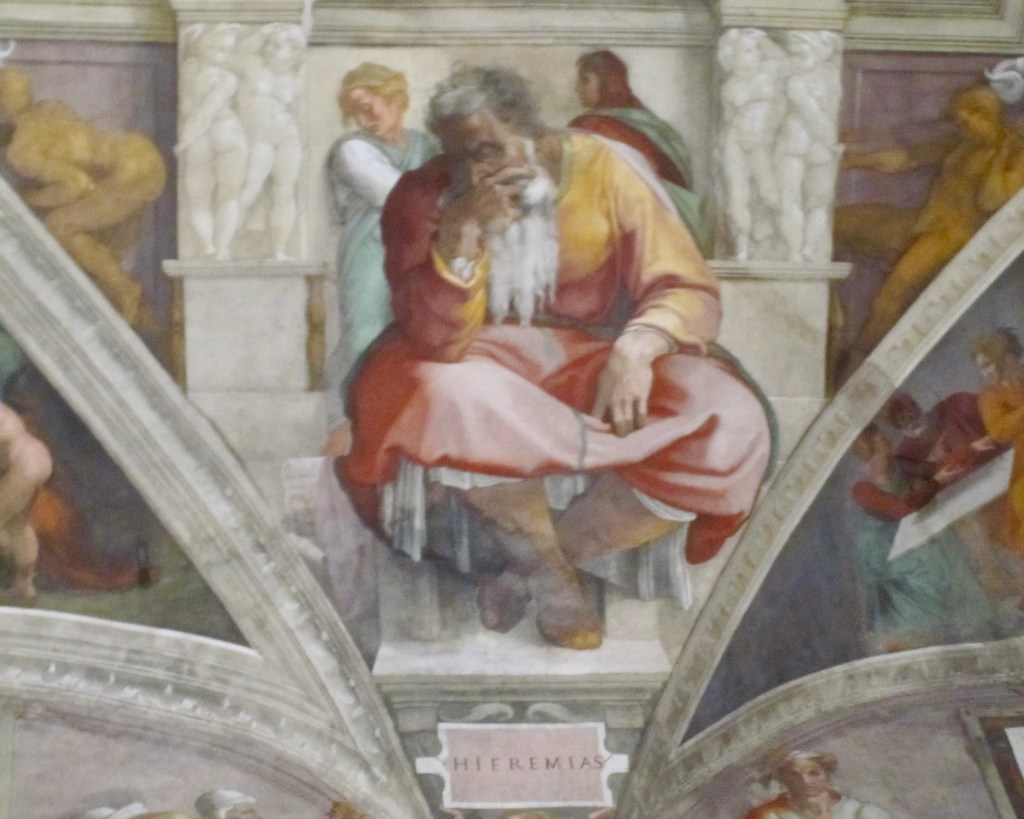
Jeremiah (Michelangelo, Sistine Chapel)
I think Eeyore would like today’s readings. The prophet Jeremiah is a prophet of doom. The message he receives from God to tell the citizens of Jerusalem is pessimistic. Destruction will come to the holy city, Jeremiah says. The king of Jerusalem and his advisors do not want to hear this message, so they find a more optimistic prophet, Hananiah, and plot to throw Jeremiah into a pit.
Jesus’ words today are also, in a way, words of doom. He repeats the prophecy of his crucifixion, which the disciples consistently try to avoid. Here, instead of listening to him, they immediately turn to church politics—who will have the highest position.
As is traditional for the First Week of Lent, the Pope and the Roman Curia will spend several days making their annual spiritual exercises. This year’s retreat is being preached by Bishop Erik Varden of Trondeim, Norway. Some readers might know Bishop Varden already from his wonderful blog Coram Fratribus. A convert and then a Trappist monk, Bishop Varden has a gift for communication comparable to our own great Robert Barron, though with his own unique style.
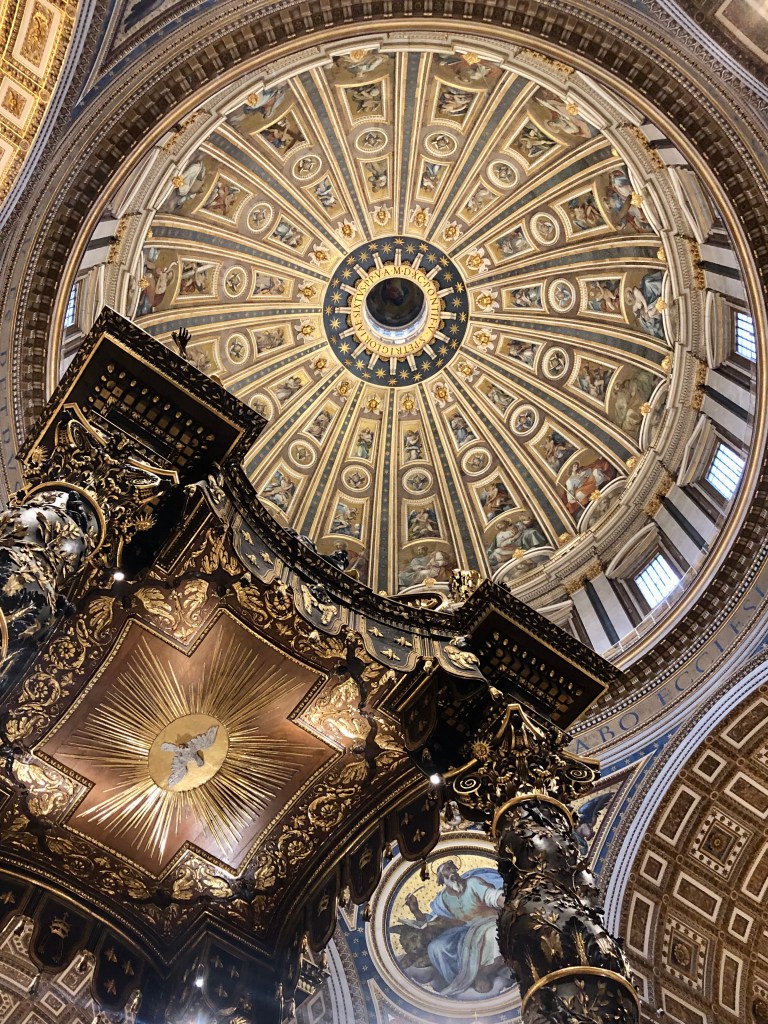
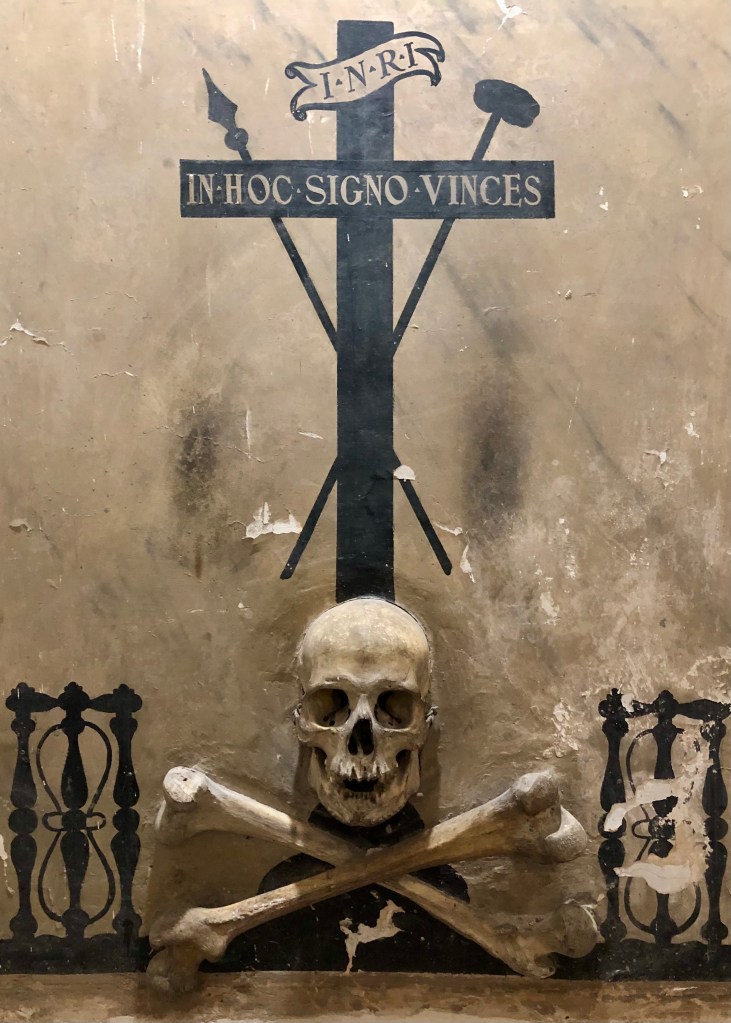
St. Peter’s Basilica, Rome
At a mere 51 years old, Bishop Varden also represents something of a turning of the page in the life of the Church. I’ve written before (here and here) that the zealous and youthful Church I encountered in Scandinavia hints at what fidelity and evangelization must look like in an increasingly secularized world. Bishop Varden–articulate, orthodox, cultured, and creative–seems to understand how to respond to our twenty-first century reality.
Last year I read Bishop Varden’s profound book Chastity: Reconciliation of the Senses, and I thought this week would be a good opportunity to share a few of its many insights…
Last year’s (brief) homily for Ash Wednesday. Original Italian.
In the readings with which we begin Lent today, we see two sides to this season of conversion. There is a public side. In the first reading, Joel calls the people to gather together, to declare a public fast, and to renew their worship. In the second reading, too, we are called to public witness: we are “ambassadors” of Christ, says St. Paul.
It might seem that there is a certain tension between these readings and the Gospel, which exhorts us to perform pious practices in private. However, there is no contradiction, because both of these aspects are part of the mission of a Christian in this world. The Gospel is a warning against hypocrisy, against the temptation to try to gain something—even if only the esteem of others—through our religious observances. All our practices—almsgiving, fasting, prayer—must be directed to the glory of God and not to our own glory.
During this season of Lent, let us seek above all purity of heart, integrity of public conduct, and an interior life consistent with the great call to follow the Lord Jesus as his disciples.
Readings: Joel 2:12-18; 2 Cor 5:20-6:2; Matt 6:1-6, 16-18
Homily for the Fifth Sunday in Ordinary Time (Year A).
Bagnoregio, Italy
After the Christmas break another Jesuit in our community returned to Rome after having had corrective eye surgery. The surgery went so well that for a week after he returned, he wore sunglasses at all times of day, even indoors; of course, we gave him a hard time about imagining that he had become a movie star. What happened was that, with his vision corrected, at first his pupils were letting in too much light—so much light that he couldn’t see. For our eyes to work, we need light, but we also need contrasts. Some parts of our field of vision must be lighter or darker than others, otherwise we’ll end up falling down the stairs and running into walls.
If there is no light, of course, we cannot see. But too much light can blind us too. In the Biblical world, before electric lighting, the risk of darkness was almost always greater than having too much light. In the Bible the metaphor of light is usually good, though occasionally the light of God is overwhelming—think of Jesus appearing to St. Paul on the road to Damascus. Paul is knocked over and blinded by the vision. If we were to be hit right now with heaven’s light in all its purity, we would probably be paralyzed too. In order to experience that light, we need to grow, to be re-formed—the same way my confrere’s eyes had to convert after surgery and our own eyes have to adjust when we step outside at midday. We might, in fact, say that God’s light shines even on those in hell, and that their darkness is the result of eyes grown used to the shadows, forever unwilling to adjust to the daylight. However, this world in which we live right now contains both light and darkness. In order to navigate in this world, we need to be able to recognize the contrasts.
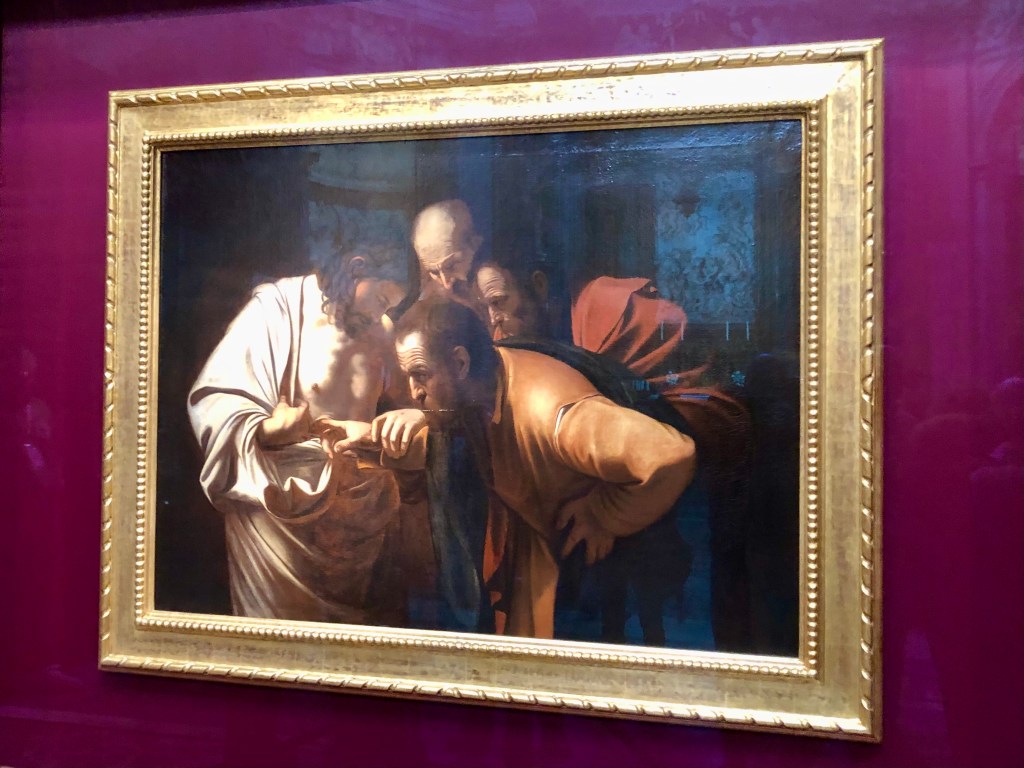
The Incredulity of St. Thomas, Caravaggio (1602-7)
Readers of this blog will know that one of the delights of living in the center of Rome is that a Caravaggio is never more than a stroll away. I’ve written about the great spiritual insight in Caravaggio’s Matthew cycle in the Church of San Luigi dei Francesi. Last year, I reflected in The Catholic Thing on why Caravaggio so resonates with contemporary viewers after visiting an extraordinary exhibit of his work in Palazzo Barberini.
At the tail end of the Jubilee I caught another extraordinary exhibit, albeit of just one Caravaggio, at Sant’Agnese in Agone. The work, The Incredulity of St. Thomas (1602-7), was on loan from a private collection in Florence. It’s a work full of drama and humanity and shows Thomas wide-eyed while inserting his index finger into the Risen Lord’s side. Jesus himself is utterly serene as he guides the doubting apostle’s hand toward his torso. (A nice detail is that the Lord’s face seems a bit sunburned, while his body is not.) Two other apostles look on over Thomas’s shoulder with both concentration and astonishment.
We are now in the middle of the exam period at the Gregorian University. For me, that means a seemingly endless stack of papers to read and evaluate. My students know that I am prone to harp on the importance of clarity in writing. (When your professor has to read 500 pages of student writing, it’s really in your own interest not to make his job any harder than it has to be!) My students have heard repeatedly the advice I once received from a great philosophy professor at Loyola Chicago (Dr. Jacqueline Scott, who taught Nietzsche): always define your terms.
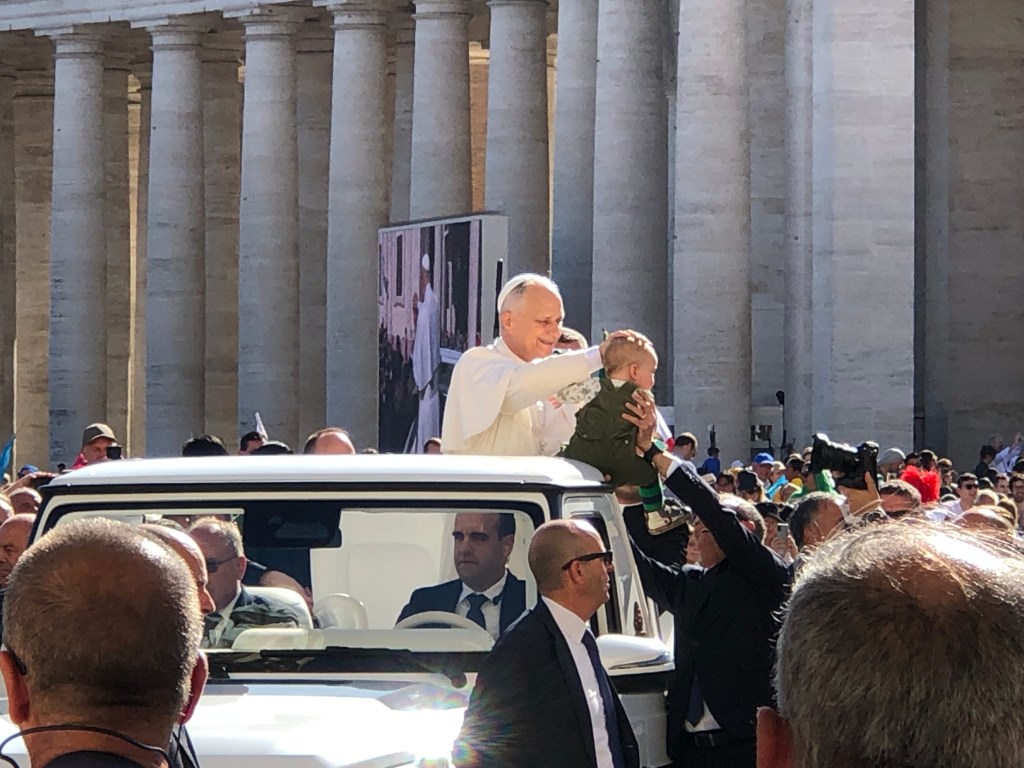
Pope Leo XIV in St. Peter’s Square
You can imagine my joy then to read the same advice (more or less) from no less an authority than Pope Leo XIV. His speech to the Vatican Diplomatic Corps from earlier this month is extremely interesting and among the most important of his papacy thus far. I found his reflections on language especially insightful and necessary, and they reawakened all my old writing teacher instincts. Muddled writing often means muddled thinking. And today’s public discourse is… well, let’s just say “muddled” is euphemistic. The ubiquitous use of “they” as a singular pronoun, for example, I find nothing short of barbaric. Not quite as bad as the guillotine, but close.
Here are a few of Leo’s words on the uses and misuses of language, though the whole speech is worthwhile. It wouldn’t be the worst side effect if a few Vatican documents got a bit shorter as a result… just saying.
“[I ]n order to engage in dialogue, there needs to be agreement on the words and concepts that are used. Rediscovering the meaning of words is perhaps one of the primary challenges of our time. When words lose their connection to reality, and reality itself becomes debatable and ultimately incommunicable, we become like the two people to whom Saint Augustine refers, who are forced to stay together without either of them knowing the other’s language. He observes that, “Dumb animals, even those of different species, understand each other more easily than these two individuals. For even though they are both human beings, their common nature is no help to friendliness when they are prevented by diversity of language from conveying their sentiments to one another; so that a man would more readily converse with his dog than with a foreigner!”
Today, the meaning of words is ever more fluid, and the concepts they represent are increasingly ambiguous. Language is no longer the preferred means by which human beings come to know and encounter one another. Moreover, in the contortions of semantic ambiguity, language is becoming more and more a weapon with which to deceive, or to strike and offend opponents. We need words once again to express distinct and clear realities unequivocally. Only in this way can authentic dialogue resume without misunderstandings. This should happen in our homes and public spaces, in politics, in the media and on social media. It should likewise occur in the context of international relations and multilateralism, so that the latter can regain the strength needed for undertaking its role of encounter and mediation. This is indeed necessary for preventing conflicts, and for ensuring that no one is tempted to prevail over others with the mindset of force, whether verbal, physical or military.
A couple of years ago I taught a seminar on the sacrament of marriage, using Mark Regnerus’s excellent book The Future of Christian Marriage, which I reviewed for the Homiletic and Pastoral Review. I taught the same seminar again this past semester and reviewed another recent contribution to the subject, Brad Wilcox’s Get Married: Why Americans Must Defy the Elites, Forge Strong Families, and Save Civilization (Broadside Books, 2024). You can read the review below or visit HRP and read it again!
Marriage is among the most important social justice issues of our day. Classic Catholic social teaching—think Leo XIII in Rerum Novarum—has long recognized the connection between social well-being and a family life built on marriage. As Brad Wilcox points out in Get Married: Why Americans Must Defy the Elites, Forge Strong Families, and Save Civilization, “questions of marriage and family” are better predictors of positive or negative social outcomes than “race, education, and government spending” (xiv). Yet even in Catholic circles, questions of marriage and sexual ethics are often treated not as issues of pressing social concern, but as matters of private morality—or dismissed as “cultural issues.”
Such dismissiveness has little theological basis. And Wilcox—a professor of sociology and the director of the National Marriage Project at the University of Virginia—demonstrates that it is even harder to justify from a sociological point of view. Marriage is good both for society as a whole—a higher percentage of married parents correlates with lower child poverty (73)—and for individuals, both men and women, who report higher rates of happiness, find more meaning in their lives, and are less lonely than their unmarried—and childless—peers (51-52, 115, 121).
With yesterday’s feast of the Baptism of the Lord reminding us of the beauty and uniqueness of the sacrament of baptism, it seemed an opportune moment for an update on my work on baptism of desire. I’ve continued to do a bit of research on the question of infants that die before baptism and posted some reflections on the issue here and here late last year.
The Baptism of the Lord (above), Guglielmo of Pisa (1160), pulpit, Cagliari cathedral (Sardinia)
The Baptism of the Lord, El Greco
Reviews of Baptism of Desire and Christian Salvation continue to come out, so far all deeply appreciative. Theology today is no longer an exclusively European enterprise, so I’m especially excited to have an international response to the book. The Hekima Review, Africa’s leading theological journal, recommends it for both “Catholic clergy and lay people as it foregrounds the pastoral implications of the doctrine and the need for evangelisation.” Meanwhile, India’s top theological journal, the Vidyajyoti Journal of Theological Reflection published a particularly detailed and insightful review, which noted the specific value of the book in the context of Indian religious pluralism. It expressed the hope that the book would become the standard “theological ‘textbook'” for discussing such issues. The reviewer also picked up on the way the work responds to the deeper philosophical currents of the twentieth century:
This work belongs to what the dogmatic theologian José Granados has identified as a corporeal turn in theology, an emphasis on the body after the heady years of the twentieth century that – whether primarily or exclusively – emphasized cognition. This corporeal turn has meant a returning emphasis on not just the body, but the embodied nature of the Christian faith. It recognizes that the embrace of the faith cannot be restricted to some conceptual nod, but must necessarily embrace ritual, and recognize that the materiality of ritual is important. As Lusvardi writes “The instinct of the early Church to emphasize the ritual was not wrong, for the ritual says and does what nothing else can” (p. 342). In stressing the importance of the corporeal, Lusvardi’s work also becomes part of the corpus of the critique of modernity, which consciously, or unconsciously, seeks to restore a holistic view of the world, sundered through modernity’s adoption of Cartesian binaries, and has powered so much of Indian post-colonial thought.
Closer to home, The New Ressourcement journal said:
Lusvardi’s excellent book … is a must-read for anyone interested in the history of baptism, the nature of sin and salvation, or the hope for non-Christians and infants. It is hard to do justice to the extensive ground this book covers. In a compelling way, it draws the reader to see that the good news of Christian salvation is truly good news for its hearers precisely because the experience of Christ’s saving death and life is available to all in baptism.
Baptism of Desire and Christian Salvation in an Indian stole
The reviewer also offered a defense of the standard scholastic approach to the doctrine, aspects of which I call into question in the book–evidence, I think, that the issues the book raises are worthy of robust theological examination and debate.
So put it on your reading list for the new year!
Baptism of Desire and Christian Salvation is available from Catholic University of America Press (20% discount with the code CT10), Amazon, and other online booksellers. I have collected reviews, interviews, and other news here.
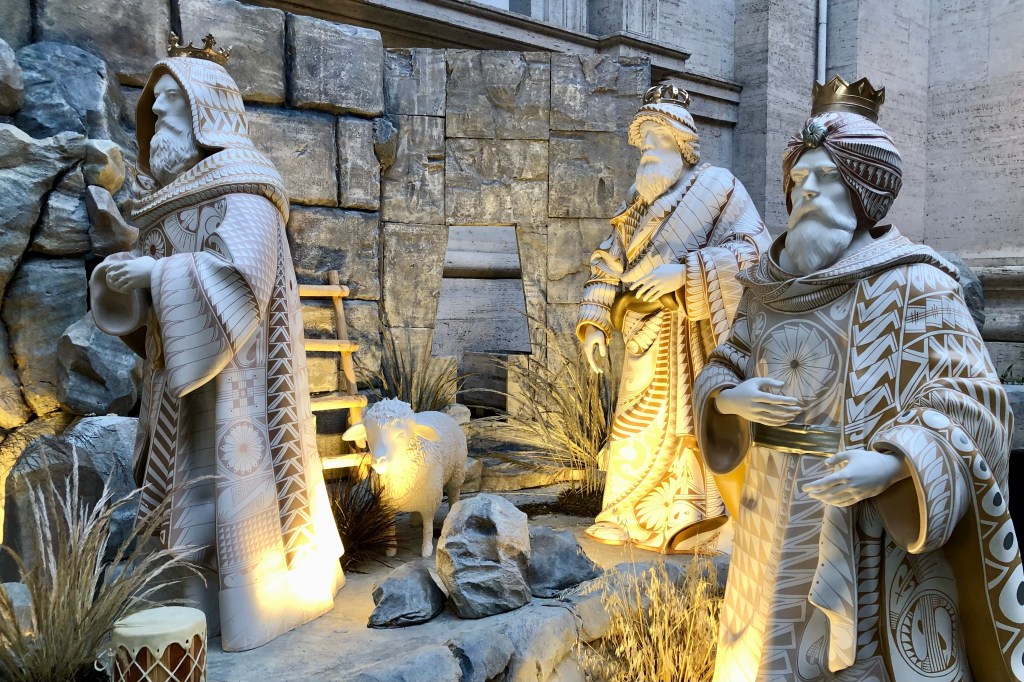
The Three Kings, from a Mexican Nativity displayed inside the Vatican, 2025
Homily for the Solemnity of the Epiphany.
Today’s feast, the Epiphany, traditionally was the day for gift-giving in Italy, though that tradition has been somewhat superseded by the arrival of a more aggressive salesman, Santa Claus. Santa accepts both Visa and Mastercard—and, in some places, American Express—whereas the Magi bartered or traded in old-fashioned gold.
The Magi are still, however, known for their gifts. Matthew’s Gospel does not give a precise number of Magi, but since it lists three gifts, the Christian artistic tradition has always depicted three Magi—or kings or wise men, depending on how you translate the word for these learned, wealthy, and adventuresome visitors. Their gifts—gold, frankincense, and myrrh—struck a chord in the Christian imagination, even if most of us would have trouble explaining what exactly you do with myrrh.
Ancient spiritual writers attributed symbolic meaning to their gifts: gold symbolized Christ’s kingship; frankincense—a type of incense used in worship—symbolized his divinity; and myrrh—myrrh again, gave them a little trouble. Some associated myrrh with virtue or with prayer. Myrrh is actually very similar to frankincense; both come from the resin—the sap—of desert trees, which makes them rare and valuable. Both give off distinct smells when burnt. Frankincense is sweeter, while myrrh gives off bitter notes sometimes described as earthy or somber. In the ancient near east, myrrh was used to prepare bodies for burial, so the presence of myrrh at Christ’s birth is sometimes interpreted as foreshadowing his passion and death. Perhaps that explains why myrrh is no longer popular as a Christmas gift today.
But more than the specific gifts of the Magi, this morning I would like to reflect on what a gift is to begin with. Today our idea of gift-giving is so shaped by Santa Claus—and by Amazon and Black Friday—that we sometimes lose the sense of what a gift meant in the time of Jesus. And when we lose our grasp of the logic of gift-giving and gift-receiving, we start to have trouble understanding not only today’s feast of the Epiphany, but other parts of our faith as well, like marriage and the Eucharist. Even our own existence in this world, which we did not create ourselves and did nothing to earn, becomes difficult to understand.




 Tony Lusvardi, S.J.