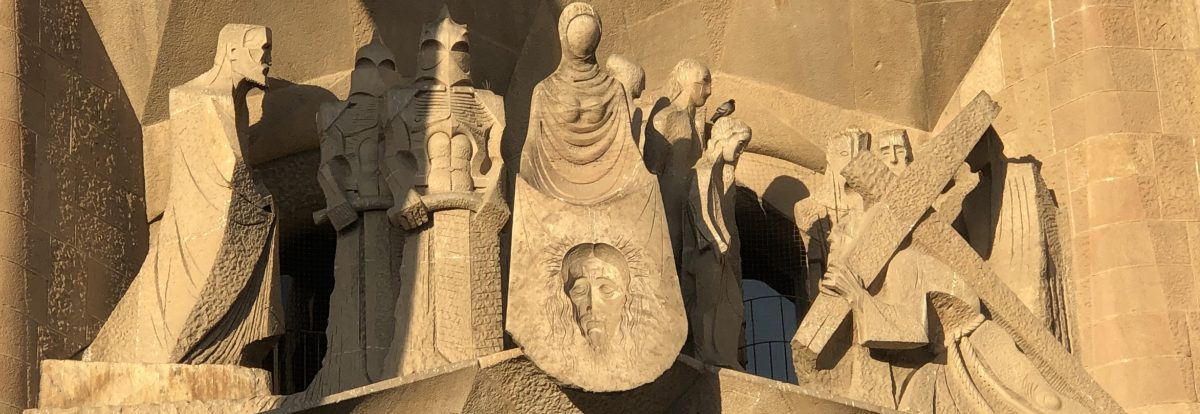
This Homily for Easter Sunday comes from 2019 and was given just a few days after the fire at Notre Dame Cathedral in Paris — thus the reference to the rose window at the end. Seems appropriate this year when Notre Dame has been reopened…
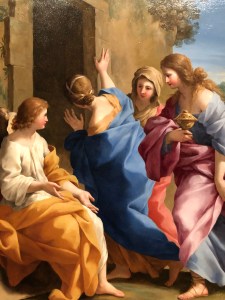
Occasionally the most erudite theologians overlook the most obvious things. This morning’s gospel contains a curious detail that has provoked a great deal of discussion among theologians: why do Mary of Magdala and John, the other disciple, not enter the tomb? Mary sees the stone removed from the tomb and returns to the apostles. John, running and perhaps a bit younger than Peter, arrives at the tomb first, but remains outside. Why? Biblical exegetes have explained this event symbolically–maybe John represents prophecy and Peter represents the institutional Church–but in my opinion the reason is simpler.
It’s a tomb. They were afraid.
Sometimes the simplest explanations are also the most profound. We know that Jesus is risen–maybe this announcement has become too familiar and gets taken for granted–but at that moment Mary, John and Peter did not have that advantage. We must imagine their psychological state that morning. Two days ago, they had seen the humiliation and killing of their Lord, teacher and friend at the hands of evil men. We must imagine the darkness of those days, when violence, lies and selfishness defeated the truth.
They saw Jesus’ miracles, knew his power and believed in his divinity. Simon Peter confessed, “You are the Christ, the son of the living God.” But two days earlier the Christ was defeated. God lost. Death won. Not even the son of the living God could overcome it.
They were right to be afraid. They were right not to want to enter the tomb. If death could defeat Jesus, who were they to confront it? And in the case of Peter in particular, we probably cannot imagine the incalculable weight he felt in his heart because of his own weakness, his own fear. John and Mary at least stayed with Jesus when he was suffering. Peter, on the other hand, was reduced by a servant girl’s question to denying the Lord.
Imagine Peter’s Holy Saturday. Imagine the torture Peter experienced that Sabbath knowing that among the last things Jesus heard in this world were his words of denial. In those hours, Peter truly lived in hell.
So who entered the tomb first? Who else could have entered? Who else but Peter, a sinner like us, afraid like us. The most desperate, the most needy. But moved by a love for Jesus, a love beyond his fear, beyond his sense of shame and guilt, perhaps even beyond all reason–who else but a sinner could have discovered redemption?
On the night Jesus was arrested, Peter was the most cowardly disciple. But the Lord did not err when He chose the fisherman from Galilee. He chose Simon, called him Peter, and let him feel the bitterness of being lost so that he could discover the greatness of redemption.
This is a mystery that all of us Christians must discover. To find salvation, like Peter, we too must enter the tomb. We must discover a love greater than our fears.
Easter is the celebration of Jesus’ resurrection, and it is no accident that in the early Church Easter was the privileged feast to celebrate baptism. And to really understand the importance of Baptism we need to think about the way adults were baptized in those days.
You may have visited a baptistery in Roman times and know that the baptismal font was a large basin below the floor level. Baptism was by immersion, and the symbolism of the gesture of going below the ground, into the water was deeply felt. To be baptized, to be a Christian, requires us to go down into the tomb of Jesus. And from the waters, from the tomb, we rise. Or, rather, we are lifted up to a new life.
However, for most of us, baptized as children, our main experience of dying and rising again comes through the other sacrament of rebirth. The sacrament that most resembles baptism, which renews the grace of baptism, is penance.
This too is a sacrament that also requires a descent, not physical like immersion in water, but emotional and moral. It requires that we follow St. Peter in his time of need, when despite his guilt he ran to the Lord. Like that first step of Peter into the tomb, confession requires courage. It does not require perfection. It does not mean being without fear or doubt. Instead, it requires hope. Hope does not mean certainty, but instead living by the faith that despite the defeats we have suffered and the wounds that remain, despite our fears, we run toward God.
Who knows what those three disciples feared outside the tomb. The demons that Jesus exorcised? A Roman trick? Ghosts? The stench of a rotting corpse or the putrefaction of their disappointments?
But what did they find inside the grave?
Nothing. The grave was empty.
And their fears also were empty.
I imagine that among the first joys of heaven is to look with Jesus at the darkest moments of our earthly existence and begin to laugh when he asks us, “But what were you afraid of?”
Disciples of Christ, take courage. We live in times when there is no shortage of darkness, and perhaps we are right to be afraid. But in the act of facing our fears, they lose their strength. And like the light of dawn entering through the rose window of Notre Dame Cathedral Tuesday morning, the light of the living God has the power to paint even the ashes with hope.
Disciples of Christ, take courage. Do not be afraid to enter the tomb. The tomb is empty. Jesus Christ is risen.
Readings: Acts 10:34a, 37-43, Col 3:1-4, John 20:1-9
(Original: Italian)
Easter Sunday 2019
Santuario della Madonna dello Splendore
Giulianova, Italy

 Tony Lusvardi, S.J.
Thank you Fr. Anthony for your enlightening homily on the resurrection of Christ.
I loved reading your interpretation of the sacrament of penance to the empty tomb. Certainly gives a freshness to the reality and importance of this sacrament.
Give the sacrament an even deeper meaning and perspective.
I remember reading years ago Peter probably experienced a “nervous breakdown” after his denial of the Lord. Would this be a correct assumption do you think?
LikeLike