Community is worth fighting for: homily for the 26th Sunday of Ordinary Time

Homily for the 26th Sunday of Ordinary Time (A)

The preaching of St. Paul, Boroea, Greece

When I get near the end of my time in Rapid City every summer—or this year, fall—I feel a little nostalgic.  It helps me to imagine how St. Paul would have felt throughout his ministry, founding communities and then having to move on.  He invested himself completely into each one; he made friends; he faced opposition, persecution, and disease; sometimes he owed his survival to the care he received from the Christians in each place.  And because it was much harder for Paul to travel by foot and ship across the Mediterranean than it is for me to book an airline ticket across the Atlantic, I find the yearning and love expressed in his letters particularly poignant.  This is especially the case in his letter to the Philippians.  

Not all of Paul’s letters are as warm as the one to the Philippians.  (The Philippians, just so we’re clear, were residents of the city of Philippi in northern Greece, not to be confused with Filipinos who come from islands in the Pacific.)  In some letters—to the Corinthians, for example—Paul is in battle mode, trying to straighten out bad behavior.  He wrote his letter to the Romans before he arrived in Rome, so it’s sort of an introduction and also a fundraising appeal.  But Paul knows the Philippians well; he describes them as his partners for the Gospel from the first day.  His letter to them was written from prison, probably in Rome.  Contemplating the quarantine that awaits me on my own return to Rome, this is also something I can relate to.  But despite these circumstances, Paul’s letter to the Philippians overflows with joy and peace.  It’s obvious that his affection for the little church in Philippi is a comfort to him even in imprisonment.  He writes, “I am confident… that the one who began a good work in you will continue to complete it until the day of Christ Jesus.”  Paul knows that we can never just tread water in the life of discipleship.  We must always keep striving.  So the letter is an exhortation to continue to grow in Christ, but its tone is more that of encouragement than a call to repent.  

Now you are probably used to being told not to take certain parts of the Bible literally.  Today, however, I’m going to tell you to do the opposite.  Read St. Paul’s words to the Philippians, and take them as if they were addressed to you, as if the letter began, “to all the holy ones of Christ Jesus who are in Rapid City.”  And take these words literally: “If there is any encouragement in Christ, any solace in love, any participation in the Spirit, any compassion and mercy, complete my joy by being of the same mind, with the same love, united in heart, thinking one thing.  Do nothing out of selfishness or out of vainglory; rather, humbly regard others as more important than yourselves, each looking out not for his own interests, but also for those of others.  Have in you the same attitude that is also in Christ Jesus.”

Continue reading “Community is worth fighting for: homily for the 26th Sunday of Ordinary Time”

Mercy or Justice? Homily for the twenty-fifth Sunday of Ordinary Time

Homily for the 25th Sunday of Ordinary Time (A)

Florence Baptistry

Today’s Gospel raises a host of tricky questions—what is justice?  What is the relationship between divine justice and human justice?  Or between God’s justice and his mercy?  What does the apparently unfair situation described by Jesus in the Gospel—no doubt in violation of several labor laws—tell us about salvation?  Or conversion?  One thing, however, is clear: if I preach for eight hours, or five hours, or three hours, or twelve minutes, I’m going to get paid the same amount anyway.  So I’ll leave some of these questions unanswered.

It’s obvious that Jesus is not giving instruction for how to run a business, but is instead trying to teach us something about salvation.  He is also reinforcing what the prophet Isaiah says: “my thoughts are not your thoughts, nor are your ways my ways, says the Lord.  As high as the heavens are above the earth, so high are my ways above your ways and my thoughts above your thoughts.”  No matter how much advice we give the Lord, he has his own ideas about how to run the universe and he doesn’t always explain them to us.  And sometimes he does explain, but we hear only the parts we want to hear.  

In its original context, the earliest Christians probably understood today’s parable to be about the relationship between Jewish Christians and Gentile Christians, which was the big controversy in the first century.  Even though the Jewish people received divine revelation first, this did not mean that Gentiles who converted to Christianity were in any way less Christian.  Still, even then the passage’s broader meaning would have been apparent to everyone: conversion is possible, even for the worst sinner, even a deathbed conversion.  Thus, Isaiah says, “Let the scoundrel forsake his way, and the wicked his thoughts.”

Now it sounds very nice to say conversion is possible for even the worst sinners.  But Jesus’ parable forces us to confront the difficult question: is that really fair?  Or, to put it another way, what does this mean about the relationship between God’s mercy and his justice?  Do they contradict each other?  We know that God is both merciful and just, but sometimes it’s hard to understand how he can be both.  Is he 50% just, 50% merciful?  Is he just in the obvious cases, but merciful in the ones that are borderline, sort of willing to round up?  In fact, God is 100% merciful and 100% just, and there can be no contradiction between his mercy and his justice.  If we’re thinking about divine justice and divine mercy as contradictory, we’re thinking about them wrong.  

Continue reading “Mercy or Justice? Homily for the twenty-fifth Sunday of Ordinary Time”

Letting go of our anger–or hugging it tight: homily for the twenty-fourth Sunday of Ordinary Time

Homily for the 24th Sunday in Ordinary Time (A)

The giant saguaro, found in southern Arizona and northern Mexico, is the largest cactus in the world, growing up to forty feet tall.  Saguaros are covered in spines almost three inches long, spines almost as strong as steel needles, so sharp, in fact, that they have been known to puncture the skull of bighorn sheep that run into the cactus.  From this, two conclusions are clear.  First, sheep probably do deserve their dim reputation for intelligence, and, second, you really don’t want to hug a saguaro.  

Capitoline Museum, Rome

Now you may be thinking, “Thank you, Father Obvious, for that really helpful advice.”  Probably we don’t need to be told what a bad idea it is to hug a cactus.  And yet, in the Book of Sirach we read about people doing something that is potentially just as painful and damaging.  “Wrath and anger are hateful things,” Sirach says, “yet the sinner hugs them tight.”  And we have probably had the experience of tightly hugging our anger, of nurturing a grudge with more fertilizer than we give to our gardens.  The leaves and flowers fall off a grudge very quickly and leave us with nothing else but spikes.  

In last Sunday’s Gospel reading Jesus gave us some practical advice for dealing with conflict between Christians, and this Sunday we have readings on the related theme of forgiveness.  I think we can identify two levels of meaning when Jesus teaches about forgiveness.  The first is practical—how do I do it?  Part of the reason forgiveness is such a frequent theme in the Gospel, I suspect, is that it is often so hard to do.  Even if we get to the point of forsaking revenge, of no longer trying to hurt someone who has hurt us, even if we say the words “I forgive you,” the gnawing wound sometimes still remains.  We can remove the spike, but the sting is inside.  How do we let go?  

Continue reading “Letting go of our anger–or hugging it tight: homily for the twenty-fourth Sunday of Ordinary Time”

Hope vs. optimism: homily for the twenty-third Sunday of Ordinary Time

Homily for the 23rd Sunday of Ordinary Time (A)

Prophet Ezekiel, Sistine Chapel

Of all the Old Testament prophets, the one whose writings most resemble a hallucination caused by LSD is probably Ezekiel.  There’s a psychedelic temple; four-faced creatures that are part man, part lion, part eagle, part ox; apocalyptic battles; a bit of cannibalism; an army of dry bones that rattle back to life; and a few scenes that are definitely rated R.  If you’re seeking entertainment, cancel your HBO subscription this month and just read the book of Ezekiel.

Now please don’t go home and tell people, “Father preached this morning about LSD.  He was a Jesuit—you know how they are.”  In order to appreciate this marvelous book of the Bible, I want to draw a contrast between hallucination, optimism, and the central theme of the book of Ezekiel—hope. 

Ezekiel lived through what might be considered the most hopeless moment in the history of the Jewish people.  The corruption of the Israelite monarchy had so weakened and divided Israelite society that the nation was easy prey first for the brutal Assyrian empire, which utterly destroyed ten of the twelve tribes of Israel, and then a few decades later for the even more ruthless Babylonians.  Ezekiel was a priest, who along with the other educated members of Israelite society was carted off into forced exile in Babylon.  It would have appeared to any observer at the time that Israel’s story was over.  They had been favored by God; they had been given the Promised Land and a covenant, and they blew it.  They broke the covenant, lost their land, and had only slavery and extinction to look forward to.   

And at this moment in history, in exile in the heart of enemy territory, in Babylon itself, Ezekiel started receiving visions.  Ezekiel’s visions were wild but not hallucinations.  They pointed toward a better future but it would be difficult to call Ezekiel—or any of the Hebrew prophets—an optimist. Ezekiel’s vision was something else entirely—it was a vision of hope.  What’s the difference, you ask.

Continue reading “Hope vs. optimism: homily for the twenty-third Sunday of Ordinary Time”

A poem and a prayer for Australia (and Jesuits!)

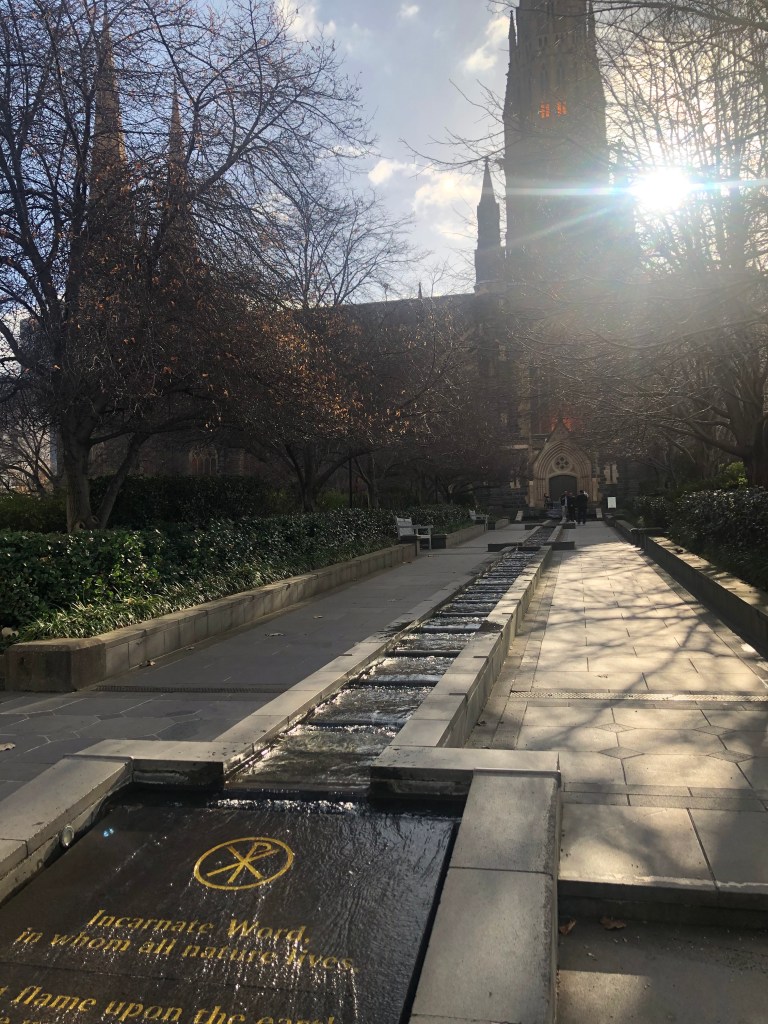
St. Patrick’s Cathedral, Melbourne, Australia

After a very blessed time of tertianship–the final formal part of Jesuit formation–and travel afterwards, I arrived back in Rome this week to begin preparing for the semester ahead. For me, this new beginning is also a time to look back with gratitude at my time in Australia’s tertianship program. I thought I’d share this poem from Australian poet James McAuley (1917-1976), a prayer for his remarkable country that could just as easily be a prayer for us Jesuits.

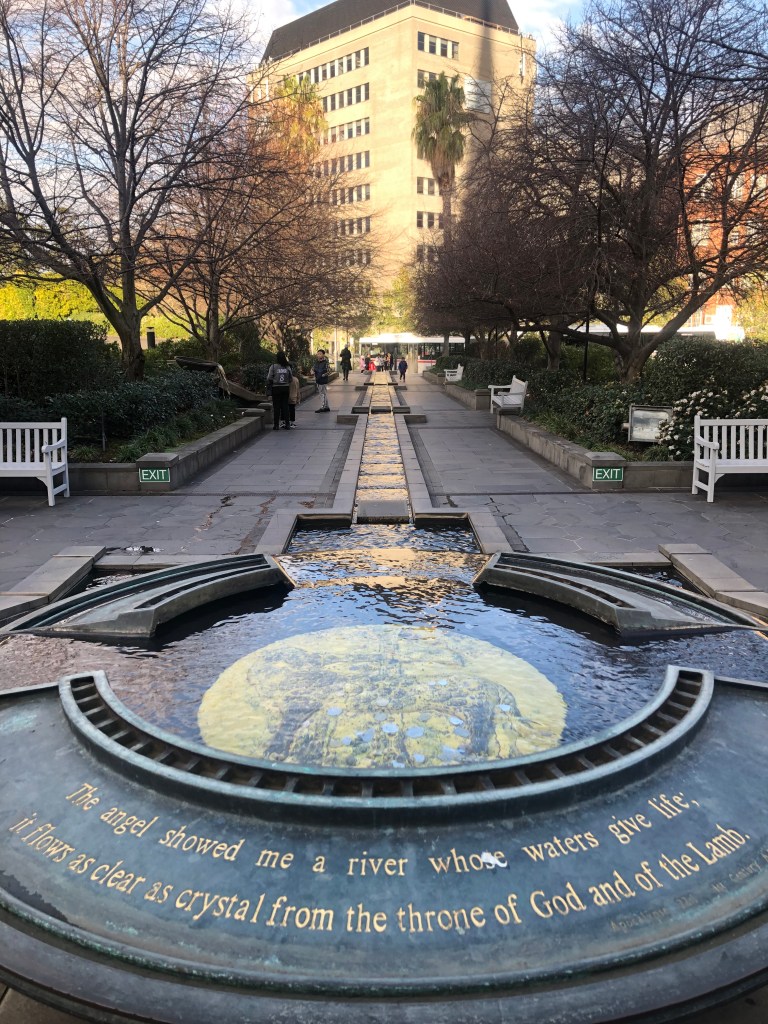
The poem is a part of a fountain outside of Melbourne’s cathedral that runs from the doors of the church out toward the city–evoking Ezekiel’s image of the waters of life flowing from the temple. The sculpture includes quotations from both the Old and New Testaments (John 4:14, Ps 23:2-3). It is inspired by the words of Revelation: “Then [the angel] showed me the river of the water of life, bright as crystal, flowing from the throne of God and of the Lamb through the middle of the street of the city; also, on either side of the river, the tree of life […] and the leaves of the tree were for the healing of the nations” (Rv 22:1-2).

St. Patrick’s Cathedral, Melbourne, Australia

Here’s McAuley’s poem:

Incarnate Word,

in whom all nature lives,

cast flame upon the earth:

raise up contemplatives

among us, men who walk within the fire

of ceaseless prayer,

impetuous desire.

Set pools of silence in this thirsty land.

James McAuley (1917-1976), Australian poet
St. Patrick’s Cathedral, Melbourne, Australia