As is traditional for the First Week of Lent, the Pope and the Roman Curia will spend several days making their annual spiritual exercises. This year’s retreat is being preached by Bishop Erik Varden of Trondeim, Norway. Some readers might know Bishop Varden already from his wonderful blog Coram Fratribus. A convert and then a Trappist monk, Bishop Varden has a gift for communication comparable to our own great Robert Barron, though with his own unique style.
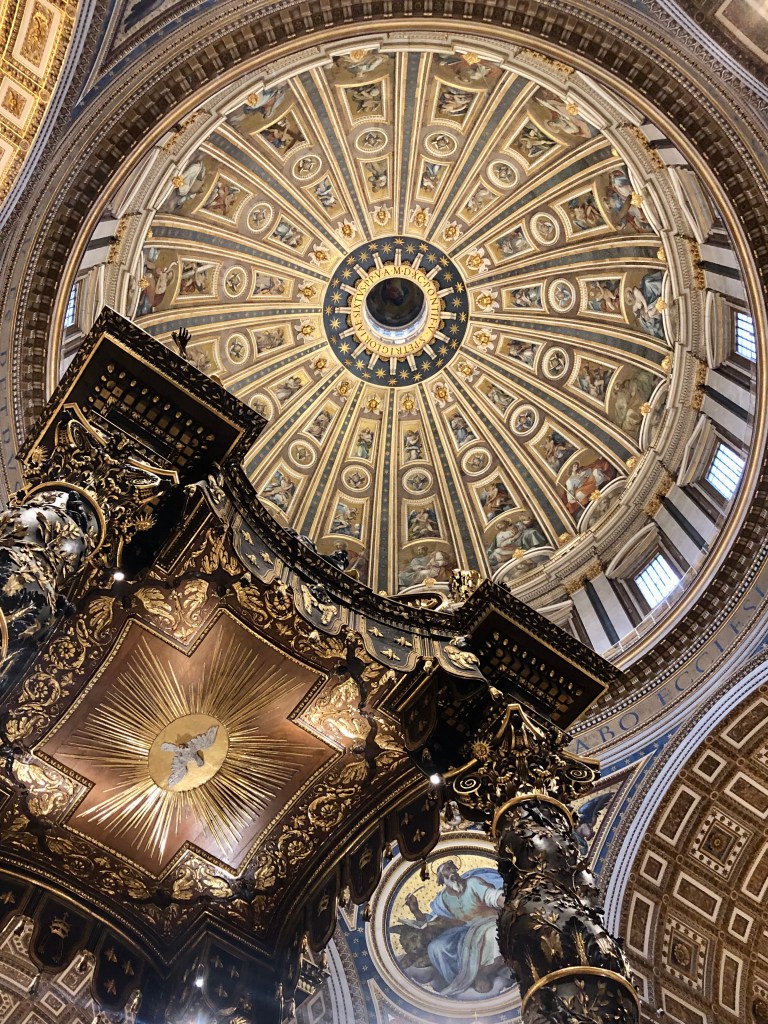
St. Peter’s Basilica, Rome
At a mere 51 years old, Bishop Varden also represents something of a turning of the page in the life of the Church. I’ve written before (here and here) that the zealous and youthful Church I encountered in Scandinavia hints at what fidelity and evangelization must look like in an increasingly secularized world. Bishop Varden–articulate, orthodox, cultured, and creative–seems to understand how to respond to our twenty-first century reality.
Last year I read Bishop Varden’s profound book Chastity: Reconciliation of the Senses, and I thought this week would be a good opportunity to share a few of its many insights…
With yesterday’s feast of the Baptism of the Lord reminding us of the beauty and uniqueness of the sacrament of baptism, it seemed an opportune moment for an update on my work on baptism of desire. I’ve continued to do a bit of research on the question of infants that die before baptism and posted some reflections on the issue here and here late last year.
The Baptism of the Lord (above), Guglielmo of Pisa (1160), pulpit, Cagliari cathedral (Sardinia)
The Baptism of the Lord, El Greco
Reviews of Baptism of Desire and Christian Salvation continue to come out, so far all deeply appreciative. Theology today is no longer an exclusively European enterprise, so I’m especially excited to have an international response to the book. The Hekima Review, Africa’s leading theological journal, recommends it for both “Catholic clergy and lay people as it foregrounds the pastoral implications of the doctrine and the need for evangelisation.” Meanwhile, India’s top theological journal, the Vidyajyoti Journal of Theological Reflection published a particularly detailed and insightful review, which noted the specific value of the book in the context of Indian religious pluralism. It expressed the hope that the book would become the standard “theological ‘textbook'” for discussing such issues. The reviewer also picked up on the way the work responds to the deeper philosophical currents of the twentieth century:
This work belongs to what the dogmatic theologian José Granados has identified as a corporeal turn in theology, an emphasis on the body after the heady years of the twentieth century that – whether primarily or exclusively – emphasized cognition. This corporeal turn has meant a returning emphasis on not just the body, but the embodied nature of the Christian faith. It recognizes that the embrace of the faith cannot be restricted to some conceptual nod, but must necessarily embrace ritual, and recognize that the materiality of ritual is important. As Lusvardi writes “The instinct of the early Church to emphasize the ritual was not wrong, for the ritual says and does what nothing else can” (p. 342). In stressing the importance of the corporeal, Lusvardi’s work also becomes part of the corpus of the critique of modernity, which consciously, or unconsciously, seeks to restore a holistic view of the world, sundered through modernity’s adoption of Cartesian binaries, and has powered so much of Indian post-colonial thought.
Closer to home, The New Ressourcement journal said:
Lusvardi’s excellent book … is a must-read for anyone interested in the history of baptism, the nature of sin and salvation, or the hope for non-Christians and infants. It is hard to do justice to the extensive ground this book covers. In a compelling way, it draws the reader to see that the good news of Christian salvation is truly good news for its hearers precisely because the experience of Christ’s saving death and life is available to all in baptism.
Baptism of Desire and Christian Salvation in an Indian stole
The reviewer also offered a defense of the standard scholastic approach to the doctrine, aspects of which I call into question in the book–evidence, I think, that the issues the book raises are worthy of robust theological examination and debate.
So put it on your reading list for the new year!
Baptism of Desire and Christian Salvation is available from Catholic University of America Press (20% discount with the code CT10), Amazon, and other online booksellers. I have collected reviews, interviews, and other news here.
As I mentioned earlier, over the summer God’s providence brought me into contact with a group of people dedicated to sharing the story of Baby Brian Gallagher. The circumstances of Baby Brian’s short life raise the question of babies who die before baptism and baptism of desire, and the group asked me to write up a one page summary of the argument I present in my book Baptism of Desire and Christian Salvation. Of course, for the full story–and much else besides–buy the book! What I wrote is not intended as a full pastoral response to those who have lost a child too soon, but a very brief sketch of the theological issues involved.
Theologians have a precise mission within the Church. Our task is not to “create” the truth, but to use the tools of reason and study to understand better what God has revealed to us. When it comes to salvation, theologians don’t “decide” what the Church believes; we merely try to express with greater clarity what we find in Christian revelation.
Good theologians, then, must be humble and cautious in what they claim. Historically, theologians have found the question of what happens to babies who die before baptism particularly difficult. We know that baptism is necessary for salvation (John 3:5) because baptism is the unique way Jesus has revealed for us to participate in his death and resurrection (Romans 6:3-5). At the same time, the doctrine of baptism of desire has found strong support among theologians and in the Church’s official teaching. Baptism of desire does not deny the necessity of baptism or create an alternative to the sacrament. Instead, the doctrine means that those who desire the sacrament but are prevented by circumstances beyond their control from receiving it can still obtain baptism’s effect—rebirth to eternal life.
Historically, most—but not all—theologians have had trouble seeing how baptism of desire could apply in the case of infants who are too young to formulate a desire of their own. After a decade studying baptism of desire, however, I believe that these theologians have tended to leave out a decisive piece of evidence: our practice of the sacrament of baptism. The key theological principle that has been neglected up until now is known as lex orandi—lex credendi, which means “the law of prayer is the law of belief.” In other words, the way we celebrate the sacraments is itself a guide to what is true. In this case, the Church’s firmly-established practice invites us to look more deeply into how to understand the desire for baptism in regard to infants.
Baptism of Desire and Christian Salvation has now been out long enough to begin generating some discussion, and I’m grateful to have seen a number of new reviews and reactions over the past few months.
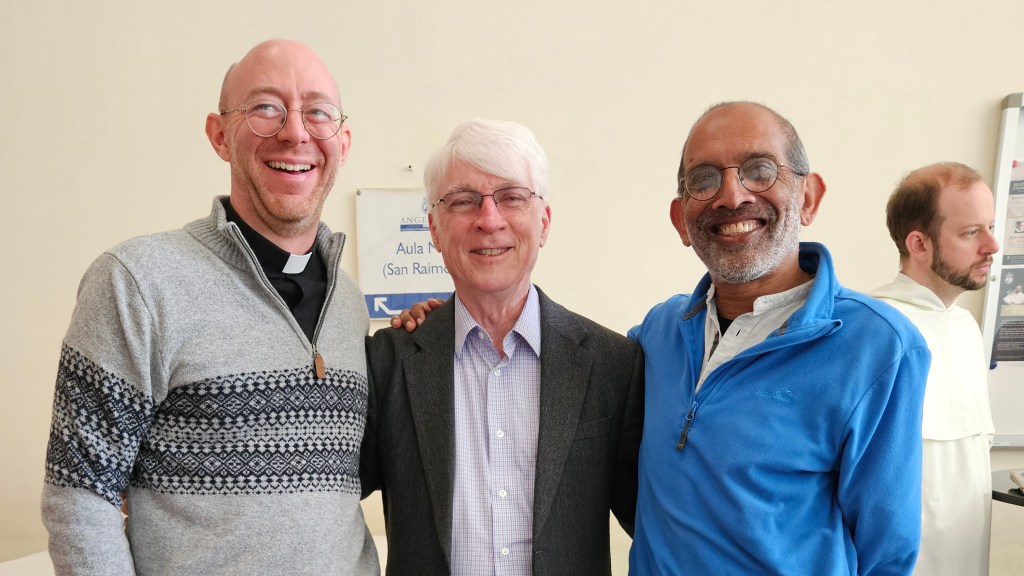
With Dr. Ralph Martin and Dr. Gavin D’Costa
I was delighted to see Dr. Ralph Martin, one of the world’s top authorities on the new evangelization, mention the book in his latest update at Renewal Ministries. Dr. Martin mentions meeting up while he was visiting Rome. I had a charming and stimulating conversation with him and his wonderful wife Anne, as well as a number of equally enjoyable conversations with Dr. Gavin D’Costa, whom he also mentions, an expert on world religions who teaches at the Angelicum. We also discussed Dr. Martin’s book Will Many Be Saved?, which I cite in my work. I’m deeply honored that he considers Baptism of Desire and Christian Salvation “a very solid and brave work of scholarship that faithfully presents the doctrinal and moral implications of the Church’s–and Jesus’–insistence on baptism to be saved.”
I’m equally grateful to have stumbled upon the careful and detailed review and summary of the book by Fr. Richard Conlin at The Prodigal Catholic Blog. I’m especially glad that Fr. Conlin considers the book “a must-read for anyone who wants to understand how salvation works in the Church’s tradition–especially in ‘hard cases’ like the unbaptized, non-Christians, or infants” and that he highly recommends it “especially for priests, catechists, and anyone serious about the faith.” A scholarly book such as Baptism of Desire and Christian Salvation might seem intimidating, but I think this one is important for more than just an academic audience. My intention was always that it would be accessible not just to specialists but to anyone with a theological background. So it’s encouraging to read that Fr. Conlin found it “both theologically rich and remarkably readable–a rare combination.”
Those who read Italian might check out the insightful review in Ecclesia Orans by Prof. Paolo Trianni, who recognizes the theological approach as “innovative” because it seeks to overcome a “legalistic concept of the sacrament” present at times in scholasticism and neo-scholasticism.
Finally and somewhat unexpectedly, I was recently contacted by Brianne Edwards of Rapid City, who brought to my attention the remarkable story of baby Brian Thomas Gallagher, who died 43 minutes after his birth in 1982 and whose body was found to be apparently incorrupt in 2019. He happens to be interred at Black Hills National Cemetery. I discuss the possibility that infants can receive baptism of desire in the book, and Baby Brian’s case seems almost to have been designed to fit the argument I make. I’ll have more to say on the subject in the future…
In the meantime, remember that Baptism of Desire and Christian Salvation is available on Amazon, directly from Catholic University of America Press (20% discount with the code CT10), and at other online booksellers.
This month I’ve been asked to contribute Sunday homilies to the Homiletic and Pastoral Review. You can find the rest of the month’s homilies there as well. Here’s this week’s contribution:
Homily for Trinity Sunday (C)
The Holy Trinity, Camarines Sur, 18th century, molave wood (St. Augustine Museum, Manila)
There’s an old saying, which probably goes back to Socrates, that the more you know, the more you realize you don’t know. This observation on what it means to be truly wise is not meant to discourage learning or study or reflection. When used in a Christian context it’s not meant to suggest, for example, that our faith should be reduced to a couple of folksy slogans. Nor does it mean that when reflecting on the doctrine which we remember today—the Most Holy Trinity—that we should take an anti-intellectual approach—it’s a mystery, just have faith, don’t ask any questions.
The Trinity is a mystery, but today’s readings suggest the attitude we should have toward “mystery” in the context of our faith. Calling the Trinity a mystery means that we will never get to the end of understanding it, but that should not make us want to throw up our hands and give up. Instead, it should make us want to know more. There’s a great history podcast that I listen to, and, after each episode, I often want to go online and start buying books about the subject to discover more. Usually, I have to restrain that impulse because the books start to pile up and I don’t have time to read them!
When we talk about the mysteries of our faith, that’s the dynamic we’re suggesting: not that we don’t want any questions, but that there will always be more to say and our capacity to learn is limited. Jesus suggests as much in the Gospel when he ways, “I have much more to tell you, but you cannot bear it now.” Those words tell us something important about God. Jesus talks about knowing the Father by seeing the Son and living in the Spirit of truth. If you tried to diagram what that meant, you might end up with a triangle and lots of arrows going back and forth between the angles. Perhaps that’s not a bad start because one thing that we can take from the invitation of Jesus to know him and know his Father and know the Holy Spirit is that he is inviting us into a relationship that will change us. It’s a relationship that, in a way, is always moving.
With a year approaching since Baptism of Desire and Christian Salvation‘s publication, I’m pleased to see reviews starting to appear. I just read a great one by Joseph Arias of Christendom College in the journal of liturgical theology Antiphon. Arias provides a summary and identifies “controversial” points where I challenge the received wisdom. I’m grateful to have such careful readers and can’t say I mind having the book described as “monumental” and “unmatched”!
Here’s just a sample:
“The author takes the reader on a profoundly illuminating historical and dogmatic theology journey from the apostolic age to our own, acting throughout as an immensely capable and careful guide, making sure we do not miss either major or minor attractions that can enhance the experience of trying to arrive at a deeper understanding of a profoundly significant (though sometimes underappreciated) teaching that is firmly rooted in the Catholic tradition…
… this volume is unmatched in what it positively contributes towards a better understanding of this area of theology.”
And more good news — it looks like the price of the book may have dropped on Amazon as well.
Also, following up on my previous post on the Ukrainian bishops’ statement about the war in their country last week, I have a new piece out on the subject in America. It is equally about what is dysfunctional in our own American political culture right now.
I’m honored to have a couple of recent works appear in print in the past few weeks, the first an article in La Civiltà Cattolica, a publication founded by Italian Jesuits in 1850, which has since gone international. The article “Gestis Verbisque: The Words and Actions of the Sacraments” (the Italian is here) analyzes a recent Vatican document dealing with sacramental theology — specifically the question of invalid baptisms. The document Gestis verbisque was available only in Italian at the time I wrote the article, but has since come out in English (and other languages) here. It’s an important document because it reminds priests and deacons of the need to faithfully celebrate the sacraments according to the Church’s tradition and liturgical books. We probably all have had unfortunate experiences of goofy things happening in liturgy because Father thought that he could improve upon a centuries-old ritual with regrettable results. Gestis verbisque reminds us that “The Church is the ‘minister’ of the Sacraments, but she does not own them.” My own article fleshes out some of the background behind the document and points out where I think it adds something theologically (its treatment of the minister’s intention). It was interesting to see some of the strange cases in history that I found while researching Baptism of Desire and Christian Salvation come up again in modern settings. You’d think we’d learn!
The other publication is the first short story I’ve published in a while–too busy with academic work–in a magazine that will be familiar to readers of these pages, Dappled Things. Dappled Things is the only literary magazine I know of dedicated exclusively to Catholic literature. I’ve been honored to have a number of short stories and essays appear in their pages over the years, some of which can be found on their site. My most recent story, “Pious Tchotchkes,” is in their Easter 2024 issue, which is only available in print. Their print issues are always beautifully crafted.
The story is set in Portugal, and here are a couple of places alluded to — baroque exuberance in Coimbra and Cabo da Roca, the westernmost point in continental Europe.
It might seem that there’s nothing new under the sun in the world of theology, but that’s not the case. This spring, The New Ressourcement journal launched its first issue. The journal is sponsored by Word on Fire Academic, one of the many great ministries founded by Bishop Robert Barron. In fact, Bishop Barron has an article in the first issue. The editorial staff is an all-star lineup: Matthew Levering of Mundelein Seminary, Jonathan Ciraulo of St. Meinrad Seminary, and my own colleague at the Gregorian University, Aaron Pidel, S.J. The authors represented in the first issue can also all be fairly described as all stars.
Here’s a description of the journal from its website:
The New Ressourcement
is a quarterly journal of theology and philosophy published by Word on Fire Academic. It serves the Church and the academy by publishing scholarly articles that demonstrate the depth and relevance of the entirety of the Catholic tradition.
This journal aims to sentire cum tota ecclesia, to think with the whole Church as it has ever reflected on the mystery of the Incarnate Christ, as seen in sources that are biblical, patristic, medieval, as well as modern. The journal draws inspiration from, and seeks to continue the work of, previous generations of ressourcement theologians. It shares with them a conviction that the renewal of theology and philosophy occurs by returning to sources that remain inexhaustible. This ressourcement is “new” because we trust that this patrimony is fertile enough to encounter contemporary questions confidently and to illuminate the challenges and opportunities that shape the present age.
My book Baptism of Desire and Christian Salvation is now available to order, though its shipping date will be a little later. Its official publication date was originally last Friday but now seems to have been bumped to March. I’ve been working on the topic of baptism of desire since my STL studies at Sant’Anselmo–a good six years ago–so it has been a long time coming. I think the result says some important things for Catholic theology and the evangelizing mission of the Church. So let me assure you, it’s worth the wait!
I’ll have more on the topic to say, of course, and I’ll share the reactions of others to the book so you don’t have to take my word for it. For now I’ll just share the official description from Catholic University of America Press. The book is available directly from CUA’s website as well as other online booksellers such as Amazon. This spring CUA is offering a 20% discount on new books with the promo code CT10. Make sure that your library gets a copy, too!
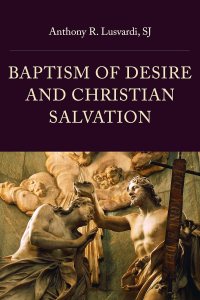
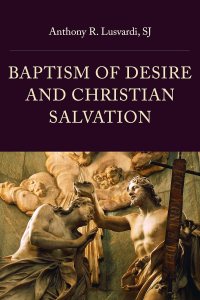
Baptism of Desire and Christian Salvation. Belief in the necessity of baptism for salvation is rooted in the New Testament and was forcefully affirmed by the Church Fathers, yet today this belief is treated with unease if not ignored altogether. Over the course of centuries, Catholic theology has wrestled with a doctrine—baptism of desire—that both preserves this fundamental principle and allows for salvation in hard cases, such as catechumens dying unexpectedly. Baptism of Desire and Christian Salvation traces this doctrine’s varied history, from its genesis in a fourth century funeral oration given by Ambrose of Milan to its uneasy position in the Anonymous Christianity of Karl Rahner.
More than a history, however, this book raises questions about the nature of religious ritual and the sacraments, the mission of the Church, and the essence of salvation. Arguing that theologians of the past two centuries have tended to downplay the role of the sacraments when discussing salvation, Lusvardi suggests that baptism should remain our theological starting point. Engaging with the theological tradition and at times challenging the conventional wisdom, Baptism of Desire and Christian Salvation shows how such a sacramental approach can offer credible—and sometimes surprising—responses to questions related to the salvation of non-Christians, the fate of unbaptized infants, and the relevance of the Church’s mission today.
If you go to Mass on Trinity Sunday, there’s a very good chance that you will hear the word “mystery.” What does that word “mystery” mean? When we’re talking about a mystery of faith, it doesn’t mean a detective story. A mystery of faith is something we can always understand more deeply, something we can never reach the end of, something that never gets old. No matter how many times you see the sunset across the ocean, the beauty of it is always new, the colors always a little different each time.
Sunset, Malta
Trinity Sunday is a celebration of the mystery of God. To be more precise, it’s a celebration of the fact that God has given us a starting point to discover him, to know him, and to be united with him. God is so different than anything we know that without his help we could say almost nothing about him. God is not a very big thing. He’s not like a gas that gets into the nooks and crannies of everything. He’s not nature and the universe. We know he’s the Creator of the universe because the universe exists, but nothing in the universe is capable of creating the universe. And it’s true that he exists and we exist, but even his way of existing is different than ours. You know who Harry Potter is, so in a way he exists. But he doesn’t exist in the same way that J.K. Rowlings exists. They have different ways of being. And it’s the same with us and God.





 Tony Lusvardi, S.J.