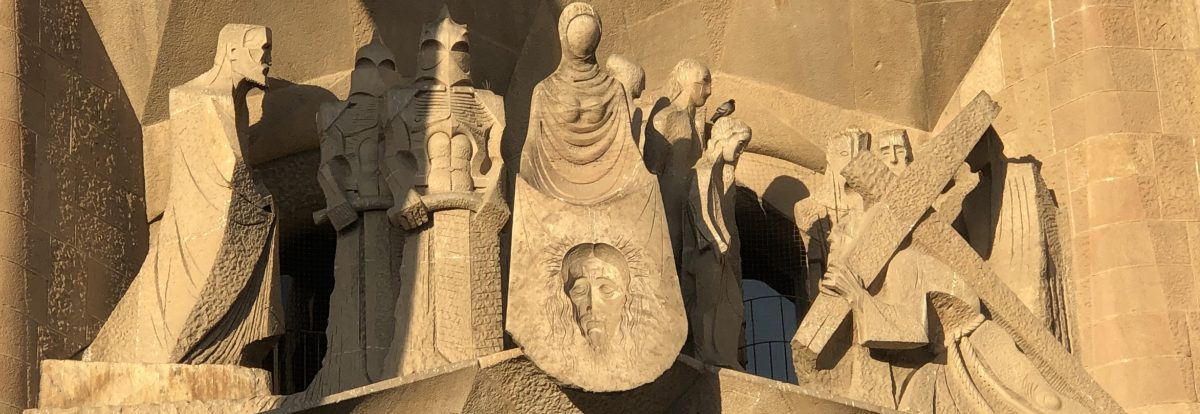
On the road with St. Augustine

It seems like I’ve been on the road–or more precisely in the air–a lot this summer. Some of the journeys have been planned, others unexpected; some have involved meeting old friends, others making new ones. One was to bury my grandfather (that was tough); others involved planting new seeds (both spiritually and literally). My retreat for Jesuits on praying the liturgy got off the ground; I was able to return to St. Isaac Jogues and Rapid City and to Cloisters on the Platte to give a retreat; and for the first time I participated in the marvelous Free Society Seminar in Slovakia. St. Augustine’s words from the Feast of Martha, Mary, and Lazarus a few weeks ago struck me in a particular way this year, a reminder of the journey we all are on…

“Our Lord’s words teach us that though we labor among many distractions of this world, we should have but one goal. For we are but travelers on a journey without as yet a fixed abode; we are on our way, not yet in our native land; we are in a state of longing, not yet of enjoyment. But let us continue on our way, and continue without sloth or respite, so that we may ultimately arrive at our destination.”

St. Augustine, Sermo 103
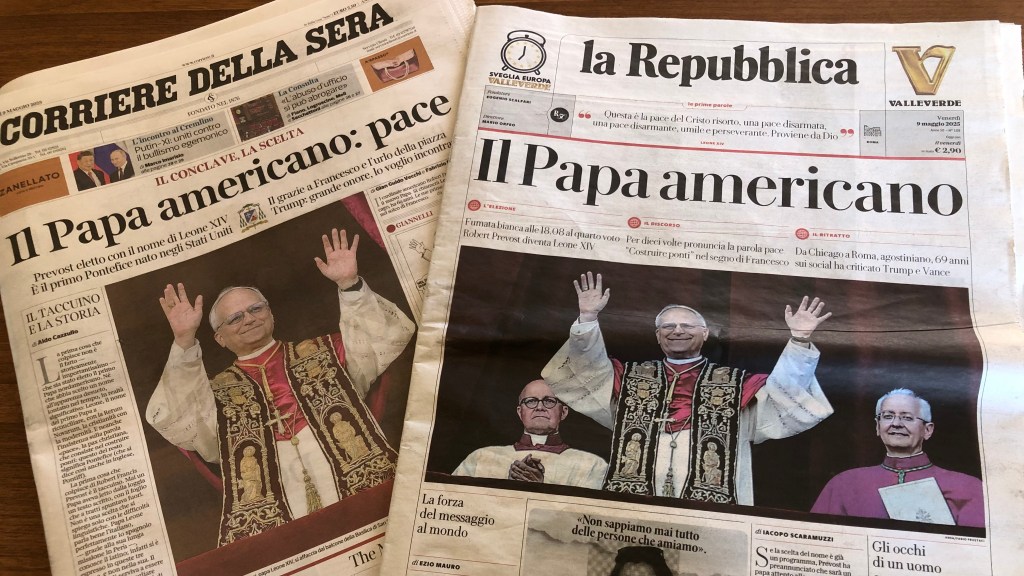
Pope Leo: an ever-ancient, ever-new beginning for the Church

Just over a week ago I stood among the throng in St. Peter’s Square waiting for Pope Leo XIV’s Mass of installation. As the new pope emerged on the back of a white truck and made the rounds through the square, one of the priests who was with me to concelebrate whispered, “It still feels surreal.”

It still does.

The one iron-clad rule of papal elections, after all, used to be that the cardinals would never elect an American pope. And now we have a pope who grew up cheering for the Chicago White Sox. Going into the conclave, the Church seemed tired and divided. Yet Pope Leo has managed to evoke good will on all sides, and he hasn’t had to resort to any particular gimmicks to do so. Rome is elated.

What is perhaps most striking about our new Holy Father is the paradoxical way in which he seems both totally at ease in his new role–as if he’d been pope-ing for years already–and at the same time totally unassuming. One could imagine sitting next to him at a baseball game and him introducing himself as “Bob from Chicago.” At the same time, seeing him on the balcony of St. Peter’s Basilica or meeting world leaders in the robes of his office, one senses the quiet dignity of a successor of the Apostles.

A lot has already been written about Pope Leo on the basis of relatively scant pre-conclave writings and interviews. I was particularly impressed by the first homily he gave to the cardinals after his election. His brief address to the Synod of Bishops on evangelization more than a decade ago equally impressed me because he seemed to grasp one of the central problems facing the Church: the role of the media in communicating–and sometimes miscommunicating–our message. I remember an interview given by the late Cardinal Avery Dulles to Charlie Rose, in which the cardinal observed that the biggest problem faced by the Church was that most Catholics learn what they know about Catholicism not from the Church herself, but from the media. Leo XIV understands that dynamic–and he is alert to the equally challenging frontiers now being opened by artificial intelligence.

Continue reading “Pope Leo: an ever-ancient, ever-new beginning for the Church”

Intentions, motives, and what makes for a valid sacrament

The question of invalid baptisms has been in the news recently. In my commentary on the question in La Civiltà Cattolica, I pointed out that the Vatican’s most recent document on the question, Gestis verbisque, gives renewed attention to the minister’s intention. For a sacrament to be valid, a minister must intend to do what the Church does when celebrating that sacrament. And that means that if he changes what the Church prescribes in her official liturgical texts–by inserting his own words or deleting something required to be there–then he manifests an intention to do something else. It’s just as straightforward as it sounds. The proof is not in the pudding, but in the action.

Baptismal font, St. Peter’s Basilica

Last week, however, another question was sent to the Vatican about what sort of intention might invalidate a sacrament, this time an ordination. The question proposed the distasteful case of a bishop who ordained a man with whom he had engaged in an illicit sexual relationship. Could he possibly have the right intention? Wouldn’t such a sinful situation invalidate the ordination?

The article in which this question was raised described it as “potentially explosive.” Fortunately, this grenade was defused by St. Augustine in the fifth century. The great theologian was responding to controversy about the validity of baptisms, whether the sinfulness of a minster invalidated the sacrament. He responded no. Augustine’s principle has remained a bedrock of sacramental theology ever since. It is really Christ who baptizes, Augustine said, and he can do so even through profoundly imperfect human instruments. The same goes for ordinations. Augustine sagely realized that if perfection were required of ministers in order for sacraments to be valid, then we simply wouldn’t have sacraments.

So how does Augustine’s principle fit with the requirement that one has to have the right intention to celebrate a sacrament validly? Here we have to make what might at first seem like a rather technical distinction but is, once you’ve thought the question through, also rather straightforward. The distinction is between intention and motive.

Continue reading “Intentions, motives, and what makes for a valid sacrament”

Ascension

Transfiguration, pulpit (Pisan 1160), Cattedrale, Cagliari

“Today our Lord Jesus Christ ascended into heaven; let our hearts ascend with him. Listen to the words of the Apostle: ‘If you have risen with Christ, set your hearts on the things that are above, where Christ is, seated at the right hand of God; seek the things that are above, not the things that are on earth’ (Col. 3:1-2). For just as he remained with us even after his ascension, so we too are already in heaven with him, even though what is promised us has not yet been fulfilled in our bodies.”

St. Augustine, homily on the Lord’s Ascension, quoted in Robert Imbelli’s
Christ Brings All Newness (Word on Fire Academic, 2023), p. 144.

From John Paul II’s “Letter to Artists”

Every genuine artistic intuition goes beyond what the senses perceive and, reaching beneath reality’s surface, strives to interpret its hidden mystery. The intuition itself springs from the depths of the human soul, where the desire to give meaning to one’s own life is joined by the fleeting vision of beauty and of the mysterious unity of things. All artists experience the unbridgeable gap which lies between the work of their hands, however successful it may be, and the dazzling perfection of the beauty glimpsed in the ardour of the creative moment: what they manage to express in their painting, their sculpting, their creating is no more than a glimmer of the splendour which flared for a moment before the eyes of their spirit.

Believers find nothing strange in this: they know that they have had a momentary glimpse of the abyss of light which has its original wellspring in God. Is it in any way surprising that this leaves the spirit overwhelmed as it were, so that it can only stammer in reply? True artists above all are ready to acknowledge their limits and to make their own the words of the Apostle Paul, according to whom “God does not dwell in shrines made by human hands” so that “we ought not to think that the Deity is like gold or silver or stone, a representation by human art and imagination” (Acts 17:24, 29). If the intimate reality of things is always “beyond” the powers of human perception, how much more so is God in the depths of his unfathomable mystery!  […]

Beauty is a key to the mystery and a call to transcendence. It is an invitation to savour life and to dream of the future. That is why the beauty of created things can never fully satisfy. It stirs that hidden nostalgia for God which a lover of beauty like Saint Augustine could express in incomparable terms: “Late have I loved you, beauty so old and so new: late have I loved you!”

From Pope St. John Paul II, Letter to Artists (1999)

Sing, but keep going

Yesterday’s reading from the Office, the last of the liturgical year, is also one of the best, St. Augustine at his most eloquent. Like this time of year in the liturgy itself, it’s as much about beginning as it is about ending. It captures that joyful hope that so characterizes the Advent season and which I think is much in need these days — that flicker of unfailing light to guide us through the winter darkness.

Santa Croce in Gerusalemme, Rome

There’s nothing saccharine in Augustine — Rome was crumbling as he wrote, and his honesty about his own failings and man’s sinfulness is unflinching — but that’s what makes his alleluia really count. Despite his own weakness and wrongheadedness, he knew God’s pursuit was unfailing. And he knew — something I feel acutely today given the state of the Church and the world — that there is still so much work before us…

“Let us sing alleluia here on earth, while we still live in anxiety, so that we may sing it one day in heaven in full security… Even here amidst trials and temptations let us, let all men, sing alleluia. God is faithful, says holy Scripture, and he will not allow you to be tried beyond your strength. So let us sing alleluia, even here on earth. Man is still a debtor, but God is faithful…

“O the happiness of the heavenly alleluia, sung in security, in fear of no adversity! We shall have no enemies in heaven, we shall never lose a friend. God’s praises are sung both there and here, but here they are sung in anxiety, there, in security; here they are sung by those destined to die, there, by those destined to live forever; here they are sung in hope, there, in hope’s fulfillment; here they are sung by wayfarers, there, by those living in their own country.

“So, then, my brothers, let us sing now, not in order to enjoy a life of leisure, but in order to lighten our labors. You should sing as wayfarers do — sing, but continue your journey. Do not be lazy, but sing to make your journey more enjoyable. Sing, but keep going…”

St. Augustine, Sermo 256

Office of Readings

Saturday, 34th Week in Ordinary Time

Thomas Aquinas on eternal life

The end of the liturgical year coincides with a number of gems from the Office of Readings, including this conference from St. Thomas Aquinas, which I’d never taken note of before. It reinforces a number of things that I’ve noticed over the past several years researching the theme of baptism of desire. The first–that eternal life means union with God–is perhaps the most important and, today, the most neglected. Heaven, in others words, does not mean having more treats, but communion with God. It’s maybe uncomfortable to say in our age of “moralistic therapeutic Deism”, but those who don’t desire communion with God don’t really want what we mean by heaven. In the end, heaven has more to do with how we love than with where we are.

Here’s how Thomas puts it:

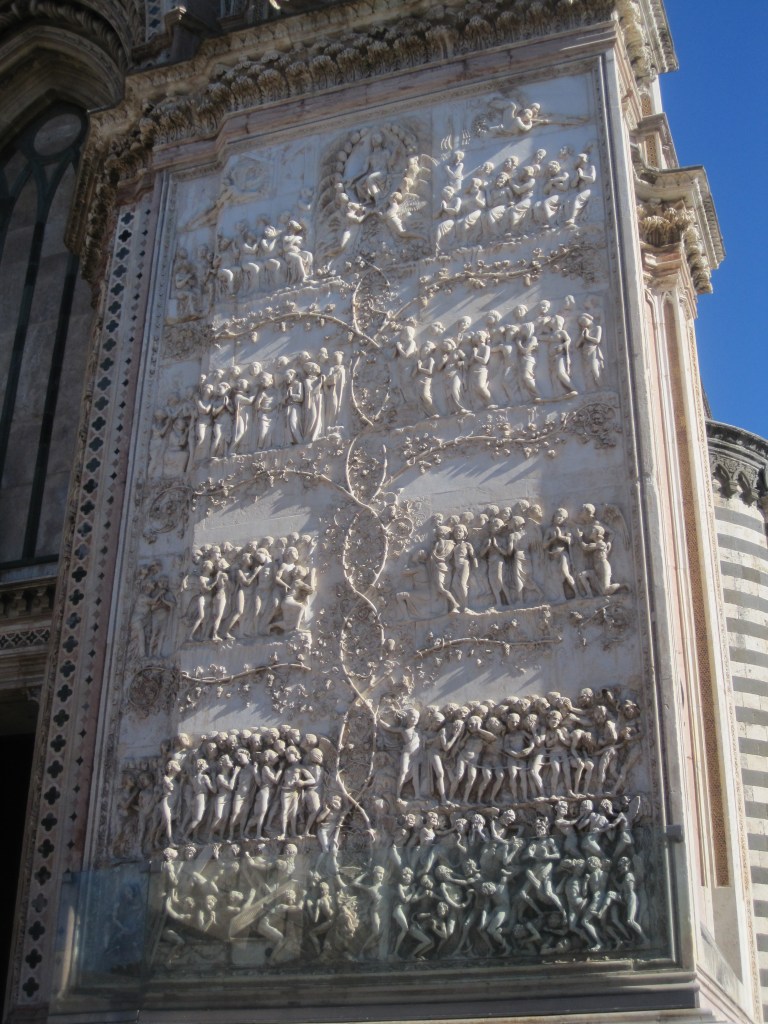
Final Judgment, Orvieto Cathedral

“The first point about eternal life is that man is united with God. For God himself is the reward and end of all our labors…

“Next it consists in perfect praise…

“It also consists in the complete satisfaction of desire, for there the blessed will be given more than they wanted or hoped for. The reason is that in this life no one can fulfill his longing, nor can any creature satisfy man’s desire. Only God satisfies, he infinitely exceeds all other pleasures. That is why man can rest in nothing but God. As Augustine says: You have made us for yourself, Lord, and our heart can find no rest until it rests in you

“…eternal life consists of the joyous community of all the blessed, a community of supreme delight, since everyone will share all that is good with all the blessed. Everyone will love everyone else as himself…”

St. Thomas Aquinas, Credo in Deum

Office of Readings

Saturday of the Thirty-third week in Ordinary Time

Not peace, but division: homily for the twentieth Sunday of Ordinary Time

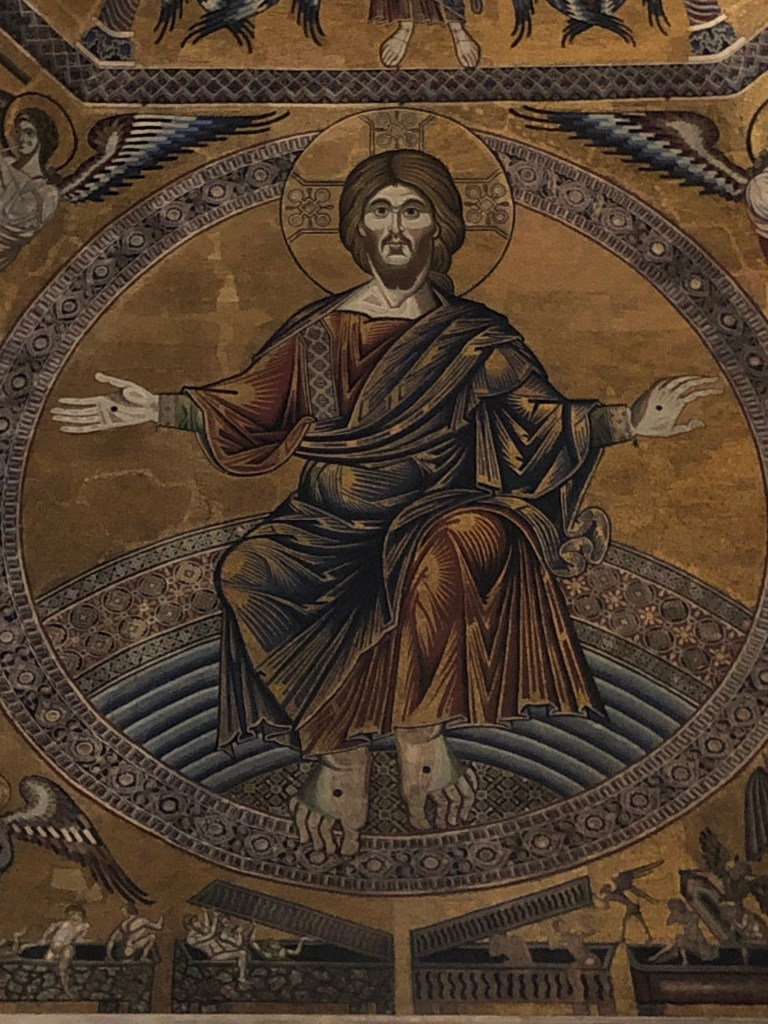
Baptistry, Florence

Homily for the 20th Sunday in Ordinary Time (C)

Politicians frequently claim to be uniters, not dividers.  If you wanted proof, therefore, that Jesus was not a politician, look no further than today’s Gospel: “Do you think that I have come to establish peace on the earth?  No, I tell you, but rather division.”

Political promises of unity, of course, come cheaply; sometimes they simply mean, “If you disagree with me, I’ll accuse you of being a divider.”  In today’s Gospel reading, however, Jesus makes a move never recommended by any political consultant: he preemptively accuses himself of bringing division.  Other than the desire to put centuries of future homilists in a very awkward position, why would Jesus do this?

Continue reading “Not peace, but division: homily for the twentieth Sunday of Ordinary Time”

Augustine’s baptism

The baptism of St. Augustine, San Pietro in Ciel d’Oro, Pavia, Italy

Anyone reading St. Augustine’s Confessions, of course, knows exactly where the book is leading, even if the story itself recounts a tortuous journey from doubt and confusion to faith. Augustine dedicates relatively few words to his baptism–at the time, Christians avoided describing what happened during the celebration of the sacraments to those not yet initiated–but what he does say reveals much about the power of the rite. Augustine was baptized by St. Ambrose in the baptistry of Milan’s cathedral on April 24, 387, along with his fifteen-year-old son Adeodatus. Adeodatus died only two years later. Looking up the passage anew, I was struck by the feeling in what Augustine wrote about his son:

“You had made him a fine person. He was about fifteen years old, and his intelligence surpassed that of many serious and well-educated men. I praise you for your gifts, my Lord God, Creator of all and with great power giving form to our deformities. For I contributed nothing to that boy other than sin… I learned many other remarkable things about him. His intelligence left me awestruck. Who but you could be the Maker of such wonders? Early on you took him away from life on earth. I recall him with no anxiety; there was nothing to fear in his boyhood or adolescence or indeed his manhood.”

Augustine goes on to describe his baptism, side by side with Adeodatus, both now reborn “the same age in grace”.

“We were baptized, and disquiet about our past life vanished from us. During those days I found an insatiable and amazing delight in considering the profundity of your purpose for the salvation of the human race. How I wept during your hymns and songs! I was deeply moved by the music of the sweet chants of your Church. The sounds flowed into my ears and the truth was distilled into my heart. This caused the feelings of devotion to overflow. Tears ran, and it was good for me to have that experience.”

St. Augustine, Confessions, Book IX, vi (14)

More on Augustine (and Ambrose)

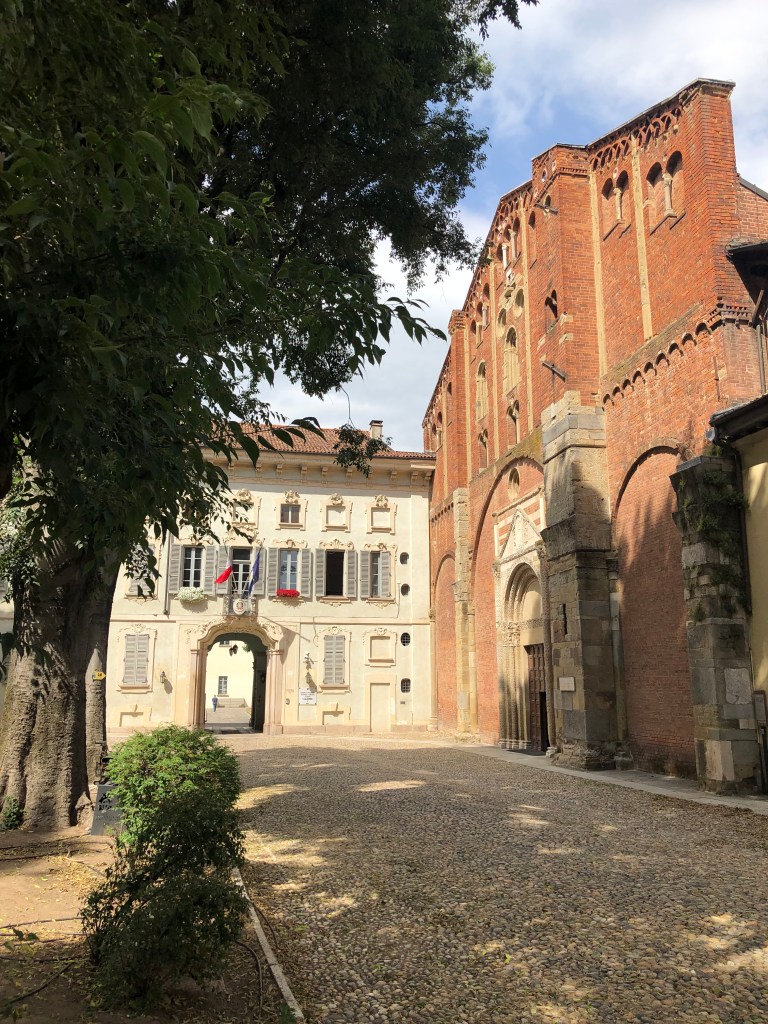
Last week, I mentioned visiting the church of San Pietro in Ciel d’Oro in Pavia, resting place of the relics of St. Augustine. This week, I thought I’d share a few more pictures of the church and the tomb, as well as a favorite panel from the monument, a scene of young Augustine listening to St. Ambrose preaching.

San Pietro in Ciel d’Oro, Pavia, Italy

Ambrose, then bishop of Milan, is another of my favorite theologians. He was the first Christian thinker to formulate the doctrine of baptism of desire, which–1530 years later–became the subject of my doctoral dissertation and book Baptism of Desire and Christian Salvation. (Augustine was the second… I’m not quite sure where I fall on the list, but it’s significantly farther down.)

In any case, below is Augustine’s description of his encounter with Ambrose to accompany the photos.

Continue reading “More on Augustine (and Ambrose)”