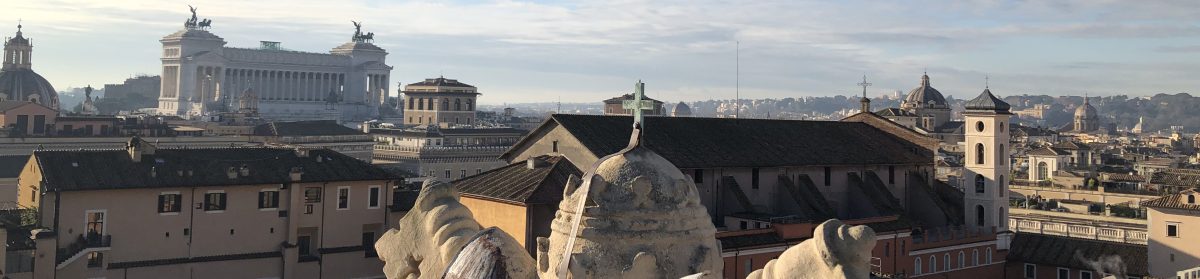
Santa Maria in Cosmedin – home to St. Valentine

Santa Maria in Cosmedin, Piazza della Bocca della Verità, Rome

It’s not one of Rome’s station churches, but Santa Maria in Cosmedin was one of my stops as Lent began this year because of the coincidence of Valentine’s Day falling on Ash Wednesday. A college English professor once advised me that in literature love and death are always intertwined, and this year’s liturgical calendar seems to add an exclamation point to the theory. What does all of this have to do with Santa Maria in Cosmedin, a twelfth century Roman church a stone’s throw from the Circus Maximus?

Well, Santa Maria in Cosmedin is home to the relics of St. Valentine. And, given his current appearance, I’d say Valentine drives home Ash Wednesday’s message pretty well. Not much is known about his life; Valentine was third century Roman priest martyred for continuing to minister to his flock in the midst of persecution. A note near his altar says the saint has been turned to not only for love, but as an intercessor in times of plague.

The relics of St. Valentine — romance abounds!

The church itself is rather fascinating. The current building, with its stubby façade and soaring bell tower, dates from the 12th century but was built on the site of an eighth century diaconia. Diaconia were the Catholic Social Services hubs of their day, centers where various forms of charity were distributed to the needy. Today the church is home to Rome’s Melkite community.

Continue reading “Santa Maria in Cosmedin – home to St. Valentine”
Visiting Augustine’s Tomb

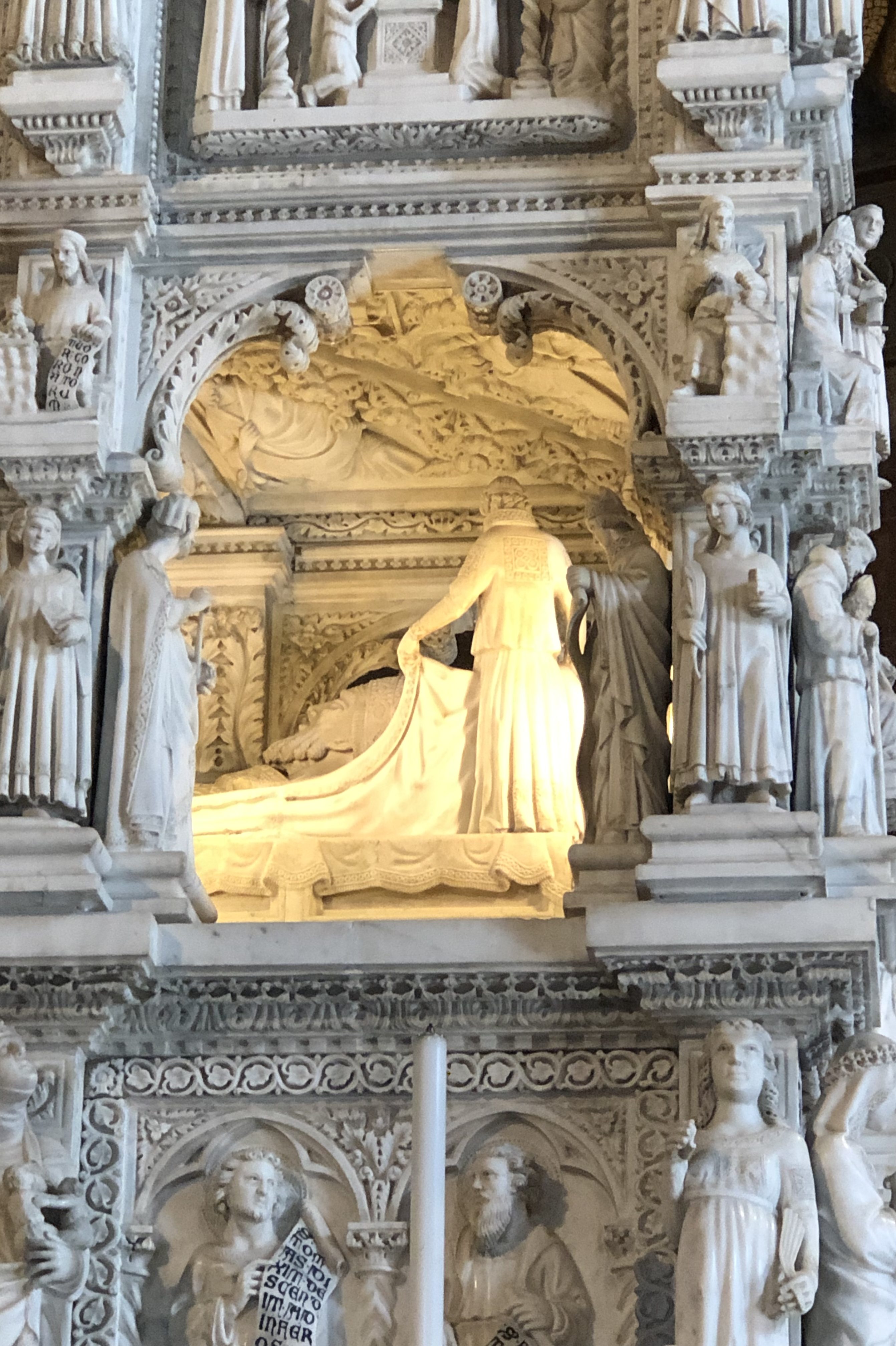
Arca di Sant’Agostino (1362), San Pietro in Ciel d’Oro, Pavia, Italy

Theologian don’t have a G.O.A.T. designation. (That’s “Greatest of All Time” for those who aren’t as hip as yours truly.) But if we did, Augustine of Hippo would probably get my vote. Sure, he’s not as systematic as Thomas Aquinas, but he more than makes up for it with humanity and passion, the way you can feel him throw himself so completely into the quest for God in his sermons and treatises. If you read Augustine’s sermons out loud, you can feel the power of his rhetoric. I’ve had many a conversation with the saint as I worked on my book Baptism of Desire and Christian Salvation. Augustine, alongside Ambrose of Milan, can be considered one of the doctrine’s fathers.

So it was quite a thrill–like visiting Graceland, or Disney World before it went woke–to spend an afternoon at the tomb of St. Augustine in Pavia last week. You might reasonably wonder how the North African theologian’s bones ended up in a smallish city in the north of Italy. Pavia, today sensible and pleasant, was the capital of the Kingdom of the Lombards in the 8th century. After his death, Augustine’s relics had been hustled out of Hippo to save them from the Vandals (today the tribe would be called the Mostly Peaceful Protesters) who lay siege to Hippo as its bishop lay dying. The saint’s body ended up in Sardinia, which, like much of the Mediterranean coastline in the Middle Ages, was subject to vicious Saracen raiding. For safekeeping, Liutprand, King of the Lombards–who is buried in the same church–had the bones brought to Pavia. There they reside in the church of San Pietro in Ciel d’Oro.

Continue reading “Visiting Augustine’s Tomb”