Humility is our glory: homily for the 22nd Sunday in Ordinary Time

Homily for the twenty-second Sunday in Ordinary Time (C).
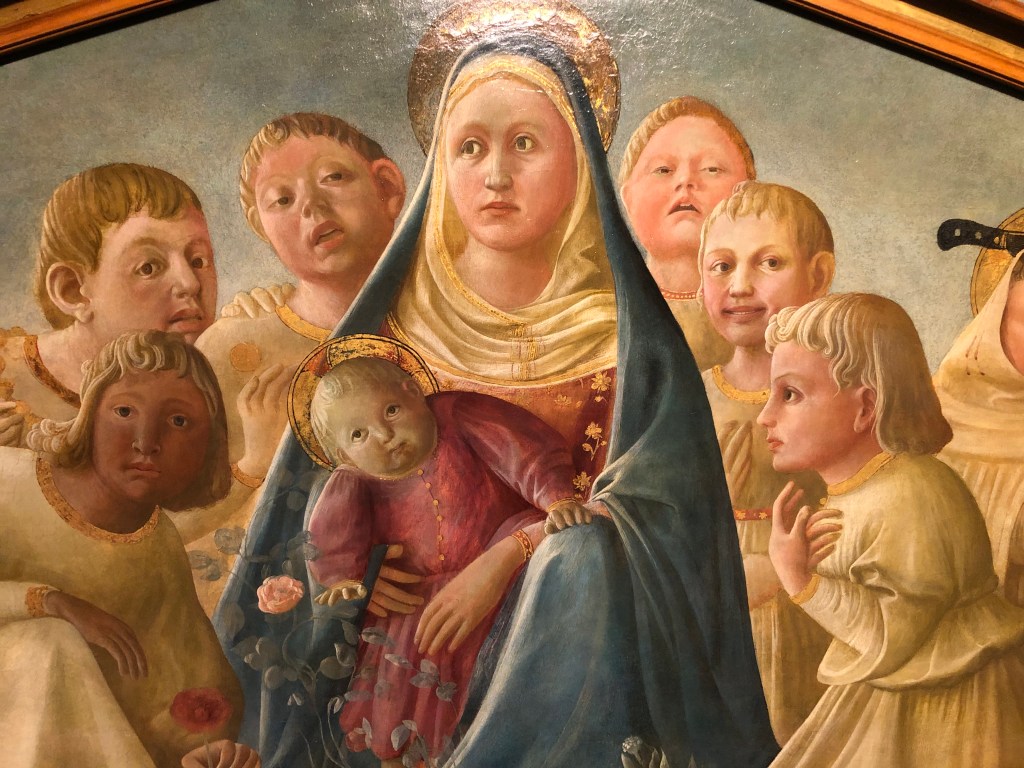
Filippo Lippi, Madonna of Humility, 1420

Humility is the virtue that stands out both in today’s Gospel reading and in Sirach’s advice to “conduct your affairs with humility” and to “humble yourself the more, the greater you are.”  I’ve been thinking about humility a lot this summer because I’ve been thinking about my grandfathers.  One passed away in June, the other fourteen years ago, and “humble” is one of the first words that comes to mind when I think of either of them—perhaps in both cases because my grandfathers were the quiet ones, and my grandmothers were the talkers!  One grandfather was a baker, the other lived his whole life in the same small town in Minnesota.  I think of them both as great men not because they sought attention or prestige, but because they didn’t.  Because they dedicated themselves to others, to their families and to their communities, without making a fuss about it, and left the lives of many better as a result.  In the homely etiquette lesson Jesus offers in the Gospel—take the lower place instead of elbowing your way to the head of the table—he points to one way in which a humble act can leave one better off in the long run.

Continue reading “Humility is our glory: homily for the 22nd Sunday in Ordinary Time”

Mary the Mother of God and the relationships that define us: homily for the Solemnity

Madonna and Child, Umbrian , 14th century, Spoleto

Homily for the Solemnity of Mary, the Mother of God

Today we celebrate the Solemnity of Mary Mother of God.  Fortunately, as you came into church this morning, you did not see armed troops guarding the doors, nor bishops jostling and shouting angrily at each other in Greek.  We should be grateful for such peace and calm this New Year’s Day, 2024.  Sixteen-hundred years ago, you might have seen just that.  At that time, the fiercest controversy in the Catholic Church was over whether the title “Mother of God” could be applied to Mary, a controversy settled by the Council of Ephesus in 431.  Before the Council of Ephesus, Nestorius, the bishop of Constantinople, had claimed that Mary could be called the “Mother of Christ” or the “Mother of Jesus” but not the “Mother of God.”

If you think for a minute about what is at stake in the title, you’ll realize that the controversy was not really about the identity of Mary, but the identity of her son.  Mary can only be called “Mother of God” if Jesus is, in fact, fully man and fully God.  The Council of Ephesus declared Nestorius a heretic for obscuring what we celebrate this Christmas season: that the Son of God has become man, that from the moment of his conception in Mary’s womb Jesus was and is God.

But today is a Marian feast.  What does this title tell us about Mary?  You have probably heard many times that Mary always points to Christ.  Her final words recorded in Scripture are to the servants at Cana, after she has dropped an unsubtle hint to Jesus about the need for more wine at the party: “Do whatever he tells you,” she says (Jn 2:5).  It is hard to think of a more exalted title to bestow on anyone than “Mother of God,” yet there’s a humility in the title too because by exalting Mary we are first exalting her son.

Mary is a woman of both humility and strength, of contemplation and action, of wisdom and patience, of courage and compassion, and yet her greatness—what makes her the greatest woman to have lived, worthy of the title of today’s feast—is the relationship she has with her son.  And there is a lesson here for us, a lesson about the importance of relationships.

Continue reading “Mary the Mother of God and the relationships that define us: homily for the Solemnity”