As is traditional for the First Week of Lent, the Pope and the Roman Curia will spend several days making their annual spiritual exercises. This year’s retreat is being preached by Bishop Erik Varden of Trondeim, Norway. Some readers might know Bishop Varden already from his wonderful blog Coram Fratribus. A convert and then a Trappist monk, Bishop Varden has a gift for communication comparable to our own great Robert Barron, though with his own unique style.
St. Peter’s Basilica, Rome
At a mere 51 years old, Bishop Varden also represents something of a turning of the page in the life of the Church. I’ve written before (here and here) that the zealous and youthful Church I encountered in Scandinavia hints at what fidelity and evangelization must look like in an increasingly secularized world. Bishop Varden–articulate, orthodox, cultured, and creative–seems to understand how to respond to our twenty-first century reality.
Last year I read Bishop Varden’s profound book Chastity: Reconciliation of the Senses, and I thought this week would be a good opportunity to share a few of its many insights…
We are now in the middle of the exam period at the Gregorian University. For me, that means a seemingly endless stack of papers to read and evaluate. My students know that I am prone to harp on the importance of clarity in writing. (When your professor has to read 500 pages of student writing, it’s really in your own interest not to make his job any harder than it has to be!) My students have heard repeatedly the advice I once received from a great philosophy professor at Loyola Chicago (Dr. Jacqueline Scott, who taught Nietzsche): always define your terms.
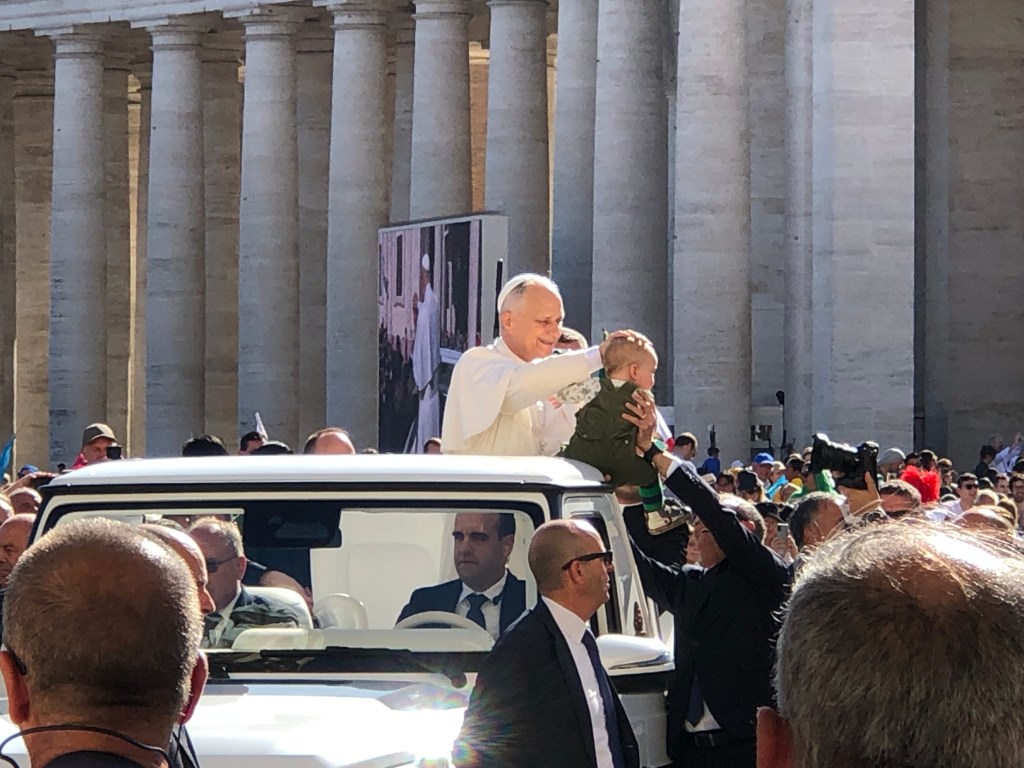
Pope Leo XIV in St. Peter’s Square
You can imagine my joy then to read the same advice (more or less) from no less an authority than Pope Leo XIV. His speech to the Vatican Diplomatic Corps from earlier this month is extremely interesting and among the most important of his papacy thus far. I found his reflections on language especially insightful and necessary, and they reawakened all my old writing teacher instincts. Muddled writing often means muddled thinking. And today’s public discourse is… well, let’s just say “muddled” is euphemistic. The ubiquitous use of “they” as a singular pronoun, for example, I find nothing short of barbaric. Not quite as bad as the guillotine, but close.
Here are a few of Leo’s words on the uses and misuses of language, though the whole speech is worthwhile. It wouldn’t be the worst side effect if a few Vatican documents got a bit shorter as a result… just saying.
“[I ]n order to engage in dialogue, there needs to be agreement on the words and concepts that are used. Rediscovering the meaning of words is perhaps one of the primary challenges of our time. When words lose their connection to reality, and reality itself becomes debatable and ultimately incommunicable, we become like the two people to whom Saint Augustine refers, who are forced to stay together without either of them knowing the other’s language. He observes that, “Dumb animals, even those of different species, understand each other more easily than these two individuals. For even though they are both human beings, their common nature is no help to friendliness when they are prevented by diversity of language from conveying their sentiments to one another; so that a man would more readily converse with his dog than with a foreigner!”
Today, the meaning of words is ever more fluid, and the concepts they represent are increasingly ambiguous. Language is no longer the preferred means by which human beings come to know and encounter one another. Moreover, in the contortions of semantic ambiguity, language is becoming more and more a weapon with which to deceive, or to strike and offend opponents. We need words once again to express distinct and clear realities unequivocally. Only in this way can authentic dialogue resume without misunderstandings. This should happen in our homes and public spaces, in politics, in the media and on social media. It should likewise occur in the context of international relations and multilateralism, so that the latter can regain the strength needed for undertaking its role of encounter and mediation. This is indeed necessary for preventing conflicts, and for ensuring that no one is tempted to prevail over others with the mindset of force, whether verbal, physical or military.


 Tony Lusvardi, S.J.