The Immaculate Conception: God’s own Advent preparation

Homily for the Immaculate Conception (2019. Note, that year, the Solemnity fell on a Sunday.)

On the first Sunday of Advent, I cleaned my room. I must admit, it needed it—there were coffee stains on the desk; the trash can was overflowing; I found forgotten lists of things not to forget. But Advent is the beginning of a new liturgical year, the season when we prepare for Christmas, and it seemed right to start with a clean room. In the coming weeks, there will be many other things to prepare: food, gifts, decorations, travel.

Column of the Immaculate Conception, Rome

This is the second Sunday of Advent, and normally the readings highlight the figure of St. John the Baptist, who speaks of another kind of preparation, another kind of cleaning—in fact, a much deeper cleaning than coffee stains. John the Baptist warns of the need for inner cleansing, moral and spiritual conversion. And this too is part of the preparation for Christmas. As a confessor, I have to do a little advertising for my profession, strangely absent from all the Black Friday advertising we received last month. But I must say that our special offer—the forgiveness of sins, eternal life—is truly the best deal in the world.

However, this year is a bit special, because this second Sunday of Advent is December 8, the Solemnity of the Immaculate Conception of Mary, the Mother of Jesus. This coincidence of dates is interesting because the Immaculate Conception is also a feast of preparation. But not the preparation we do during this season. The preparation that God has done for us.

Continue reading “The Immaculate Conception: God’s own Advent preparation”

Mary’s Assumption: the ultimate celebration of the human body

Homily for the Assumption of the Blessed Virgin Mary (from 2021.)

Crowning of the Virgin, St. Martin’s Cathedral, Spišská Kapitula, Slovakia

Ounce per ounce, the largest bone in our body, the femur, is stronger than steel.  Laid out end to end, the blood vessels from an adult’s body could circle the globe four times.  Our brains contain 86 billion nerve cells, which are joined by 100 trillion connections.

Right now in your brains several million of those connections are lighting up asking, “What in the world is he talking about?  Nice factoids, padre, but what do they have to do with anything?”  The answer is that today’s feast, among the most solemn on the Church’s calendar, is a celebration of the human body.  

Today we celebrate the Assumption of the Blessed Virgin Mary, the dogma that at the end of her life Mary was taken up soul and body into heavenly glory.  This dogma is more than just an interesting factoid.  It is deeply relevant to each one of us because Christianity professes belief in the resurrection of the body.  St. Paul’s First Letter to the Corinthians talks about Christ’s resurrection as “the firstfruits” of a much larger harvest.  In a sense, Mary’s Assumption is also a guarantee that the fruits of the resurrection will be shared with the whole Church.  Mary, the first Christian believer, the first to receive the news of Jesus’ Incarnation, represents the Church in a way nobody else can.  

We human beings are both body and soul.  We are not souls trapped in a body; our bodies are part of who we are.  Angels are souls without bodies, but we are not angels.  If the resurrection were an entirely spiritual phenomenon, it wouldn’t be us rising from the dead.  This is why Jesus became incarnate, coming in the flesh.  It is why the Gospels insist so forcefully that, when Jesus rose from the dead, he had not become a ghost or a hologram but remained a man who ate food and whose flesh bore the wounds of his passion.  It is why the sacraments require material elements, and not just any material elements but specific elements connected to Jesus’ physical existence on earth.

Continue reading “Mary’s Assumption: the ultimate celebration of the human body”

“Icons of Hope” in Rome

Last week I mentioned the Church of Sant’ Agnese in Agone, one of Rome’s architectural gems and a monument to the city’s martyrs.

The last time I visited Sant’Agnese, I found that the Church was hosting a special display for the Jubilee (until February 16) dedicated to the theme “Icons of Hope.” The display brings together a number of icons from the Vatican Museum.

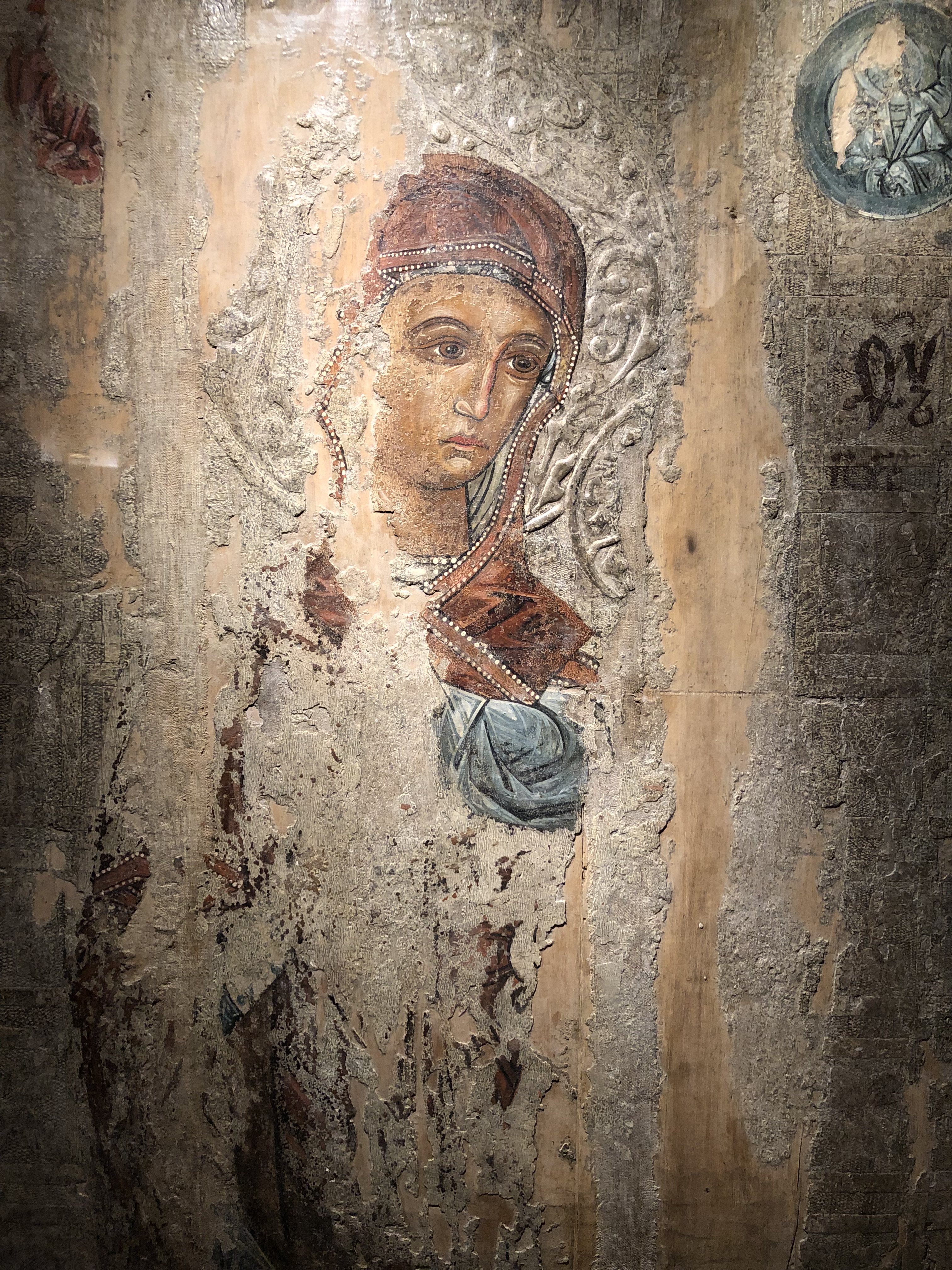
Virgin Hodegetria, Ukrainian, 17th-18th century

The most moving piece in the exhibition had to be the Ukrainian Virgin Hodegetria (17th/18th century). The engraved silver on a wood panel has been damaged over time, but the icon is all the more hauntingly beautiful. The Virgin’s face is still clearly visible, her eyes clear and sad, the expression that of someone who has known suffering but lost none of her dignity.

It is, of course, impossible to view the icon and not see in it the image of the suffering of the Ukrainian people as the Russian assault on their country every day grows more cruel and barbaric. Last week I wrote about the courage of the martyrs. Ukraine’s defense of its freedom and right to exist as a country has perhaps stung the conscience of the world because, in a self-indulgent age, the country’s display of genuine courage is bracing. And as George Weigel has pointed out, “Ukraine is fighting for all of us.”

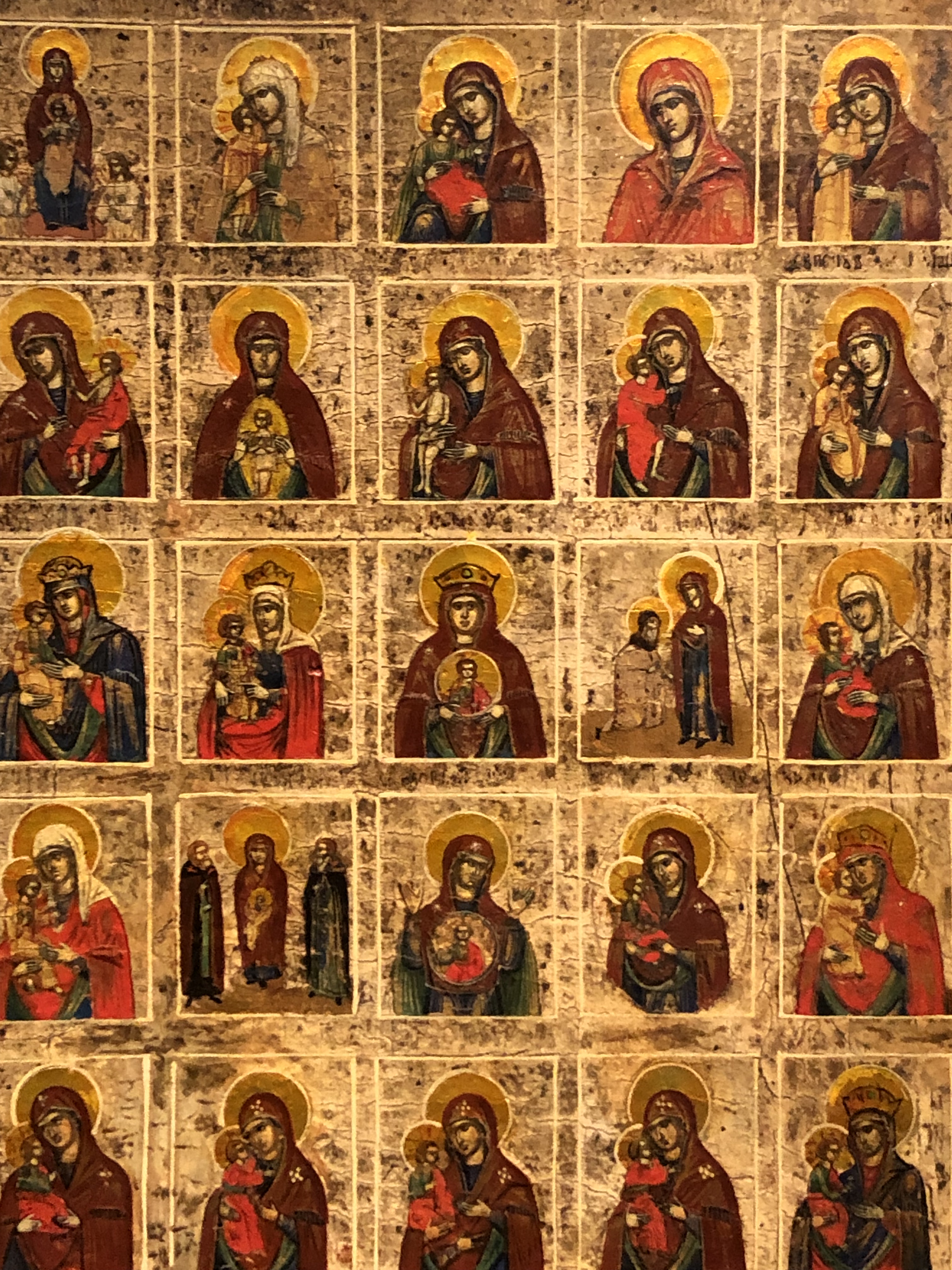
The display also contains icons from other eastern European countries–a sampling below.

Taking the gold for Team Humanity: homily for the Assumption of the Blessed Virgin Mary

Homily for the Assumption

Raphael, Coronation of the Virgin, Vatican Museums

My brothers and sisters, I’m no angel.  Before you respond with too much glee, “Oh, Father, we know,” let me point out—you’re no angels, either.

Now, when people say, “He’s no angel,” usually what they’re saying doesn’t mean what they think it does.  Usually, if someone says, “He’s no angel,” they mean, “He’s not so nice.”  Maybe there are a few skeletons in his closet.

But not all the angels were good.  Lucifer and the demons are angels, and they have so many skeletons there’s no room for clothes in their closets.  Today’s great feast is dedicated to a woman who never sinned.  But today, the feast of the Assumption, we celebrate the fact that Mary is no angel.  She is a human being.  A woman.  One of us.

You see, because the real reason demons don’t have clothes in their closets is because they don’t have anything to wear them on.  Angels don’t have bodies.  But we do.  That’s the difference between angels and human beings.  Otherwise, we’re quite a bit alike.  We both have intelligence and free will—which is how the fallen angels sinned.  The big difference is the body.

Today we celebrate the fact that at the end of her life on earth, Mary’s body entered immediately into heavenly glory.

And, my friends, this is not some bit of religious trivia, but something very, very important for each one of us.  Because it means that to be saved, to enter into heavenly glory, we don’t have to give up being human.  We don’t have to become angels.  God wants to save us as human beings, which is why his plan for our salvation involved taking the flesh of Mary, a woman, to become a man, so that we, women and men, might be saved in our human bodies.

Continue reading “Taking the gold for Team Humanity: homily for the Assumption of the Blessed Virgin Mary”

Mary the Mother of God and the relationships that define us: homily for the Solemnity

Madonna and Child, Umbrian , 14th century, Spoleto

Homily for the Solemnity of Mary, the Mother of God

Today we celebrate the Solemnity of Mary Mother of God.  Fortunately, as you came into church this morning, you did not see armed troops guarding the doors, nor bishops jostling and shouting angrily at each other in Greek.  We should be grateful for such peace and calm this New Year’s Day, 2024.  Sixteen-hundred years ago, you might have seen just that.  At that time, the fiercest controversy in the Catholic Church was over whether the title “Mother of God” could be applied to Mary, a controversy settled by the Council of Ephesus in 431.  Before the Council of Ephesus, Nestorius, the bishop of Constantinople, had claimed that Mary could be called the “Mother of Christ” or the “Mother of Jesus” but not the “Mother of God.”

If you think for a minute about what is at stake in the title, you’ll realize that the controversy was not really about the identity of Mary, but the identity of her son.  Mary can only be called “Mother of God” if Jesus is, in fact, fully man and fully God.  The Council of Ephesus declared Nestorius a heretic for obscuring what we celebrate this Christmas season: that the Son of God has become man, that from the moment of his conception in Mary’s womb Jesus was and is God.

But today is a Marian feast.  What does this title tell us about Mary?  You have probably heard many times that Mary always points to Christ.  Her final words recorded in Scripture are to the servants at Cana, after she has dropped an unsubtle hint to Jesus about the need for more wine at the party: “Do whatever he tells you,” she says (Jn 2:5).  It is hard to think of a more exalted title to bestow on anyone than “Mother of God,” yet there’s a humility in the title too because by exalting Mary we are first exalting her son.

Mary is a woman of both humility and strength, of contemplation and action, of wisdom and patience, of courage and compassion, and yet her greatness—what makes her the greatest woman to have lived, worthy of the title of today’s feast—is the relationship she has with her son.  And there is a lesson here for us, a lesson about the importance of relationships.

Continue reading “Mary the Mother of God and the relationships that define us: homily for the Solemnity”

Light in Holy Week

Jesuit Retreat Center, Sevenhill, Australia

Today is unofficially known as “Spy Wednesday” on the Church calendar because the Gospel reading recounts the story of Judas’s betrayal. I spent this Lent doing the 30-day Spiritual Exercises of St. Ignatius Loyola, and, for me, the most moving part of the retreat was contemplating the Lord’s Passion, in which, through the liturgy, we participate during Holy Week.

There is much to say about the retreat and much to say about Holy Week–but having been away for over a month, I also have a fair bit of catching up to do. So for now, I’ll share just one thought.

Until we reach Easter Sunday, this week is incredibly dark. Judas is present at the Last Supper and his impending betrayal colors everything else. Even before the Lord’s arrest, Jesus suffers because of his disciple’s mendacity. Peter’s courage and good intentions fail. The physical torture–scourging, beating, the nails, exposure and slow suffocation on the cross–is inhuman, enough to turn one’s stomach just thinking about it. And then, the cravenness of Pilate, the calculated cruelty of Jerusalem’s religious leaders, the callous and fickle crowd. What is most sobering of all is the realization that there is some of Judas and Pilate and Peter in each one of us. The Lord suffers for our sins.

Continue reading “Light in Holy Week”

Weight-lifting for the Assumption: homily for Mary’s Assumption

Homily for the Solemnity of the Assumption of the Blessed Virgin Mary

Santa Maria in Trastevere, Rome

If you are looking for an appropriate way to observe today’s Solemnity of the Assumption of the Blessed Virgin Mary, may I suggest weight-lifting.

Today’s feast is a celebration of strength.  The strength we celebrate today is more than that shown by Olympic weightlifters—though it includes a little of that—more than the moral strength of a figure like Rosa Parks—though it includes that too—more than the geo-political strength projected by a squadron of B-21 bombers—though that’s not absent either.  Add to all of these the strength of a cosmic force—like the gravity of the sun or the moon tugging at the tides—and you get an idea of the strength we’re dealing with. 

Continue reading “Weight-lifting for the Assumption: homily for Mary’s Assumption”