Epiphany homily: recapturing the logic of the gift

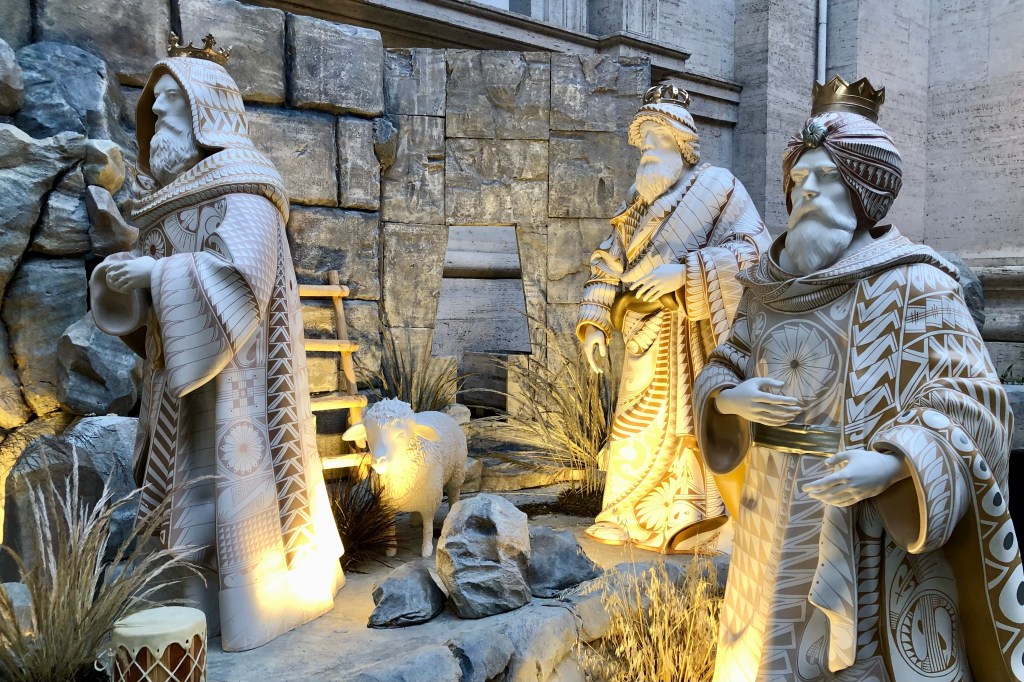
The Three Kings, from a Mexican Nativity displayed inside the Vatican, 2025

Homily for the Solemnity of the Epiphany.

Today’s feast, the Epiphany, traditionally was the day for gift-giving in Italy, though that tradition has been somewhat superseded by the arrival of a more aggressive salesman, Santa Claus.  Santa accepts both Visa and Mastercard—and, in some places, American Express—whereas the Magi bartered or traded in old-fashioned gold.

The Magi are still, however, known for their gifts.  Matthew’s Gospel does not give a precise number of Magi, but since it lists three gifts, the Christian artistic tradition has always depicted three Magi—or kings or wise men, depending on how you translate the word for these learned, wealthy, and adventuresome visitors.  Their gifts—gold, frankincense, and myrrh—struck a chord in the Christian imagination, even if most of us would have trouble explaining what exactly you do with myrrh.

Ancient spiritual writers attributed symbolic meaning to their gifts: gold symbolized Christ’s kingship; frankincense—a type of incense used in worship—symbolized his divinity; and myrrh—myrrh again, gave them a little trouble.  Some associated myrrh with virtue or with prayer.  Myrrh is actually very similar to frankincense; both come from the resin—the sap—of desert trees, which makes them rare and valuable.  Both give off distinct smells when burnt.  Frankincense is sweeter, while myrrh gives off bitter notes sometimes described as earthy or somber.  In the ancient near east, myrrh was used to prepare bodies for burial, so the presence of myrrh at Christ’s birth is sometimes interpreted as foreshadowing his passion and death.  Perhaps that explains why myrrh is no longer popular as a Christmas gift today.

But more than the specific gifts of the Magi, this morning I would like to reflect on what a gift is to begin with.  Today our idea of gift-giving is so shaped by Santa Claus—and by Amazon and Black Friday—that we sometimes lose the sense of what a gift meant in the time of Jesus.  And when we lose our grasp of the logic of gift-giving and gift-receiving, we start to have trouble understanding not only today’s feast of the Epiphany, but other parts of our faith as well, like marriage and the Eucharist.  Even our own existence in this world, which we did not create ourselves and did nothing to earn, becomes difficult to understand.

Continue reading “Epiphany homily: recapturing the logic of the gift”

Homily for the Feast of the Holy Family

Homily for the Feast of the Holy Family (Year A). Original Italian.

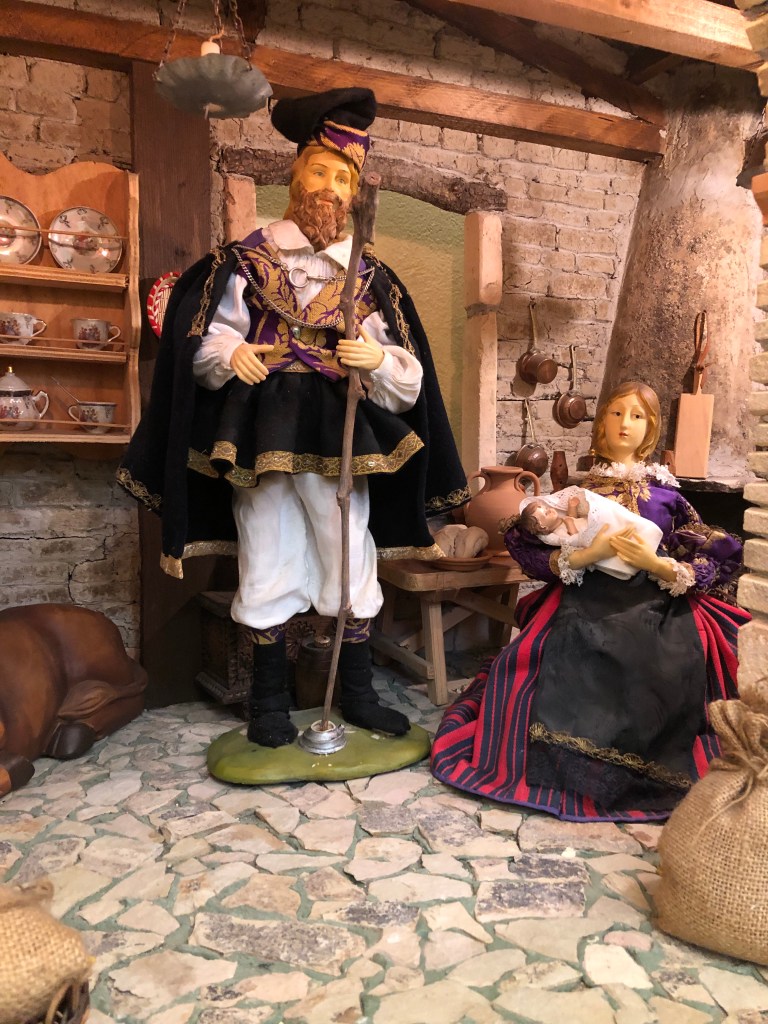
Sardinian Nativity scene, Maracalagonis (Sardinia)

Today we celebrate the story of one particular family—and the story of every family.

On the one hand, the story of the Holy Family of Jesus, Mary, and Joseph is absolutely unique. There is no other historical event comparable to the Incarnation of the Son of God, and the birth of Jesus is surrounded by other miraculous events—the appearance of the archangel Gabriel, the angelic messages that come to Joseph in dreams, the arrival of the Magi, the adoration of the shepherds—which highlight the unique identity of Jesus Christ. Furthermore, Jesus is divine, Mary is immaculate, and Joseph is holy; therefore, this family is threatened by sin, but always from outside. Herod’s envy is one example.

In our families, however, we must admit that often the most damaging wounds are caused by our own sins. Nevertheless, I do not believe that this difference—the holiness of the Holy Family—creates a distance between them and us, because all the actions of the Holy Family are done for us. They are a guide, a support, and a source of hope for us.

Joseph and Mary faced great challenges: an unexpected pregnancy that changed all their plans, the misunderstanding of their neighbors, a period of extreme poverty, danger, a threat to their child’s life, exile; and then all the daily challenges, including—if we think of Jesus’ disappearance in the temple—the difficulties of communication that sometimes occur even between people of good will. At the same time, the Holy Family experienced unexpected joys, tenderness, the celebrations of their religion, and belonging to their people. They experienced the fullness of family life.

Their particular experience offers us inspiration and encouragement to live our Christian mission fully, despite the challenges.

Continue reading “Homily for the Feast of the Holy Family”

Sacraments of loyalty, marriage and Eucharist: homily for the twenty-first Sunday in Ordinary Time

Homily for the 21st Sunday in Ordinary Time (B)

Are there any Bears fans here?  I have a question for you: if I reached into my wallet, how much money would I have to offer to get you to root for the Vikings?  I know what you’re thinking: “You keep your wallet where it is, Father, because there ain’t enough money in the world to make me a Vikings fan.” Fair enough.  I am a Notre Dame fan, and you could fill up the collection plate with hundred dollar bills, but you’d never get me to root for USC or Michigan. 

Triumph of Faith over Idolatry, Jean-Baptistre Théodon, Church of the Gesù, Rome

In both cases, the reason why is loyalty.  Each of today’s readings is about loyalty, though much more important types of loyalty than what we show our sports teams.  When the first reading takes place, Joshua and the Israelites have spent their lifetime conquering the Promised Land after the death of Moses; here Joshua is an old man and he is putting a choice to the people.  They’ve arrived, the land is theirs, and he tells them: Now you have to decide whom to serve.  The God of our fathers Abraham and Moses got us here, and he has given us his law.  Other nations have other gods, maybe with laws that aren’t so demanding.  You are free to make a choice.  You can serve whichever god you wish, Joshua says, but “as for me and my house, we will serve the Lord.”  

And the people agree to serve the Lord.  But if you continuing reading in the book of Joshua, you’ll see that Joshua asks the people a second time.  Are you sure?  Because if you agree to serve the Lord, then God will hold you to his law.  You are free, but your choice is binding.  

Continue reading “Sacraments of loyalty, marriage and Eucharist: homily for the twenty-first Sunday in Ordinary Time”

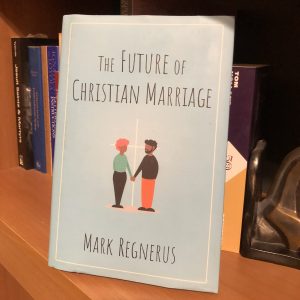
The Future of Christian Marriage

This week marks the end of the first semester at the Greg. One of the semester’s blessings has been the seminar I taught on the sacrament of marriage, which looked first at some classic theological texts on the subject and then attempted to grapple with the contemporary problems the Christian vision of marriage faces. No small task, and I learned much from the discussion. I’m grateful to my lively group of students.

To guide our discussion I assigned sociologist Mark Regnerus’s engaging and insightful book The Future of Christian Marriage (Oxford 2020). The book makes use of social surveys, Regnerus’s own extensive research on the subject, and 200 interviews conducted with young Christians in seven different countries. My students–who hailed from a total of eight different countries–found the book quite helpful for understanding the situation they themselves face. Having real-world data also improved our theological discussion, which, in today’s climate, can sometimes get bogged down in sloganeering.

At the root of Regnerus’s argument is the contention that attitudes toward marriage have changed from seeing it as a “foundation” to seeing it as a “capstone.” In other words, instead of a unit based on mutual exchange that helps a couple to weather life’s uncertainties, young people have increasingly come to see marriage as a capstone one acquires only after attaining personal, financial, and career success. This means that marriage is delayed, comes with more difficult-to-realize expectations of one’s spouse, and, for many, ultimately becomes unattainable. This is all part of the “atomization” of society as individuals become our primary social grouping at the expense of families.

Continue reading “The Future of Christian Marriage”

Mary the Mother of God and the relationships that define us: homily for the Solemnity

Madonna and Child, Umbrian , 14th century, Spoleto

Homily for the Solemnity of Mary, the Mother of God

Today we celebrate the Solemnity of Mary Mother of God.  Fortunately, as you came into church this morning, you did not see armed troops guarding the doors, nor bishops jostling and shouting angrily at each other in Greek.  We should be grateful for such peace and calm this New Year’s Day, 2024.  Sixteen-hundred years ago, you might have seen just that.  At that time, the fiercest controversy in the Catholic Church was over whether the title “Mother of God” could be applied to Mary, a controversy settled by the Council of Ephesus in 431.  Before the Council of Ephesus, Nestorius, the bishop of Constantinople, had claimed that Mary could be called the “Mother of Christ” or the “Mother of Jesus” but not the “Mother of God.”

If you think for a minute about what is at stake in the title, you’ll realize that the controversy was not really about the identity of Mary, but the identity of her son.  Mary can only be called “Mother of God” if Jesus is, in fact, fully man and fully God.  The Council of Ephesus declared Nestorius a heretic for obscuring what we celebrate this Christmas season: that the Son of God has become man, that from the moment of his conception in Mary’s womb Jesus was and is God.

But today is a Marian feast.  What does this title tell us about Mary?  You have probably heard many times that Mary always points to Christ.  Her final words recorded in Scripture are to the servants at Cana, after she has dropped an unsubtle hint to Jesus about the need for more wine at the party: “Do whatever he tells you,” she says (Jn 2:5).  It is hard to think of a more exalted title to bestow on anyone than “Mother of God,” yet there’s a humility in the title too because by exalting Mary we are first exalting her son.

Mary is a woman of both humility and strength, of contemplation and action, of wisdom and patience, of courage and compassion, and yet her greatness—what makes her the greatest woman to have lived, worthy of the title of today’s feast—is the relationship she has with her son.  And there is a lesson here for us, a lesson about the importance of relationships.

Continue reading “Mary the Mother of God and the relationships that define us: homily for the Solemnity”