
Get Married: A review

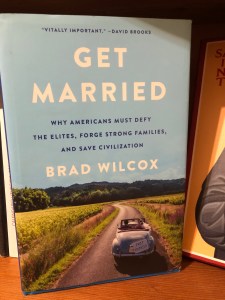
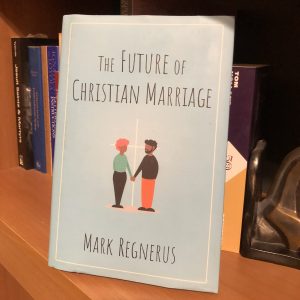
A couple of years ago I taught a seminar on the sacrament of marriage, using Mark Regnerus’s excellent book The Future of Christian Marriage, which I reviewed for the Homiletic and Pastoral Review. I taught the same seminar again this past semester and reviewed another recent contribution to the subject, Brad Wilcox’s  Get Married: Why Americans Must Defy the Elites, Forge Strong Families, and Save Civilization (Broadside Books, 2024). You can read the review below or visit HRP and read it again!

Marriage is among the most important social justice issues of our day.  Classic Catholic social teaching—think Leo XIII in Rerum Novarum—has long recognized the connection between social well-being and a family life built on marriage. As Brad Wilcox points out in Get Married: Why Americans Must Defy the Elites, Forge Strong Families, and Save Civilization, “questions of marriage and family” are better predictors of positive or negative social outcomes than “race, education, and government spending” (xiv).  Yet even in Catholic circles, questions of marriage and sexual ethics are often treated not as issues of pressing social concern, but as matters of private morality—or dismissed as “cultural issues.”

Such dismissiveness has little theological basis.  And Wilcox—a professor of sociology and the director of the National Marriage Project at the University of Virginia—demonstrates that it is even harder to justify from a sociological point of view.  Marriage is good both for society as a whole—a higher percentage of married parents correlates with lower child poverty (73)—and for individuals, both men and women, who report higher rates of happiness, find more meaning in their lives, and are less lonely than their unmarried—and childless—peers (51-52, 115, 121).

Continue reading “Get Married: A review”

The Future of Christian Marriage

This week marks the end of the first semester at the Greg. One of the semester’s blessings has been the seminar I taught on the sacrament of marriage, which looked first at some classic theological texts on the subject and then attempted to grapple with the contemporary problems the Christian vision of marriage faces. No small task, and I learned much from the discussion. I’m grateful to my lively group of students.

To guide our discussion I assigned sociologist Mark Regnerus’s engaging and insightful book The Future of Christian Marriage (Oxford 2020). The book makes use of social surveys, Regnerus’s own extensive research on the subject, and 200 interviews conducted with young Christians in seven different countries. My students–who hailed from a total of eight different countries–found the book quite helpful for understanding the situation they themselves face. Having real-world data also improved our theological discussion, which, in today’s climate, can sometimes get bogged down in sloganeering.

At the root of Regnerus’s argument is the contention that attitudes toward marriage have changed from seeing it as a “foundation” to seeing it as a “capstone.” In other words, instead of a unit based on mutual exchange that helps a couple to weather life’s uncertainties, young people have increasingly come to see marriage as a capstone one acquires only after attaining personal, financial, and career success. This means that marriage is delayed, comes with more difficult-to-realize expectations of one’s spouse, and, for many, ultimately becomes unattainable. This is all part of the “atomization” of society as individuals become our primary social grouping at the expense of families.

Continue reading “The Future of Christian Marriage”