The Art of Waiting: Homily for the First Sunday of Advent

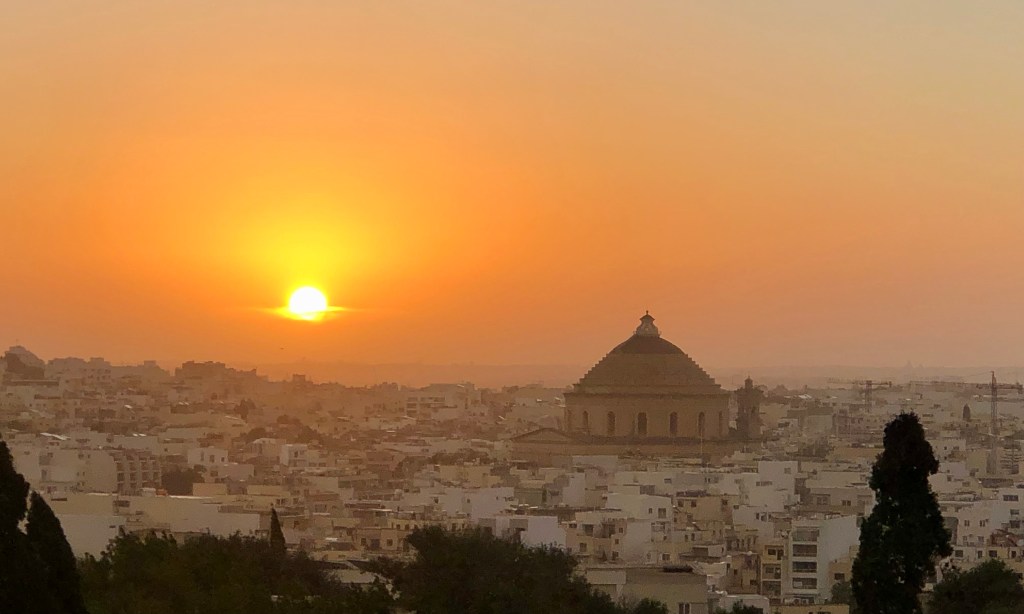
Basilica di Santa Maria Assunta, Torcello, Venice

Homily for the First Sunday of Advent (C)

One of the casualties of the smartphone revolution has been losing our ability to wait.  Instead of waiting, we scroll.  Losing the ability to wait may not seem a real loss, but I think it is.  Scrolling and checking messages and adding new apps has not made me more productive.  Instead, I’m more easily distracted and impatient.  Inside our electronic cocoons, we miss the things that used to happen while we waited—people watching, striking up conversations, noticing the landscape from the window, wondering at it.

Today’s readings are about the art of waiting.  But they warn us not to romanticize it.  Times of waiting can be dangerous.  Today’s Gospel identifies two dangers of waiting: anxiety and drowsiness.

The anxieties mentioned in the Gospel come from genuinely terrifying world events—“people will die of fright,” the Gospel warns—but also everyday anxieties that seem related to drowsiness.  The context of today’s readings, of course, is the Lord’s second coming, when Jesus will return in awesome and awful judgment, remaking all reality.  It may be that some of us are anxious about meeting Jesus because we’re afraid of that judgment.  Paul warns the Thessalonians to conduct themselves to please God, as they have been taught.  Advent is a time when the Church reminds us to examine our consciences, to make use of the sacrament of penance, to align our lives with Jesus’ teaching.  

Continue reading “The Art of Waiting: Homily for the First Sunday of Advent”

Launched: book, articles, interview

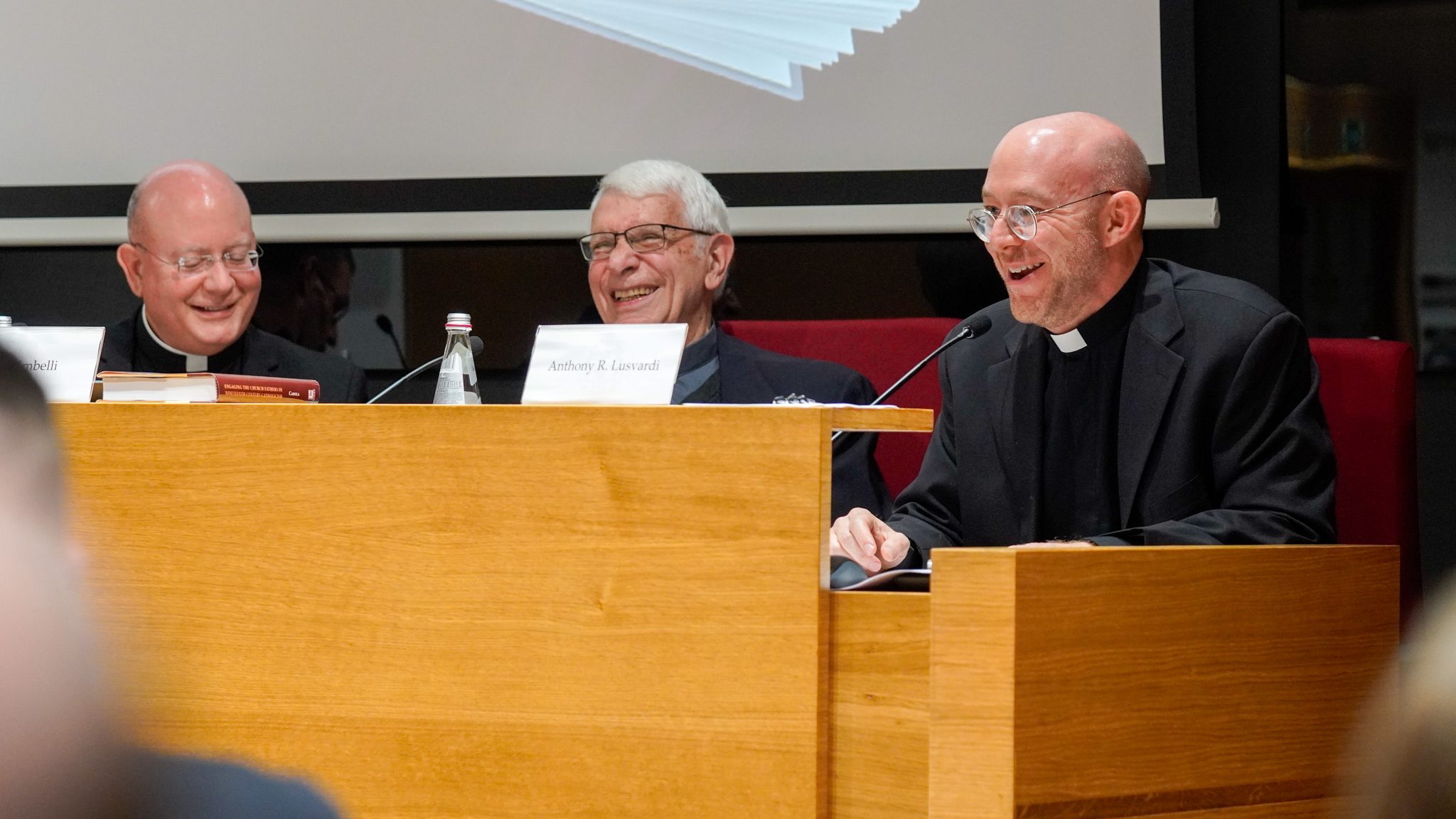
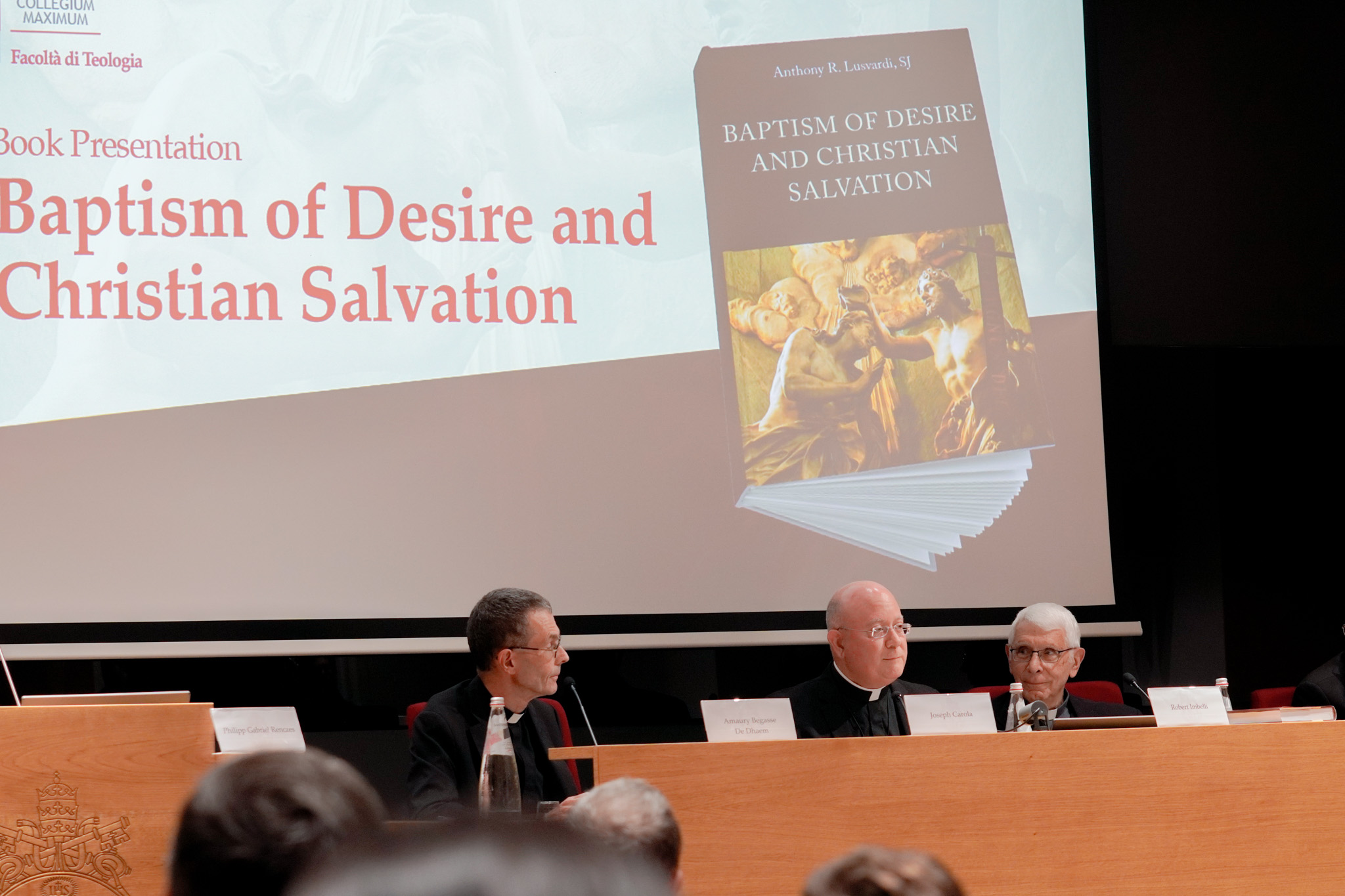
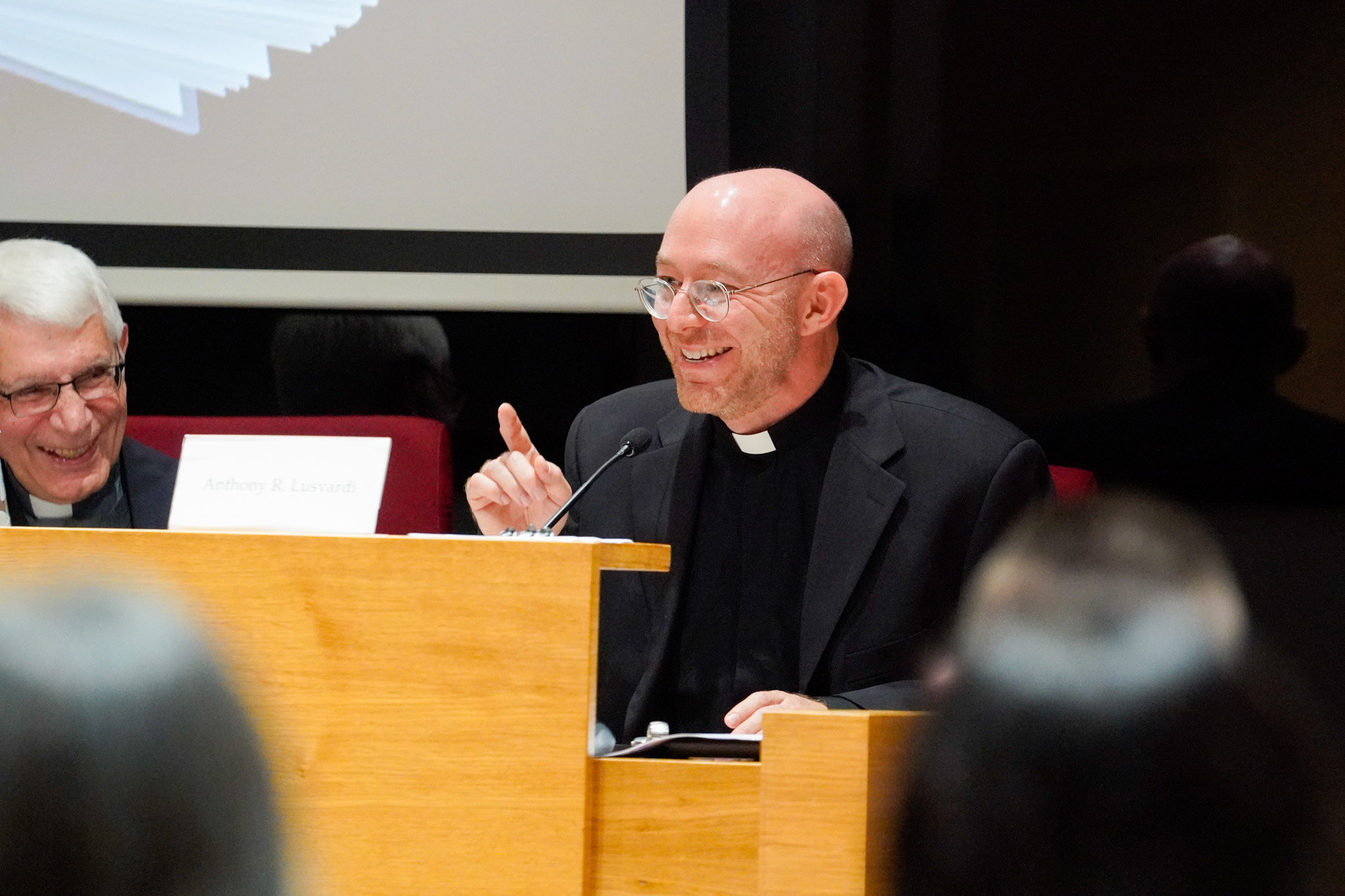
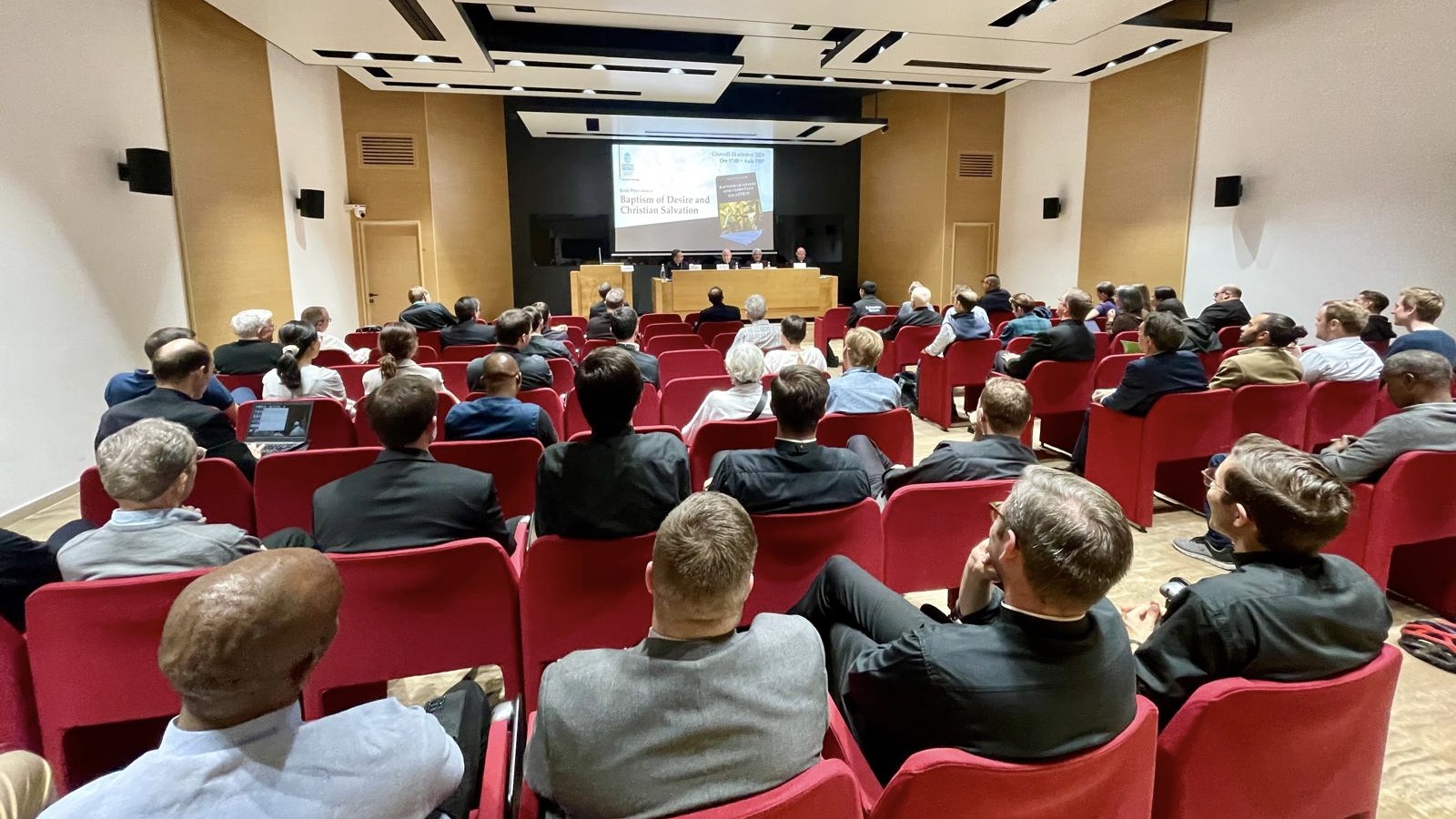
Baptism of Desire and Christian Salvation is now in orbit after an excellent turnout at the official book launch at the Gregorian last Thursday. More good news: the code CT10 still gives you a 20% discount if ordering the book directly from Catholic University of America Press. At the presentation of the book, Fr. Joseph Carola gave an overview of its content and shared some stories from personal experience to illustrate its pastoral relevance. Fr. Bob Imbelli drew on other contemporary thinkers, such as Khaled Anatolios, Charles Taylor, and William Cavanaugh to demonstrate its relevance. I hope to have video of the presentations up on the Baptism of Desire page soon.

Fr. Joseph Carola, S.J., Fr. Robert Imbelli, Fr. Anthony Lusvardi, S.J.

Just a week before, I was also pleased to talk about the book with my old friend Sean Salai at Catholic World Report. Read the interview here: Defending the necessity of baptism: An interview with Fr. Anthony Lusvardi, S.J.

On another note, in this month’s First Things I return to an issue I raised a few years ago in an article in America magazine, the effects of technology on the liturgy. Here’s the new article: “Screens and Sacraments.” The original from 2020 is here.

And, finally, if you’re looking for some pre-election reading that isn’t about either Donald or Kamala, but instead about the way voting functions as a civic ritual, check out my latest at The Catholic Thing: “Rites (and Wrongs) of Democracy.

Homily for the Feast of St. Ignatius

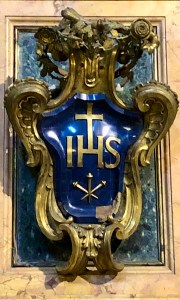
The feast of St. Ignatius was back in July, of course, but I thought the reflections on discernment in my homily might be helpful in any season. Last year, I was asked for some thoughts on the process of communal discernment used by the Synod on Synodality. These reflections build on those observations.

Inigo the Pilgrim (2017), Church of St. Ignatius, Norwood, South Australia

You might have had the experience of the warning light on your dashboard coming on while you’re driving, signaling that you are low on gas, near the minimum.  Here in South Dakota especially–where outside of the city gas stations can be few and far between–you don’t want to fall below that minimum.  You might end up out in the cold or in this merciless heat—both dangerous circumstances—and in need of a good Samaritan to rescue you.

If you keep your tank filled, however, and don’t fall below the minimum, you can drive wherever you like.  You just plug the destination into the GPS and go.

The warning light and the GPS are both helpful, but they serve different functions—the warning light tells us not to drop below the minimum and the GPS gives us directions.  The readings for today’s feast of St. Ignatius, I think, point to a way of living the Christian faith that goes beyond the minimum.

If we think about the commandments, they are very useful for giving us the minimal rules of the road necessary to avoid an accident or a breakdown by the roadside. Because of this function, most of the commandments are written in a negative form—“Thou shall not…”  Even those that aren’t prohibitions—“Keep holy the Sabbath” and “Honor thy father and mother”—set a minimum of necessary behaviors.  Sunday Mass is the minimum necessary worship if we are to do justice to God, and fulfilling our family duties is the minimum necessary social obligation if we’re to maintain a functional social harmony.

But just doing the minimum isn’t enough to live a fulfilling life or to live a life of discipleship.  If I put on my to-do list for tomorrow, “Don’t kill anyone, don’t commit adultery, don’t steal,” I’ll end up rather bored.  The minimum tells us what to avoid, but not much of what to do.

Continue reading “Homily for the Feast of St. Ignatius”

Faithfully unfashionable: homily for the twenty-third Sunday in Ordinary Time

Homily for the 23rd Sunday of Ordinary Time (B)

Prophet Isaiah, Raphael (1511-2), Church of Sant’Agostino Rome

A mile or so from where I live in Rome is a street called Via dei Condotti; there you can find the stores of Armani, Tiffany’s, Gucci—the highest high-end designers.  Sometimes I like to amuse myself by looking in the windows at the prices—a thousand dollars for a sweater, twelve hundred dollars for a necktie, twenty thousand dollars for a watch.  Of course, many of the stores don’t list prices because if you have to ask, you can’t afford it.  I’ve never gone inside any of these stores because they are usually guarded by a man with a shaved head, six inches taller than I am, with a black suit and a mouth that never smiles.  In fact, I think they’ve had the facial muscles that allow you to smile surgically removed.  

The owners of these stores would not be happy to read today’s Letter of St. James.  James says: don’t favor a person with gold rings over a person in shabby clothes.  Of course, sometimes shabby clothes are fashionable and expensive; having torn jeans means that you’re one of the cool kids.  What’s in fashion always changes because it’s not based on anything real.  A thousand dollar sweater won’t keep you any warmer than a thirty dollar sweater; a twenty thousand dollar Rollex tells the same time as my twenty dollar Timex.  Fashions based on wealth, prestige, and the most up-to-date style are like the leaves that you see on the trees this September day; next month they’ll be a different color; a month after that, they’ll be gone.

Even though fashion and prestige aren’t based on anything true and lasting, they can be used to hurt people in some very real ways.  I think of how hard it is for someone not to be one of the “cool kids” in middle school or high school.  Adults are sometimes just as bad; I can remember from my time here on the reservation that sometimes people are looked down on for being “too Native”; other times they may be looked down on for “not being Native enough.”  In either case, sometimes people can be treated quite unfairly.  

Continue reading “Faithfully unfashionable: homily for the twenty-third Sunday in Ordinary Time”

Law and communion: homily for the twenty-second Sunday in Ordinary Time

Homily for the 22nd Sunday in Ordinary Time (B)

If you could pick eight of the Ten Commandments to follow and drop two, which would they be?  What if you could keep six as commandments and downgrade four to recommendations?  Perhaps you’re thinking, “I probably only need about five or so, but I know a lot of people who could use a few more, maybe 12 or 15 for them.”  The Pharisees in the Gospel seem to have adopted this last strategy, and perhaps because of their bad example sometimes the very idea of law gets a bad rap.  Didn’t Jesus teach grace rather than law, mercy instead of rules?  Didn’t Jesus say, “All you need is love, love is all you need”?  

Actually, that was the Beatles.  Jesus said in the Sermon on the Mount:  “Do not think that I have come to abolish the law or the prophets.  I have come not to abolish but to fulfill.  Amen, I say to you, until heaven and earth pass away, not the smallest letter or the smallest part of a letter will pass from the law.”

Basilica de Santo Nino, Cebu City, Philippines

Now it is true that, as in today’s Gospel reading, Jesus harshly criticizes a certain way of using the law as self-serving and hypocritical.  So to be disciples of Jesus we need to think carefully about the role the law plays in salvation history and in our own lives of faith.  

Today’s first reading from Deuteronomy makes clear that the law of Israel is God’s gift.  It makes equally clear that no one but God may add to or subtract from what he commands.  No matter how much we find the commandments hard to follow, no matter how old they are, no matter if we think we could attract crowds of new people to our Church by loosening the loopholes, only God can modify the law of God.  

Continue reading “Law and communion: homily for the twenty-second Sunday in Ordinary Time”

Intentions, motives, and what makes for a valid sacrament

The question of invalid baptisms has been in the news recently. In my commentary on the question in La Civiltà Cattolica, I pointed out that the Vatican’s most recent document on the question, Gestis verbisque, gives renewed attention to the minister’s intention. For a sacrament to be valid, a minister must intend to do what the Church does when celebrating that sacrament. And that means that if he changes what the Church prescribes in her official liturgical texts–by inserting his own words or deleting something required to be there–then he manifests an intention to do something else. It’s just as straightforward as it sounds. The proof is not in the pudding, but in the action.

Baptismal font, St. Peter’s Basilica

Last week, however, another question was sent to the Vatican about what sort of intention might invalidate a sacrament, this time an ordination. The question proposed the distasteful case of a bishop who ordained a man with whom he had engaged in an illicit sexual relationship. Could he possibly have the right intention? Wouldn’t such a sinful situation invalidate the ordination?

The article in which this question was raised described it as “potentially explosive.” Fortunately, this grenade was defused by St. Augustine in the fifth century. The great theologian was responding to controversy about the validity of baptisms, whether the sinfulness of a minster invalidated the sacrament. He responded no. Augustine’s principle has remained a bedrock of sacramental theology ever since. It is really Christ who baptizes, Augustine said, and he can do so even through profoundly imperfect human instruments. The same goes for ordinations. Augustine sagely realized that if perfection were required of ministers in order for sacraments to be valid, then we simply wouldn’t have sacraments.

So how does Augustine’s principle fit with the requirement that one has to have the right intention to celebrate a sacrament validly? Here we have to make what might at first seem like a rather technical distinction but is, once you’ve thought the question through, also rather straightforward. The distinction is between intention and motive.

Continue reading “Intentions, motives, and what makes for a valid sacrament”

Ascension

Transfiguration, pulpit (Pisan 1160), Cattedrale, Cagliari

“Today our Lord Jesus Christ ascended into heaven; let our hearts ascend with him. Listen to the words of the Apostle: ‘If you have risen with Christ, set your hearts on the things that are above, where Christ is, seated at the right hand of God; seek the things that are above, not the things that are on earth’ (Col. 3:1-2). For just as he remained with us even after his ascension, so we too are already in heaven with him, even though what is promised us has not yet been fulfilled in our bodies.”

St. Augustine, homily on the Lord’s Ascension, quoted in Robert Imbelli’s
Christ Brings All Newness (Word on Fire Academic, 2023), p. 144.

Romano Guardini on the liturgy

In preparation for I talk I gave last week to a group of seminary rectors from Africa and Asia, I read Romano Guardini’s short but profound book Liturgy and Liturgical Formation.

Guardini was one of the twentieth century’s sharpest and most balanced theological minds, and his writings on the liturgy are particularly valuable. He understands the irreducibility of liturgy and liturgical symbols and has absorbed the way the Fathers experienced liturgy, best exemplified by the line from Pope St. Leo the Great’s Ascension homily: “What was visible in the Lord has passed over into the mysteries.”

Chapel of San Basilio, Maracalagonis, Sardinia

Here are a few gems from Liturgy and Liturgical Formation:

“Liturgy does not deal with knowledge but with reality. There is knowledge of the liturgical action, which precedes it and could be called liturgical knowledge. And there is knowledge within it; the liturgical event allows an insight into itself. To speak of this today is not easy because it has escaped our religious consciousness at large. The liturgy itself is not merely knowledge but a full reality, which embraces much more than knowledge alone: a doing, an order, and the being of itself.” (13)

Continue reading “Romano Guardini on the liturgy”

Baptism of Desire and Christian Salvation — now in print!

After a few delays, I am pleased to report that my book is now officially in print and copies have arrived for those who preordered. It seems to have been released on Good Friday no less.

If you’re still on the fence about whether it’s worth the read, I thought I’d share the very kind words of endorsement from Fr. Joseph Carola, SJ, my colleague at the Gregorian University and expert in both the Church Fathers and Nineteenth Century theology.

So take it from Fr. Carola:

Jesus instructed Nicodemus that, “unless one is born of water and the Spirit, he cannot enter the kingdom of God” (John 3:5).  Faithful to the Lord’s revelation, Christians have insisted for two millennia upon the necessity of baptism for salvation.  But already in the ancient Church, salvation’s rough edges, as Father Anthony Lusvardi creatively calls them, have challenged believers.  What is the fate of those who lived before Christ and therefore died without Christian baptism?  What happens to the catechumen who dies unexpectedly before being baptized?  Can unbaptized babies get to heaven?  Is there any hope for the salvation of non-Christians?  In his thoroughly historical and insightfully theological study of the baptism of desire, Father Lusvardi offers his readers a fresh perspective on this traditional notion often misunderstood and misapplied in contemporary theology and pastoral practice.  Providing a convincing response to the challenges that the hard cases present, Father Lusvardi especially appeals to the Catholic Church’s lex orandi in order to establish the Church’s lex credendi that simultaneously upholds the necessity of baptism, the need for evangelization, and the nuances of desire.  Historically informative, theologically rich, and occasionally even humorous, Baptism of Desire and Christian Salvation is a book not only for theologians, but perhaps even more so for pastors who labor on the rough edges of salvation.

Joseph Carola, S.J., S.T.D.

November 2, 2023

All Souls

The Pontifical Gregorian University, Rome

An event unlike any other: homily for Easter Sunday

Homily for Easter Sunday 2024

National Gallery of Victoria, Melbourne

What is a miracle? The word is used often and not always in a very precise way. A quick search on the Internet revealed exercises, mineral solutions, and even a perfume, all described as “miraculous.”

At least the word seems to be useful for advertising. Probably we have also heard stories from the Middle Ages or antiquity that tell of extraordinary events. And probably some are really miracles, others are legends. They are the special effects that storytellers from a time before movies used to make a story more fascinating, moving, or funny.

Speaking more precisely, a miracle is something that happens in this world caused by a power beyond this world. Miracles do not mean that the divine is absent from non-miraculous events, from everyday events. When a doctor uses his intelligence to save life, he is using a divine gift–intelligence–to cooperate with the purpose of God who wants to save life and not destroy it. When a woman gives birth it is not a miracle in the literal sense–it does not require a force beyond human biology–but I would say there is something divine about that event because it is a participation in the Creator’s work.

A miracle, however, requires a power that no creature possesses.

We know with certainty that there has been at least one miracle in the history of the universe, namely, the creation of the universe. No existing thing possesses the power to create everything from nothing. This power is the essence of a miracle. I haven’t smelled the miraculous perfume, but I doubt that it qualifies .

Today we celebrate the miracle of miracles–the resurrection of Jesus Christ from the dead. Since creation there has been no other event like this. It is the most important event in human history, an event so different from all other historical events that, even today, after almost two thousand years, it remains difficult to explain.

Continue reading “An event unlike any other: homily for Easter Sunday”