One is always discovering new artists in Rome, and earlier this year, thanks to a special exhibit at the Scuderie del Quirinale and the recommendation of a friend, I discovered Guercino (1591-1666). Born Giovanni Francesco Barbieri in Cento (Emilia-Romagna), he worked in Rome when baroque art was at its zenith.
Guercino, Gregory XV, ca. 1621
The exhibit was of particular interest to me because Guercino’s time in Rome corresponded to the period when the Jesuits were also at their zenith. The pope who proved to be Guercino’s great patron, Gregory XV (Alessandro Ludovisi), also favored the Society of Jesus, especially in its mission of spreading Catholicism around the globe.
The Jesuits have often been associated with the baroque because it was the artistic style in vogue around the time of our founding, so our great Roman churches, the Gesù and Sant’Ignazio — and all the other Jesuit churches around the world built to imitate them — are classic examples of baroque architecture.
As you could probably tell from last week’s post, I’m back in Rome getting ready for the start of the new academic year next month. It was a full and eventful summer more than a restful one. It started out with my first trip to the Philippines for a meeting of the Jungmann Society, the international association of Jesuit liturgists, where I gave a talk on daily Mass in Jesuit communities. It was encouraging to meet many young Jesuits interested in the liturgy, especially those from Asia. Some new initiatives are coming out of the meeting as well. The initiative I am most excited about is an eight-day retreat for Jesuits I am preparing for next summer: “Praying the Liturgy,” which will be offered June 29 – July 7, 2025 at the Jesuit Retreat Center in Parma, OH. It is open to all Jesuits.
I also spent some quality time at St. Isaac Jogues in Rapid City and back at home in Minnesota, connecting with friends. For the first time, I led a retreat at the gorgeous new retreat center Cloisters on the Platte outside of Omaha, and attended a really excellent conference in Mundelein, IL on the divergent theologies of Karl Rahner and Joseph Ratzinger organized by Prof. Matthew Levering and the Greg’s own Fr. Aaron Pidel, SJ. Some theological all-stars there. A book will be coming out at a later date with papers from the conference, including my own contribution on the two theologians and the liturgy, arguing that Ratzinger continues the project of the Liturgical Movement while Rahner’s attitude toward the liturgy is an extension of pre-Vatican II scholasticism.
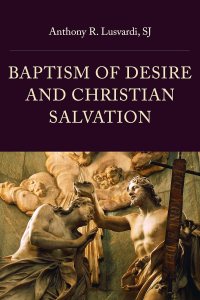
Also, if you didn’t get a chance, you might enjoy my article “Getting Back in the Baptizing Business” in The Catholic Thing which explains why I think my book on baptism of desire is important.
And speaking of Baptism of Desire and Christian Salvation, I was pleased to be able to bring my summer to a close by giving several talks on the book in Sweden. I had an enjoyable discussion with the participants of the Hörge seminariet at the Newman Institute in Uppsala and was deeply encouraged by the large and energetic group of young adults at Sankta Eugenia in Stockholm. It is great to see the book both resonating with people and provoking discussion.
More on Baptism of Desire and Christian Salvation will be coming soon, including an official “book launch” here in Rome…
Last month the Gregorian Jesuits took our spring community outing to L’Aquila, capital of the Abruzzo region. L’Aquila was most recently in the news for a 2009 earthquake that tragically killed over 300 people. Most buildings in the city have been restored, though construction still abounds.
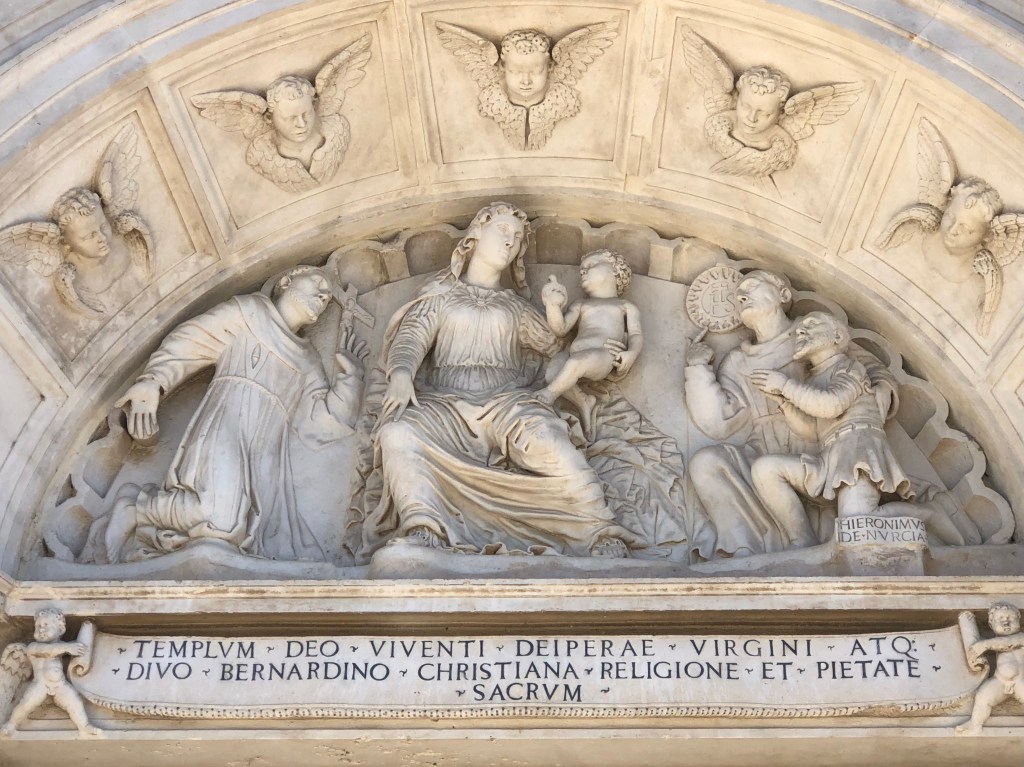
Highlights of the trip were two churches. The first, the Basilica of St. Bernardino of Siena, is dedicated to the Franciscan preacher (1380-1444) with a great devotion to the name of Jesus. In fact, in images of St. Bernardino one frequently sees the IHS Christogram–using the Greek letters for the name of Jesus. The “IHS” was later taken up, of course, by the Society of Jesus. The IHS sunburst with the three nails of Christ’s passion is prominently displayed all over the Basilica of San Bernardino. The saint died in L’Aquila and is buried in the basilica.
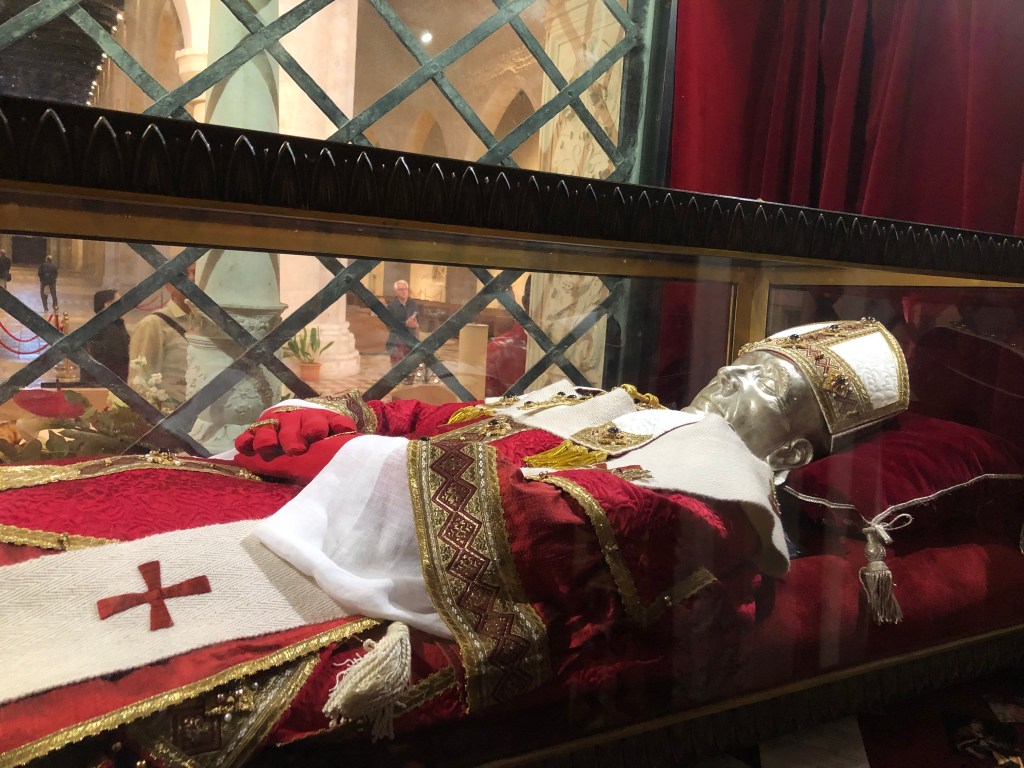
Tomb of Pope St. Celestine V, L’Aquila
L’Aquila’s other iconic church is Santa Maria di Collemaggio, burial place of Pope Celestine V (1215-1296). It is known as the Church of Pardon because of the plenary indulgence Celestine attached to the church–what locals refer to as an annual Jubilee. Celestine’s papacy, however, could hardly be considered a success, and he resigned after only a few months in office. He was a holy hermit, perhaps never really cut out to be pope.
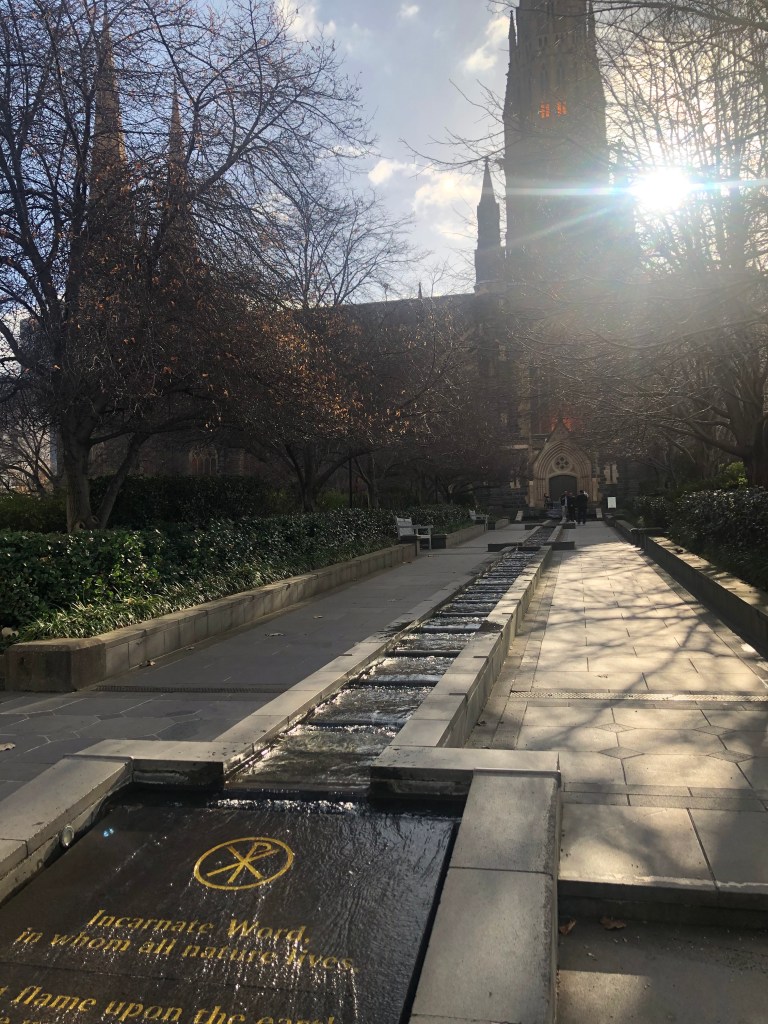
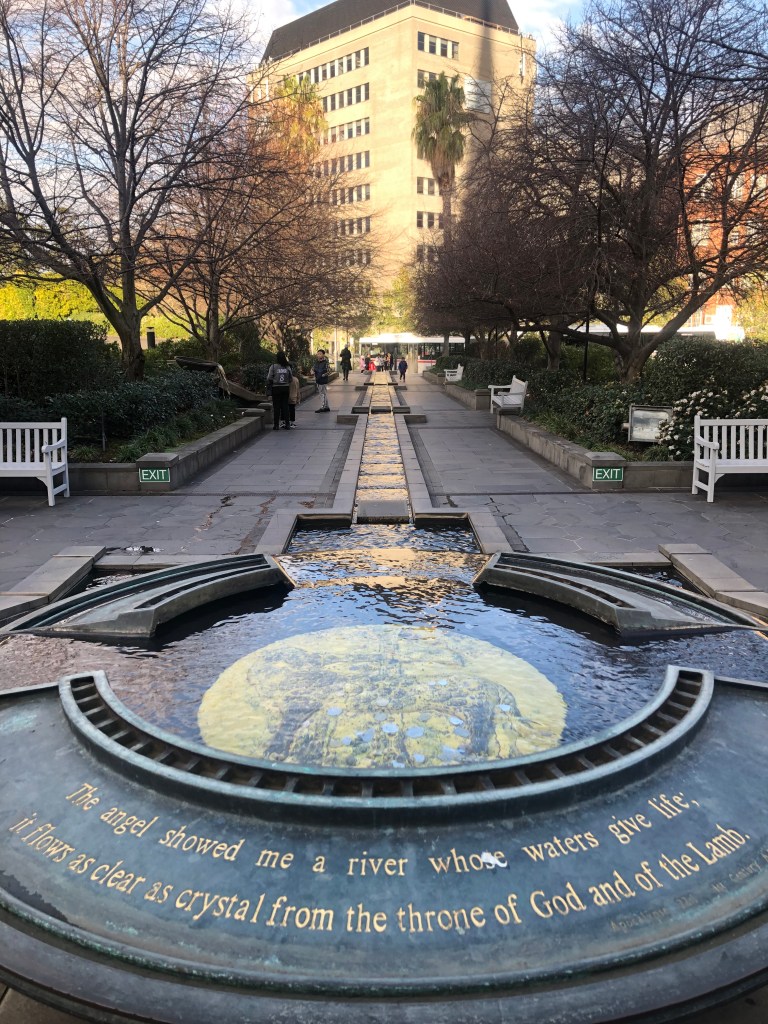
After a very blessed time of tertianship–the final formal part of Jesuit formation–and travel afterwards, I arrived back in Rome this week to begin preparing for the semester ahead. For me, this new beginning is also a time to look back with gratitude at my time in Australia’s tertianship program. I thought I’d share this poem from Australian poet James McAuley (1917-1976), a prayer for his remarkable country that could just as easily be a prayer for us Jesuits.
The poem is a part of a fountain outside of Melbourne’s cathedral that runs from the doors of the church out toward the city–evoking Ezekiel’s image of the waters of life flowing from the temple. The sculpture includes quotations from both the Old and New Testaments (John 4:14, Ps 23:2-3). It is inspired by the words of Revelation: “Then [the angel] showed me the river of the water of life, bright as crystal, flowing from the throne of God and of the Lamb through the middle of the street of the city; also, on either side of the river, the tree of life […] and the leaves of the tree were for the healing of the nations” (Rv 22:1-2).
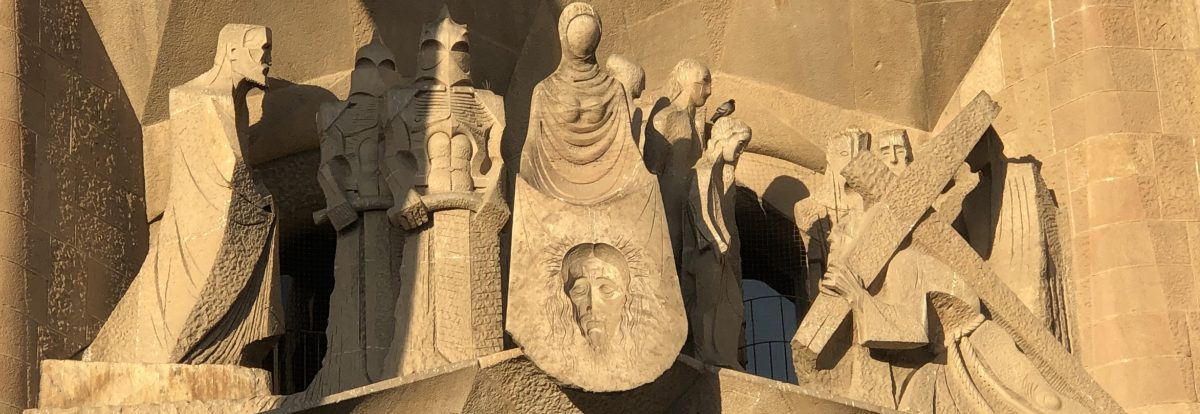
I was recently reminded of a post I wrote on the old Whosoever Desires blog eleven years ago. It was prompted by controversy over Mel Gibson and The Passion of the Christ, but the questions it asks are perhaps still worth considering this Spy Wednesday as well…
Nathan’s post on Mel Gibson’s The Passion of the Christ last year generated a lot of discussion and ended with an intriguing question: “Why does Pilate always get so much empathy from us?”
It would be easy, at this point, to start tossing around charges of anti-Semitism, charges which would allow us to feel a certain measure of moral superiority over those less enlightened than ourselves. Then we could pray like the righteous Pharisee, “God, I thank thee that I am not like other men, extortioners, unjust, anti-Semites like Mel Gibson over there” (Lk 18:10).
Throwing around such charges is a way of doing precisely the same thing that blaming the Jews for the crucifixion once did: deflecting guilt from ourselves. I would suggest a far more troubling answer to the question, “Why do we empathize with Pilate?”
Because Pontius Pilate is the character in the Passion who is most like us.





 Tony Lusvardi, S.J.