Do we still desire holiness? Homily for the Feast of All Saints and Blesseds of the Society of Jesus

November 5 is a special feast day on the Jesuit liturgical calendar–the Feast of All Saints and Blesseds of the Society of Jesus, a kind of All Saints Day for Jesuits. Five years ago, in 2020, at the height of the pandemic, I celebrated Mass in our formation community in Rome on that day. The homily, translated into English, is below.

We need saints.

Today more than ever, I feel this need. In these days of isolation, loneliness, anxiety, and disillusionment, we need companions. We need to know that we are not alone—even in the dark nights when we cannot sleep. And when we are confused, afraid, full of doubts, we need companions who have experienced confusion, opposition, doubt, sin and penance, and yet have come to peace.

Today we celebrate the great consolation that we have such companions. As Jesuits, we celebrate the fact that among all the saints recognized by the Church, there are many who made the same choice we have made, who prayed as we pray–who have, we might say, eaten with us in the refectory. As Moses says of the word of God, these companions are not across the sea but are near to us. In the long winter we are experiencing, we need only open our mouths in prayer, and these companions will be present at our side.

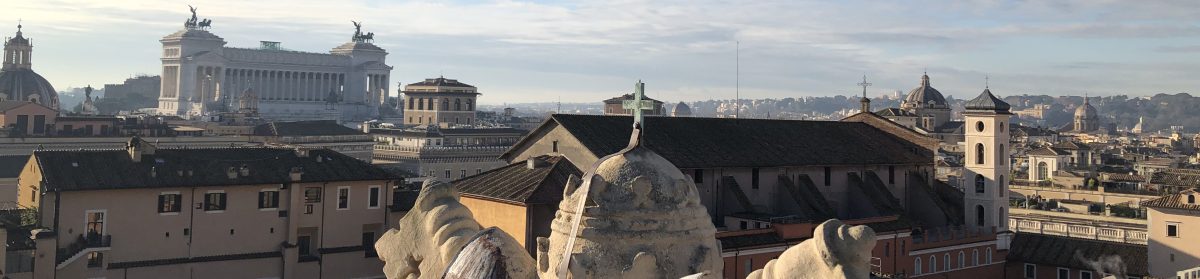
Church of St. Ignatius (ceiling), Rome

Today we remember not only the great names—Robert Bellarmine, who cheers us on in our studies, and Francis Xavier, who reminds us that our studies are only a means to spread the Gospel. Among these heavenly friends, there are many less famous ones, perhaps even some companions we have known in this life who are now in the Father’s house.

Every year when we reach the second half of Ordinary Time and volume four of the breviary, I find the holy card of Bob Araujo, a Jesuit who taught me in Chicago and greatly encouraged me in my studies and advised me during some doubtful moments of my formation. Bob suffered quite a bit in his life, first, from opposition in his career and, then, from a slow and painful cancer. He died in October 2015. When he died, the words of St. Paul came to mind: “I have fought the good fight; I have finished the race; I have kept the faith.” When he died, another companion said to me, “He’ll get right in.” Now I talk to Bob from time to time, and I ask him, “What do you think? How am I doing? Do you have any advice for me?” I imagine you also have such companions.

But when we talk about saints and Jesuit saints, I must admit that there is also something that disturbs me, just as there is something that disturbs us in the Gospel passage chosen for this feast: “Whoever loves his life loses it, and whoever hates his life in this world will preserve it for eternal life.”

Continue reading “Do we still desire holiness? Homily for the Feast of All Saints and Blesseds of the Society of Jesus”

Fools for love: homily for the seventeenth Sunday of Ordinary Time

National Gallery of Victoria, Melbourne, Australia

Homily for the 17th Sunday of Ordinary Time (A)

When he was a young priest St. Philip Neri shaved off half his beard in order to counteract vanity.  St. Simeon the Stylite lived on a small platform on top of a 50-foot tall pillar in Syria for over 30 years. Another St. Simeon (of Emesa), known as the Holy Fool, walked through town with a dead dog tied around his waist.  St. Catherine of Siena lived for weeks on nothing more than the hosts she received at communion.  Shortly after his conversion, St. Francis stripped naked in front of the bishop of Assisi.  St. Francis Xavier, a Jesuit, tending plague victims in a hospital found himself holding back out of fear of contracting the disease.  (This one’s a little gross.)  So he scraped the back of one of the sick men he was tending, gathered up a handful of puss, and put it in his mouth.  And St. Maximiliam Kolbe, a Polish Franciscan priest imprisoned in Auschwitz, asked his Nazi guards if he could take the place of a man condemned to die in order to save that man’s life and give up his own instead.

I am not recommending that you try any of these things at home.  Instead I want to ask you a question:  are these saints foolish or wise?  And if they are wise, then what does wisdom really mean? 

In our first reading, the young King Solomon is praised by God for asking for the gift of wisdom.  But what makes someone wise?  Wisdom is not the same as memorizing lots of facts or accumulating knowledge.  You could go home and memorize the phonebook, but I’d consider someone who just looked up phone numbers as needed actually to be wiser.  We probably know people—perhaps grandparents—who received relatively little formal education but we’d consider wise.  And I’ve known a plenty of people with PhDs who were not nearly as smart as they told you they were.

Continue reading “Fools for love: homily for the seventeenth Sunday of Ordinary Time”

St. Aloysius Gonzaga and giving God your all: homily for St. Aloysius

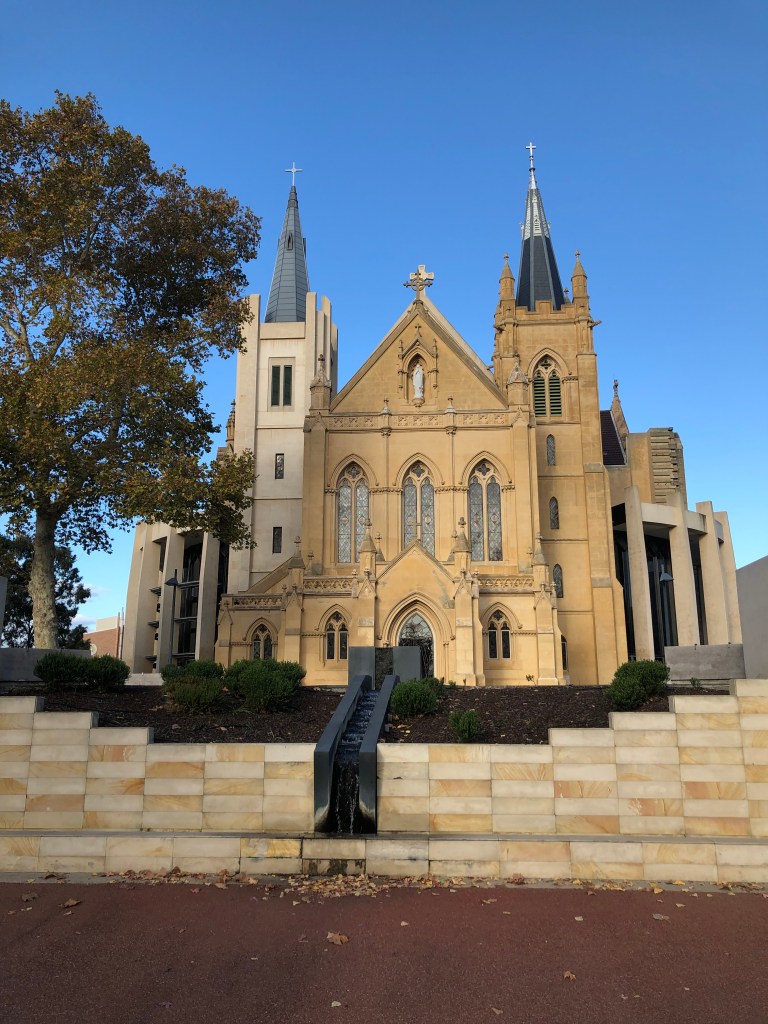
St. Mary’s Cathedral, Perth

The readings for our celebration of the life of St. Aloysius Gonzaga tell us to show our love for God by keeping his commandments.  Sometimes people talk about love and the commandments as if there were a contradiction between the two, but Jesus teaches us otherwise.  

For Jesus, love isn’t a feeling.  Don’t confuse love with romance, which can be produced with mood lighting and champagne.  For Jesus, love is life-giving.  God, the creator, first shows his love for us by giving us life.  And Jesus, the Son of God, shows the power and depth of his love by giving up his own life so that we might have eternal life.

But life is a delicate thing.  If you plant a garden, you have to know the right amount of water to give the seeds—too much and they’ll rot, too little and they’ll dry up.  I’ve killed a few houseplants learning this lesson.  If you just leave your garden alone to do whatever it wants, it will soon choke with weeds and die.  Keeping plants alive sometimes requires trimming them.  Nurturing life requires rules.

Continue reading “St. Aloysius Gonzaga and giving God your all: homily for St. Aloysius”