Do we still desire holiness? Homily for the Feast of All Saints and Blesseds of the Society of Jesus

November 5 is a special feast day on the Jesuit liturgical calendar–the Feast of All Saints and Blesseds of the Society of Jesus, a kind of All Saints Day for Jesuits. Five years ago, in 2020, at the height of the pandemic, I celebrated Mass in our formation community in Rome on that day. The homily, translated into English, is below.

We need saints.

Today more than ever, I feel this need. In these days of isolation, loneliness, anxiety, and disillusionment, we need companions. We need to know that we are not alone—even in the dark nights when we cannot sleep. And when we are confused, afraid, full of doubts, we need companions who have experienced confusion, opposition, doubt, sin and penance, and yet have come to peace.

Today we celebrate the great consolation that we have such companions. As Jesuits, we celebrate the fact that among all the saints recognized by the Church, there are many who made the same choice we have made, who prayed as we pray–who have, we might say, eaten with us in the refectory. As Moses says of the word of God, these companions are not across the sea but are near to us. In the long winter we are experiencing, we need only open our mouths in prayer, and these companions will be present at our side.

Church of St. Ignatius (ceiling), Rome

Today we remember not only the great names—Robert Bellarmine, who cheers us on in our studies, and Francis Xavier, who reminds us that our studies are only a means to spread the Gospel. Among these heavenly friends, there are many less famous ones, perhaps even some companions we have known in this life who are now in the Father’s house.

Every year when we reach the second half of Ordinary Time and volume four of the breviary, I find the holy card of Bob Araujo, a Jesuit who taught me in Chicago and greatly encouraged me in my studies and advised me during some doubtful moments of my formation. Bob suffered quite a bit in his life, first, from opposition in his career and, then, from a slow and painful cancer. He died in October 2015. When he died, the words of St. Paul came to mind: “I have fought the good fight; I have finished the race; I have kept the faith.” When he died, another companion said to me, “He’ll get right in.” Now I talk to Bob from time to time, and I ask him, “What do you think? How am I doing? Do you have any advice for me?” I imagine you also have such companions.

But when we talk about saints and Jesuit saints, I must admit that there is also something that disturbs me, just as there is something that disturbs us in the Gospel passage chosen for this feast: “Whoever loves his life loses it, and whoever hates his life in this world will preserve it for eternal life.”

Continue reading “Do we still desire holiness? Homily for the Feast of All Saints and Blesseds of the Society of Jesus”

Susanna and the wicked judges

Monday of the fifth week of Lent brings one of the Bible’s great courtroom dramas — the story of Susanna and the elders from the Book of Daniel. It’s one of the longest readings in the lectionary, but one that deserves to be read with relish. An innocent woman does what is right even at the cost of her life. Two powerful and corrupt men, overthrown by lust, suppress their consciences, and compound debauchery with vindictiveness. And a lone idealistic voice, indignant at the injustice of the crowd, speaks out — and the old goats are snared in the net they’ve woven.

Susanna and the Elders, Guercino, 1617

There’s something refreshing about the story. It’s not hard to tell the bad guys from the good gal, and for once justice is throughly vindicated. A few weeks ago in my post about Guercino, I mentioned the baroque era’s love of drama (one might be excused for saying “melodrama”). I was happy to see Guercino take up the story of Susanna. Quite a lot could be said about tale — the Lord hears the cry of the innocent even when everyone else seems deaf — but it is, first of all, a great yarn. As we look forward to Holy Week, Susanna’s travail is a reminder that, even if it doesn’t always happen quickly — or even in this life — justice will ultimately prevail.

Susanna and the Elders, Guercino, 1617

Guercino, Rome, and the Jesuit baroque

Guercino, Moses

One is always discovering new artists in Rome, and earlier this year, thanks to a special exhibit at the Scuderie del Quirinale and the recommendation of a friend, I discovered Guercino (1591-1666). Born Giovanni Francesco Barbieri in Cento (Emilia-Romagna), he worked in Rome when baroque art was at its zenith.

Guercino, Gregory XV, ca. 1621

The exhibit was of particular interest to me because Guercino’s time in Rome corresponded to the period when the Jesuits were also at their zenith. The pope who proved to be Guercino’s great patron, Gregory XV (Alessandro Ludovisi), also favored the Society of Jesus, especially in its mission of spreading Catholicism around the globe.

The Jesuits have often been associated with the baroque because it was the artistic style in vogue around the time of our founding, so our great Roman churches, the Gesù and Sant’Ignazio — and all the other Jesuit churches around the world built to imitate them — are classic examples of baroque architecture.

Guercino, St. Peter Raising Tabitha, 1618
Continue reading “Guercino, Rome, and the Jesuit baroque”

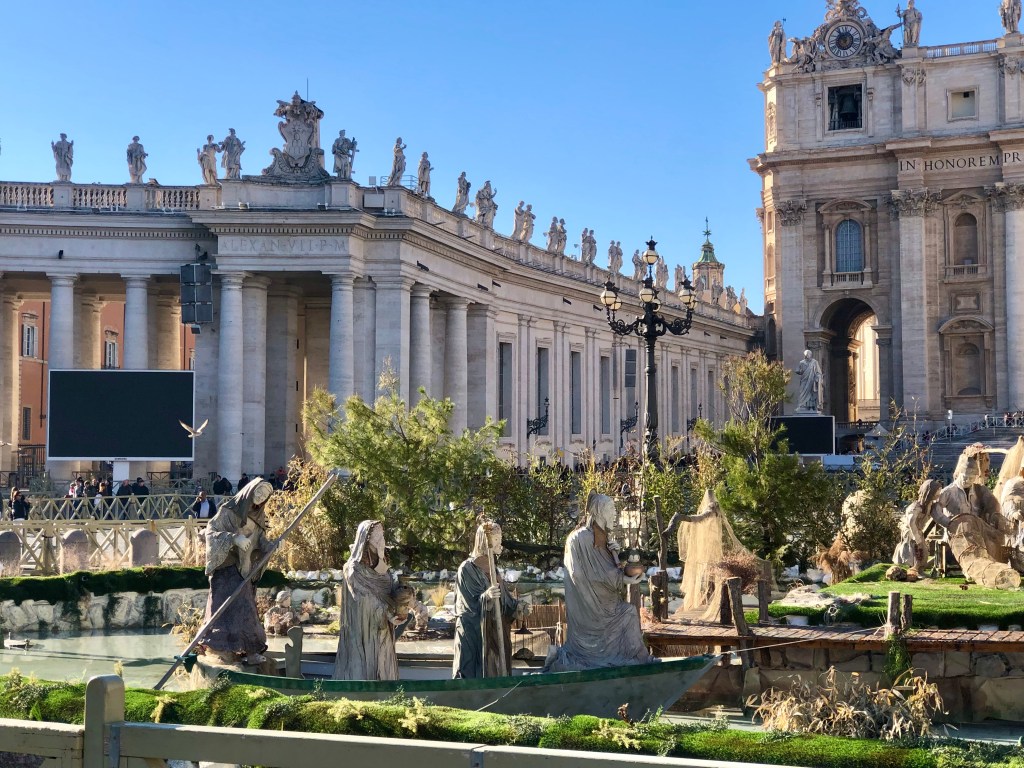
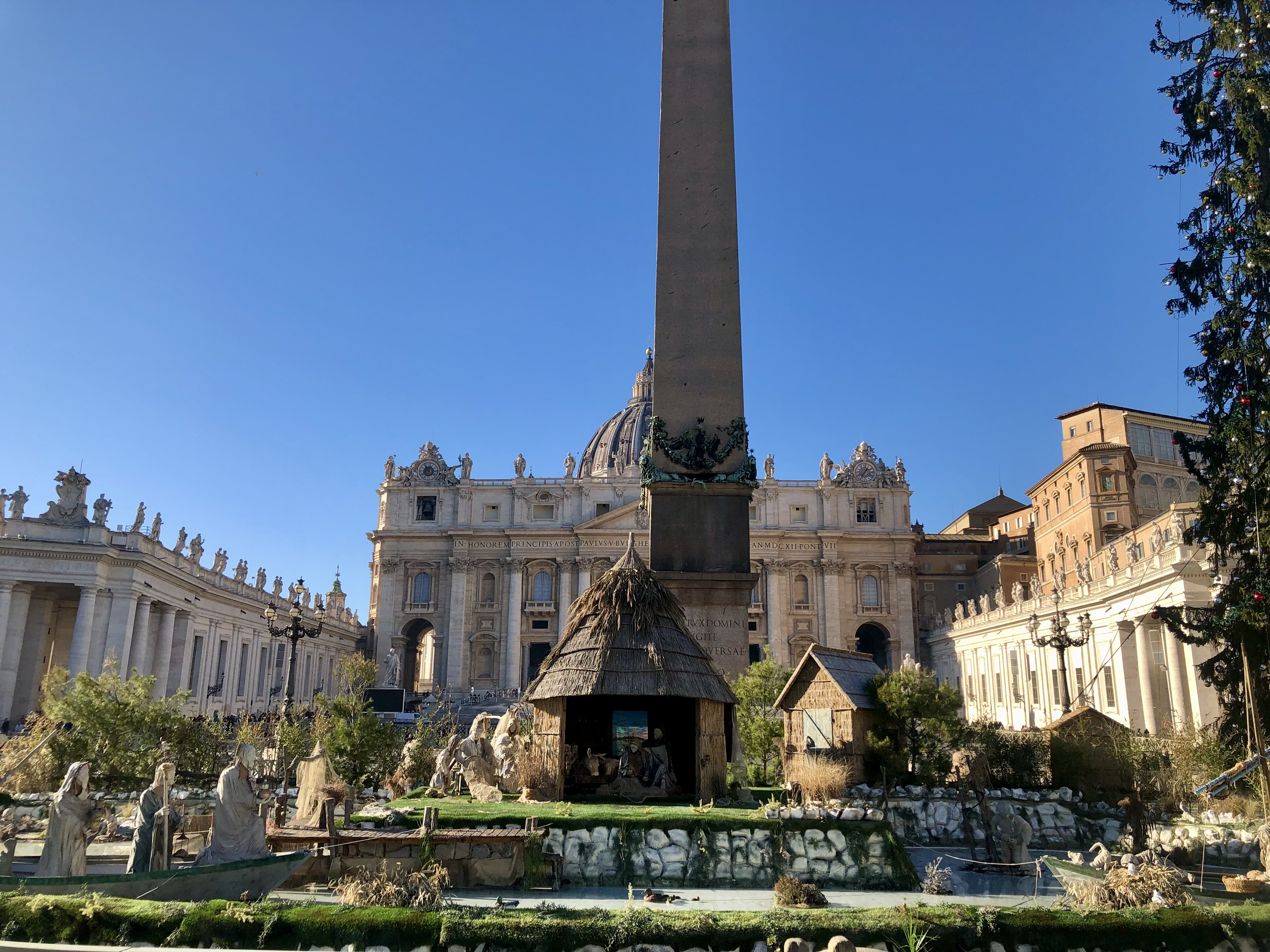
The Vatican Nativity Scene, 2024

Merry Christmas to all! I am spending Christmas at the church of the Santa Vergine degli Angeli in Maracalagonis, Sardinia, where I was fortunate to spend Holy Week earlier this year.

Before I left Rome, I was able to check out this year’s Nativity scene in St. Peter’s Square, always a source of discussion (and sometimes critique) among Romans. (For comparison, here are pictures of the Vatican Nativity scenes from the past two years: 2022 and 2023.) Last year was the 800th anniversary of this tradition, attributed to St. Francis–more about its origins in the town of Greccio here and here.

This year’s Vatican scene has a river theme, with the three kings making an aquatic landing in Bethlehem. As I noted last year, the point of such popular devotions, like Ignatian contemplation, is not to recreate history–or geography–but to help us find ourselves in the story. To that end, I found this year’s Nativity attractive and I especially liked the ducks in the foreground!

Wishing everyone many blessings and much happiness this Christmas!

Homily for the Feast of St. Ignatius

The feast of St. Ignatius was back in July, of course, but I thought the reflections on discernment in my homily might be helpful in any season. Last year, I was asked for some thoughts on the process of communal discernment used by the Synod on Synodality. These reflections build on those observations.

Inigo the Pilgrim (2017), Church of St. Ignatius, Norwood, South Australia

You might have had the experience of the warning light on your dashboard coming on while you’re driving, signaling that you are low on gas, near the minimum.  Here in South Dakota especially–where outside of the city gas stations can be few and far between–you don’t want to fall below that minimum.  You might end up out in the cold or in this merciless heat—both dangerous circumstances—and in need of a good Samaritan to rescue you.

If you keep your tank filled, however, and don’t fall below the minimum, you can drive wherever you like.  You just plug the destination into the GPS and go.

The warning light and the GPS are both helpful, but they serve different functions—the warning light tells us not to drop below the minimum and the GPS gives us directions.  The readings for today’s feast of St. Ignatius, I think, point to a way of living the Christian faith that goes beyond the minimum.

If we think about the commandments, they are very useful for giving us the minimal rules of the road necessary to avoid an accident or a breakdown by the roadside. Because of this function, most of the commandments are written in a negative form—“Thou shall not…”  Even those that aren’t prohibitions—“Keep holy the Sabbath” and “Honor thy father and mother”—set a minimum of necessary behaviors.  Sunday Mass is the minimum necessary worship if we are to do justice to God, and fulfilling our family duties is the minimum necessary social obligation if we’re to maintain a functional social harmony.

But just doing the minimum isn’t enough to live a fulfilling life or to live a life of discipleship.  If I put on my to-do list for tomorrow, “Don’t kill anyone, don’t commit adultery, don’t steal,” I’ll end up rather bored.  The minimum tells us what to avoid, but not much of what to do.

Continue reading “Homily for the Feast of St. Ignatius”

Praying for confusion

Church of St. Ignatius, Rome

One of the more puzzling turns of phrase in the Spiritual Exercises comes early in the First Week when St. Ignatius directs the person making the Exercises to ask God for “shame and confusion” for one’s sins (48). Shame I get; we ought to feel ashamed for our sins. If we say someone has no sense of shame, it means his conscience isn’t working. But confusion?

Confusion seems to cut against the whole thrust of the Spiritual Exercises and, indeed, Ignatian discernment in general. Isn’t the whole point of doing the Exercises to see the world more clearly, to cut through the illusions thrown up by the Evil Spirit in order to make good decisions and then stick to those decisions with confidence? Confusion is what we feel when we’re lost.

Continue reading “Praying for confusion”

The Nativity scene at 800

Santuario Francescano del Presepe, Greccio

A few weeks before Christmas in the year 1223, St. Francis told one of his brothers that he wished to celebrate the holiday in Greccio, a hamlet about halfway between Assisi and Rome. He added something more: that he wanted to see with his own eyes the baby born in Bethlehem and the crude stable where he lay.

The brother went on ahead and arranged everything as the saint had asked in a little grotto just outside the town, a scene now familiar to us–figures of Mary and Joseph, the shepherds, the ox and the ass. The sight drew men and women from around Greccio and delighted Francis, who served as a deacon at Mass that Christmas night. The tradition of the Christmas manger scene was born.

It’s a tradition that thrives all over the world, but especially in Italy. It’s also an example of what is known to theologians as “inculturation,” the way the Gospel enters into different cultures and finds ever-new expression in their traditions. The traditional Nativity scenes of Italy, especially Naples, often include dozens, even hundreds, of figures going about the tasks of daily life–shopkeepers, bakers, fruit vendors, beggars, musicians, servants, housewives, children, farmers, you name it. Dress and architecture in the scenes reflect the daily life of those who create them.

Continue reading “The Nativity scene at 800”

Sacred Heart of Jesus homily

Sometimes certain people get on my nerves, and it’s hard to love them.  Sometimes people behave badly toward others, and it’s hard to love them, too.  Sometimes people have hurt me; it’s hard enough to forgive them and even harder to love them.  

The first letter of John tells us that God is love, and remaining in his love means loving others as he does.  In the Sermon on the Mount, Jesus commands us to love our enemies, just as our heavenly Father loves them.  From the cross, he even prays for the forgiveness of those who crucified him.  

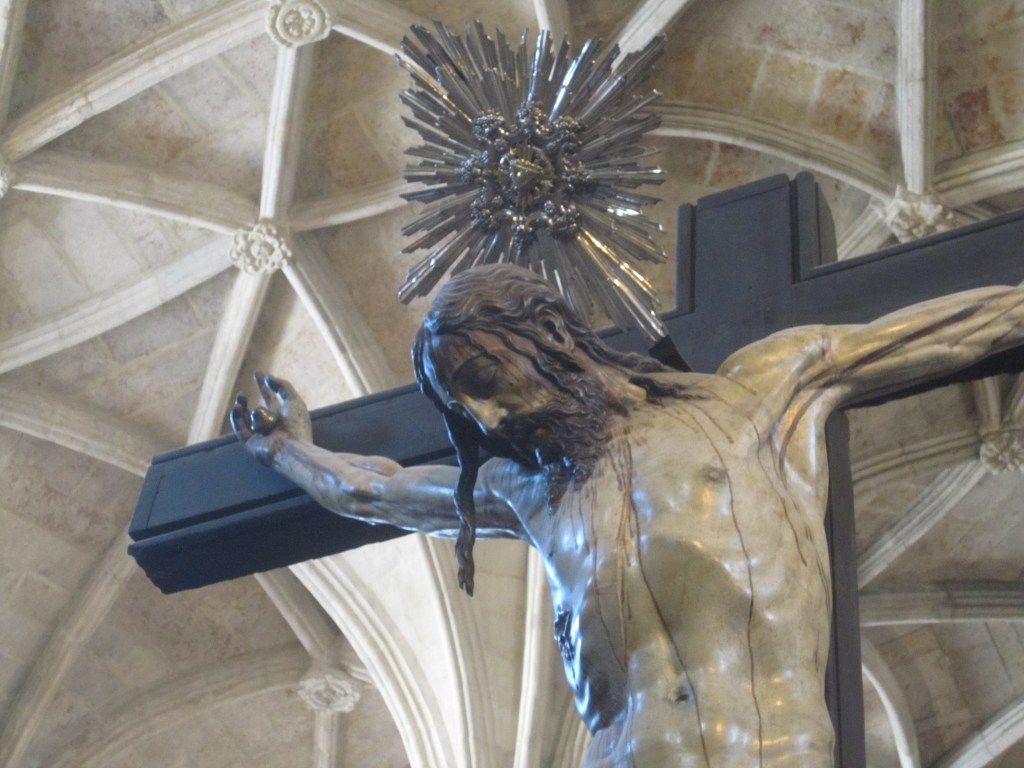
Jerónimos Monastery, Belén, Portugal

But it’s hard to love those who irritate me or who’ve hurt me or who behave obnoxiously or cruelly.  With effort, I succeed in being kind and fair to them maybe 75% of the time, though that percentage falls quickly if I’m tired or hungry or disappointed.  Sometimes I want to say to Jesus, “This yoke doesn’t seem easy to me.” 

Continue reading “Sacred Heart of Jesus homily”