Melchizedek, Jesus, and perfect sacrifice: Homily for Corpus Christi

This month I’ve been asked to contribute Sunday homilies to the Homiletic and Pastoral Review. You can find the rest of the month’s homilies there as well. Here’s this week’s contribution:


Homily for the Most Holy Body and Blood of Christ (C)

I thought I’d begin today by saying a word about Melchizedek. I’d wager most of you don’t know much of anything about Melchizedek. It’s a safe wager because nobody knows much about Melchizedek. His biographical details are limited to what you just heard in the first reading. But Melchizedek turns out to be an important figure. In the first reading, in Genesis, he seems to come out of nowhere. It turns out, when we get to the Letter to the Hebrews in the New Testament, that this mysterious origin is what makes him interesting. The New Testament speaks of Melchizedek as a forerunner of Jesus, the great high priest who has neither beginning nor end. Melchizedek, the Letter to the Hebrews says, represents an eternal priesthood — the priesthood of Jesus Christ.

In fact, perhaps it’s surprising that Genesis would mention Melchizedek at all. Even more surprising is that it mentions the sacrifice that he offers — bread and wine. At the time, bread and wine were not particularly impressive sacrifices. In the ancient world, if you wanted to impress, you offered meat. Birds were OK, lamb was better, a bull best of all. Bread and wine were not the sort of sacrifice a king would brag about.

Continue reading “Melchizedek, Jesus, and perfect sacrifice: Homily for Corpus Christi”
A bloody Sunday: Corpus Christi homily

Homily for the Solemnity of Corpus Christi (B)

Today’s readings are bloody.  Some years the readings for Corpus Christi emphasize the bread that becomes the body of Christ, and they remind us that the Eucharist is our nourishment and also the source of our unity.  A single loaf of bread is formed from many individual grains of wheat.  

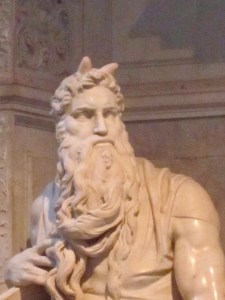
Moses, Michelangelo

But today’s readings are full of blood.  This is not a Sunday for the squeamish.  Blood sprinkled, blood shed, blood poured out, drinking blood.  If we are tempted to imagine that worship is something abstract or comfortable or safe, the blood-spattered images in today’s readings should give us second thoughts.  In the ancient world and in the time of Jesus, worship was a matter of flesh and blood, of life and death.  Entering the Temple of Jerusalem would have been a shock to the senses—crowds of visitors both from Judea and from the Jewish diaspora; animals—birds, sheep, goats, bulls—and all their animal noises and smells; the sounds of these animals being slaughtered; the smell of blood; and the songs of prayer, of the psalms rising to heaven, with the smoke of burning incense and roasting meat.  Worshipping God was not for the squeamish.

I think the fact that today’s readings speak rather vividly of the blood of goats, heifers, and bulls—bowls of blood—is perhaps a way of reminding us that Christianity—following Jesus—requires a certain courage.  In one way or another we all have to overcome our squeamishness, whatever form it might take.  The perfect act of worship, after all, the sacrifice which is the model for all other acts of worship, the death of Jesus on the cross, was not only bloody, but brutal.  There was nothing abstract or comfortable in the scrouging and beating, in the nails, the crown of thorns, or the agonizing hours on the cross.  And yet this was not, in the final analysis, merely an act of violence or a miscarriage of justice but an act of self-giving love.  The blood of the new covenant was shed for those Jesus calls to be his friends and disciples.

But why blood?  What is the meaning, for example, of what probably seems to us the very strange gesture of Moses who, to seal the covenant between God and his people, splashes blood upon the altar and then sprinkles it on the people.  When I read this passage one of my first very modern, very practical thoughts is, “How are the Israelites going to get all that blood out of their clothes?  What a mess!”  But we are told, in the letter to the Hebrews, that it is blood—the blood of Christ—that cleanses.

Continue reading “A bloody Sunday: Corpus Christi homily”