Epiphany homily: recapturing the logic of the gift

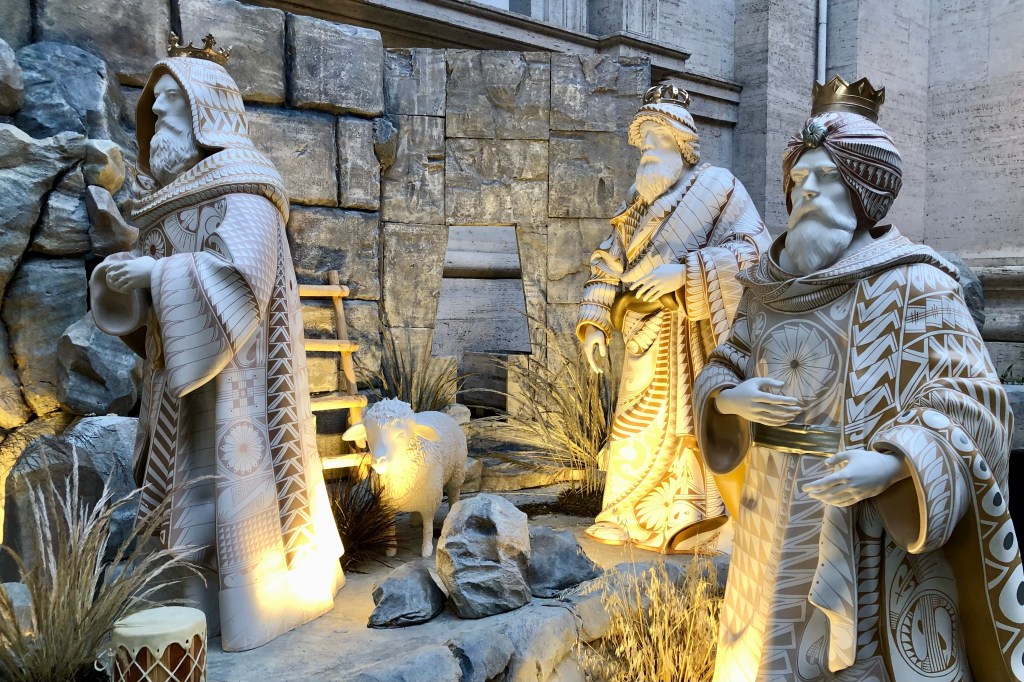
The Three Kings, from a Mexican Nativity displayed inside the Vatican, 2025

Homily for the Solemnity of the Epiphany.

Today’s feast, the Epiphany, traditionally was the day for gift-giving in Italy, though that tradition has been somewhat superseded by the arrival of a more aggressive salesman, Santa Claus.  Santa accepts both Visa and Mastercard—and, in some places, American Express—whereas the Magi bartered or traded in old-fashioned gold.

The Magi are still, however, known for their gifts.  Matthew’s Gospel does not give a precise number of Magi, but since it lists three gifts, the Christian artistic tradition has always depicted three Magi—or kings or wise men, depending on how you translate the word for these learned, wealthy, and adventuresome visitors.  Their gifts—gold, frankincense, and myrrh—struck a chord in the Christian imagination, even if most of us would have trouble explaining what exactly you do with myrrh.

Ancient spiritual writers attributed symbolic meaning to their gifts: gold symbolized Christ’s kingship; frankincense—a type of incense used in worship—symbolized his divinity; and myrrh—myrrh again, gave them a little trouble.  Some associated myrrh with virtue or with prayer.  Myrrh is actually very similar to frankincense; both come from the resin—the sap—of desert trees, which makes them rare and valuable.  Both give off distinct smells when burnt.  Frankincense is sweeter, while myrrh gives off bitter notes sometimes described as earthy or somber.  In the ancient near east, myrrh was used to prepare bodies for burial, so the presence of myrrh at Christ’s birth is sometimes interpreted as foreshadowing his passion and death.  Perhaps that explains why myrrh is no longer popular as a Christmas gift today.

But more than the specific gifts of the Magi, this morning I would like to reflect on what a gift is to begin with.  Today our idea of gift-giving is so shaped by Santa Claus—and by Amazon and Black Friday—that we sometimes lose the sense of what a gift meant in the time of Jesus.  And when we lose our grasp of the logic of gift-giving and gift-receiving, we start to have trouble understanding not only today’s feast of the Epiphany, but other parts of our faith as well, like marriage and the Eucharist.  Even our own existence in this world, which we did not create ourselves and did nothing to earn, becomes difficult to understand.

Continue reading “Epiphany homily: recapturing the logic of the gift”

Remember to say “Thank you”: Homily for the 28th Sunday of Ordinary Time

Homily for the twenty-eighth Sunday of Ordinary Time (C).

One of the lessons I remember being drilled into me as a child was the importance of saying “thank you.”  As with so many of the lessons we learn in childhood, I may not have appreciated its importance at the time, but now I’m grateful for it.  The next time I see my mom and dad, I’ll have to remember to thank them.

Today’s readings are all about remembering—and forgetting—to give thanks.  The attention that Sacred Scripture dedicates to the theme suggests that we are dealing with something much deeper than polite social convention.  Gratitude does make for more pleasant social interactions, but it is also necessary for us to see the world truthfully.  And it is something we easily forget.

Certosa di San Martino, Naples

Today’s Gospel passage, in fact, hints that perhaps we are more inclined to forget to give thanks than to remember.  Ten lepers were cleansed, Jesus points out, but only one returned to thank him.  Busyness can distract us from gratitude—we need to move on to the next thing, we don’t have time.  When we get what we want, often our tendency, instead of saying thank you, is to try to get more.  This is part of what theologians call “concupiscence,” the habit of selfishness burned into human nature by original sin.  Today we can add a sense of entitlement to concupiscence.  We like to speak of our rights—and politicians like to promise more rights—but while the rights we claim for ourselves multiply exponentially, our sense of responsibility never quite seems to keep pace.  We forget that we would have no rights whatsoever if these hadn’t been granted to us by our Creator.  To this forgetfulness we can add advertising that pushes us to buy more, to watch more, to scroll more, to consume more, and not to waste time remembering where we came from.  My parents did well to drill saying “thank you” into me because there are so many other voices saying, “Don’t worry—just give me your credit card.”

The loss of a sense of gratitude makes a truly Christian life impossible.  It’s no accident that the word that describes the central action in the life of the Church—“Eucharist”—comes from the Greek word for thanksgiving.  In some ways, this might seem surprising because in the celebration of the Eucharist, God’s action, and not ours, is central.  It is Jesus who gives himself to us; it is his power that transforms bread and wine into his Body and Blood, his living presence among us.  What we do in this sacrament we do only because he gave us the instructions.  The initiative is always God’s.  The same can be said of all of creation.  Everything that is is an unmerited gift.

Continue reading “Remember to say “Thank you”: Homily for the 28th Sunday of Ordinary Time”

Bread of life or never-ending breadsticks? Homily for the eighteenth Sunday in Ordinary Time

Homily for the 18th Sunday in Ordinary Time (B)

If there were an Olympic event for complaining, the ancient Israelites just might take the gold medal. Today, after being liberated from slavery, they ask to go back, forgetting the oppression they suffered in Egypt and remembering the country as an ancient Olive Garden with fleshpots and never-ending bread sticks.  Hearing their complaint, God sends them manna and quail to eat, but we know that soon enough they’ll start complaining again—“Manna again?  We want leaks and onions, not these leftovers!”  And they’ll attack Moses: “Why’d you have to lead us out here?  Weren’t there enough graves in Egypt?”

The preaching of St. Paul, Rabat, Malta

But, if complaining were an Olympic event, the competition would be fierce.  I suspect there’s something deep in our human nature—some survival mechanism from caveman days that made our ancestors less likely to be eaten by sabretooth tigers or stomped on by wooly mammoths if they were quicker to see the negative than the positive, more inclined to fear than to gratitude.  The problem is if you’re not being stalked by a sabretooth tiger, this instinct for the negative sometimes results in clubbing our friends or retreating into the darkness of our own self-constructed caves.  

Continue reading “Bread of life or never-ending breadsticks? Homily for the eighteenth Sunday in Ordinary Time”

Our Great American Holiday

As an American abroad, I’ll readily confess to a bit of nostalgia come Thanksgiving time. As a national rite, the holiday is sublime in its simplicity: turkey, family, eating–and an implicit spirituality as unobtrusive and essential as bedrock. I do celebrate here in Rome with other expats, but the Italian interpretation of cranberry sauce, stuffing, and pumpkin pie, while sometimes whimsical and frequently tasty, is never quite the same. Thanksgiving is quintessentially American, expressing what is best about our country–and perhaps also something of what we seem to be losing.

Continue reading “Our Great American Holiday”

Letting go of our anger–or hugging it tight: homily for the twenty-fourth Sunday of Ordinary Time

Homily for the 24th Sunday in Ordinary Time (A)

The giant saguaro, found in southern Arizona and northern Mexico, is the largest cactus in the world, growing up to forty feet tall.  Saguaros are covered in spines almost three inches long, spines almost as strong as steel needles, so sharp, in fact, that they have been known to puncture the skull of bighorn sheep that run into the cactus.  From this, two conclusions are clear.  First, sheep probably do deserve their dim reputation for intelligence, and, second, you really don’t want to hug a saguaro.  

Capitoline Museum, Rome

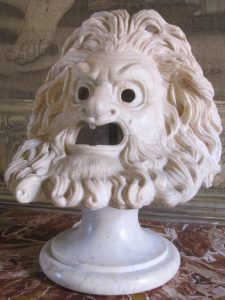
Now you may be thinking, “Thank you, Father Obvious, for that really helpful advice.”  Probably we don’t need to be told what a bad idea it is to hug a cactus.  And yet, in the Book of Sirach we read about people doing something that is potentially just as painful and damaging.  “Wrath and anger are hateful things,” Sirach says, “yet the sinner hugs them tight.”  And we have probably had the experience of tightly hugging our anger, of nurturing a grudge with more fertilizer than we give to our gardens.  The leaves and flowers fall off a grudge very quickly and leave us with nothing else but spikes.  

In last Sunday’s Gospel reading Jesus gave us some practical advice for dealing with conflict between Christians, and this Sunday we have readings on the related theme of forgiveness.  I think we can identify two levels of meaning when Jesus teaches about forgiveness.  The first is practical—how do I do it?  Part of the reason forgiveness is such a frequent theme in the Gospel, I suspect, is that it is often so hard to do.  Even if we get to the point of forsaking revenge, of no longer trying to hurt someone who has hurt us, even if we say the words “I forgive you,” the gnawing wound sometimes still remains.  We can remove the spike, but the sting is inside.  How do we let go?  

Continue reading “Letting go of our anger–or hugging it tight: homily for the twenty-fourth Sunday of Ordinary Time”