Doubting Caravaggio’s Doubting Thomas

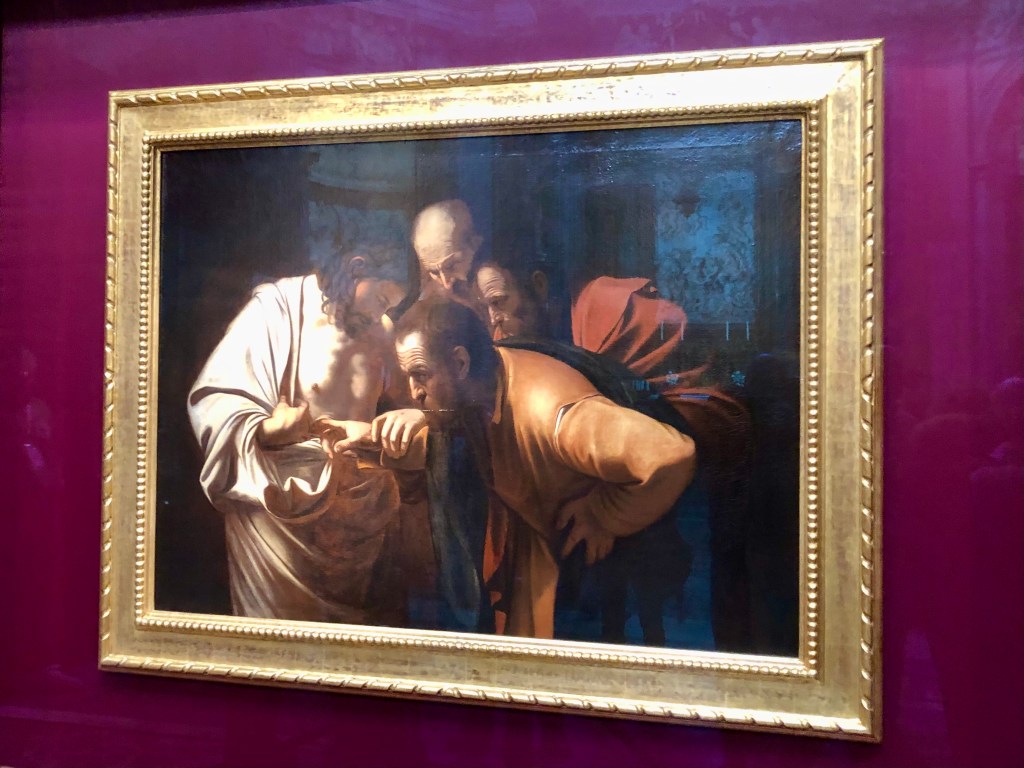
The Incredulity of St. Thomas, Caravaggio (1602-7)

Readers of this blog will know that one of the delights of living in the center of Rome is that a Caravaggio is never more than a stroll away. I’ve written about the great spiritual insight in Caravaggio’s Matthew cycle in the Church of San Luigi dei Francesi. Last year, I reflected in The Catholic Thing on why Caravaggio so resonates with contemporary viewers after visiting an extraordinary exhibit of his work in Palazzo Barberini.

At the tail end of the Jubilee I caught another extraordinary exhibit, albeit of just one Caravaggio, at Sant’Agnese in Agone. The work, The Incredulity of St. Thomas (1602-7), was on loan from a private collection in Florence. It’s a work full of drama and humanity and shows Thomas wide-eyed while inserting his index finger into the Risen Lord’s side. Jesus himself is utterly serene as he guides the doubting apostle’s hand toward his torso. (A nice detail is that the Lord’s face seems a bit sunburned, while his body is not.) Two other apostles look on over Thomas’s shoulder with both concentration and astonishment.

Continue reading “Doubting Caravaggio’s Doubting Thomas”

Doubt and bearing witness: a homily for the second Sunday of Easter

Explaining St. Paul’s first letter to the Corinthians, St. Thomas Aquinas says that in heaven there will be no faith. We will not need faith when we experience the beatific vision. We need faith now because we live in a world of uncertainties.

Palazzo Venezia, Rome (collection)

We live with doubts. Sometimes these doubts are justified. We doubt our political and church leadership when those in power are not honest, when they use words to hide the truth instead of expressing it. We doubt our abilities when we recognize the same tendency in our own hearts or when, despite our sincerity, our strength is insufficient and we fail. When the world changes unexpectedly, we doubt the future.

Why does Thomas doubt? From one point of view, uncertainty seems justifiable. Believing that a man has come back from the dead is not easy. But it would not have been the first time that Thomas witnessed such an event. He was present at the resurrection of Lazarus. And it seems unlikely that the other disciples had fabricated this story only to deceive him–it is hardly clear what motive they would have had to make up such a lie.

It is true that Thomas speaks of evidence, of what he can see and what he can touch, but his doubt is not really based on a lack of empirical evidence. He does not express the need for more study before coming to a conclusion. He expresses the refusal to believe, the decision not to believe: “I will not believe.”

Continue reading “Doubt and bearing witness: a homily for the second Sunday of Easter”