Homily for the Feast of St. Ignatius

The feast of St. Ignatius was back in July, of course, but I thought the reflections on discernment in my homily might be helpful in any season. Last year, I was asked for some thoughts on the process of communal discernment used by the Synod on Synodality. These reflections build on those observations.

Inigo the Pilgrim (2017), Church of St. Ignatius, Norwood, South Australia

You might have had the experience of the warning light on your dashboard coming on while you’re driving, signaling that you are low on gas, near the minimum.  Here in South Dakota especially–where outside of the city gas stations can be few and far between–you don’t want to fall below that minimum.  You might end up out in the cold or in this merciless heat—both dangerous circumstances—and in need of a good Samaritan to rescue you.

If you keep your tank filled, however, and don’t fall below the minimum, you can drive wherever you like.  You just plug the destination into the GPS and go.

The warning light and the GPS are both helpful, but they serve different functions—the warning light tells us not to drop below the minimum and the GPS gives us directions.  The readings for today’s feast of St. Ignatius, I think, point to a way of living the Christian faith that goes beyond the minimum.

If we think about the commandments, they are very useful for giving us the minimal rules of the road necessary to avoid an accident or a breakdown by the roadside. Because of this function, most of the commandments are written in a negative form—“Thou shall not…”  Even those that aren’t prohibitions—“Keep holy the Sabbath” and “Honor thy father and mother”—set a minimum of necessary behaviors.  Sunday Mass is the minimum necessary worship if we are to do justice to God, and fulfilling our family duties is the minimum necessary social obligation if we’re to maintain a functional social harmony.

But just doing the minimum isn’t enough to live a fulfilling life or to live a life of discipleship.  If I put on my to-do list for tomorrow, “Don’t kill anyone, don’t commit adultery, don’t steal,” I’ll end up rather bored.  The minimum tells us what to avoid, but not much of what to do.

Continue reading “Homily for the Feast of St. Ignatius”
Law and communion: homily for the twenty-second Sunday in Ordinary Time

Homily for the 22nd Sunday in Ordinary Time (B)

If you could pick eight of the Ten Commandments to follow and drop two, which would they be?  What if you could keep six as commandments and downgrade four to recommendations?  Perhaps you’re thinking, “I probably only need about five or so, but I know a lot of people who could use a few more, maybe 12 or 15 for them.”  The Pharisees in the Gospel seem to have adopted this last strategy, and perhaps because of their bad example sometimes the very idea of law gets a bad rap.  Didn’t Jesus teach grace rather than law, mercy instead of rules?  Didn’t Jesus say, “All you need is love, love is all you need”?  

Actually, that was the Beatles.  Jesus said in the Sermon on the Mount:  “Do not think that I have come to abolish the law or the prophets.  I have come not to abolish but to fulfill.  Amen, I say to you, until heaven and earth pass away, not the smallest letter or the smallest part of a letter will pass from the law.”

Basilica de Santo Nino, Cebu City, Philippines

Now it is true that, as in today’s Gospel reading, Jesus harshly criticizes a certain way of using the law as self-serving and hypocritical.  So to be disciples of Jesus we need to think carefully about the role the law plays in salvation history and in our own lives of faith.  

Today’s first reading from Deuteronomy makes clear that the law of Israel is God’s gift.  It makes equally clear that no one but God may add to or subtract from what he commands.  No matter how much we find the commandments hard to follow, no matter how old they are, no matter if we think we could attract crowds of new people to our Church by loosening the loopholes, only God can modify the law of God.  

Continue reading “Law and communion: homily for the twenty-second Sunday in Ordinary Time”

St. Aloysius Gonzaga and giving God your all: homily for St. Aloysius

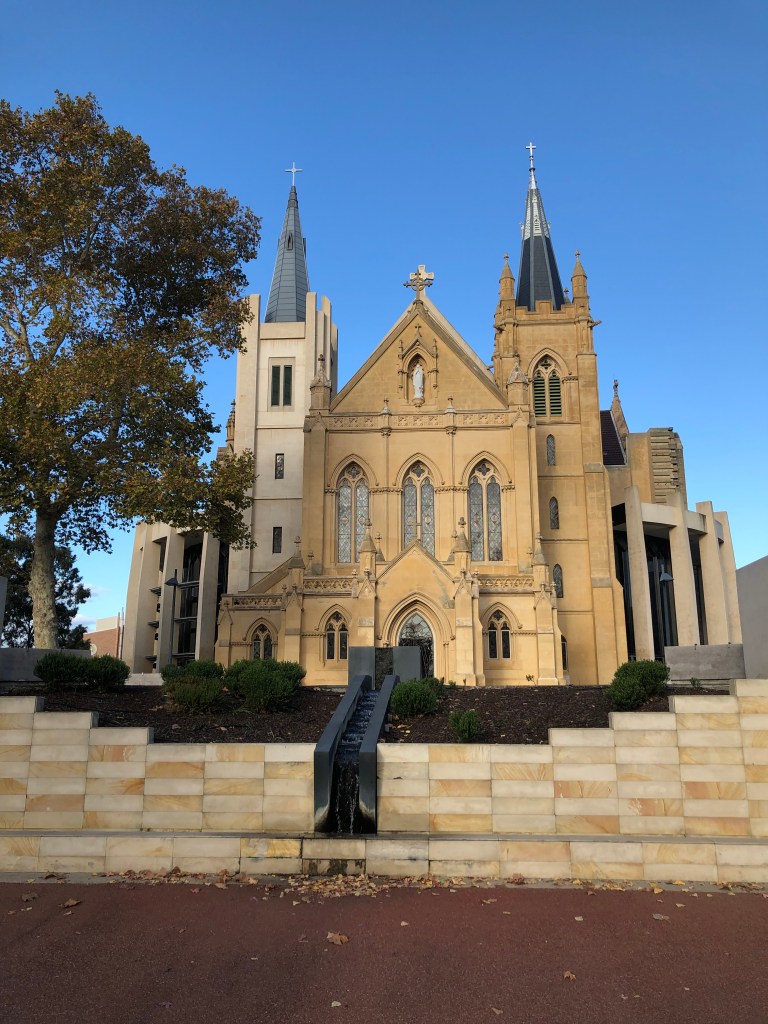
St. Mary’s Cathedral, Perth

The readings for our celebration of the life of St. Aloysius Gonzaga tell us to show our love for God by keeping his commandments.  Sometimes people talk about love and the commandments as if there were a contradiction between the two, but Jesus teaches us otherwise.  

For Jesus, love isn’t a feeling.  Don’t confuse love with romance, which can be produced with mood lighting and champagne.  For Jesus, love is life-giving.  God, the creator, first shows his love for us by giving us life.  And Jesus, the Son of God, shows the power and depth of his love by giving up his own life so that we might have eternal life.

But life is a delicate thing.  If you plant a garden, you have to know the right amount of water to give the seeds—too much and they’ll rot, too little and they’ll dry up.  I’ve killed a few houseplants learning this lesson.  If you just leave your garden alone to do whatever it wants, it will soon choke with weeds and die.  Keeping plants alive sometimes requires trimming them.  Nurturing life requires rules.

Continue reading “St. Aloysius Gonzaga and giving God your all: homily for St. Aloysius”