Epiphany homily: recapturing the logic of the gift

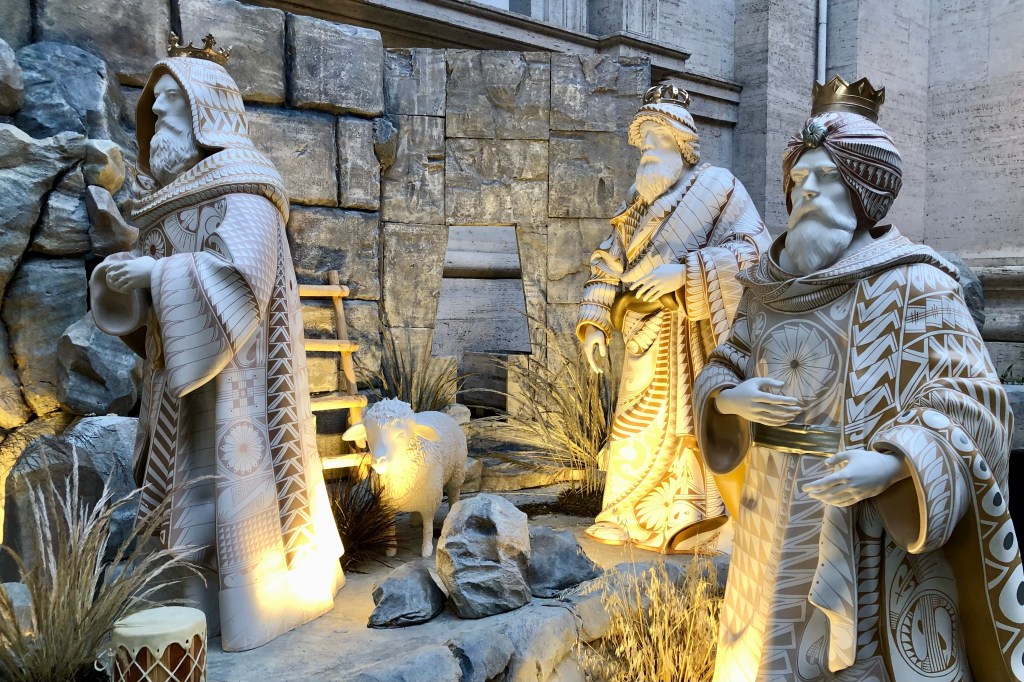
The Three Kings, from a Mexican Nativity displayed inside the Vatican, 2025

Homily for the Solemnity of the Epiphany.

Today’s feast, the Epiphany, traditionally was the day for gift-giving in Italy, though that tradition has been somewhat superseded by the arrival of a more aggressive salesman, Santa Claus.  Santa accepts both Visa and Mastercard—and, in some places, American Express—whereas the Magi bartered or traded in old-fashioned gold.

The Magi are still, however, known for their gifts.  Matthew’s Gospel does not give a precise number of Magi, but since it lists three gifts, the Christian artistic tradition has always depicted three Magi—or kings or wise men, depending on how you translate the word for these learned, wealthy, and adventuresome visitors.  Their gifts—gold, frankincense, and myrrh—struck a chord in the Christian imagination, even if most of us would have trouble explaining what exactly you do with myrrh.

Ancient spiritual writers attributed symbolic meaning to their gifts: gold symbolized Christ’s kingship; frankincense—a type of incense used in worship—symbolized his divinity; and myrrh—myrrh again, gave them a little trouble.  Some associated myrrh with virtue or with prayer.  Myrrh is actually very similar to frankincense; both come from the resin—the sap—of desert trees, which makes them rare and valuable.  Both give off distinct smells when burnt.  Frankincense is sweeter, while myrrh gives off bitter notes sometimes described as earthy or somber.  In the ancient near east, myrrh was used to prepare bodies for burial, so the presence of myrrh at Christ’s birth is sometimes interpreted as foreshadowing his passion and death.  Perhaps that explains why myrrh is no longer popular as a Christmas gift today.

But more than the specific gifts of the Magi, this morning I would like to reflect on what a gift is to begin with.  Today our idea of gift-giving is so shaped by Santa Claus—and by Amazon and Black Friday—that we sometimes lose the sense of what a gift meant in the time of Jesus.  And when we lose our grasp of the logic of gift-giving and gift-receiving, we start to have trouble understanding not only today’s feast of the Epiphany, but other parts of our faith as well, like marriage and the Eucharist.  Even our own existence in this world, which we did not create ourselves and did nothing to earn, becomes difficult to understand.

Continue reading “Epiphany homily: recapturing the logic of the gift”
Homily for the Feast of the Holy Family

Homily for the Feast of the Holy Family (Year A). Original Italian.

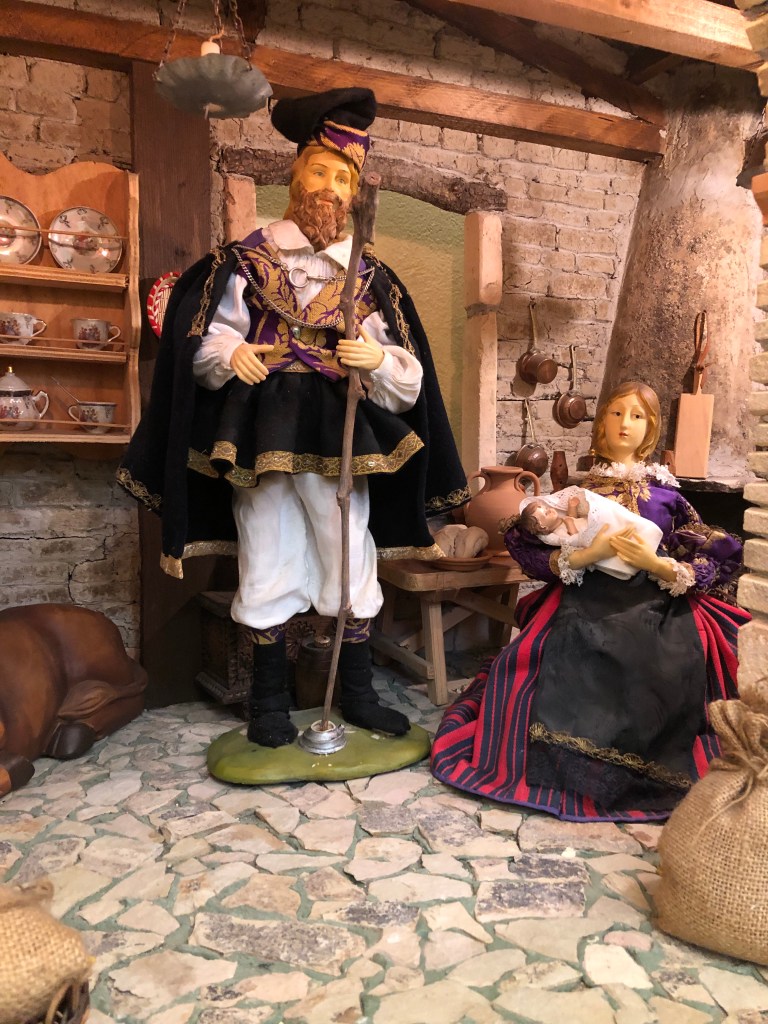
Sardinian Nativity scene, Maracalagonis (Sardinia)

Today we celebrate the story of one particular family—and the story of every family.

On the one hand, the story of the Holy Family of Jesus, Mary, and Joseph is absolutely unique. There is no other historical event comparable to the Incarnation of the Son of God, and the birth of Jesus is surrounded by other miraculous events—the appearance of the archangel Gabriel, the angelic messages that come to Joseph in dreams, the arrival of the Magi, the adoration of the shepherds—which highlight the unique identity of Jesus Christ. Furthermore, Jesus is divine, Mary is immaculate, and Joseph is holy; therefore, this family is threatened by sin, but always from outside. Herod’s envy is one example.

In our families, however, we must admit that often the most damaging wounds are caused by our own sins. Nevertheless, I do not believe that this difference—the holiness of the Holy Family—creates a distance between them and us, because all the actions of the Holy Family are done for us. They are a guide, a support, and a source of hope for us.

Joseph and Mary faced great challenges: an unexpected pregnancy that changed all their plans, the misunderstanding of their neighbors, a period of extreme poverty, danger, a threat to their child’s life, exile; and then all the daily challenges, including—if we think of Jesus’ disappearance in the temple—the difficulties of communication that sometimes occur even between people of good will. At the same time, the Holy Family experienced unexpected joys, tenderness, the celebrations of their religion, and belonging to their people. They experienced the fullness of family life.

Their particular experience offers us inspiration and encouragement to live our Christian mission fully, despite the challenges.

Continue reading “Homily for the Feast of the Holy Family”

Abraham’s promises: homily for the sixteenth Sunday in Ordinary Time

Homily for the sixteenth Sunday in Ordinary Time (C)

This morning, I want to talk about Abraham.  For many of us, perhaps, Abraham is like one of those distant relatives your grandmother mentions occasionally but you’re never quite sure how you’re related.  Fortunately, it’s easy to see how Abraham fits into the family tree.  He’s at the top—Abraham is the patriarch, the father of the Jewish people and also, according to the New Testament, the father of us all in faith.

Caravaggio, Sacrifice of Isaac, Uffizi Gallery, Florence

We find Abraham’s story in the book of Genesis.  He lives in that period in history after the fall, when the sin of Adam has left humanity existentially disoriented.  It’s the era of Cain and Abel, the Tower of Babel, Noah and the Flood—man is lost, and every turn he makes only worsens his desolation.  When I was in the Peace Corps, I was once heating a bucket of water with an electric coil, which was, shall we say, not up to OSHA standards.  And without noticing that the plastic safety handle around the coil had melted, I picked it up and gave myself a shock.  And in the moments after the shock, everything was fuzzy, and I couldn’t quite tell what had happened or what I was doing—so I picked it up and shocked myself again.  And that’s kind of what original sin did to mankind.

Continue reading “Abraham’s promises: homily for the sixteenth Sunday in Ordinary Time”