Radiant in the darkness: Caravaggio 2025

Caravaggio, Flagellation of Christ, 1607

Several weeks ago I spent a wonderful afternoon at a special exhibit of 24 paintings by Caravaggio brought together in Palazzo Barberini and dubbed Caravaggio 2025. The exhibition made me wonder at Caravaggio’s extraordinary popularity. Why is Caravaggio so popular today? And what does this tell us about where we are spiritually? I think the answer is not unrelated to the other recent events in Rome: the election of a missionary as Pope Leo XIV; our new Holy Father’s goal of steering the Church faithfully through the digital revolution, just as Leo XIII provided guidance during the industrial revolution; and this Jubilee year’s theme of hope.

I’ll have more on Pope Leo soon. For now, suffice it to say that the mood here in Rome is elated. In the meantime, you can read my thoughts on Caravaggio at The Catholic Thing.
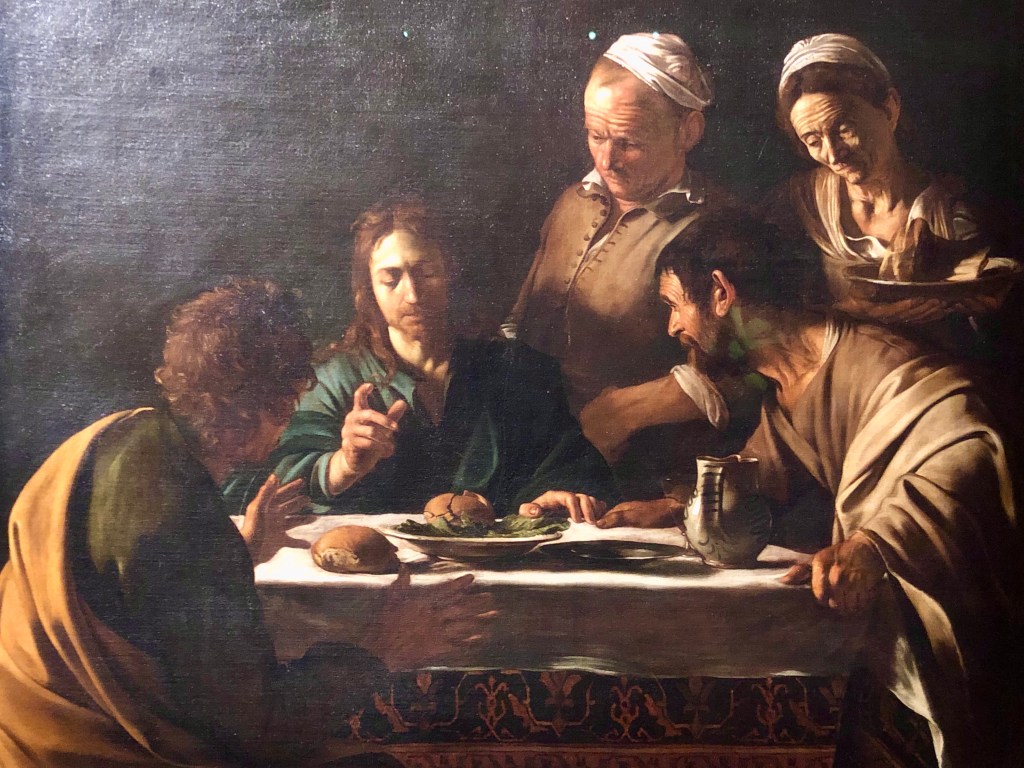
Caravaggio, Supper at Emmaus, 1606

While you’re at it, check out some reflections from a few months back on the artist’s spectacular St. Matthew cycle and a different conversion of St. Paul. And there’s plenty of other great work at The Catholic Thing, including, if you missed it, an explanation of why I think my book on baptism of desire is so important at this time when renewing the Church’s missionary spirit is such a vital challenge: Getting Back into the Baptizing Business. The price on Amazon seems to have dropped a bit recently.

All Souls Day

November 2 is All Souls Day on which we remember and pray for the dead. For Catholics, November is traditionally a month dedicated to praying for the dead, a practice that goes back to the earliest days of the Church and, indeed, even to pre-Christian times. This pair of days, All Saints and All Souls, is a reminder of the profound solidarity that exists between all Christ’s faithful, on whichever side of the grave we currently find ourselves. Our lives and our journeys continue to intertwine with those who have come and gone before us.

Santa Maria del Purgatorio, Monopoli, Italy

The first reason we pray for the dead, of course, is to help those in the final process of purification we call purgatory. Since heaven means existing in a state of perfection and most of us still aren’t perfect when we die, purgatory is the time we need to reach that perfect way of being we long for.

This doesn’t mean that purgatory is a second chance, as if this earthly life were a video game in which you get five or six lives to move up levels. No, the choices we make in this life are decisive. Our free will really matters. Purgatory is the completion of what we start on earth.

Continue reading “All Souls Day”

Making sense of our post-Christian culture

San Galgano, Tuscany

In the West today, pessimism is warranted. Suicide, crime, and drug use are up; birthrates are down. In America, woke excess has undermined much of the progress made toward racial reconciliation over the course of the last century. The decline in religious practice has eroded those values that transcend political conflict and material consumption; we’re losing the shared cultural language with which we could talk to one another about matters touching on the common good. In the absence of a common cultural narrative and shared values, tribal loyalties have filled the void, becoming our false gods.

I don’t think it disloyal to admit that the Church has not adequately responded to the West’s malaise. Faced with Covid, we closed shop. Rome these days sometimes seems to be swimming in nostalgia for the 1960s. No doubt it was more pleasant to be a young cleric in the heady days of Vatican Council II–at least, before the seminaries emptied–but those are not our days.

Half a century ago, perhaps, Catholics in the West could still see their societies as Christian, though ones that were rapidly changing. So it seemed reasonable enough to hope that with a bit of updating around the edges, a little accommodation to the Zeitgeist, we might experience a new flourishing of Christian life. That didn’t happen, and it is no longer reasonable to expect that it will. We need a new response to today’s reality.

A recent article by Sydney’s Archbishop Anthony Fisher The West: Post- or Pre-Christian? provides a helpful, nuanced diagnosis of where we are.

Continue reading “Making sense of our post-Christian culture”

A Church of all nations: homily for the twenty-first Sunday of Ordinary Time

Homily for the 21st Sunday in Ordinary Time (C)

Not long ago, at dinner in my community in Rome, which houses Jesuits from maybe 30 different countries, one of my brothers from Columbia was talking with one of my brothers from Poland about the different things people eat around the world, and he mentioned hearing that in parts of Asia people eat dog meat.  And another of my brothers from the Philippines, who is normally very quiet, looked up from his plate and said, “Oh, yes, very good,” and then he went on with his meal.  

Altar of St. Francis Xavier, Gesù Church, Rome

There is no more diverse an organization in the world than the Catholic Church.  Not only do Catholics come from different countries and races and language groups, but the Church includes saints of different historical periods, the great cloud of witnesses mentioned by the letter to the Hebrews last week.  The martyrs of first century Rome, of seventeenth century Japan, of 20th century Spain and Mexico, and, in our still-young century, of Turkey, Pakistan, Kenya, Nigeria, France and elsewhere could not have been more different culturally or socially, yet they all shared a belief in Catholicism so strong they were willing to die for it.  People have indeed come, as the Lord says, from the east and from the west, from the north and from the south to the table in the kingdom of God, around which we gather this morning.

Continue reading “A Church of all nations: homily for the twenty-first Sunday of Ordinary Time”

Holy Saturday

The Harrowing of Hell, Andrea di Bonaiuto, Santa Maria Novella, Florence

Today’s reading from the Office of Readings put me in mind of the fresco of Christ’s descent into the limbo of the patriarchs in the chapter room of Santa Maria Novella in Florence. Note the demon crushed under the doors of hell at Christ’s feet and the other bewildered devils on the right. (Don’t feel sorry for them.) It’s what the Middle Ages had instead of superhero movies.

Continue reading “Holy Saturday”