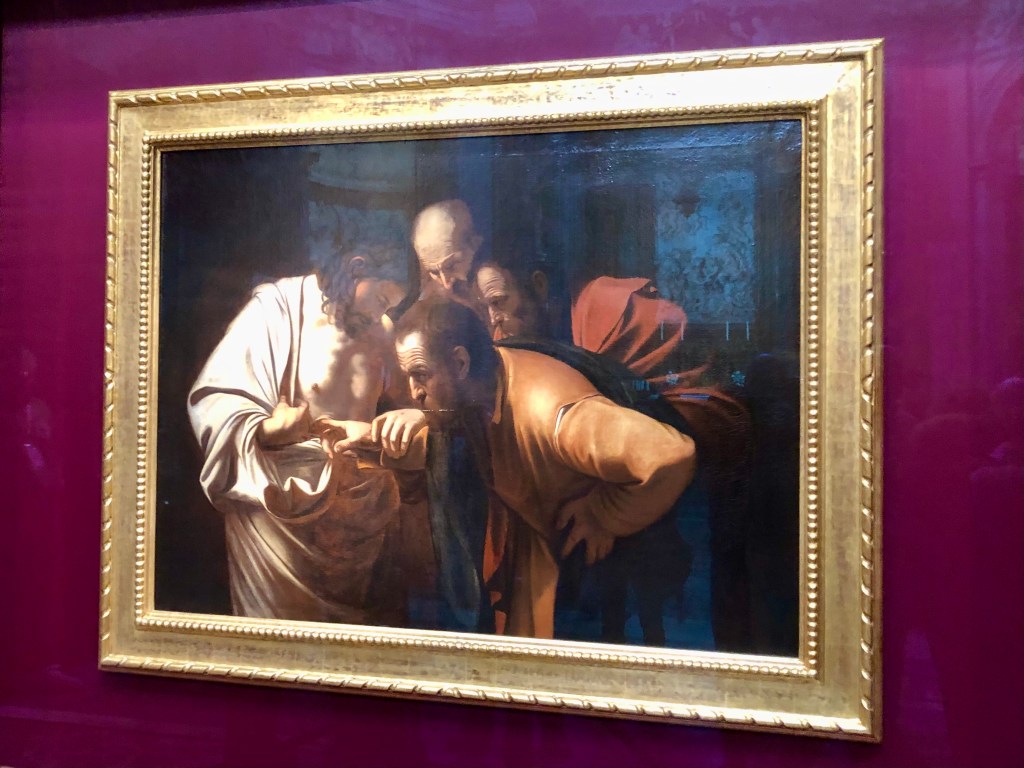
The Incredulity of St. Thomas, Caravaggio (1602-7)
Readers of this blog will know that one of the delights of living in the center of Rome is that a Caravaggio is never more than a stroll away. I’ve written about the great spiritual insight in Caravaggio’s Matthew cycle in the Church of San Luigi dei Francesi. Last year, I reflected in The Catholic Thing on why Caravaggio so resonates with contemporary viewers after visiting an extraordinary exhibit of his work in Palazzo Barberini.
At the tail end of the Jubilee I caught another extraordinary exhibit, albeit of just one Caravaggio, at Sant’Agnese in Agone. The work, The Incredulity of St. Thomas (1602-7), was on loan from a private collection in Florence. It’s a work full of drama and humanity and shows Thomas wide-eyed while inserting his index finger into the Risen Lord’s side. Jesus himself is utterly serene as he guides the doubting apostle’s hand toward his torso. (A nice detail is that the Lord’s face seems a bit sunburned, while his body is not.) Two other apostles look on over Thomas’s shoulder with both concentration and astonishment.
Several weeks ago I spent a wonderful afternoon at a special exhibit of 24 paintings by Caravaggio brought together in Palazzo Barberini and dubbed Caravaggio 2025. The exhibition made me wonder at Caravaggio’s extraordinary popularity. Why is Caravaggio so popular today? And what does this tell us about where we are spiritually? I think the answer is not unrelated to the other recent events in Rome: the election of a missionary as Pope Leo XIV; our new Holy Father’s goal of steering the Church faithfully through the digital revolution, just as Leo XIII provided guidance during the industrial revolution; and this Jubilee year’s theme of hope.
While you’re at it, check out some reflections from a few months back on the artist’s spectacular St. Matthew cycleand a different conversion of St. Paul. And there’s plenty of other great work at The Catholic Thing, including, if you missed it, an explanation of why I think my book on baptism of desire is so important at this time when renewing the Church’s missionary spirit is such a vital challenge: Getting Back into the Baptizing Business. The price on Amazon seems to have dropped a bit recently.
One of the most remarkable places in this remarkable city of art is the Contarelli Chapel in the Church of San Luigi dei Francesi, home to the St. Matthew trilogy of Michelangelo Merisi da Caravaggio. Three paintings–The Conversion, The Inspiration, and The Martyrdom of St. Matthew–tell the story of the life of the saint, from his improbable calling to his death. The paintings are full of artistic drama, reflecting the artist’s own spiritual struggles and his attempt to find his place among Italy’s artistic greats.
Contarelli Chapel, San Luigi dei Francesi, Rome
The paintings date from early in Caravaggio’s career (1599-1600), when he was at the apex of his success in Rome. Only a few years after painting the St. Matthew trilogy, however, Caravaggio’s artistic career was sabotaged by his own unruly passions–he was forced to flee Rome after murdering a man in a brawl. As I’ve argued before, the fact that Caravaggio sinned so spectacularly does not negate a deep thirst for God or his spiritual and sacramental sense. In fact, as so often happens, awareness of his sin may have heightened the need the artist felt for redemption. In one of his later works, which he painted while in exile for his crime, David holds the head of Goliath–who bears Caravaggio’s own anguished face.
David with the Head of Goliath, Caravaggio, Borghese Gallery, Rome
Conversion also drives the “plot” of Caravaggio’s St. Matthew cycle. The first of the paintings, The Call of Matthew, depicts the moment when Jesus walks into Matthew’s customs post where the tax collector sits among cronies, coins spread over the table in front of him. Light shines in from a window just over the Lord’s head and hits Matthew straight on as Jesus raises his hand and points an unrelenting finger, as if to say, “You.” The tax collector’s own finger rises to his chest and his eyes widen, as if to respond, “Who? Me?” Or perhaps he is trying to distract the Lord’s gaze by pointing to the ne’er-do-well next to him, whose eyes are still fixed on the coins. In either case, the painting captures all the passion and confusion of the call to conversion–the unrelenting gaze of God, the instinctual avoidance and doubt of the sinner who is called. Does Matthew think himself unworthy? Shy away from relinquishing the wealth he knows? Hesitate when truth itself dissolves the shadows of ambiguity he has woven around himself? Probably, all of the above.
The Conversion of St. Paul, Michelangelo Merisi da Caravaggio (1571-1610)
It looks like a picture of a horse’s… well, of the back part of a horse. Caravaggio’s painting of the conversion of St. Paul in the church of Santa Maria del Popolo in Rome puts the story’s equine character front and center. What gives? The practical joke of a roguish artist?



 Tony Lusvardi, S.J.