The Trinity, mystery and relationship: homily for Trinity Sunday

This month I’ve been asked to contribute Sunday homilies to the Homiletic and Pastoral Review. You can find the rest of the month’s homilies there as well. Here’s this week’s contribution:


Homily for Trinity Sunday (C)

The Holy Trinity, Camarines Sur, 18th century, molave wood (St. Augustine Museum, Manila)

There’s an old saying, which probably goes back to Socrates, that the more you know, the more you realize you don’t know.  This observation on what it means to be truly wise is not meant to discourage learning or study or reflection.  When used in a Christian context it’s not meant to suggest, for example, that our faith should be reduced to a couple of folksy slogans.  Nor does it mean that when reflecting on the doctrine which we remember today—the Most Holy Trinity—that we should take an anti-intellectual approach—it’s a mystery, just have faith, don’t ask any questions.

The Trinity is a mystery, but today’s readings suggest the attitude we should have toward “mystery” in the context of our faith.  Calling the Trinity a mystery means that we will never get to the end of understanding it, but that should not make us want to throw up our hands and give up.  Instead, it should make us want to know more.  There’s a great history podcast that I listen to, and, after each episode, I often want to go online and start buying books about the subject to discover more.  Usually, I have to restrain that impulse because the books start to pile up and I don’t have time to read them!  

When we talk about the mysteries of our faith, that’s the dynamic we’re suggesting: not that we don’t want any questions, but that there will always be more to say and our capacity to learn is limited. Jesus suggests as much in the Gospel when he ways, “I have much more to tell you, but you cannot bear it now.”  Those words tell us something important about God.  Jesus talks about knowing the Father by seeing the Son and living in the Spirit of truth.  If you tried to diagram what that meant, you might end up with a triangle and lots of arrows going back and forth between the angles.  Perhaps that’s not a bad start because one thing that we can take from the invitation of Jesus to know him and know his Father and know the Holy Spirit is that he is inviting us into a relationship that will change us.  It’s a relationship that, in a way, is always moving.

Continue reading “The Trinity, mystery and relationship: homily for Trinity Sunday”
IHSes and resigning popes

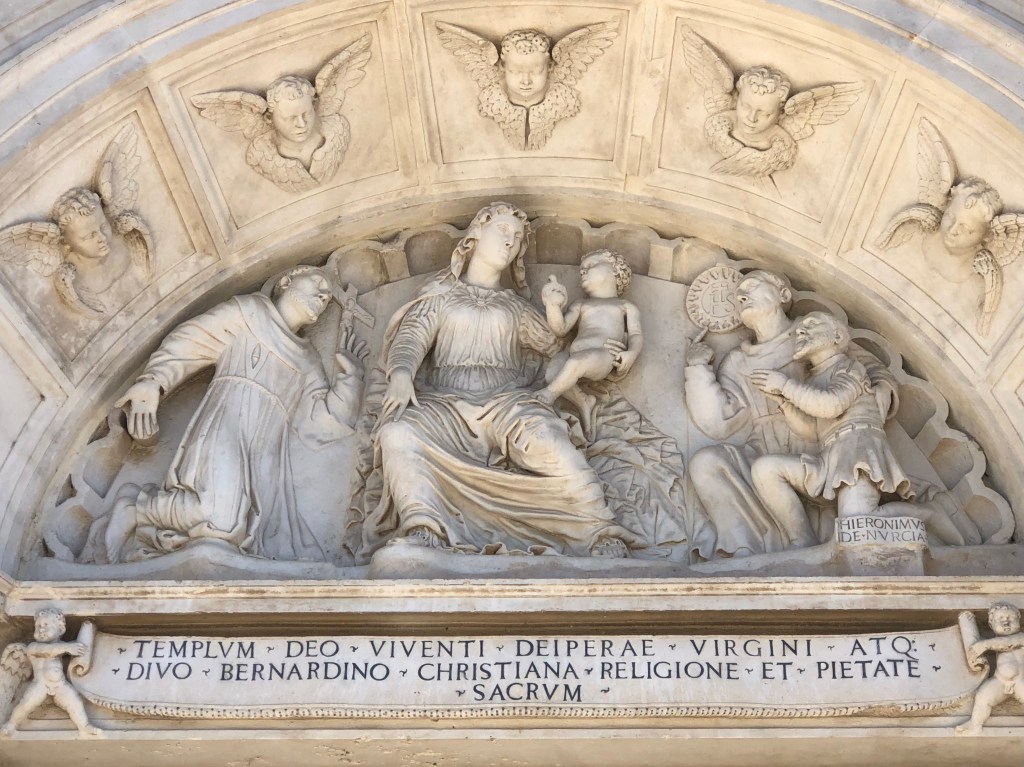
Basilica of San Bernardino, L’Aquila

Last month the Gregorian Jesuits took our spring community outing to L’Aquila, capital of the Abruzzo region. L’Aquila was most recently in the news for a 2009 earthquake that tragically killed over 300 people. Most buildings in the city have been restored, though construction still abounds.

Highlights of the trip were two churches. The first, the Basilica of St. Bernardino of Siena, is dedicated to the Franciscan preacher (1380-1444) with a great devotion to the name of Jesus. In fact, in images of St. Bernardino one frequently sees the IHS Christogram–using the Greek letters for the name of Jesus. The “IHS” was later taken up, of course, by the Society of Jesus. The IHS sunburst with the three nails of Christ’s passion is prominently displayed all over the Basilica of San Bernardino. The saint died in L’Aquila and is buried in the basilica.

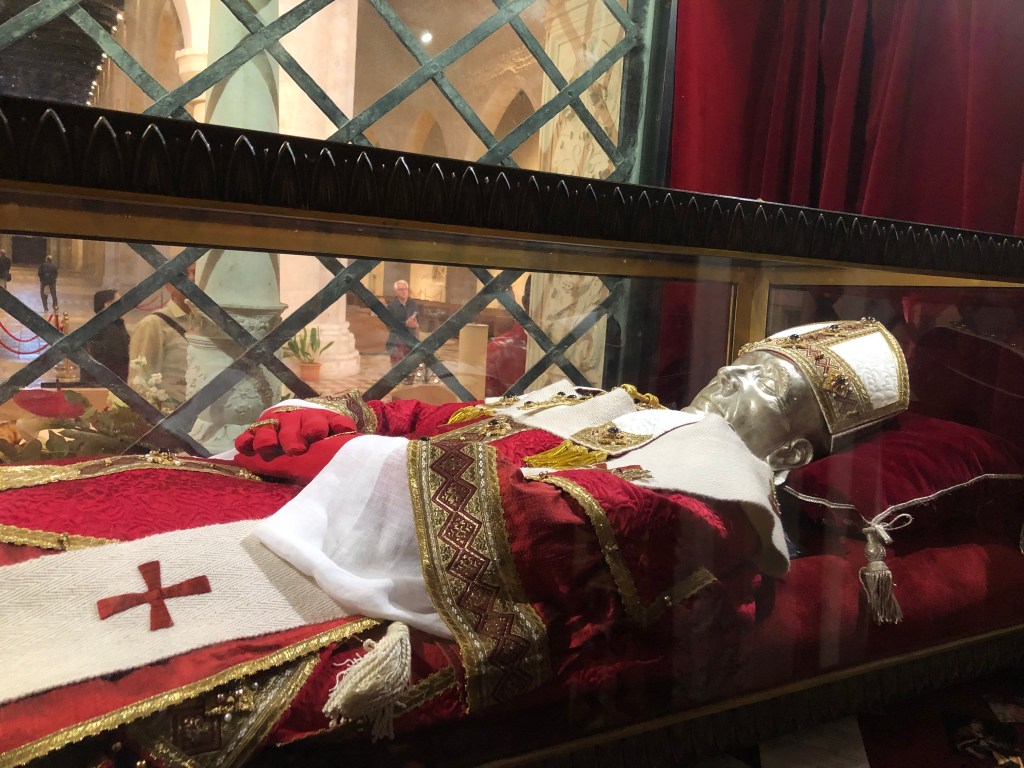
Tomb of Pope St. Celestine V, L’Aquila

L’Aquila’s other iconic church is Santa Maria di Collemaggio, burial place of Pope Celestine V (1215-1296). It is known as the Church of Pardon because of the plenary indulgence Celestine attached to the church–what locals refer to as an annual Jubilee. Celestine’s papacy, however, could hardly be considered a success, and he resigned after only a few months in office. He was a holy hermit, perhaps never really cut out to be pope.

Continue reading “IHSes and resigning popes”

Benedict XVI on creation

Mount Cook, New Zealand

The new year came early for me this year–while in America 2022 still had almost a full day left to go, I was as close to the International Date Line as I’ve ever been watching fireworks erupt from the Sky Tower in Auckland, New Zealand. I will be spending the first half of the year doing Jesuit “tertianship” in Melbourne, Australia. Tertianship is the final formal stage of Jesuit formation in which we do the 30-day Spiritual Exercises again and have a chance to reflect on all that’s happened so far.

New Year’s Eve also brought the sad news of the passing of Pope Emeritus Benedict XVI, someone I have immensely admired as a man whose character balanced both courage and humility, as a Christian for whom Jesus was the center of everything, and as a theologian capable of expressing the most profound truths with luminous clarity. Benedict knew how to cut through both theological jargon and political rhetoric to get to the heart of the matter– always the absolutely unique encounter with Jesus Christ.

Rotorua, New Zealand

Shortly after Benedict’s death I was contacted by a scholar of Lakota Catholicism, Damian Costello, who wrote this article highlighting an under-appreciated aspect of Benedict’s work, his focus on creation: The unexpected way Pope Benedict helped me learn to pray with all creation. Dr. Costello’s work came to my attention last year in an insightful article in America magazine about Native American religious sensibilities and the Latin Mass. His book Black Elk: Colonialism and Lakota Catholicism makes an important and original argument, and it’s on my to-read list.

Clay Cliffs, Omarama, New Zealand
Continue reading “Benedict XVI on creation”