Is the Great Gatsby the Great American Novel?

The dome of the Cathedral of St. Paul from Summit Avenue, not far from where F. Scott Fitzgerald grew up.

As an undergraduate, I was an English major, so it was a real treat for me to have the chance to reread one the classics of American literature, F. Scott Fitzgerald’s The Great Gatsby this spring. This year marks the 100th anniversary of the novel’s publishing. My essay to mark the occasion recently appeared in Law & Liberty, and you can check it out here. The occasion prompted me to dig up another essay I wrote several years ago about “Benediction,” one of Fitzgerald’s few stories with an explicitly Catholic theme (check it out here).

As much as any other book, I think, Gatsby can stake a claim to be the Great American Novel, in part because the novel itself grapples with the question of what it really means to be “great.” Equally important, it wrestles with the nature of the American character. It is an elegantly slim novel but, as I realized while writing and rewriting my reflection on it and still feeling like I couldn’t quite do it justice, it is taut with beauty, irony, and subtle meaning.
Post-election thoughts from Rome

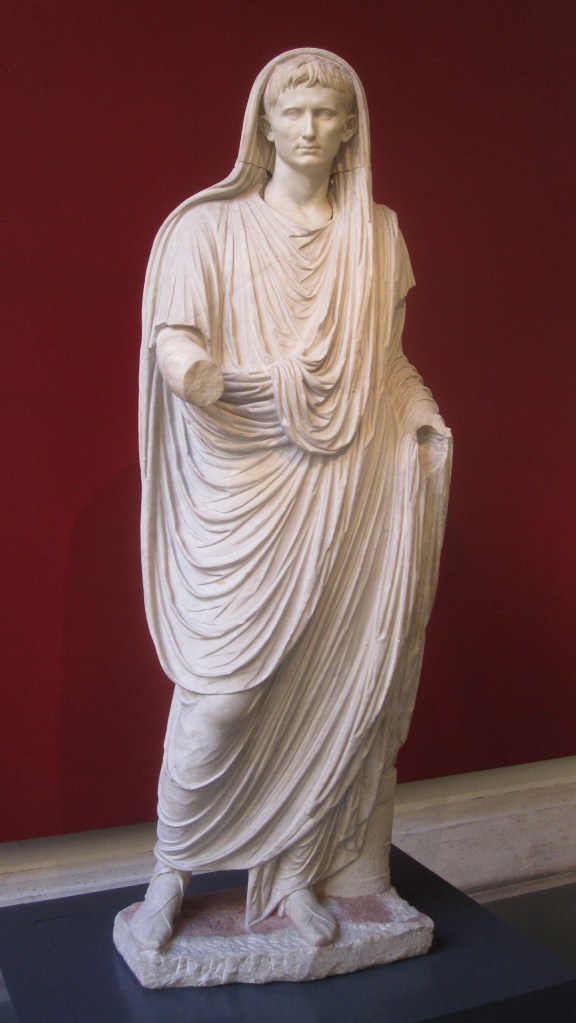
Augustus Caesar in the robes of supreme pontiff, Palazzo Massimo, Rome

As a follow up to my piece at The Catholic Thing on elections as civic rituals, America magazine asked me to reflect on how the US Presidential election looked from Rome. So here are my thoughts from an election morning walk to the Mausoleum of Caesar Augustus: Caesars, presidents and apostles: Viewing the presidential election from Rome. I was happy to see some pieces of our election rituals restored this time around; President Biden’s invitation of President-elect Trump to the White House was a gracious moment, more important as a symbol than because of anything said between the two men.

With the election now behind us, I also thought it worth sharing what for me was one of the more interesting–even edifying–reflections to come out of campaign. When he converted to Catholicism, Vice-President-elect JD Vance penned a thoughtful account of what led him to the faith in The Lamp (where yours truly has also published). Regardless of what you think of his politics, it is refreshing to read about a public figure’s faith journey, both personal and intellectual. I was particularly interested to read about the role René Girard’s work played in Vance’s conversion. From 2020, “How I joined the resistance” is worth a read.


Those who weren’t able to be at the book launch of Baptism of Desire and Christian Salvation last month might be interested to read Jonathan Liedl’s account of the event–with a tie-in to one of Rome’s most unique Jesuit relics–in The Catholic Spirit: What a severed arm can tell us about evangelization. A reminder that the discount code CT10 gives 20% off on new releases when purchasing directly from the CUA Press website. The book is also available on Amazon and seems to be in stock again. In Italy, it might be faster to order through IBS or La Feltrinelli. The Libreria Sole across from the Gregorian University was also supposed to order copies. I hope to have a video of the talks from the book launch up on the Baptism of Desire page soon.

Our Great American Holiday

As an American abroad, I’ll readily confess to a bit of nostalgia come Thanksgiving time. As a national rite, the holiday is sublime in its simplicity: turkey, family, eating–and an implicit spirituality as unobtrusive and essential as bedrock. I do celebrate here in Rome with other expats, but the Italian interpretation of cranberry sauce, stuffing, and pumpkin pie, while sometimes whimsical and frequently tasty, is never quite the same. Thanksgiving is quintessentially American, expressing what is best about our country–and perhaps also something of what we seem to be losing.

Continue reading “Our Great American Holiday”