Is the Great Gatsby the Great American Novel?

The dome of the Cathedral of St. Paul from Summit Avenue, not far from where F. Scott Fitzgerald grew up.

As an undergraduate, I was an English major, so it was a real treat for me to have the chance to reread one the classics of American literature, F. Scott Fitzgerald’s The Great Gatsby this spring. This year marks the 100th anniversary of the novel’s publishing. My essay to mark the occasion recently appeared in Law & Liberty, and you can check it out here. The occasion prompted me to dig up another essay I wrote several years ago about “Benediction,” one of Fitzgerald’s few stories with an explicitly Catholic theme (check it out here).

As much as any other book, I think, Gatsby can stake a claim to be the Great American Novel, in part because the novel itself grapples with the question of what it really means to be “great.” Equally important, it wrestles with the nature of the American character. It is an elegantly slim novel but, as I realized while writing and rewriting my reflection on it and still feeling like I couldn’t quite do it justice, it is taut with beauty, irony, and subtle meaning.

A “monumental study… unmatched in what it positively contributes”

With a year approaching since Baptism of Desire and Christian Salvation‘s publication, I’m pleased to see reviews starting to appear. I just read a great one by Joseph Arias of Christendom College in the journal of liturgical theology Antiphon. Arias provides a summary and identifies “controversial” points where I challenge the received wisdom. I’m grateful to have such careful readers and can’t say I mind having the book described as “monumental” and “unmatched”!

Here’s just a sample:

“The author takes the reader on a profoundly illuminating historical and dogmatic theology journey from the apostolic age to our own, acting throughout as an immensely capable and careful guide, making sure we do not miss either major or minor attractions that can enhance the experience of trying to arrive at a deeper understanding of a profoundly significant (though sometimes underappreciated) teaching that is firmly rooted in the Catholic tradition…

… this volume is unmatched in what it positively contributes towards a better understanding of this area of theology.”

And more good news — it looks like the price of the book may have dropped on Amazon as well.

Also, following up on my previous post on the Ukrainian bishops’ statement about the war in their country last week, I have a new piece out on the subject in America. It is equally about what is dysfunctional in our own American political culture right now.

Our Great American Holiday

As an American abroad, I’ll readily confess to a bit of nostalgia come Thanksgiving time. As a national rite, the holiday is sublime in its simplicity: turkey, family, eating–and an implicit spirituality as unobtrusive and essential as bedrock. I do celebrate here in Rome with other expats, but the Italian interpretation of cranberry sauce, stuffing, and pumpkin pie, while sometimes whimsical and frequently tasty, is never quite the same. Thanksgiving is quintessentially American, expressing what is best about our country–and perhaps also something of what we seem to be losing.

Continue reading “Our Great American Holiday”

Washington’s Birthday

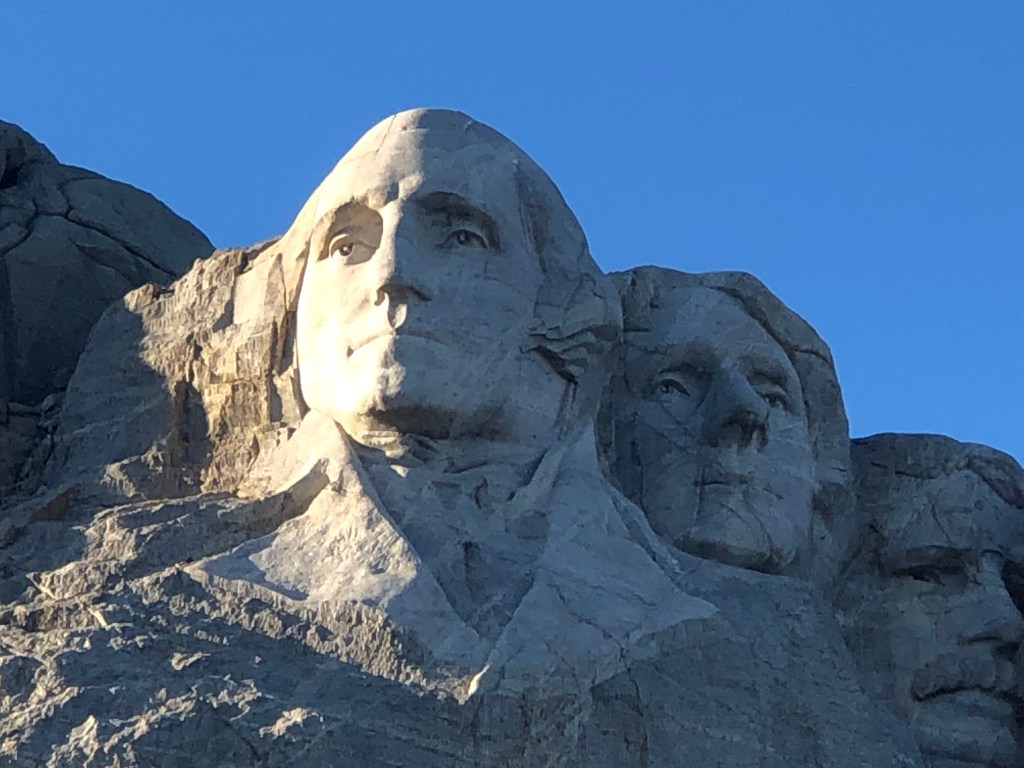
I paid a visit to chilly Mount Rushmore on my last trip to South Dakota and was stuck by the way the sunlight hit Washington’s face, casting it half in light and half in shadow. It occurred me how little I knew of our first president, whose birthday–with characteristic American efficiency–we combine with Lincoln’s to produce a three-day weekend.

Mount Rushmore

To remedy my lack of knowledge–and perhaps because Americana takes on added interest when you live abroad–I read a biography of our first president.1 And it stuck me just how fortunate those thirteen colonies were to have a man like George Washington as their leader.

Continue reading “Washington’s Birthday”