In case you missed it, an essay of mine appeared recently in issue 19 of The Lamp, a relatively new Catholic magazine full of interesting and thoughtful writing (if I do say so myself).
“Public apologies for historical wrongs have multiplied in recent years… Yet we do not seem to have become a more reconciled and understanding society.”
This particular essay, “Confessing Other People’s Sins,” is among the most important things I’ve written. The essay draws on a lot — my experiences in South Dakota, as a confessor, and studying theology.
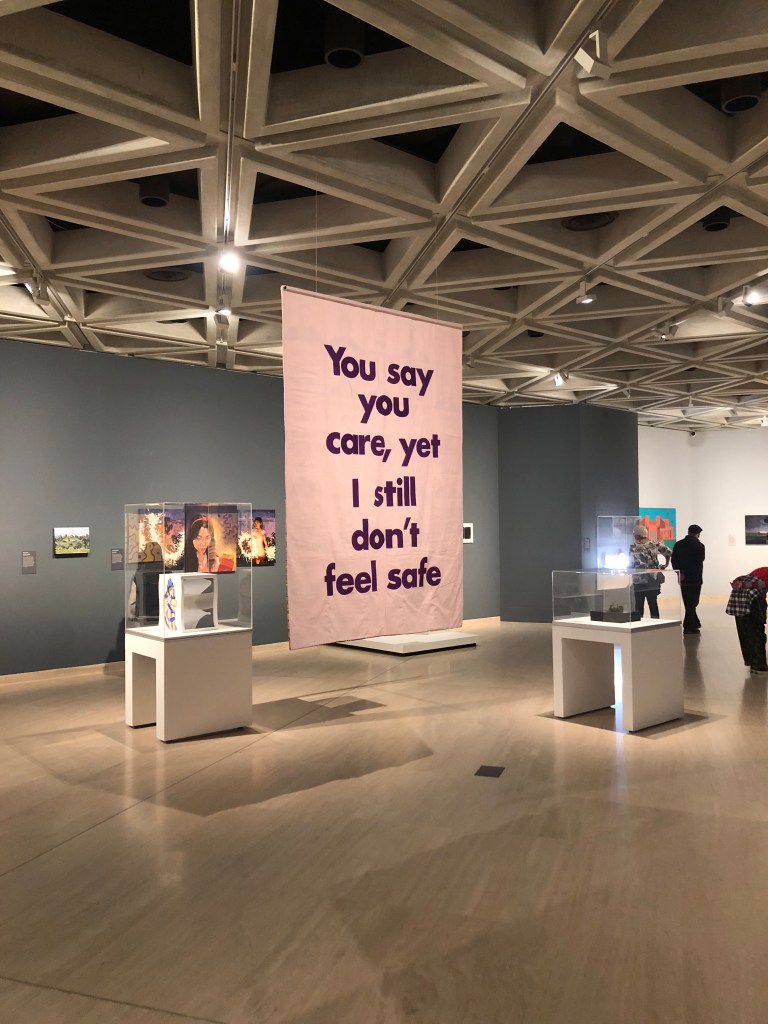
A couple of weeks ago I visited the Art Gallery of Western Australia, not very far from here, and I was moved by an exhibition of works by young artists, Year 12 Visual Arts graduates, from here in WA. In addition to the talent of these young people, I was moved—even disturbed—by the pain that I saw expressed in their work. Not youthful idealism, but pain.
Western Australia Pulse 2023 Exhibition, Perth
The pain that I saw expressed so honestly in art was not from material deprivation. These young artists enjoyed all the advantages and opportunities of a state-of-the-art education system. No generation has ever had the material advantages we enjoy today in the West. Yet as I have traveled in America, in Australia, in Europe I have felt what I think many people today perceive, an ache, an emptiness—sometimes a sense of rootlessness, sometimes a vague, unspecified guilt, often a lack of purpose and meaning. We claim to be free, yet fear of giving offense suffocates us. We are hyperconnected through media and gadgets, yet no generation has ever been so lonely. We boast of the diversity of our societies, yet we barely speak to those with whom we disagree. Something is wrong, something is missing—something at the root of the hurt expressed in those young artists’ work.
In the popular culture of the West, the spiritual void is inescapable. We have uncountable comforts. In fact, I don’t think that our most characteristic compulsion is to acquire more stuff. Instead, today, we are addicted to being entertained. But our entertainment does not lift the soul—it is not like the art of Michelangelo. It just keeps us occupied and keeps us paying. How could we, beings created in the image of God, find this satisfying?
In the West today, pessimism is warranted. Suicide, crime, and drug use are up; birthrates are down. In America, woke excess has undermined much of the progress made toward racial reconciliation over the course of the last century. The decline in religious practice has eroded those values that transcend political conflict and material consumption; we’re losing the shared cultural language with which we could talk to one another about matters touching on the common good. In the absence of a common cultural narrative and shared values, tribal loyalties have filled the void, becoming our false gods.
I don’t think it disloyal to admit that the Church has not adequately responded to the West’s malaise. Faced with Covid, we closed shop. Rome these days sometimes seems to be swimming in nostalgia for the 1960s. No doubt it was more pleasant to be a young cleric in the heady days of Vatican Council II–at least, before the seminaries emptied–but those are not our days.
Half a century ago, perhaps, Catholics in the West could still see their societies as Christian, though ones that were rapidly changing. So it seemed reasonable enough to hope that with a bit of updating around the edges, a little accommodation to the Zeitgeist, we might experience a new flourishing of Christian life. That didn’t happen, and it is no longer reasonable to expect that it will. We need a new response to today’s reality.
A recent article by Sydney’s Archbishop Anthony Fisher The West: Post- or Pre-Christian? provides a helpful, nuanced diagnosis of where we are.
I don’t have much time for leisure reading this semester, but I was pleased to pick up Lee Oser’s witty satire Old Enemies as I settled back into Roman life last month. It’s both funny and thought-provoking. In fact, you can read the thoughts it provoked in my review “Hope in the Ruins” published at Law & Liberty. I also muse about what grounds we have for hope during the West’s current self-destructive cultural moment.
This article by Richard Doerflinger in America magazine “The U.S. bishops aren’t the extremists in the abortion debate” makes what I think are some very important points about the Catholic Church’s teaching on abortion and public policy. It answers a few questions I’m sometimes asked and clears up some misunderstandings.
Catholic teaching does, in fact, allow for an incremental approach to ending abortion, as Pope St. John Paul II taught in Evangelium Vitae, 73. This means that, while Catholic politicians can never legitimately vote for more permissive abortion laws, they can in good conscience make reasonable compromises when advancing pro-life legislation.
I know it’s not an official day on the Church’s liturgical calendar, but today is Notre Dame’s opening football game. And it’s a big one, not least because ND’s new coach Marcus Freeman is squaring off against his former team, the #2 Ohio State Buckeyes. Unfortunately, I’ll be somewhere over the Atlantic during the game–oh, the sacrifices of religious life!
For your game day spiritual reading, I’d recommend this article and interview in the National Catholic Register: Coach Marcus Freeman Talks Faith, Fatherhood and Notre Dame Football. He has wise words on all of those subjects, and I was particularly struck by his unabashed embrace of ND’s Christian identity: “I want our guys to wonder about what it means to embrace Jesus Christ.” Maybe he could take over “Mission and Identity” at our Jesuit universities too.
Not long ago, at dinner in my community in Rome, which houses Jesuits from maybe 30 different countries, one of my brothers from Columbia was talking with one of my brothers from Poland about the different things people eat around the world, and he mentioned hearing that in parts of Asia people eat dog meat. And another of my brothers from the Philippines, who is normally very quiet, looked up from his plate and said, “Oh, yes, very good,” and then he went on with his meal.
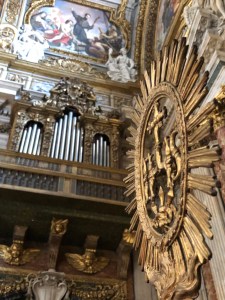
Altar of St. Francis Xavier, Gesù Church, Rome
There is no more diverse an organization in the world than the Catholic Church. Not only do Catholics come from different countries and races and language groups, but the Church includes saints of different historical periods, the great cloud of witnesses mentioned by the letter to the Hebrews last week. The martyrs of first century Rome, of seventeenth century Japan, of 20th century Spain and Mexico, and, in our still-young century, of Turkey, Pakistan, Kenya, Nigeria, France and elsewhere could not have been more different culturally or socially, yet they all shared a belief in Catholicism so strong they were willing to die for it. People have indeed come, as the Lord says, from the east and from the west, from the north and from the south to the table in the kingdom of God, around which we gather this morning.
Homily for the sixteenth Sunday in Ordinary Time (C)
This morning, I want to talk about Abraham. For many of us, perhaps, Abraham is like one of those distant relatives your grandmother mentions occasionally but you’re never quite sure how you’re related. Fortunately, it’s easy to see how Abraham fits into the family tree. He’s at the top—Abraham is the patriarch, the father of the Jewish people and also, according to the New Testament, the father of us all in faith.
Caravaggio, Sacrifice of Isaac, Uffizi Gallery, Florence
We find Abraham’s story in the book of Genesis. He lives in that period in history after the fall, when the sin of Adam has left humanity existentially disoriented. It’s the era of Cain and Abel, the Tower of Babel, Noah and the Flood—man is lost, and every turn he makes only worsens his desolation. When I was in the Peace Corps, I was once heating a bucket of water with an electric coil, which was, shall we say, not up to OSHA standards. And without noticing that the plastic safety handle around the coil had melted, I picked it up and gave myself a shock. And in the moments after the shock, everything was fuzzy, and I couldn’t quite tell what had happened or what I was doing—so I picked it up and shocked myself again. And that’s kind of what original sin did to mankind.
Over at America, my friend Rachel Lu has authored the most thought-provoking reaction I’ve seen so far on what appears to be the downfall of Roe vs. Wade, Do we really honor motherhood?. It’s both personal and penetratingly analytical, a thought-provoking lead-up to Mother’s Day.
Roe vs. Wade was a horrific decision in every respect, an act of judicial lawlessness, the fruits of which can be seen in the lawless tactics — from slandering Supreme Court nominees to this week’s leak and violent protests — employed to defend it. Violence begets violence. There seems no line of decency or ethics that Roe’s partisans will not cross to protect it — like a lie that requires a whole string of other lies to keep it going. Listening to the President bluster about having the “right” to abortion-without-limits “because I’m just a child of God, I exist,” one cannot help but wonder, Have you no shame, man?
Rachel’s essay goes deeper than political debates and gets at more complex questions of our social and human identity. There’s plenty in it to challenge everyone’s thinking, including theologians and pro-lifers. It suggests ways in which we’ve ended up with the brutal culture of abortion that has prevailed in Roe’s wake by taking the sacrifices women make to be mothers for granted. I’ll offer just one example, Rachel’s surprising analogy between soldiers and mothers.
At first glance, it might seem strange to compare mothering to soldiering; one involves killing and the other fosters life. In many ways though, the parallels are quite strong. Historically, these are the only two demanding vocations that have been foisted on people in nearly all human societies, with little or no regard for their personal feelings or level of preparation. The demands are daunting, but failure can bring crippling consequences for individuals and society. Motherhood is also like military service in that both require recruits to put their very bodies on the line, running very real risks of disfigurement or death. These remarkable demands are justified in the simplest of terms: They are necessary. Civilization itself is at stake.
I was recently reminded of a post I wrote on the old Whosoever Desires blog eleven years ago. It was prompted by controversy over Mel Gibson and The Passion of the Christ, but the questions it asks are perhaps still worth considering this Spy Wednesday as well…
Nathan’s post on Mel Gibson’s The Passion of the Christ last year generated a lot of discussion and ended with an intriguing question: “Why does Pilate always get so much empathy from us?”
It would be easy, at this point, to start tossing around charges of anti-Semitism, charges which would allow us to feel a certain measure of moral superiority over those less enlightened than ourselves. Then we could pray like the righteous Pharisee, “God, I thank thee that I am not like other men, extortioners, unjust, anti-Semites like Mel Gibson over there” (Lk 18:10).
Throwing around such charges is a way of doing precisely the same thing that blaming the Jews for the crucifixion once did: deflecting guilt from ourselves. I would suggest a far more troubling answer to the question, “Why do we empathize with Pilate?”
Because Pontius Pilate is the character in the Passion who is most like us.