New journal!

It might seem that there’s nothing new under the sun in the world of theology, but that’s not the case. This spring, The New Ressourcement journal launched its first issue. The journal is sponsored by Word on Fire Academic, one of the many great ministries founded by Bishop Robert Barron. In fact, Bishop Barron has an article in the first issue. The editorial staff is an all-star lineup: Matthew Levering of Mundelein Seminary, Jonathan Ciraulo of St. Meinrad Seminary, and my own colleague at the Gregorian University, Aaron Pidel, S.J. The authors represented in the first issue can also all be fairly described as all stars.

Here’s a description of the journal from its website:

The New Ressourcement

 is a quarterly journal of theology and philosophy published by Word on Fire Academic. It serves the Church and the academy by publishing scholarly articles that demonstrate the depth and relevance of the entirety of the Catholic tradition.

This journal aims to sentire cum tota ecclesia, to think with the whole Church as it has ever reflected on the mystery of the Incarnate Christ, as seen in sources that are biblical, patristic, medieval, as well as modern. The journal draws inspiration from, and seeks to continue the work of, previous generations of ressourcement theologians. It shares with them a conviction that the renewal of theology and philosophy occurs by returning to sources that remain inexhaustible. This ressourcement is “new” because we trust that this patrimony is fertile enough to encounter contemporary questions confidently and to illuminate the challenges and opportunities that shape the present age.

https://newressourcement.wordonfire.org
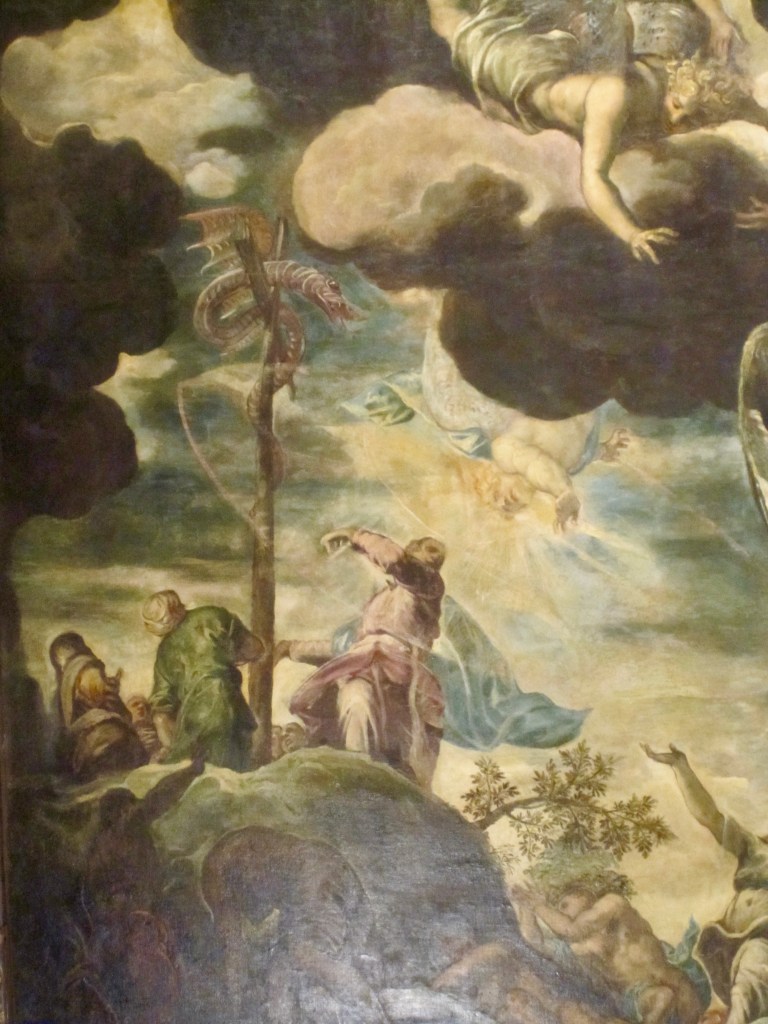
Serpents, Cyrus, and salvation: homily for the fourth Sunday of Lent

Miracle of the Bronze Serpent, Tintoretto (Scuola Grande di San Rocco, Venice, 1564-1587)

Homily for the 4th Sunday of Lent (B)

Today’s readings are a workout.  The serpent in the desert, God’s love and the refusal of many to accept it, faith and works, the prophets, Israel’s exile in Babylon, and King Cyrus, a Gentile who saves the day.  Getting through today’s readings means not just getting in your spiritual steps for the day—it’s more like earning a medal for the decathlon.

For a bit of mid-Lent spiritual exercise, the first image from today’s Gospel is a good place to start.  At first glance, it might seem a bit obscure.  What was Moses doing lifting up a serpent in the desert?  Jesus is referring to an incident during Israel’s wandering in the desert found in the Book of Numbers.  The Israelites, as seems to be their habit, complain against God and against Moses, saying “There is no food” and “We loathe this worthless food.”  The complaint does raise the question, which is it?  Is there no food or just food the Israelites don’t like?  There seems to be a bit of manipulative use of language in the Israelites’ rebelliousness, perhaps even a bit of self-delusion.  The phenomenon is not unique to the ancient world.  Today our political and social divisions are often made worse because we use exaggerated terms to describe our opponents and their intentions—or to mask uncomfortable facts we do not want to hear—and then we start to believe our own rhetoric.  The result is poisonous.  And, in fact, in the Book of Numbers, God punishes the people of Israel for their rebellion by sending fiery serpents to bite them.

Continue reading “Serpents, Cyrus, and salvation: homily for the fourth Sunday of Lent”

Santa Maria in Cosmedin – home to St. Valentine

Santa Maria in Cosmedin, Piazza della Bocca della Verità, Rome

It’s not one of Rome’s station churches, but Santa Maria in Cosmedin was one of my stops as Lent began this year because of the coincidence of Valentine’s Day falling on Ash Wednesday. A college English professor once advised me that in literature love and death are always intertwined, and this year’s liturgical calendar seems to add an exclamation point to the theory. What does all of this have to do with Santa Maria in Cosmedin, a twelfth century Roman church a stone’s throw from the Circus Maximus?

Well, Santa Maria in Cosmedin is home to the relics of St. Valentine. And, given his current appearance, I’d say Valentine drives home Ash Wednesday’s message pretty well. Not much is known about his life; Valentine was third century Roman priest martyred for continuing to minister to his flock in the midst of persecution. A note near his altar says the saint has been turned to not only for love, but as an intercessor in times of plague.

The relics of St. Valentine — romance abounds!

The church itself is rather fascinating. The current building, with its stubby façade and soaring bell tower, dates from the 12th century but was built on the site of an eighth century diaconia. Diaconia were the Catholic Social Services hubs of their day, centers where various forms of charity were distributed to the needy. Today the church is home to Rome’s Melkite community.

Continue reading “Santa Maria in Cosmedin – home to St. Valentine”

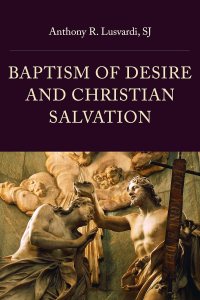
Baptism of Desire and Christian Salvation

My book Baptism of Desire and Christian Salvation is now available to order, though its shipping date will be a little later. Its official publication date was originally last Friday but now seems to have been bumped to March. I’ve been working on the topic of baptism of desire since my STL studies at Sant’Anselmo–a good six years ago–so it has been a long time coming. I think the result says some important things for Catholic theology and the evangelizing mission of the Church. So let me assure you, it’s worth the wait!

I’ll have more on the topic to say, of course, and I’ll share the reactions of others to the book so you don’t have to take my word for it. For now I’ll just share the official description from Catholic University of America Press. The book is available directly from CUA’s website as well as other online booksellers such as Amazon. This spring CUA is offering a 20% discount on new books with the promo code CT10. Make sure that your library gets a copy, too!

Baptism of Desire and Christian Salvation. Belief in the necessity of baptism for salvation is rooted in the New Testament and was forcefully affirmed by the Church Fathers, yet today this belief is treated with unease if not ignored altogether. Over the course of centuries, Catholic theology has wrestled with a doctrine—baptism of desire—that both preserves this fundamental principle and allows for salvation in hard cases, such as catechumens dying unexpectedly. Baptism of Desire and Christian Salvation traces this doctrine’s varied history, from its genesis in a fourth century funeral oration given by Ambrose of Milan to its uneasy position in the Anonymous Christianity of Karl Rahner. 

More than a history, however, this book raises questions about the nature of religious ritual and the sacraments, the mission of the Church, and the essence of salvation. Arguing that theologians of the past two centuries have tended to downplay the role of the sacraments when discussing salvation, Lusvardi suggests that baptism should remain our theological starting point. Engaging with the theological tradition and at times challenging the conventional wisdom, Baptism of Desire and Christian Salvation shows how such a sacramental approach can offer credible—and sometimes surprising—responses to questions related to the salvation of non-Christians, the fate of unbaptized infants, and the relevance of the Church’s mission today.

Praying for confusion

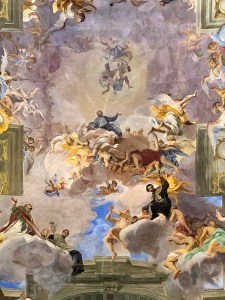
Church of St. Ignatius, Rome

One of the more puzzling turns of phrase in the Spiritual Exercises comes early in the First Week when St. Ignatius directs the person making the Exercises to ask God for “shame and confusion” for one’s sins (48). Shame I get; we ought to feel ashamed for our sins. If we say someone has no sense of shame, it means his conscience isn’t working. But confusion?

Confusion seems to cut against the whole thrust of the Spiritual Exercises and, indeed, Ignatian discernment in general. Isn’t the whole point of doing the Exercises to see the world more clearly, to cut through the illusions thrown up by the Evil Spirit in order to make good decisions and then stick to those decisions with confidence? Confusion is what we feel when we’re lost.

Continue reading “Praying for confusion”

Be made clean: Homily for the Sixth Sunday of Ordinary Time

Homily for the Sixth Sunday of Ordinary Time (B)

Five years ago, if we had read this passage from Leviticus, we might have looked rather harshly at the Old Testament rules for the treatment of lepers.  Making a man shout “Unclean, unclean!” and dwell apart, outside the camp—quarantined—might have seemed unenlightened.  

Church of St. Ignatius (ceiling), Rome

Four years ago, about this time of year, all those purity laws in Leviticus started to look a lot more familiar.  We made each other dwell apart outside the camp, in quarantine, not because a scab or pustule or blotch had appeared, but because it might, you never know, you can never be too safe.  Suddenly those purity laws were not so unreasonable after all.

When we read the Gospel, we usually imagine that of course we would take the side of Jesus instead of the Pharisees.  But I wonder.  Look at Jesus in today’s Gospel passage.  No six feet of social distancing, no mask, no respect for the opinion of the experts, touching the infected without hand sanitizer before or after—would we really take the side of Jesus?

Continue reading “Be made clean: Homily for the Sixth Sunday of Ordinary Time”

From John Paul II’s “Letter to Artists”

Every genuine artistic intuition goes beyond what the senses perceive and, reaching beneath reality’s surface, strives to interpret its hidden mystery. The intuition itself springs from the depths of the human soul, where the desire to give meaning to one’s own life is joined by the fleeting vision of beauty and of the mysterious unity of things. All artists experience the unbridgeable gap which lies between the work of their hands, however successful it may be, and the dazzling perfection of the beauty glimpsed in the ardour of the creative moment: what they manage to express in their painting, their sculpting, their creating is no more than a glimmer of the splendour which flared for a moment before the eyes of their spirit.

Believers find nothing strange in this: they know that they have had a momentary glimpse of the abyss of light which has its original wellspring in God. Is it in any way surprising that this leaves the spirit overwhelmed as it were, so that it can only stammer in reply? True artists above all are ready to acknowledge their limits and to make their own the words of the Apostle Paul, according to whom “God does not dwell in shrines made by human hands” so that “we ought not to think that the Deity is like gold or silver or stone, a representation by human art and imagination” (Acts 17:24, 29). If the intimate reality of things is always “beyond” the powers of human perception, how much more so is God in the depths of his unfathomable mystery!  […]

Beauty is a key to the mystery and a call to transcendence. It is an invitation to savour life and to dream of the future. That is why the beauty of created things can never fully satisfy. It stirs that hidden nostalgia for God which a lover of beauty like Saint Augustine could express in incomparable terms: “Late have I loved you, beauty so old and so new: late have I loved you!”

From Pope St. John Paul II, Letter to Artists (1999)

Saint Emilianus of Trevi

St. Emilianus of Trevi is perhaps destined to be overshadowed by St. Thomas Aquinas with whom he shares a feast day, January 28. He was one of the many bishops martyred during Roman persecution who provided inspiration and strength to their local communities but today are little know, the details of their biographies mingled with legend.

From the Martyrdom of St. Emilianus of Trevi, 12th century, Spoleto

I came across a striking set of 12th century carvings depicting the martyrdom of the saint in Spoleto last year and was taken by their vividness. St. Emilianus hailed originally from Armenia and came to Italy in the third century, where he was made the first bishop of Trevi. He was martyred during the persecution under Emperor Diocletian in 304, and his relics are preserved in Spoleto Cathedral.

He was condemned to die by a Roman proconsul for his refusal to sacrifice to the gods, but–as the panels from Spoleto recount–the first attempts to put him to death failed. The wild beasts sent to kill him instead bowed before him, and when he was tied up to be burnt the torches of his would be executioners fizzled out as they approached him. Finally, he was beheaded. The last panel of the work depicts Christ enthroned in heaven welcoming the martyr.

The Virtue of Penance

Last week, I mentioned the seminar I taught this past semester about the sacrament of marriage. I also taught a course about the sacrament of penance. (I learned to be careful when describing my course load to make clear that those were, in fact, two different courses and not a sly commentary on marriage!)

Jonah sarcophagus (ca. AD 300), Vatican Museums

The sacrament of penance has a fascinating history, and the way in which it has been practiced over the centuries has varied more than perhaps any other sacrament. A major theme of the class, however, was that the sacrament itself is not the only way that Christians practice penance. As Thomas Aquinas pointed out (in the Summa Theologiae III q. 85), penance is not only a sacrament but also a virtue. He didn’t come up with that particular insight himself, of course, but was summarizing the theological tradition before him.

Continue reading “The Virtue of Penance”

The Future of Christian Marriage

This week marks the end of the first semester at the Greg. One of the semester’s blessings has been the seminar I taught on the sacrament of marriage, which looked first at some classic theological texts on the subject and then attempted to grapple with the contemporary problems the Christian vision of marriage faces. No small task, and I learned much from the discussion. I’m grateful to my lively group of students.

To guide our discussion I assigned sociologist Mark Regnerus’s engaging and insightful book The Future of Christian Marriage (Oxford 2020). The book makes use of social surveys, Regnerus’s own extensive research on the subject, and 200 interviews conducted with young Christians in seven different countries. My students–who hailed from a total of eight different countries–found the book quite helpful for understanding the situation they themselves face. Having real-world data also improved our theological discussion, which, in today’s climate, can sometimes get bogged down in sloganeering.

At the root of Regnerus’s argument is the contention that attitudes toward marriage have changed from seeing it as a “foundation” to seeing it as a “capstone.” In other words, instead of a unit based on mutual exchange that helps a couple to weather life’s uncertainties, young people have increasingly come to see marriage as a capstone one acquires only after attaining personal, financial, and career success. This means that marriage is delayed, comes with more difficult-to-realize expectations of one’s spouse, and, for many, ultimately becomes unattainable. This is all part of the “atomization” of society as individuals become our primary social grouping at the expense of families.

Continue reading “The Future of Christian Marriage”