Homily for the Fifth Sunday in Ordinary Time (Year A).
After the Christmas break another Jesuit in our community returned to Rome after having had corrective eye surgery. The surgery went so well that for a week after he returned, he wore sunglasses at all times of day, even indoors; of course, we gave him a hard time about imagining that he had become a movie star. What happened was that, with his vision corrected, at first his pupils were letting in too much light—so much light that he couldn’t see. For our eyes to work, we need light, but we also need contrasts. Some parts of our field of vision must be lighter or darker than others, otherwise we’ll end up falling down the stairs and running into walls.
If there is no light, of course, we cannot see. But too much light can blind us too. In the Biblical world, before electric lighting, the risk of darkness was almost always greater than having too much light. In the Bible the metaphor of light is usually good, though occasionally the light of God is overwhelming—think of Jesus appearing to St. Paul on the road to Damascus. Paul is knocked over and blinded by the vision. If we were to be hit right now with heaven’s light in all its purity, we would probably be paralyzed too. In order to experience that light, we need to grow, to be re-formed—the same way my confrere’s eyes had to convert after surgery and our own eyes have to adjust when we step outside at midday. We might, in fact, say that God’s light shines even on those in hell, and that their darkness is the result of eyes grown used to the shadows, forever unwilling to adjust to the daylight. However, this world in which we live right now contains both light and darkness. In order to navigate in this world, we need to be able to recognize the contrasts.
When Jesus says “you are the light of the world,” he is talking about this world of contrasts, a world in which the light is often lacking. When he says, “you are the salt of the earth,” he is making a similar point. Food typically contains only a little salt—a pinch or a teaspoon—but that’s enough to give it flavor. With these metaphors, Jesus seems to have a particular problem in mind. He warns against salt that loses its taste, just as he warns against hiding our lamp under a bushel basket. He is worried about the problem that goes along with being a minority—with being a dash of salt in a pot of soup. He is worried about salt that becomes so diluted you can no longer taste it. The temptation when you are a religious minority is of simply blending in; or, if you like, of shading our light so as not to startle the majority living in the shadows. The image of the lamp presupposes that it is dark, that the world around us needs the light to see.
The images that Jesus uses tell us not to be afraid of contrasts and perhaps to be a little suspicious when our lives and beliefs start to look just like those who do not acknowledge Jesus as Lord. It’s worth noting that Jesus is not endorsing unnecessary combativeness. Some people have argumentative personality types, but Christianity is not a personality type. In today’s reading from Isaiah, the Lord recommends acts of mercy that will make his people shine in the gloom—feeding the hungry, sheltering the oppressed and homeless, clothing the naked.
But Isaiah speaks about more than simply doing these good works. Isaiah speaks of “the glory of the Lord” and of crying out to him, of that unique relationship which God makes possible through his self-revelation. The Lord’s is not an invitation to a mere social activism. It’s possible to be activists for bad causes, too, and to mix good works with evil; we might think of Hamas providing social services but also murdering people. Isaiah adds an instruction about necessary moral cleansing. Your light will only shine, he says, “If you remove from your midst oppression, false accusation and malicious speech.” The context for Jesus’ sayings about salt and light is the Sermon on the Mount, in which he exhorts his disciples to eliminate lust, anger, envy, and deceit from their actions and even from their thoughts.
To use a more modern word, Jesus is talking about integrity. Integrity is a virtue that I think Christians need particularly in today’s social circumstances. Most of us live in societies that were once—and even recently—shaped deeply by Christianity but have come to be characterized today by religious indifference, materialism and consumerism, and a constantly mutating array of noisy ideologies. Is there any better image for religious indifferentism than salt that has lost its taste? Over the centuries, we Christians in the West grew used to thinking of ourselves as part of the cultural majority, which means we tend to be complacent and naïve about what it takes to keep our lamp burning. We are habituated to just blending in. We have forgotten what it takes to survive as a minority—and remember that the Lord tells us not just to survive, but to shine. Integrity—consistency and tenacity in following the teachings of Jesus—is necessary to shine. We need not be combative, but we cannot compromise with the shadows. When the world says one thing and the Church says another, when whatever ideology we find most attractive demands our absolute loyalty, we must answer with a bit of saltiness. We must be prepared to answer, like Joshua in the Old Testament, “You are free to do as you like. As for me and my house, we will serve the Lord” (cf. Jos 24:15).
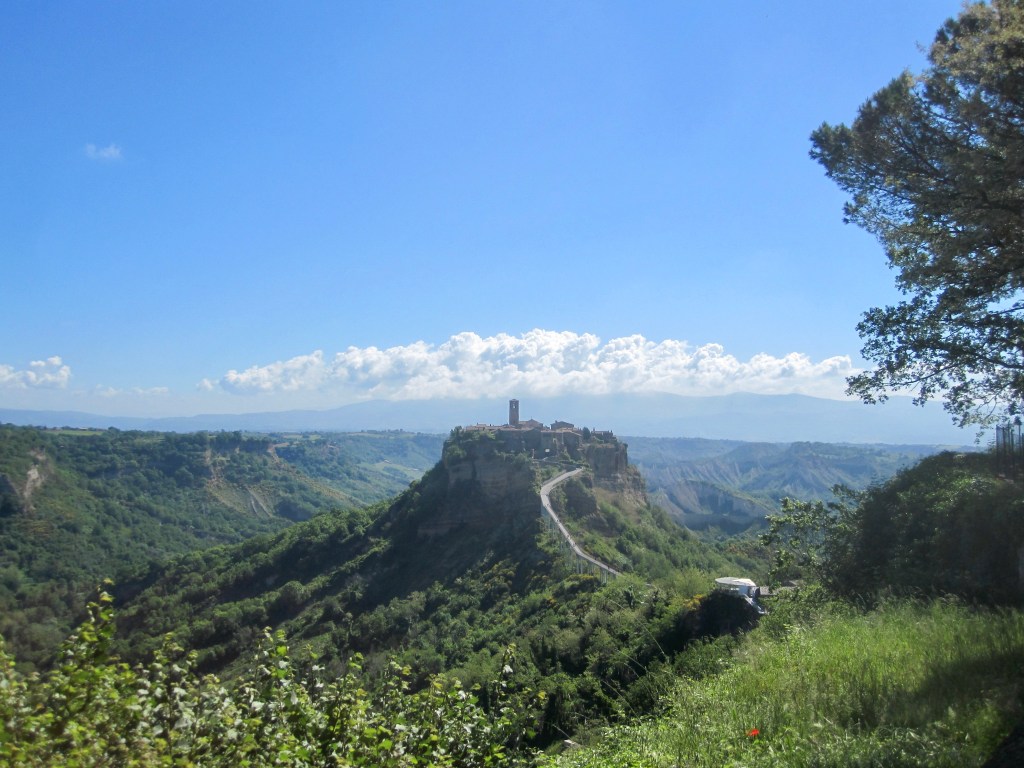
Salt, light. Jesus adds one more image in today’s reading: a city on a mountaintop. People do not build cities on mountaintops primarily to be seen—though here in Italy we can appreciate how picturesque so many ancient hilltop towns are today. Building a city on a hill requires a lot more energy and effort than dwelling in the valleys. People build cities on mountaintops—at least in Jesus’ day—to defend themselves. Building a hilltop town is not a move made out of fear—it is not the same as running away and hiding—nor an act of aggression—invading the neighboring town before they get to us. It’s an act of determination, something that doesn’t preclude—as all those lovely Tuscan hilltop towns demonstrate—the development of beauty, culture, and hospitality. But it does require a certain extra effort, a certain self-discipline and self-confidence, a clear vision of the terrain, and a willingness to endure a certain isolation if it comes to that. It is an image of integrity.
The Lord uses a lot of images to teach how us to cultivate this integrity. With these images he tells us to stay strong, to stay bright, to stay salty—perhaps we could say to stay fresh. Elsewhere he says to be as wise as serpents and as innocent as doves (Matt 10:16). We may dwell in the mountaintops or on the plains, in different cultures and different circumstances. Always he tells us to stay faithful to him.
Readings: Is 58:7-10; 1 Cor 2:1-5; Matt 5:13-16
February 8, 2026
Oratorio San Francesco Saverio del Caravita
Rome
Support this blog by subscribing!

 Tony Lusvardi, S.J.