Homily for the Feast of the Holy Family (Year A). Original Italian.
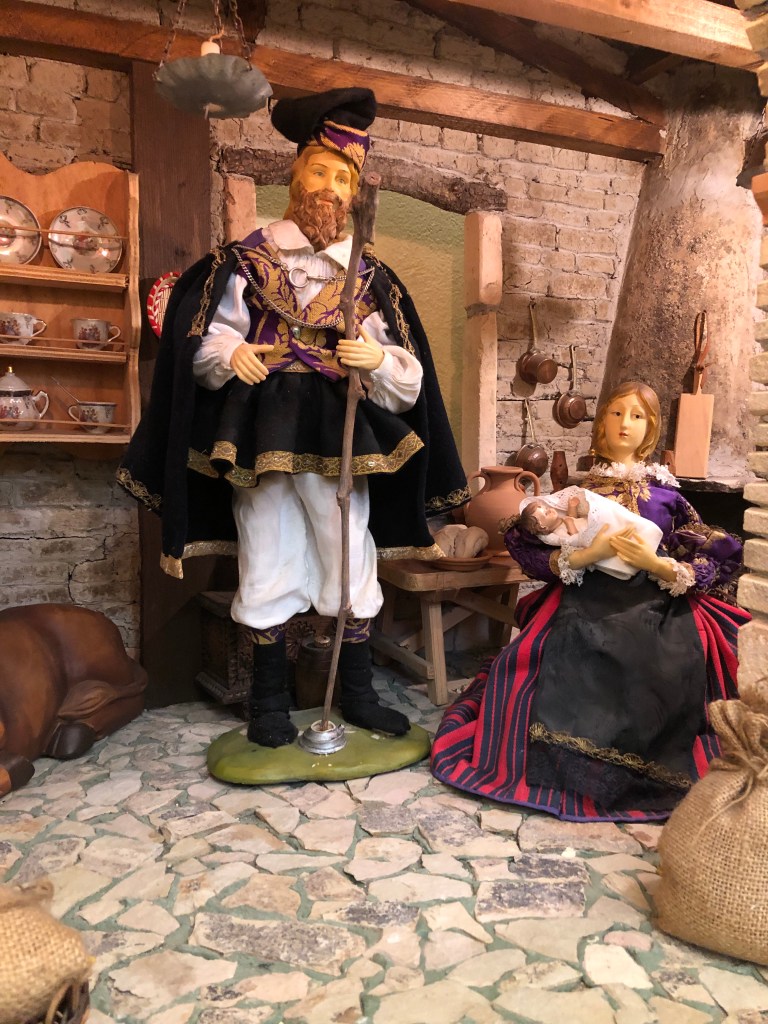
Today we celebrate the story of one particular family—and the story of every family.
On the one hand, the story of the Holy Family of Jesus, Mary, and Joseph is absolutely unique. There is no other historical event comparable to the Incarnation of the Son of God, and the birth of Jesus is surrounded by other miraculous events—the appearance of the archangel Gabriel, the angelic messages that come to Joseph in dreams, the arrival of the Magi, the adoration of the shepherds—which highlight the unique identity of Jesus Christ. Furthermore, Jesus is divine, Mary is immaculate, and Joseph is holy; therefore, this family is threatened by sin, but always from outside. Herod’s envy is one example.
In our families, however, we must admit that often the most damaging wounds are caused by our own sins. Nevertheless, I do not believe that this difference—the holiness of the Holy Family—creates a distance between them and us, because all the actions of the Holy Family are done for us. They are a guide, a support, and a source of hope for us.
Joseph and Mary faced great challenges: an unexpected pregnancy that changed all their plans, the misunderstanding of their neighbors, a period of extreme poverty, danger, a threat to their child’s life, exile; and then all the daily challenges, including—if we think of Jesus’ disappearance in the temple—the difficulties of communication that sometimes occur even between people of good will. At the same time, the Holy Family experienced unexpected joys, tenderness, the celebrations of their religion, and belonging to their people. They experienced the fullness of family life.
Their particular experience offers us inspiration and encouragement to live our Christian mission fully, despite the challenges.
Today’s Gospel passage emphasizes Joseph’s role in a special way. Starting with the most obvious: Joseph is the man of the family, he is the father—even if not biologically—and his example teaches us what it means to be a man.
His example is by no means obvious today, at a time when there is much talk of “toxic masculinity,” a selfish and destructive masculinity. St. Joseph, on the other hand, is the example par excellence of authentic masculinity. He is not a man of many words—the Holy Scriptures do not record any of his words—but he knows how to act when necessary. This does not mean that he never had doubts, but he listens to the voice of God, he listens to the voice of conscience, and he puts the good of his family first. When his family is in danger, he does not hesitate to protect them, even when this means fleeing to Egypt, a foreign land. He does not act for his own interest, but for the good of others, of those entrusted to him. In this willingness to sacrifice himself for others, we see, I believe, the paternal vocation, true masculinity.
This willingness to live for others, to act for others, to sacrifice oneself for a mission greater than oneself—expressed in different ways—is at the heart of every Christian’s mission and is the bond that holds the Christian family together, as we read in St. Paul’s letter to the Colossians.
There is another lesson that is particularly evident in the story of the Holy Family, which today is obscured by certain ideological currents: a child is a gift. In consumerist societies, we sometimes forget that every child is a gift. Not a product to be manufactured in a laboratory according to our specifications, nor the last experience to be obtained after having exhausted all the other possibilities offered by youth. A child is a gift because he or she is created—from the first moment of conception—in the image of God. Even when he or she does not arrive according to our plans, even when he or she is unexpected, every child is always a gift.
Perhaps we find it difficult to accept this truth because a gift is not something we can control. It is not something we buy, but something we receive. And we are afraid of what we cannot control. The story of Mary and Joseph is a story of overcoming fear, a story of courage. When Gabriel appears to Mary, he says to her, “Do not be afraid.” And the angel who appears to Joseph in a dream says the same thing to him: “Joseph, son of David, do not be afraid to take Mary as your wife.”
Perhaps even today fear remains the greatest obstacle for the Christian family: fear of the gift, fear of commitment, fear of giving oneself to another. The irony is that in the West we enjoy economic and social well-being unprecedented in human history, and yet we are paralyzed by fear, especially in the family sphere.
Today, many couples are afraid of commitment—of the “yes forever” of marriage—but another irony is that the relationships that result from such fear of commitment do not offer the advantages of marriage, but rather the disadvantages. The separation rate among couples who cohabitate before marriage is higher than among those who marry before living together. In Europe, children born to cohabitating couples are twice as likely to experience family breakdown as those born to married couples. It is not good to start a relationship with a fearful and tentative “yes,” treating the other person as a product to be tried out rather than as a son or daughter of God, worthy of absolute respect and the commitment that such respect entails.
It seems to me that Joseph and Mary faced more obstacles than the average family. The Bible does not describe their inner struggles, but we can imagine them. Even more than obstacles, however, the Holy Family shows us the way of hope—a path not without dangers, of course; a path that requires commitment, fidelity, generosity, and courage; but also a path rich in unexpected graces.
The example of the Holy Family teaches us that, in giving ourselves, we discover the greatest gift in the world.
Readings: Is 62:11-2; Tt 3:4-7; Lk 2:15-20
(Original: Italian)
December 28, 2025
SS. Vergine degli Angeli
Maracalagonis, Sardinia

 Tony Lusvardi, S.J.