Homily for the Feast of the Holy Family

Homily for the Feast of the Holy Family (Year A). Original Italian.
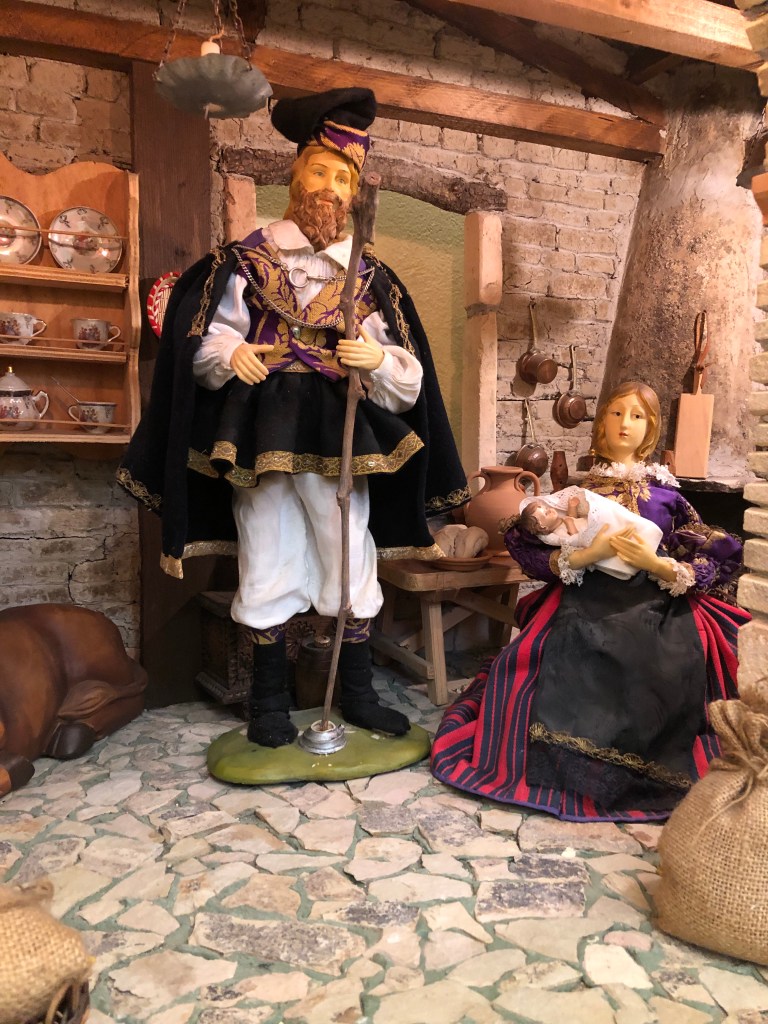
Sardinian Nativity scene, Maracalagonis (Sardinia)

Today we celebrate the story of one particular family—and the story of every family.

On the one hand, the story of the Holy Family of Jesus, Mary, and Joseph is absolutely unique. There is no other historical event comparable to the Incarnation of the Son of God, and the birth of Jesus is surrounded by other miraculous events—the appearance of the archangel Gabriel, the angelic messages that come to Joseph in dreams, the arrival of the Magi, the adoration of the shepherds—which highlight the unique identity of Jesus Christ. Furthermore, Jesus is divine, Mary is immaculate, and Joseph is holy; therefore, this family is threatened by sin, but always from outside. Herod’s envy is one example.

In our families, however, we must admit that often the most damaging wounds are caused by our own sins. Nevertheless, I do not believe that this difference—the holiness of the Holy Family—creates a distance between them and us, because all the actions of the Holy Family are done for us. They are a guide, a support, and a source of hope for us.

Joseph and Mary faced great challenges: an unexpected pregnancy that changed all their plans, the misunderstanding of their neighbors, a period of extreme poverty, danger, a threat to their child’s life, exile; and then all the daily challenges, including—if we think of Jesus’ disappearance in the temple—the difficulties of communication that sometimes occur even between people of good will. At the same time, the Holy Family experienced unexpected joys, tenderness, the celebrations of their religion, and belonging to their people. They experienced the fullness of family life.

Their particular experience offers us inspiration and encouragement to live our Christian mission fully, despite the challenges.

Continue reading “Homily for the Feast of the Holy Family”

The Vatican Nativity Scene, 2025

Vatican Nativity Scene 2025, St. Peter’s Square

While the tradition of a Nativity display dates back to St. Francis of Assisi, today such scenes are most associated with the city of Naples. There such displays came to include not just the figures of Mary, Joseph, and baby Jesus in a manager, but whole surrounding countrysides and cityscapes crowded with figures and replete with detail. These Neapolitan scenes reached their heyday in the 17th and 18th century and today provide a view into what life was like at that time. They feature all strata of society from nobles and servants to shopkeepers and children.

Continue reading “The Vatican Nativity Scene, 2025”

A Thousand Pounds: A review

The Homiletic & Pastoral Review has graciously published my review of Bri Edwards’s moving book,  A Thousand Pounds: Finding the Strength to Live and Love Under the Weight of Unbearable Loss, which I am reproducing below. (It was Bri who first brought the story of Baby Brian to my attention this past summer.) Check out the other great reviews and articles on the HPR site — and pick up a copy of Bri’s book!

A Thousand Pounds: Finding the Strength to Live and Love Under the Weight of Unbearable Loss is a profound and beautiful book, as hope-giving as it is heart-breaking.  In it, Brianne Edwards, a Catholic mother of six from South Dakota’s Black Hills, tells the story of the death of her son Lachlan to sudden infant death syndrome and the long process of learning to live anew after that loss.

The first part of the book is simply an account of Lachlan’s death.  It is a hard read, told with a directness that gives the reader access to what for most of us is an unimaginable experience.  For those involved in pastoral ministry such an opportunity to walk alongside Brianne and her family through the days of grief and confusion is invaluable.  Alongside Brianne’s own grief we see numerous other people—relatives and friends, a few priests, funeral directors, co-workers and near strangers—come in and out of the picture, often unsure how to react, some helpful and others not.  The author writes with sympathy and understanding even of those who do not quite manage to be helpful, but it is immensely valuable to see and reflect upon the different ways of being present to those experiencing such excruciating loss.

Continue reading “A Thousand Pounds: A review”

The Immaculate Conception: God’s own Advent preparation

Homily for the Immaculate Conception (2019. Note, that year, the Solemnity fell on a Sunday.)

On the first Sunday of Advent, I cleaned my room. I must admit, it needed it—there were coffee stains on the desk; the trash can was overflowing; I found forgotten lists of things not to forget. But Advent is the beginning of a new liturgical year, the season when we prepare for Christmas, and it seemed right to start with a clean room. In the coming weeks, there will be many other things to prepare: food, gifts, decorations, travel.

Column of the Immaculate Conception, Rome

This is the second Sunday of Advent, and normally the readings highlight the figure of St. John the Baptist, who speaks of another kind of preparation, another kind of cleaning—in fact, a much deeper cleaning than coffee stains. John the Baptist warns of the need for inner cleansing, moral and spiritual conversion. And this too is part of the preparation for Christmas. As a confessor, I have to do a little advertising for my profession, strangely absent from all the Black Friday advertising we received last month. But I must say that our special offer—the forgiveness of sins, eternal life—is truly the best deal in the world.

However, this year is a bit special, because this second Sunday of Advent is December 8, the Solemnity of the Immaculate Conception of Mary, the Mother of Jesus. This coincidence of dates is interesting because the Immaculate Conception is also a feast of preparation. But not the preparation we do during this season. The preparation that God has done for us.

Continue reading “The Immaculate Conception: God’s own Advent preparation”