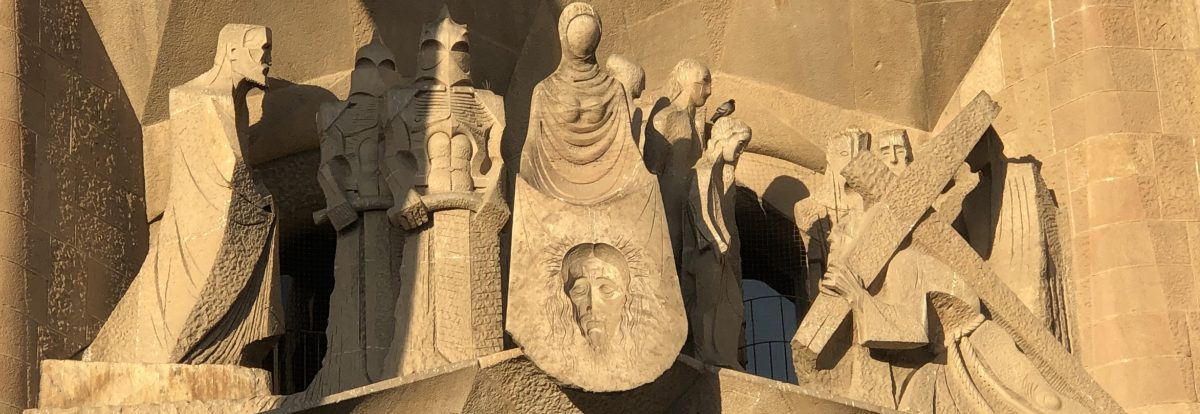
I’m pleased and honored that the Homiletic and Pastoral Review asked me to provide homilies for the Sundays of June this year. You can find the full text of all the month’s homilies here. (Regular readers might note that the homilies may not be as fleshed out as usual since they are meant to be adapted.) Be sure to visit the HPR site and check out the other articles, reviews, and fine catechetical materials they provide. Below, to give you a taste, is a homily for the Seventh Sunday of Easter (for those places where the Ascension is celebrated on its proper Thursday).
Homily for the Seventh Sunday of Easter (C).

Nowhere is Jesus Christ more visible than in his martyrs. In the Gospel of John, Jesus, who makes the Father visible to the world, prays that his disciples may be in him and he in them. In today’s first reading, we see God become dramatically visible in the life of one of those disciples, the deacon Stephen.
First, however, Stephen gazes on God. He sees Jesus standing at the right hand of his Father in the heavens. This vision is made possible by the action of the Holy Spirit, already present in Stephen’s life. In the first part of the chapter from which today’s reading is taken, Stephen delivers a sermon which is both learned and fiery, retelling the story of Israel from a Christian point of view and leveling a hard judgement against the men of Jerusalem who crucified Jesus.
This speech produces the reaction that we see today: the stoning of Stephen at the hands of these same men. Yet Stephen’s boldness is not a mistake. In fact, there’s a hint in the reading that even though Stephen’s persecutors don’t want to hear his message, they still feel the power of the truth it expresses. When they drive him from the city, they cry out in a loud voice and cover their ears. Even when it’s a truth we do not want to hear, the truth is compelling. Those who wish to avoid it do so either by shouting—creating noise to drown it out—or by covering their ears—deadening their senses. Finally, they resort to violence.
Yet, the truth of the Gospel is not silenced. In fact, in Stephen’s death, God becomes more, not less, visible. Stephen’s death itself is Christ-like, mirroring the Lord’s own death on Calvary, his words echoing Jesus’ words from the cross: “Receive my spirit” and “Lord, do not hold this sin against them.” Undergoing a death like Christ’s, Stephen becomes ever more united to Christ. He shows both Christ-like freedom and Christ-like forgiveness.
The second century Church father Tertullian famously called the blood of martyrs the seed of the Church. Certainly, martyrdom requires heroic virtue—courage above all—which even those without faith can recognize as admirable. Those who shed their blood for Christ give the ultimate testimony of their love. They bear witness to the surpassing value of their faith in Christ, the pearl of great price, the one treasure for which it is worth sacrificing everything else. The word “martyr” comes from the word for witness. The death of the martyrs is verification of the credibility of faith.
Finally, I think, Stephen’s death reveals something even deeper about the testimony of the martyrs. Their sacrifice is like a sacrament—Jesus calls his own death and martyrdom “baptism” (Mk 10:38)—in which they enter into communion with him. The words of John’s Gospel point to the communion that we see in those who have united themselves completely to Jesus. In his disciples, we see the Son. In the Son, we see the Father. In martyrdom, the disciples of Jesus are brought to perfection, made one with the self-giving love of Christ that knows no limits.
Readings: Acts 7:55-60; Rev 22:12-14, 16-17, 20; John 17:20-26
June 1, 2025

 Tony Lusvardi, S.J.