
One is always discovering new artists in Rome, and earlier this year, thanks to a special exhibit at the Scuderie del Quirinale and the recommendation of a friend, I discovered Guercino (1591-1666). Born Giovanni Francesco Barbieri in Cento (Emilia-Romagna), he worked in Rome when baroque art was at its zenith.

The exhibit was of particular interest to me because Guercino’s time in Rome corresponded to the period when the Jesuits were also at their zenith. The pope who proved to be Guercino’s great patron, Gregory XV (Alessandro Ludovisi), also favored the Society of Jesus, especially in its mission of spreading Catholicism around the globe.
The Jesuits have often been associated with the baroque because it was the artistic style in vogue around the time of our founding, so our great Roman churches, the Gesù and Sant’Ignazio — and all the other Jesuit churches around the world built to imitate them — are classic examples of baroque architecture.

Something else struck me as I examined Guercino’s work and that of several of his contemporaries. The baroque harmonizes with certain aspects of Ignatian prayer. It is characteristic of Ignatian prayer to put oneself into the Gospel scenes, using one’s imagination to make the scene come alive. With their combination of realism and flare for the dramatic, baroque artists end up doing something similar. For a contemporary sense of what this kind of Ignatian prayer is like, just watch The Chosen since that wonderful series transfers the same kind of imaginative techniques to the screen.
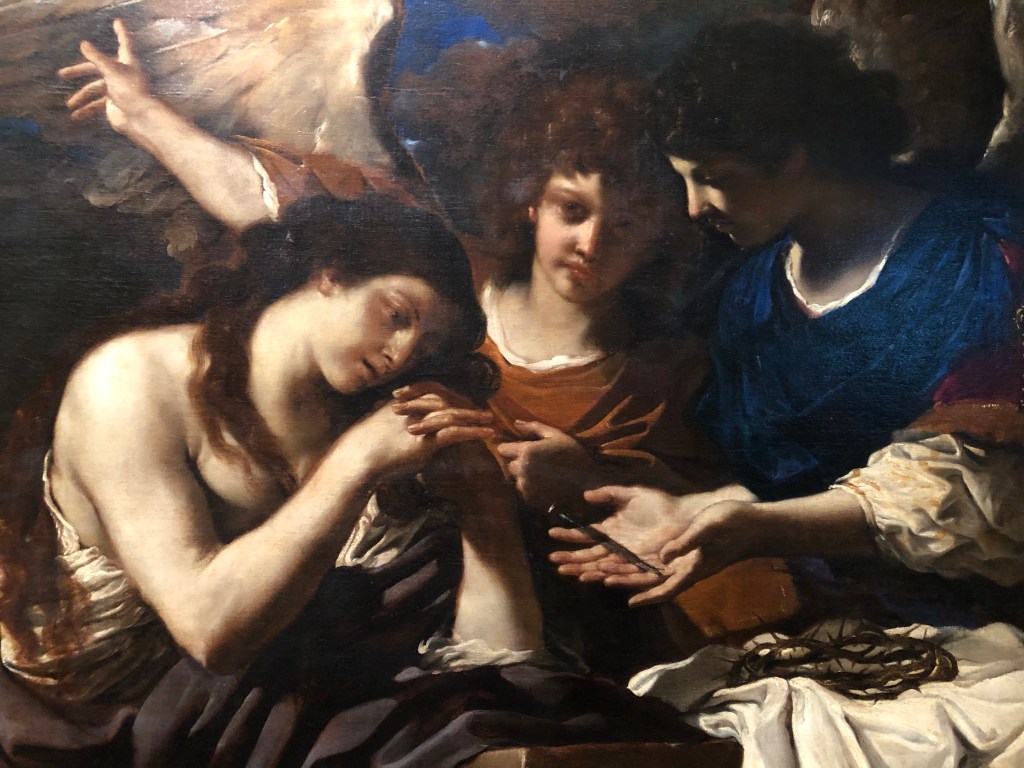
Baroque art may not be to everyone’s tastes aesthetically — it can be overly emotional or just overwhelming — though there is a theological logic at work underneath the physical exuberance. The baroque came at a time — after the arrival of Protestantism — when the sacramental nature of Christianity had been thrown into question. The baroque style — with its color and action — underlines the embodied, incarnational form that redemption takes in the person of Jesus Christ. Ignatius emphasizes the total commitment that Christ calls us to — body and soul, emotions and intellect — and the great Catholic artists of his age tried to create art that would draw its observers fully into the spiritual drama it represented.


 Tony Lusvardi, S.J.
2 thoughts on “Guercino, Rome, and the Jesuit baroque”