A “monumental study… unmatched in what it positively contributes”

With a year approaching since Baptism of Desire and Christian Salvation‘s publication, I’m pleased to see reviews starting to appear. I just read a great one by Joseph Arias of Christendom College in the journal of liturgical theology Antiphon. Arias provides a summary and identifies “controversial” points where I challenge the received wisdom. I’m grateful to have such careful readers and can’t say I mind having the book described as “monumental” and “unmatched”!

Here’s just a sample:

“The author takes the reader on a profoundly illuminating historical and dogmatic theology journey from the apostolic age to our own, acting throughout as an immensely capable and careful guide, making sure we do not miss either major or minor attractions that can enhance the experience of trying to arrive at a deeper understanding of a profoundly significant (though sometimes underappreciated) teaching that is firmly rooted in the Catholic tradition…

… this volume is unmatched in what it positively contributes towards a better understanding of this area of theology.”

And more good news — it looks like the price of the book may have dropped on Amazon as well.

Also, following up on my previous post on the Ukrainian bishops’ statement about the war in their country last week, I have a new piece out on the subject in America. It is equally about what is dysfunctional in our own American political culture right now.

Guercino, Rome, and the Jesuit baroque

Guercino, Moses

One is always discovering new artists in Rome, and earlier this year, thanks to a special exhibit at the Scuderie del Quirinale and the recommendation of a friend, I discovered Guercino (1591-1666). Born Giovanni Francesco Barbieri in Cento (Emilia-Romagna), he worked in Rome when baroque art was at its zenith.

Guercino, Gregory XV, ca. 1621

The exhibit was of particular interest to me because Guercino’s time in Rome corresponded to the period when the Jesuits were also at their zenith. The pope who proved to be Guercino’s great patron, Gregory XV (Alessandro Ludovisi), also favored the Society of Jesus, especially in its mission of spreading Catholicism around the globe.

The Jesuits have often been associated with the baroque because it was the artistic style in vogue around the time of our founding, so our great Roman churches, the Gesù and Sant’Ignazio — and all the other Jesuit churches around the world built to imitate them — are classic examples of baroque architecture.

Guercino, St. Peter Raising Tabitha, 1618
Continue reading “Guercino, Rome, and the Jesuit baroque”

Appeal of the Catholic Bishops of Ukraine

Going through homilies from Lents past, I came upon this post, which happened to date from shortly after the Russian invasion of Ukraine three years ago. The Ukrainian resistance to that invasion, I noted, was something of a jolt to a West that had grown somnolent with self-indulgence, a reminder that some things are worth fighting for.

Just over a week ago, Archbishop Sviatoslav Shevhcuk issued a statement on behalf of Ukraine’s Greek Catholic bishops that should again jolt the conscience of a world gone loopy with self-absorption. “We have not become a people defined by war — we have become a people defined by sacrifice,” the bishops write. For the bishops and for their people, this war is not a card game or great television, not, as the Vice-President of the United States to his great shame recently suggested, a “propaganda tour.”

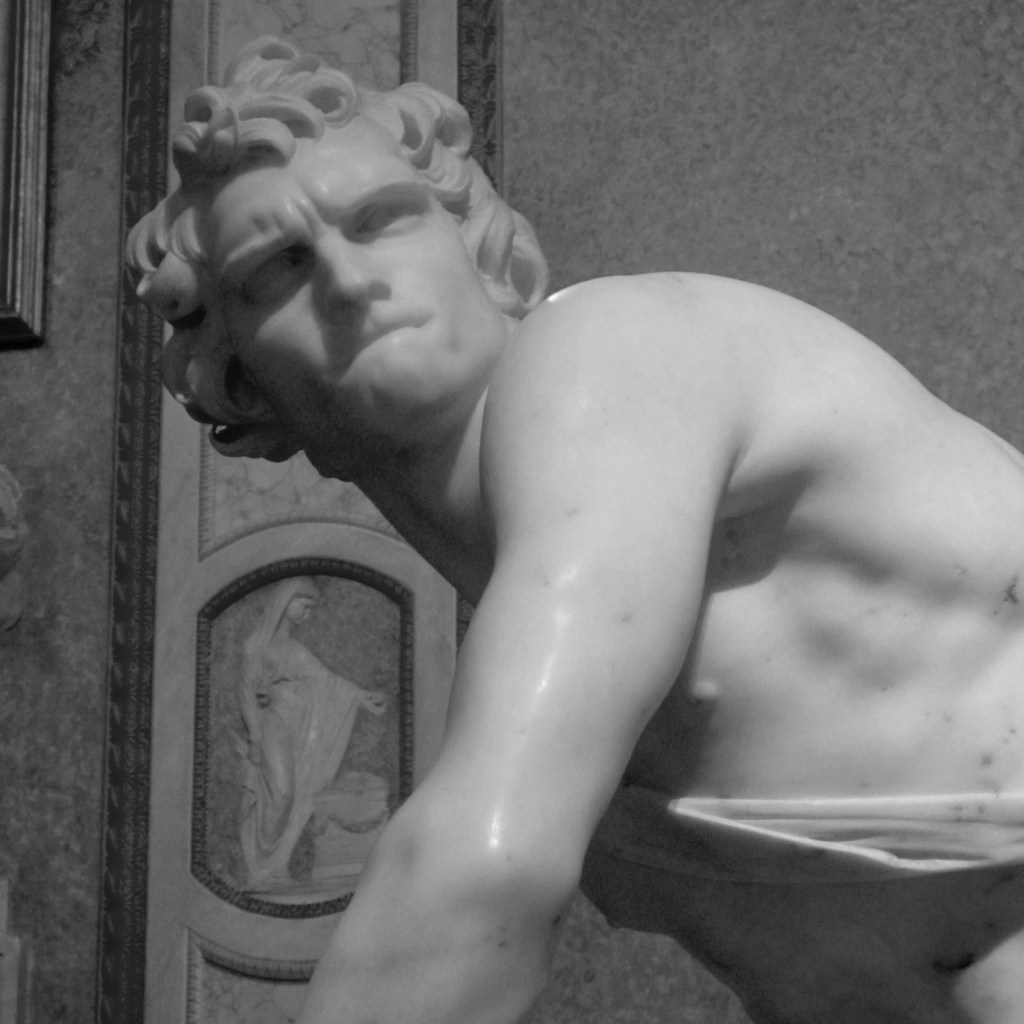
David, Gian Lorenzo Bernini

Noting the staggering trauma and destruction inflicted on their country, the bishops write: “But we have not come to terms with our losses—each one hurts. Every fallen defender, every innocent life lost remains in the memory of God and people. We remember and pray. We support and uphold. We stand and fight, ever mindful of the God-given dignity that no force on earth can take from us.”

It is obvious enough that the bishops want peace, but they also know that “peace” on Putin’s terms does not mean the end of killing Ukrainians, of kidnappings, or of brutality. The bishops know that Russian occupation will almost certainly include the persecution of Catholics; Archbishop Schevchuk was himself targeted for assassination by Russian invaders attacking Kyiv. No serious Christian should be taken in by Vladimir Putin’s pose as a defender of Christian values. His regime and its ideology are idolatrous.

Continue reading “Appeal of the Catholic Bishops of Ukraine”

Seeing truly, judging clearly: homily for the eighth Sunday of Ordinary Time

Homily for the 8th Sunday of Ordinary Time (C)

St. Luke, 13th century, Old St. Peter’s, Rome

I have to admit that the opening of today’s first reading, “When a sieve is shaken, the husks appear; so do one’s faults when one speaks,” is not the most encouraging thing to read when one has to give a homily.  Both the words of Sirach and Jesus’ sayings in the Gospel of Luke deal with what is inside a person and what becomes visible to others, what we see and what we don’t.  The first reading is a warning about putting too much faith in outward appearances.  Someone might have all the right credentials, but little wisdom; someone might repeat all the fashionable phrases, but say nothing of substance.

The test that Sirach proposes to separate the trustworthy from the slick shyster is tribulation.  “As the test of what the potter molds is in the furnace, so in tribulation is the test of the just.”  It is easy to follow Jesus when he tells us what we want to hear, less so when we might lose friends because of what he says.  Fidelity doesn’t mean much when it comes without a cost.  Imagine marriage vows modified to promise faithfulness “in good times but not bad, in health but not sickness, wherever I find my bliss.”  It’s only when the going gets tough that faith, hope, and love show their worth.

Jesus adds another criterion for distinguishing the enduring truth from the well-dressed lie: you shall know the tree by its fruit.  You may have heard people say, “It’s really what’s inside that counts.”  Jesus pours a bit of cold water on such sentimentalism.  If what’s inside produces thorns, then it can’t really be all that good.  Again and again in different ways Jesus calls for the unity of what is inside with what is outside, opposing any division between interior and exterior religion—challenging us to confess his name with both our words and our deeds.

Jesus again and again challenges us to purity of heart, which means purity all the way through—in our thoughts and in our words, in what we do, and what we chose not to do.  In the Beatitudes, Jesus promises that the pure in heart will see God.  Sight, interestingly, is also at the center of today’s Gospel reading.  The blind lead the blind into a pit, and we notice the splinter in our brother’s eye but not the beam in our own.  But that image showing the absurdity of hypocrisy also comes with an instruction and a promise: “Remove the wooden beam… then you will see clearly.”  

Continue reading “Seeing truly, judging clearly: homily for the eighth Sunday of Ordinary Time”