Homily for the Second Sunday of Advent (C)
“Look to my coming,” Gandolf tells Aragorn in the second installment of the Lord of the Ringstrilogy, The Two Towers. “At dawn on the fifth day, look east.” Those familiar with the story, know that Gandolf’s words come at a particularly dramatic moment in the epic, when the last holdouts of Rohan—one of the two remaining kingdoms of men not to succumb to the forces of evil—have retreated to their mountain stronghold, Helms Deep, and the walls of the fortress have begun to crumble, its gates to give way, and its doors to crack under the onslaught of a massive army sent by the turncoat wizard Saruman, who, seduced by power, has joined the forces of darkness. And as Aragorn, the king in exile, prepares for one final charge with what knights remain, he remembers the words of the faithful wizard Gandolf, who had left five days before to seek aid. “At dawn on the fifth day, look east.”
We read a similar instruction in the Book of Baruch, directed to the holy city, “Up, Jerusalem! Stand upon the heights; look to the east.” These words are echoed in the Advent hymn familiar to many of us, “People, Look East.” There is something primordial in this call, in the instinct to look in hope to the east. When I worked among the Lakota Sioux in South Dakota, I learned that in their traditional religion, east was the direction of prayer. I found some Lakota Christians very insistent on a Christian tradition—which I did not know about—of burying the dead facing east. The Christian tradition of prayer facing east goes back to the first centuries. St. Ambrose talks about catechumens, after their baptism, turning from the west to the east as a sign of the new orientation of their lives.
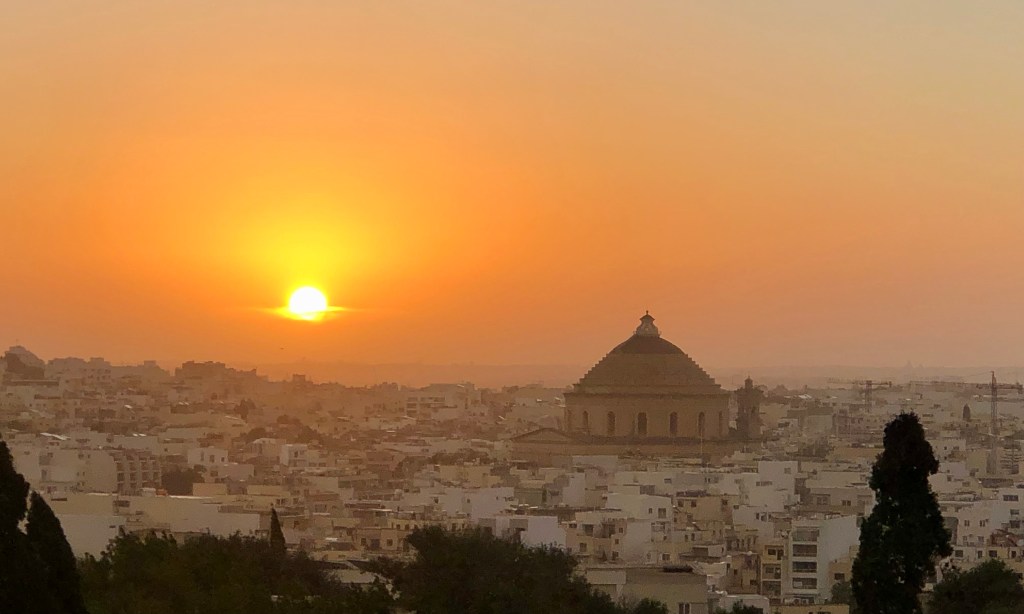
The question that I wish to pose this Advent morning is what it is we hope to see in the east. I think it is fairly obvious that in the Lakota religion, with its rootedness in the changing of the seasons and the world of nature, the east was the direction of the rising sun and thus the source of light, of warmth, of nourishment, of a new day. For Aragorn and the besieged forces in Helms Deep, reinforcements arrived from the east. But the sun’s rising was not irrelevant there either—because when Saruman’s army pivoted to face the onslaught of Gandolf’s newly arrived cavalry, they were blinded by the sun rising at his back. An example of nature building on wizardry.
The situation described by Baruch is a little different. Baruch is addressing people in a worse situation than that faced by the battered forces of Helms Deep. Baruch is addressing a people that has already been defeated. When Baruch writes, Jerusalem had undergone a siege five years before, a siege so brutal and humiliating that the residence of the city—as Baruch recounts—resorted to eating their own children. The Babylonians who captured the city burnt what remained and carried off most of its residents, especially its skilled and educated classes, to serve them as captives in Babylon. Among these was Baruch. Baruch had been the secretary to the prophet Jeremiah, who had tried to warn Judah’s rulers but was ignored. Jeremiah did forecast hope for a new life for his people after their exile—the hope even of a new covenant—but freedom from the Babylonians, he said, would not come for another seventy years. It was hope for another generation.
The length of exile still before the house of Judah makes Baruch’s prophesy today quite poignant. Much of the Book of Baruch is addressed to the exiles in Babylon, exhorting them to maintain their identity as a people even in a hostile and foreign city, but here he addresses Jerusalem and what survivors continued to eke out some existence among its charred ruins. “Look to the east and see your children gathered from the east and the west at the word of the Holy One, rejoicing that they are remembered by God.” It is poignant to remember that most of the exiles, the adults at least, will not see this return. The hope is for their children, perhaps for their children’s children. It is a hope that the people, Israel, the People of God, will endure—and not just endure but live in the justice of God’s commandments, offering him the glory of true worship.
And what do we, Christians, look for in the east? It is evident that the hope promised by Jeremiah, Baruch, and, in the Gospel, John the Baptist, is God’s work. Only God has the power to flatten mountains and fill in the age-old depths and gorges. What we look for is more than what Aragorn looked for in Helms Deep—that free men would live to fight another day. More too than the nourishment the sun gave to the Lakota of old. More even than what Baruch might have hoped for. Baruch held out hope that the refugees, bent and battered though they were, would find the strength to praise God—but not the dead. That Christian practice of burying the dead facing the east testifies to a still-bolder hope.
Our hope is bolder than the survival of a people. We use the Old Testament language of the “People of God” to talk about the Church, just as the Fathers spoke of a New Israel, but what we hope for is more than what those terms alone suggest. In a way, our Christian hope, the advent of God himself in Jesus Christ, absorbs all previous hopes, transforming them into a whole that is greater than the sum of its parts. We still hope for deliverance from present adversity; we still look to the east, as the Advent liturgy will soon enough encourage us, in hope of a radiant dawn, the sun of justice, but this rising sun will have a name. He will reveal himself to be more than an astronomical body or a cosmic force. He will be Emmanuel.
And he will invite us to be more than his people, but to be his body, sharers in his life. “Jerusalem, take off your robe of mourning and misery; put on the splendor of glory from God forever,” Baruch says—spectacular words. But even this metaphor falls a little bit short because what God offers us is more than just a change of clothing. It is himself, and communion with himself. He is the true east, the radiant dawn, the sun of justice, the splendor of eternal light. And he offers us deliverance and hope and, on this altar, himself.
Readings: Baruch 5:1-9; Phil 1:4-6, 8-11; Lk 3:1-6
Pontifical Scots College, Rome
December 8, 2024

 Tony Lusvardi, S.J.