
Homily for the First Sunday of Advent (C)
One of the casualties of the smartphone revolution has been losing our ability to wait. Instead of waiting, we scroll. Losing the ability to wait may not seem a real loss, but I think it is. Scrolling and checking messages and adding new apps has not made me more productive. Instead, I’m more easily distracted and impatient. Inside our electronic cocoons, we miss the things that used to happen while we waited—people watching, striking up conversations, noticing the landscape from the window, wondering at it.
Today’s readings are about the art of waiting. But they warn us not to romanticize it. Times of waiting can be dangerous. Today’s Gospel identifies two dangers of waiting: anxiety and drowsiness.
The anxieties mentioned in the Gospel come from genuinely terrifying world events—“people will die of fright,” the Gospel warns—but also everyday anxieties that seem related to drowsiness. The context of today’s readings, of course, is the Lord’s second coming, when Jesus will return in awesome and awful judgment, remaking all reality. It may be that some of us are anxious about meeting Jesus because we’re afraid of that judgment. Paul warns the Thessalonians to conduct themselves to please God, as they have been taught. Advent is a time when the Church reminds us to examine our consciences, to make use of the sacrament of penance, to align our lives with Jesus’ teaching.
From Paul’s words, however, it seems that the Thessalonians are not conducting themselves particularly badly; they seem at least to be on the right track because Paul encourages them to do what they are doing only “even more” so. The quite beautiful opening prayer with which we began this Mass—and the new liturgical year—asks for the resolve to run forth to meet Christ “with righteous deeds at his coming.” That kind of eagerness is the way we should approach the second coming because it is, after all, Jesus who is coming. And if we live in a way that is near to him and follow his teaching, then the sight of him “in a cloud with power and great glory” will cause us not to tremble but, as the Gospel says, to “stand erect and raise [our] heads because [our] redemption is at hand.”
If we do live in a way that makes us eager for the Lord’s return, however, we face danger from another source of anxiety. We might start to doubt that Jesus will come. In his apparent delay and the apparent victories that evil wins in his absence, we might be tempted to lose hope. The first generation of Christians—to whom Paul was writing—seem to have been especially afflicted by this kind of anxiety. They expected the Lord to appear within their lifetime, though he had warned in his preaching that no one knows God’s timeline.
Losing hope puts us in dangerous territory, just like the drowsiness and the “anxieties of daily life” that Jesus warns about, because all of these things can cause us to lose focus on what’s primary. We don’t like feeling anxious, so instead of facing our anxieties we distract ourselves. We seek an escape. The Lord warns against “carousing and drunkenness,” but I suspect he has in mind all the ways we flee from unpleasant realities. I suspect also that that escaping from reality is what makes scrolling—and social media and the twenty-four-hour news cycle and all forms of virtual reality—so entrancing and addicting. But killing time, distracting ourselves, is not the way the Lord teaches us to wait. With our faces buried in our screens, he might warn us today, we risk missing the many times when he does show up right in front of us.
So how do we wait? Advent is, I think, a school of waiting, and part of this season’s purpose is to teach us, over the next four weeks, how to wait and how not to wait. If we show the self-restraint the season asks of us—and don’t start our Christmas festivities a month in advance—we might learn something about waiting, about patience, about the work of the Creator that happens in the silences, like the growth of a baby in the womb. To get us started, I will offer two suggestions for waiting. The first comes from all the readings, and it is to do what Jeremiah and Paul and Jesus himself do today—they encourage those around them. They see the anxiety of others, and they give them reasons to hope. Paul points out what the Thessalonians are doing right, and he says, keep going. The world is not always a friendly place; our times are not always kind or just or even rational; we need courage to face them. But we are called to face them. And when we give honest encouragement to others, we may soon find the blood flowing more confidently in our hearts as well.
My second suggestion is related but comes from a different time in the liturgical year, another moment of waiting—the Easter Vigil. You might recall that the Easter Vigil contains a total of seven readings with psalms, plus an Epistle, plus the Gospel. And you might think that these tend to lengthen the service to the point that we become, well, drowsy. But that’s not quite the way to think about what happens at the Easter Vigil. We’re not trying to make something happen with all those readings. We’re waiting. The service is a vigil, like what happens in many cultures when someone dies and the relatives sit up all night with the body. The Easter Vigil is unique because the mourning is interrupted. While we wait, God interrupts. I won’t give away the ending because what I want to point out is what we do while we wait. We tell stories. All those readings tell the story of salvation history, the story of how God has acted in the world. Remembering what he’s done, reflecting on those stories—stories of antiquity in which strangely we find ourselves—remembering instead of losing ourselves in distraction is a sure source of courage and of hope. After all, we are much better off hope-wise than the disciples were at that first Easter Vigil because we have one more story to tell. And this Advent, waiting for the second coming, we have the story of the first coming—and all that it means—to retell. So take heart this Advent, be men and women of courage and encouragement. Raise your heads and stand erect—but wait for it!—our redemption is almost at hand.
Readings: Jeremiah 33:14-16; 1 Thessalonians 3:12-4:2; Luke 21:25-28, 34-36
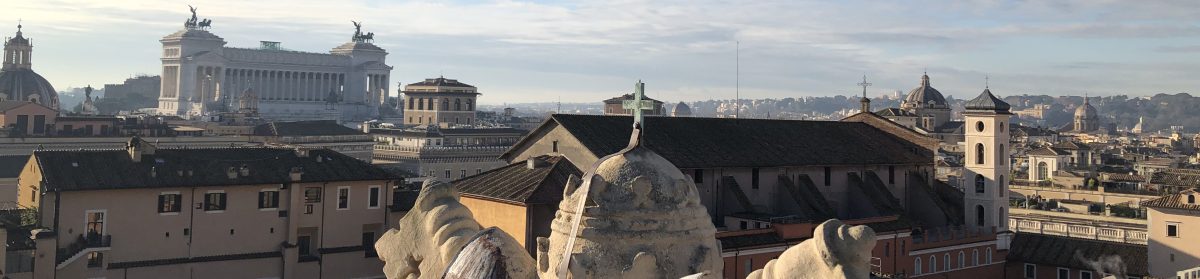
Oratorio San Francesco Saverio del Caravita, Rome
December 1, 2024

 Tony Lusvardi, S.J.